
This copy of Orbitals was provided to Source Gaming by Kepler Interactive.
The laser beam pulses with heat as it melts metal and shatters ice. A massive, asteroid-cutting blast flies across the screen. Skin, hair, and bulkheads crackle with a grainy filter, the kind you see in cel animation. Giant, shining eyes and massive grins dot every character, all of whom move in this wonderfully chunky way. Thick Japanese characters loom over the background to kick off the latest episode. The opening theme blares with synths, guitars, and the vocals of Mobile Suit Zeta Gundam singer Mami Ayukawa. Explosions come in bubbling circles of flame and huge wafts of smoke. There’s a word I thought of again and again as I played Orbitals, a new co-op puzzle game by Shapefarm and published by Kepler Interactive, and it’s “flair.” Many games try to make you feel like the star of an anime. Orbitals meets the challenge with unrelenting passion.

Image: Source Gaming. While Maki runs through a corridor with a talking time bomb, Omura blasts debris in their way just outside.
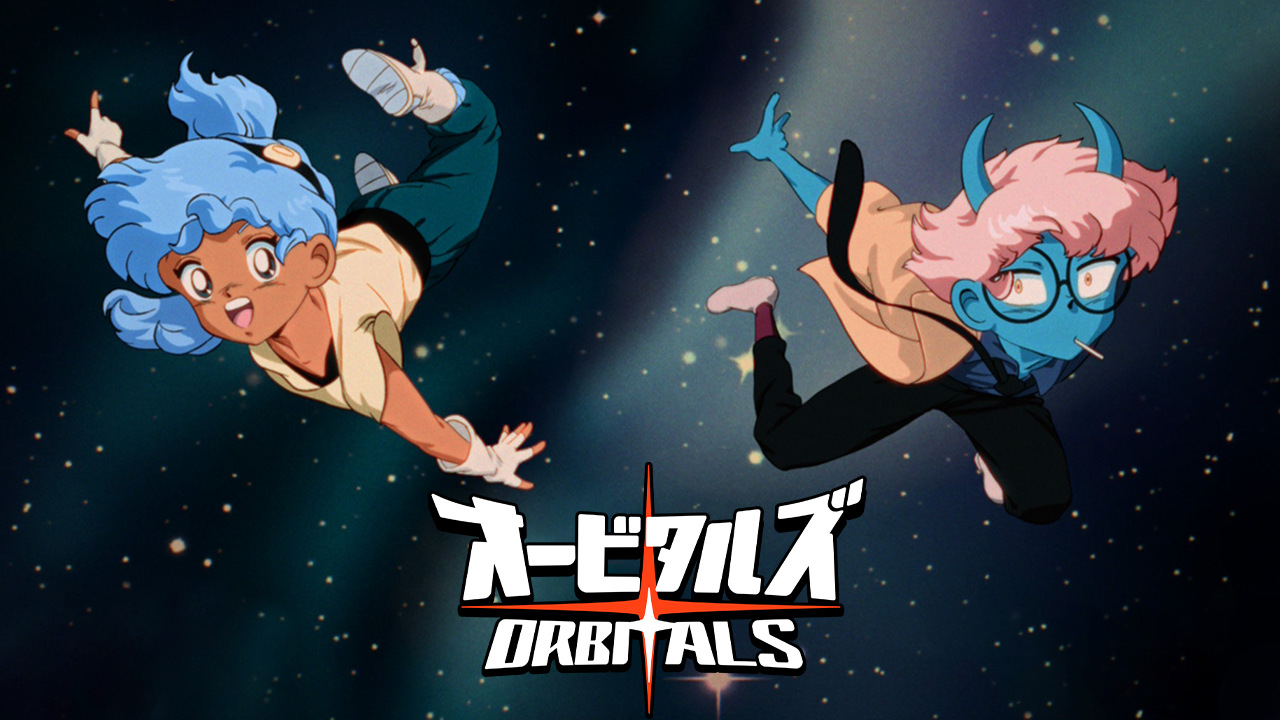
The graphics of Orbitals are probably the first thing you’ll notice. They are a proud, impressive attempt to recreate the aesthetics and imagery of 1980s anime. Characters, particularly the heroes Maki and Omura, either use or fake a lower frame rate in a way that makes them move like cartoons. Individual designs evoke the work of mangaka like Akira Toriyama and Rumiko Takahashi. Machines have that bulky, busy design, the kind that sparkled in Ghost in the Shell and Patlabor before sci-fi trended toward minimalism. The game isn’t hung up on one series in particular; Dragon Ball, Gundam, Evangelion, and Cowboy Bebop are obvious (and explicitly stated) influences, and it sits firmly in the science fiction camp, but I don’t think anything feels particularly obvious. This isn’t a work of “spot the reference.” It’s about calling back to that experience of seeing anime for the first time and finding something spectacular. If you, like me, grew up watching Toonami on Cartoon Network, Orbitals may make you feel nostalgic. If you, also like me, spent your adulthood discovering the likes of Lupin III, Dirty Pair, or The Big O, Orbitals may do the same.
For all its retro anime love, though, Orbitals is a product of this time, not unlike this year’s Mina the Hollower. It’s a puzzle game in the skin of a third-person shooter; Maki and Omura juggle unique guns to open doors, move through spacescapes, and come up with hairbrained solutions. It’s also a co-op-only game in the vein of Hazelight’s It Takes Two and Split Fiction (which tracks, given that director Jakob Lundgren is a Hazelight expat). The asteroid fields and derelict space stations are massive, letting the characters enter rooms separately and showing two camera perspectives in split-screen at all times. I joked to the friend I roped into being my co-op partner that this was the ultimate use of Nintendo Switch 2, but… I don’t think I’m wrong? Orbitals could not have existed before this decade. Its charm hides an engineering genius.

Image: Source Gaming. An early puzzle explains the basic truth of Orbitals: you can’t go it alone.
The gameplay has a comfortable loop. Maki and Omura pilot their clunky spaceship to various levels, dangerous ships or worlds hiding some vital treasure. Before leaving, they grab one tool out of a pool of three, and the game makes it clear which two are needed for each level. One’s a laser that can burn and melt, one’s a water gun perfect for cooling and pushing, and one fires a rope that lets the user pull switches and hold platforms. Across a roughly eight–to–nine-hour campaign, Orbitals never stopped coming up with combinations to these three tools. I splashed water underneath a floor of lava so my partner could open doors in my way. I ripped open panels so he could power up a drone with his laser and keep it from exploding on me. I shot crystals to make them glow as the two of us threw our weight to position a rickety vessel. The ideas never stopped coming, and neither did the permutations.
Reviewing a great puzzle game is challenging for two reasons. First is the most obvious: you don’t wanna spoil the solutions. I’m about to recommend Orbitals pretty wholeheartedly, and the last thing I want is to share even more answers. Players deserve to experience that, especially since solving puzzles cooperatively is one of the best gaming experiences anyone can have. Less obvious is that it’s hard to actually review a puzzle, or a collection of puzzles. Because of that, I’m going to cheat and say that almost every single puzzle is a masterclass without describing them. There are a few that are kinda dumb, and a few that are a bit finicky, and maybe one or two that go on a bit long, but I found the overall bar to be quite high. So many puzzles ended with one of us shouting “wait, I think I got it!” before falling into some brilliant mixture of shooting and platforming. That jump from experimentation to execution to mastery is what an action-themed puzzle game needs, and it’s so good here.

Image: Source Gaming. Ship exploration is a major part of the game. It’s simplified, but it also continues the cooperative gameplay.
It doesn’t hurt that this is an incredibly generous game. For one thing, checkpoints are everywhere, and they’re shared, so Omura can die in a run so long as Maki hits it. Long sections typically have at least one, and a generous auto-aim makes it easy to snap to targets. Combat is also appreciably limited to a few silly dogfights in which the two juggle flying and shooting in their chunky, bulky vessel. One pretty hard rhythm mini-game gave us more chances after we failed too many times. Pixel precision is rare, and the few puzzles that require it were often the only annoying ones. Loading and respawning are fast, which keeps the pace up.
In that way and in several others, Orbitals sands off many of the pressure points that a multiplayer-only game can have. While characters can’t switch their tools within an individual level, they’re encouraged to switch between them from level to level, so it’s easy to enjoy each kind of gameplay. Virtually every puzzle is fun no matter what role the player has to take, as they often involve the heroes working in tandem or protecting each other. And, nicest of all, it’s a game that players can share through either GameShare or a dedicated free “player 2” version, the Global Friend’s Pass. My friend was on GameShare and reported that it worked perfectly.
Extra mini-games are available for anyone who wants to pad out this short but sweet adventure. Players can find retro computers scattered across each level; find one, and a corresponding bonus stage will come online in Maki and Omura’s spaceship. Laser tag, whack-a-mole, and one about working a conveyor belt are the most memorable, but they’re all paper thin. What they really offer is an opportunity to stretch out and take in the world, something the game as a whole is obviously obsessed with. The hub is full of button prompts that let the kids veg out on a couch, rock a piano, or pet an adorable cat. Death animations are often silly and expressive. Alien NPCs can be hit, always responding with a fun animation. These are great for making the space feel tactile, and they further the idea of immersing yourself in this living anime. It’s a world that feels fun to be in, in the way some art can be.

Image: Source Gaming. An early cutscene with Maki, Omura, and their mentor figure Toben.
I would not describe Orbitals as having either a good story or a good plot. There are plenty of science fiction conceits: personal energy that acts almost like a soul and explains the endless revives, a solar system strewn with the debris of civilizations past, a spooky energy, and an aging society in which everyone save Maki, Omura, and their pedantic guardian Togen is old. This stuff didn’t have a particular impact on either my friend or me. The narrative ideas are underbaked, and despite openly wanting to understand the story, we were at our least energized there. I suspect this is how many players will experience the game, not because it’s bad but simply because it is a multiplayer-only shooter that makes use of the GameChat service. There are also a few points where the façade falls, and a contemporary style takes charge. Maki and Omura are modern characters through and through.
This isn’t a complaint. Anime of the 1980s was often problematic or deeply upsetting, and while the notoriously bad dubbing of the era was delightful, it’s not a direction most modern works should try to emulate. This is probably why Maki and Omura feel like characters who harken back to the past and not characters who are stuck in it. And I don’t mind the storytelling being less interesting or the cutscenes being less exciting. To me, at least, Orbitals is a tone piece. It captures the feeling of space operas and sci-fi epics and falling in love with a style you never knew existed. Plus, I don’t think involved storytelling is necessarily good in a game that can only be played with two human players. Our conversations drove the story, whether we were discussing possible solutions, specific anime references, or the eccentric side characters.

Image: Source Gaming. One of the hardest, but most satisfying, sequences involves one player cooling lava so the second can platform around to unlock doors.
The issues I do have are more about function. Namely, this is a gorgeous game filled with color and objects and overwhelming coolness, and it’s sometimes hard to parse what’s important and what isn’t. Orbitals’ palette sort of captures how cartoons have soft, painted backgrounds and more well–defined characters, but it might go a bit too far. It’s exacerbated by the co-op format, which always divides the screen into two parts. I liked being able to see my friend’s screen—that might be my nostalgia for “screen-looking,” but I found it both helpful and cool—but it did mean we had only half the real estate at all times, even in sections that probably could have let us share the perspective. There are some sequences that actually do merge the screens, and they’re rather striking.
I’ve got more complaints, I suppose, if you want them. The midair dodge only moves in the four cardinal directions, which definitely feels limiting. The Hookshot-like weapon, the Scrap Hook, is a cool device that lacks game feel. That great auto-aim can be hard to wrangle when faced with multiple targets you have to hit in a precise order. It feels a bit crummy when a section drags on or demands timing that’s a little too tight. The worst mini-games in the story mode, like a button prompt section or music puzzle, require skills that aren’t required anywhere else and come out of nowhere. These are mostly small issues from two people who played a game in long, three-hour installments. Progress never slowed, and we never found anything that felt too repetitive or overdone.

Image: Source Gaming. The grandeur of space and the details of the wreckages capture a very specific anime look.
I suppose one other question—it’s not even criticism, not really—is how fun Orbitals would be to replay. For all its excess of game feel and style, much of the fun comes from two people working together to solve ingenious puzzles. It’s silly, of course. There’s little value in judging a game or any other work of art on the metric of how good it is the second time around. But I did wonder, and with us already needing extra footage of the game to capture, I asked my colleague Phanah to start with me from the beginning. After all, while the Global Friend’s Pass only launches with the game, Kepler Interactive gave us an early copy of it along with the review copy. We didn’t play the whole adventure, just the first two hours.
Other than a confirmation that the Global Friend’s Pass is indeed really good, I found this replay pretty revealing. Some of the puzzles are indeed less fun when one of us already knows how to solve them, which, yeah, that tracks. But we still had a good time overall. It was fun to see the levels and early gameplay again. Despite having gone through them three days earlier, I had forgotten a few of the challenges and enjoyed relearning them. Certain story beats worked better the second time around, though I still think the plot’s simple and unsatisfying. Phanah was better at several of the mini-games my friend and I struggled with, like one about manipulating floating discs that drove us nuts. And even when the experimentation phase of each section was largely nonexistent, the execution phase remained fun. Because we changed up our tools repeatedly, I often took on roles that I didn’t the first time, and that was exciting. So while I will probably wait more than one day to play it again, I can easily see this being an online experience to replay many times.

Image: Source Gaming. Maki and Omura rockin’ out in their spaceship.
If that wasn’t indication enough, I’m over the moon with Orbitals. As a game, it’s a delightful engine of revelation and cooperation and is worth playing just for that. This has some of the best puzzles of the year, and I think any pair of friends, partners, or family members would have a wonderful time solving them together. But it also captures a feeling that I haven’t felt in a while, and that’s one of transportation. One night as a child, I stayed up way too late and wound up watching Blue Sub 006, a somewhat obscure OVA that aired on Toonami. I don’t remember a single thing except how enchanted I was, seeing this cartoon that seemed so new and exotic but was really always there, out of sight, waiting to be found. That feeling, that memory, came back to me through this game. Orbitals’ genius is that it isn’t interested in being some kind of ultimate Eighties anime tribute, but in recreating that feeling of seeing a work of art for the first time and falling into its world. Even the co-op-only requirement feels like an acknowledgement that discovering art is inherently communal. For its design, for its puzzles, and for dredging up those memories in all three of us, it’s a multiplayer triumph.
Thanks to NantenJex for edits.
Orbitals: Orbitals isn't interested in being purely an 80s anime tribute, instead it aims to recreate the feeling of seeing a work of art for the first time and immersing in it, alongside a good friend. It's a multiplayer triumph in visuals and gameplay, but lacks a little in the story. – Wolfman

- Back on the Bat Chapter 3: The Black Mask Casebook - September 28, 2026
- Nintendo Direct September 9, 2026: Information and Reactions - September 9, 2026
- The Legend of Zelda 40th Anniversary Direct September 8, 2026: Information and Reactions - September 8, 2026