
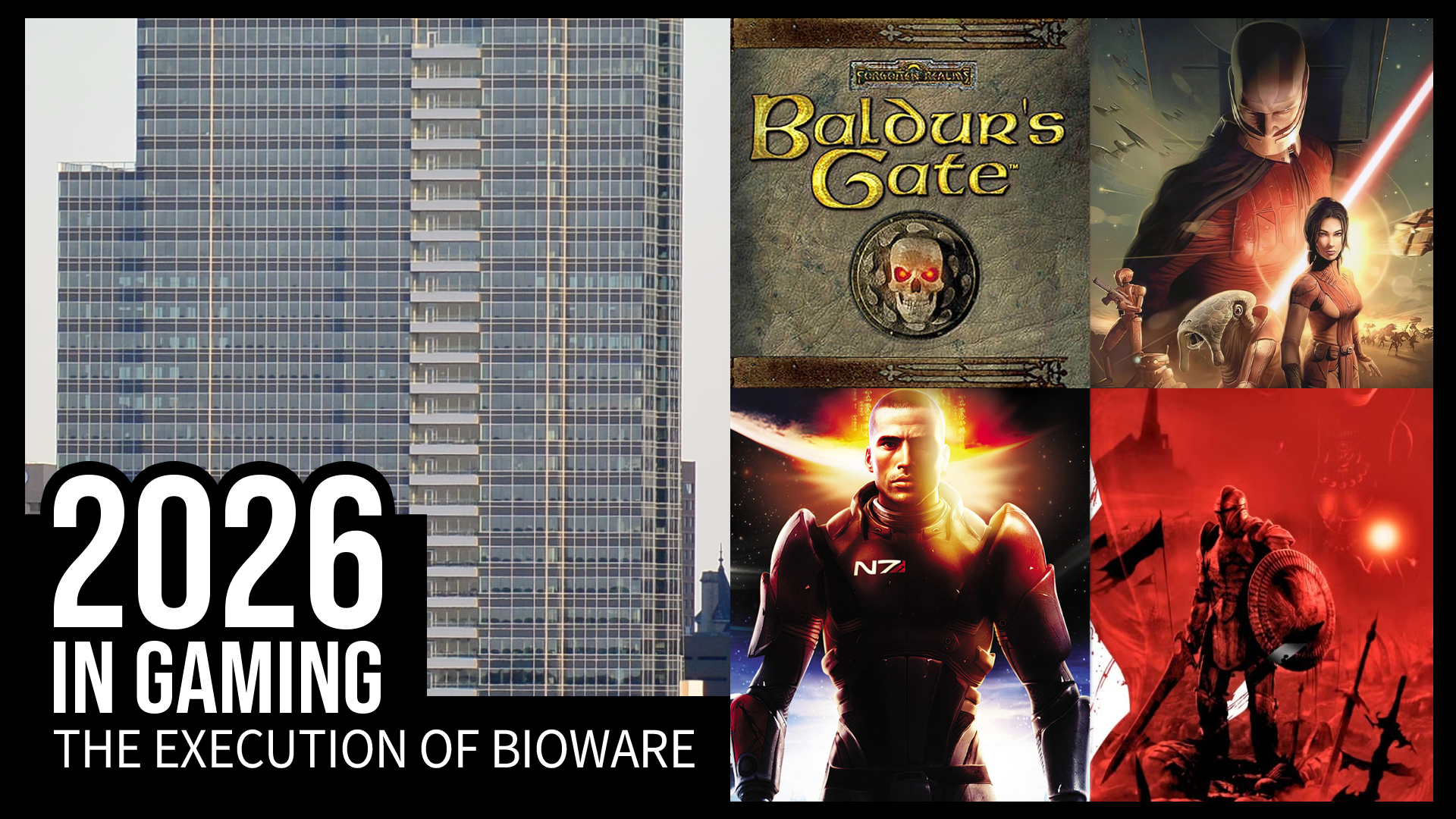
2016 has been a year of exceptional pain in the video game industry. Mass layoffs, skyrocketing prices, and deranged corporate policies have harmed almost every person in or tied to gaming. This summer alone was a nightmare, and the fall hasn’t been any better. You don’t have to look far to see yet another example of the gaming world running headlong into a possible crash.
But few things this year have hurt like the events of October 21, in which Electronic Arts closed renowned Canadian studio BioWare as part of a firing of 400 people. It was 31. From the release of its debut title, Shattered Steel, BioWare pushed the boundaries of role-playing games. Baldur’s Gate and Neverwinter Nights imagined Dungeons & Dragons with an incredible specificity. Star Wars: Knights of the Old Republic remains a high point of the Star Wars franchise. Jade Empire helped bring the genre to consoles, which had been largely the domain of Japanese RPGs. And its twin modern jewels, the Mass Effect and Dragon Age franchises, popularized and codified those tropes to the mainstream. BioWare is—was—a name studio, a brand in its own right. And what that brand promised was exceptional RPG quality.
This is not a history of BioWare. If you’d like, Eurogamer’s recent retrospective gives you a bit of that. This will cover aspects of its history, but that’s not the focus. Frankly, I’d be a poor teller for it anyway. Unlike my best friend Lily Bones, a fellow journalist whose gaming career can be tracked by the BioWare games she loved, my familiarity with the studio was much smaller. I wrote about Mass Effect: Andromeda and Dragon Age: Origins, but I truly knew it for the studio’s most iconic work, the Mass Effect Trilogy. The other games I only know by reputation. What I can talk about is the studio’s place in gaming culture. It’s an astonishing one, and the more you learn, the more painful the news becomes.
ROLE-PLAYING
BioWare, more than almost any other game studio in the world, epitomized the idea of the Computer Role-Playing Game. This was true from its first breakout hit, the 1998 Dungeons & Dragons tie-in Baldur’s Gate. Although there were D&D-inspired CRPGs as far back as the 1970s, many of which were ambitious and influential, few captured the sense of role-playing and character creation quite like Baldur’s Gate, Baldur’s Gate II, and their fellow tie-in Neverwinter Nights. Within the role-playing sphere, these games were revered and influential not just by players but other developers. They felt special, even amongst contemporaries like Wasteland, Fallout, and Diablo. Perhaps it was how personal the characters felt, or what you got to do.

Image: BioWare (whose website is still up). Baldur’s Gate was a standout even in a year with Ocarina of Time, Starcraft, and Resident Evil 2.
The core power of role-playing games, the ability to both create a character and experience the consequences of being that character, shined through these games in spectacular ways. It was strong in Knights of the Old Republic, which let you bring your amnesiac Jedi hero to the edges of the Force. It was hilarious in Dragon Age: Origins, which had endless and absurd opportunities for its Warden to upend the politics of Ferelden. It was cinematic in Mass Effect 2, which told a story that was endlessly textured and tinted by your choices. And these games loved to challenge your behavior after the fact, creating a sense that these weren’t solely power fantasies. Most Western RPGs are designed around big choices and their ramifications, but few games hit both points quite so well as BioWare’s best.
RPGs are everywhere today. It’s almost the de facto genre for games, as pretty much every Triple-A game has RPG elements. And alongside them and traditional genre entries, there’s a breadth of unique and experimental role-playing experiences. Many of these were made independently of BioWare’s work. But the mark of Baldur’s Gate, Mass Effect, KOTOR, and Dragon Age can be felt across the genre. They drove how these games are made and how we talk about them. Mass Effect and Dragon Age: Origin’s popularity were one of the major reasons why more genres began to borrow from RPGs, and why moral choice systems gained ground. And it goes beyond even that. BioWare’s relationships with the likes of Interplay, CD Projekt Red, Black Isle, and Larian Studios were crucial turning points for all companies involved. Its popular Infinity Engine was used by Planescape Torment. The effect it had on the entire genre—the entire medium, even—is astronomical.

Image: EA. Commander Shepard in Mass Effect 2, likely the company’s best regarded game by now.
You can see that particularly in the rise of more authored role-playing heroes. Historically, leads in CRPGs were nondescript silent protagonists; you’d fiddle with them in a selection screen, your decisions would alter the world, but much of the character work existed in your head. Japanese RPG leads were either similar (just without the narrative choices), or they were bespoke characters with strict personalities. Mass Effect’s Commander Shepard straddled this line, providing both an authored personality and enough room for the player to add their own material. This was done in part to give an immediate power fantasy, but it built a space for the game and the player to work together. Modern gaming icons like Lee Everett and Geralt of Rivia took this idea and ran with it, and it breathed life into game protagonists.
WRITING
It certainly didn’t hurt that BioWare had an incredibly talented cadre of writers over the course of its thirty-one years. David Gaider, Drew Karpyshyn, Mark Darrah, Trick Weekes, and Mac Walters were among the best-known, but its staff supplied fantastic work across its games. Almost every title under that circular logo could be counted on to feature a bevy of tones, most played to perfection. We played them for their drama, their comedy, their character dynamics, and their sudden digressions into horror and political intrigue. Even the inscrutable Sonic Chronicles: The Dark Brotherhood for Nintendo DS was able to transpose those qualities onto the world of Sonic the Hedgehog.

Image: Steam. HK-47 in the remaster of Knights of the Old Republic (which was made by Aspyr without BioWare’s involvement).
When people fawn over the company’s writing, they’ll often default to wit. Mass Effect 2 has Mordin Solus, redemptive alien doctor who’ll struggle with his reprehensible past one minute and sing Gilbert & Sullivan the next. Dragon Age: Origins has Morrigan, a caustic witch who starts her tenure as your sidekick by mocking the idea of doing sidequests at all. Knights of the Old Republic has HK-47, a… well, he’s Bender, he’s Bender as a Droid assassin, but his meanness is great. It’s hard to play games like KOTOR, Jade Empire, or Dragon Age and not come out with a favorite. I could rattle off at least a dozen Mass Effect heroes who could lay claim to being one of the best characters in any game just by virtue of their rich, pulpy dialogue.
Even the worst NPCs felt at least grand in their badness. It was a cliché amongst fans that every game would start you off with two horrible companions who you’d sub out the second you got someone better. Whiny ex-noble Alistair, space racist Ashley, and twee supersoldier / obvious sleeper agent Cora stunk up your roster. They were pretty bad, as were a few villains like Mass Effect 3‘s big bad Kai Leng, but that felt okay, like they were lightning rods for the writers’ worst instincts. When the games were good enough for those flaws to not mean too much, BioWare’s few absolute duds could be almost as fun as their success stories.

Image: BioWare. Jade Empire was one of Xbox’s most successful early collaborations.
The characters also helped BioWare popularize onscreen depictions of romance and sex in video games. Controversially so in one instance; Mass Effect was targeted by rightwing agitators for featuring love scenes any PG-13 movie would consider tame. These were sometimes awkwardly shot and presented, and they were definitely done at least partially for titillation, but not entirely. Sex in these games added an intimacy and personality that RPGs, virtual and otherwise, rarely explored. It allowed relationships to feel real and more validating. And while the depictions of sex in modern games don’t actively harken to BioWare’s stage direction (and some, like those in Larian’s Baldur’s Gate 3 and AdHoc’s Dispatch, are far more daring), they are part of a conversation those titles helped start.
Similarly, BioWare games provided queer relationships for the player to enter well before our biggest publishers became even moderately comfortable with representation. It wasn’t perfect. Mass Effect in particular took a long, shambling road to well-implemented or even existent same sex relationships, and while the studio’s depiction of trans identity was never hateful, it was often clumsy. But you could see the various writers bettering themselves and their games with almost every entry. The studio’s final release, Dragon Age: The Veilguard, provides some of the best gender-affirming writing and character options in any Triple-A game out there. Not unlike fellow EA team Maxis, which also got hit badly in the October layoffs, the studio amassed a loud and committed queer fanbase for a reason.

Image: IGDB. The personal expression allowed by BioWare’s customizable characters added to this writing. Dragon Age: Origin‘s Warden could fall in love, build and break friendships, and approach situations with personal morality.
It seems I’ve had to make caveats about BioWare’s writing at every turn. It had blind spots, particularly when it came to gender and sexual politics. Some of its storytelling was edgy for shock value, particularly when it came from longtime producer Casey Hudson. One of the ways its love stories were told, that your characters would have to give gifts and finish quests to open an NPC up to a relationship, morphed into the transactional vision of romance that many games use today. And at their worst, the scripts could be riddled with clichés; Mass Effect: Andromeda is full of the smarmy, lampshade-heavy writing of modern movies. But those faults don’t dismiss these games’ best dialogue, which was more often than not funny and thoughtful and powered by crackerjack voice acting. Jennifer Hale, Claudia Black, Martin Sheen, Freddie Prinze Jr., David Warner, and Keith David did some of the best work of their respective careers in these games. Even BioWare’s stunt casting worked more often than not.
CONTINUATIONS AND COMPLAINTS
Perhaps the most exciting thing about Mass Effect and Dragon Age is how their stories reached beyond the borders of a single game. All three games in the Mass Effect Trilogy were programmed to check innumerable choices made by the player, from the deaths of party members to the completion of inconsequential missions. Many were brought into the next game, making each playthrough feel specific and textured. Maybe a character would only reappear if they were flagged, or maybe an ex-lover would feel hurt seeing you with someone else. This was another element studios took, inspiring episodic games and more elaborate systems of connecting save data. There’s something truly incredible about seeing your choices reverberate, even ones that were pointless. It felt like being seen, in a good way.
This could be seen as the capstone of BioWare’s vision of player choice. It explored the idea as far back as 2000, when Baldur’s Gate II: Shadows of Amn allowed players to import characters from Baldur’s Gate. It’s the ultimate example of the RPG ideal: a character defined so well that they can intrude in a sequel. The ways this worked differed between games. Mass Effect and Dragon Age II read save data, Dragon Age: Inquisition used a website, and Dragon Age: The Veilguard simplified things to an in-game questionnaire. Each method had limitations. One of the coolest tricks Inquisition pulled was making Dragon Age II protagonist Hawke into a major NPC. It’s something you almost never see in these kinds of games because the heroes are too malleable. But to accommodate that, Hawke isn’t the character you created; they’re kind of a caricature built off responses you put on the site. They may end up feeling wrong or dishonest.

Image: Steam. Mass Effect 3‘s position of being this singular finale gave it both undue pressure and a narrative challenge it couldn’t always meet. And yet, it might be my favorite game in the series.
Unsurprisingly, then, this vision was often followed by complaints. BioWare’s Mass Effect marketing suggested an incredible depth that the games were never going to be able to fully live up to, simply because production can account for only so many variables. Fans wanted their favorite moments to matter, and they didn’t always. But BioWare also struggled to stick the landing at times. Most notorious was the ending to Mass Effect 3, which seemed to ignore the player’s hand (it also didn’t provide a more traditionally heroic ending, which I suspect is where the real hate came from). Caught off guard by a near-unprecedented tidal wave of internet rage, the studio quickly patched in an “extended cut” that added context. It was followed by extensive downloadable content that helped ME3 evolve from a somewhat anemic finale to a fifty hour epic.
That response to feedback wasn’t just found in the Mass Effect sequels. BioWare was attuned to its audience, and for good and ill, it did try to take their complaints into account. After fans whined about Dragon Age II’s bold choice to set itself entirely in a single city, the staff went through a painful struggle to give Inquisition a huge open world. When the writers saw how giddy players were to off party member Urdnot Wrex in the Mass Effect demo, they worked hard to make him compelling and likable for that tense, late game standoff. Every sequel was made as a response to its predecessor. That’s often a good idea, but it comes with a risk: being so focused on negative feedback that it threatens your ideas.

Image: Steam. BioWare’s focus on experimentation and reaction it would often have inventive ideas, like Dragon Age II‘s city of Kirkwall, only to run from them after the fact.
Because it’s impossible to discuss BioWare and ignore the bile that powered that feedback. Many former employees have talked about receiving death threats for plot points, character writing, graphics, queer content, and seemingly any other thing. And this—especially the Mass Effect 3 controversy—preceded the culture war we’re in now. In 2012, it was shocking to see fans spew so much venom over a slightly crummy ending that the venom became the story. Today, virtually every release of note has become a hotspot for vitriol, particularly a kind directed by reactionary trolls. Every nonwhite lead is demeaned; every decision is raked over the coals whether it’s bold but challenging or safe but time-tested. Worse still, publishers across the entertainment industry tie themselves into knots trying to accommodate this even when the hate is at its most illegitimate. The extended ending is better, I’ll grant, but I do wonder if the game industry had been better off had BioWare stuck to its guns.
BIOWARE MAGIC
And that’s just the company’s relationship with its fans. Inside BioWare were internal politics that were often unhealthy, toxic, and at times even self-destructive. It became more pronounced as the company began to unofficially split into Mass Effect and Dragon Age teams; the latter in particular often felt itself demeaned and unsupported despite outselling its sister franchise repeatedly (there’s an implication in retrospectives that much of the leadership seemed to view Dragon Age as “outdated” and gave it a far shorter leash). Retrospectives on various games note how a few people at the top almost jockeyed for power and did little to account for the increasing demand of modern game production. This seemed to have gotten worse by the studio’s end as more senior staff left, came back, or were put into positions of power to get late projects out the door. Because that was sometimes the only solution to a recurring problem.
Within the studio’s internal culture, there was a term known as “BioWare magic.” It was the trope of a team struggling throughout development only to pull through at the end, a hockey stick that’s long and flat before jutting upward right at the end. Most of the production might be miserable or challenging, but eventually things would come together and end with a masterpiece. Sure, the team had no idea what to do with Mass Effect 2 at the start, but look at how it ended! This is an awful way to run a company. The vision of struggling artists just barely making it through sounds romantic, but it led to runaway crunch culture and thousands of hours of work that went nowhere.

Image: Steam. Some former staffers have identified Dragon Age: Inquisition as a negative turning point due to the production’s scope and length.
While “BioWare magic” percolated into every production, it became more severe as each one took longer and cost more money, particularly Dragon Age: Inquisition. Far from the era of making modest, isometric Dungeons & Dragons games, BioWare was now responsible for huge, award winning, graphics-pushing blockbusters. It needed bodies, and to account for that, it opened branches in Montreal, Quebec and Austin, Texas. A hierarchy was quickly established: the original Edmonton studio on top, and the others as worker drones whose concerns and extensive experience were often dismissed. People at the Austin branch, the ones with work on a successful live service (Star Wars: The Old Republic, an MMO that’s often left out of BioWare history), often felt left out in the cold as the studio tried to figure out the online shooter Anthem. It was a corporate culture that allowed wild, brilliant imagination but often had little idea of how to nurture it, especially as development became more costly.
EA
And yet, for all of BioWare’s internal problems, nothing was more dangerous than its purchase by Electronic Arts, which bought the team a month before Mass Effect’s 2007 release. It’s a strange decision now. EA is built around big, iterative, often annualized multiplayer games, all sports games and first-person shooters and Star Wars tie-ins. But in the late 2000s, it was invested in building a slate of single-player powerhouses. With plans for a trilogy literally baked into its code (and having already worked with EA on Knights of the Old Republic), Mass Effect could get that. Unfortunately, it and Dragon Age were outliers in this strategy. Most of those Triple-A releases—Mirror’s Edge, Brütal Legend, The Saboteur—struggled to break out, and those that did were pulverized with a forced march of sequels. Today, the publisher’s work in the field of AAA gaming is more notable by its cancelations than its releases.
EA’s behavior is well known. It buys up studios only to close them and lay off their talent. It forces anticonsumer features into everything, from in-game ads in the Madden series to endless microtransactions. It demands that its products smooth out every interesting edge and encourages brutal working conditions. Most of these were imposed on BioWare in one form or another. While the original Mass Effect and Dragon Age both had rough gameplay, their sequels were forced to emulate traditional action games and had more generic combat for it (though Mass Effect 3 remains a tremendous third-person shooter). Developers were often forced to put resources on pointless multiplayer modes, some of which were abandoned partway through. The final batch of entries were also required to use Frostbite, a proprietary game engine that is great for first-person shooters and almost nonfunctional for any other genre. There are more than a few stories of it absolutely derailing productions. It’s hard to not see BioWare’s scummier commercial choices, like gating a lore-critical Mass Effect 3 party member behind a preorder bonus most people couldn’t access, as the product of executive meddling.
It’s fair to say EA had neither an understanding of what made BioWare work nor a respect for the art it produced. The publisher’s behavior carried the stink of disdain despite giving the studio far more rope than most of its doomed acquisitions. EA seemed to view these games through an alien prism, envisioning them as things they weren’t and resenting what they were. That’s especially true of Dragon Age; former producer Mark Darrah has talked at length about the publisher’s poor treatment of the series, particularly after 2017. When these games went through development problems, publisher demands only exacerbated them. Its current buyout—more on that later—has only worsened morale across its tens of thousands of workers.
THE LAST DECADE
Much of BioWare’s history had challenges, but the final eleven years were a severe turning point. 2017 saw the release of Mass Effect: Andromeda, a game that had suffered unrealistic visions from BioWare, infighting and a cruel favoritism by its three studios, and onerous publisher demands. The production was a nightmare. BioWare spent years on a pie in the sky pitch—players exploring hundreds of unique, procedurally generated planets—but never figured out how to program it, let alone how its award-winning writing would fit. An inability to fully work with Frostbite meant that several of the core ideas simply had to be scrapped. The Edmonton and Montreal studios were constantly at odds. With progress slowing to a crawl, the production shifted into a year and a half of unmitigated crunch to make something shippable. The final product is embarrassing: a schlocky, rubbery mess with obnoxious dialogue, bland worlds, and hilarious animation glitches.

Image: Steam. While I lauded BioWare’s characters, awful party members like Peebee were an unbelievable drain on Mass Effect: Andromeda.
Part of Andromeda’s tsuris came from BioWare putting a huge chunk of its resources into Anthem, a Destiny clone that started work in 2012 and came out in 2019. This was a top-down vision from the studio’s leadership to make “the Bob Dylan of video games.” Instead, Anthem became one of the first great symbols of live service gaming gone wrong. Before Concord, Highguard, and Marvel’s Avengers, it epitomized the slog and creative death of forever games. It got a few updates early on, only for BioWare to sheepishly abandon the project in 2021 and delist it in 2026. The game’s notorious development is an object lesson on what not to do. It once again featured extended crunch, teams antagonizing each other, the Frostbite engine killing core pillars of gameplay, creative leads shuffling on and off the project (creative director Casey Hudson left in 2014 only to return three years later), a lack of personnel, and no clear vision. Morale was obliterated over those seven years.
A recurring theme of Anthem’s production was a lack of clarity over what exactly it would be. It was always going to be an online shooter; that was straight from BioWare, not EA. But the core structure constantly shifted. The one feature critics and fans loved, the ability to fly around in Iron Man-esque mech suits, had been repeatedly cut due to technical issues and saved to give the game a hook. Key decisions on every issue were punted as staff left, whether by quitting or having to go on medically-mandated stress leave. In the end, it looked like “design by committee” sludge. And that’s sad no matter who makes it, but especially so from a studio known for its personality. There was little dialogue, no narrative choices, not even a sense of building a character. While Anthem was meant to marry the studio’s story-driven values to a conventional online shooter, the latter subsumed the former in virtually every way.

Image: EA. Anthem, in all its bland glory.
Finally, there was Dragon Age: The Veilguard. By the time it launched in 2024, the game had a target on its back from longtime fans who didn’t like its direction, some critics less enamored with its material, an admittedly horrendous marketing push, and a hate campaign from rightwing gonifs that took over the discourse. I can’t speak for The Veilguard other than thinking that some of its ideas sound pretty great and others pretty bad, something that’s true of every Dragon Age game given how radically different they were. Its production is probably the most infamous part of its story by now. It started as a single player RPG exploring a cool espionage theme, was forced to pivot to being a live service, forced back into being an RPG after Anthem flopped, but given barely any resources to accommodate for that change. The most problematic elements, like its worst writing and simplified combat, were either demands from on high or the only options on the table after so much money had been blown on the online version. And when it underperformed after and largely for following EA’s asinine demands, the team was gutted.
These issues were not born in a vacuum. They were the product of a corporate culture (and particularly an executive and publisher culture) that either glamorized unhealthy work practices or simply refused to acknowledge them. And frankly, while BioWare could make great blockbusters, it was never a right fit for what blockbuster game development has become. Few studios are, but certainly not one that believed in dramatic choices and serious writing and impressive player agency. It’s telling that the problems really began not with Andromeda but the beloved Dragon Age: Inquisition, the studio’s first release on the powerful PlayStation 4. The demands and costs rose, the timetables stretched, and the malleability of RPG stories suddenly became far more of a burden.

Image: EA. I do think The Veilguard‘s reputation will improve, but only by so much. There’s less incentive to reassess it simply because there’s no chance of the franchise coming back.
The Veilguard’s release arguably marked the end of BioWare as fans understood it. At the time when production started, most of the core creative figures had left or been laid off. A few came back and several were working on Mass Effect 5, but the studio had suffered years and waves of redundancies. This isn’t to say that any new Mass Effect couldn’t be great, or that new people couldn’t make it true to that classic BioWare spirit, or that they didn’t deserve to try, or that the old ones couldn’t make a bad game, just that the studio was a different beast now. This is common in this industry. We conflate the teams, the workers in it, the works they made, and the series those works form. That being said, BioWare did attract a certain kind of programmer, one with a love for RPGs and storytelling. From beginning to end, it was always staffed with smart people.
The studio did have one absolute, unmitigated success in this era: Mass Effect: Legendary Edition. While not necessarily perfect, this remaster of the Mass Effect Trilogy remains a fantastic case study of how to rerelease a video game. Frustrating annoyances were smoothed without being magicked away, mild tweaks helped rebalance the trilogy’s moral choice systems, and a mostly beautiful graphical overlay polished what was already there. It’s the best and most convenient way to play these games. I’d have liked to see it ported to Switch 2, but the resources for that were long gone.
THE BUYOUT
After 2024, I figured BioWare was running on borrowed time. I wasn’t the only one. It was hard for people to not be cynical; the studio’s last three games had underperformed (though not quite to the degree their reputation suggests; Anthem is the only one I’d call an outright disaster), EA is what it is, and the newly announced fifth Mass Effect game was nowhere near completion. Realistically, it’d be out no later than 2028, and BioWare had no way to generate profit in the interim. The Old Republic was moved to Broadsword Online Games in 2023, Anthem had been a money sink, and the layoffs meant there was no space for other projects. Plus, the EA executives who had gone to bat for BioWare had left.
But its fate was sealed earlier in 2026, when EA was purchased by the Saudi Arabian Public Investment Fund and a consortium of investors led by Donald Trump’s son-in-law. The PIF exists for the sake of “sportswashing,” burnishing the image of an oppressive, murderous dictatorship. Outside of perhaps Microsoft, with its apocalyptic AI vision and collaboration in Israel’s genocide in Palestine, it’d be hard to find a more evil gaming publisher. It’s also hard to imagine one more ill-suited to BioWare. Despite having spent over a decade buying shares in gaming companies, the PIF’s history as a publisher reveals an atrocious misunderstanding of the industry. BioWare’s history of LGBTQ characters and same sex romances would have been at best an awkward fit for one of the world’s most violently anti-queer governments. But more of any of those reasons, it was the money. As is standard for acquisitions, EA was saddled with the debt of its own purchase and has the marching order to jettison as much as possible.

Image: BioWare. Neverwinter Nights was a very successful CRPG, and it laid the ground work for BioWare games selling millions of copies.
The funny thing is that BioWare was a successful studio. While the last Mass Effect and Dragon Age games underperformed, those were huge, lucrative franchises. Even The Veilguard, this symbol of abject failure, still sold almost two million copies. BioWare’s games got top marks from critics, hardcore fans, and casual players. They were undeniably important for popularizing RPG tropes that are now found across the industry. There was nothing stopping the company from being a healthy developer who made profitable, popular, award-winning games—nothing except the people at the top. Departments fighting each other, directors having unrealistic ideas, a terrible vision of office culture, and a publisher with a blatant resentment towards the team it bought; these are the problems. At any point, the ship could have been turned around. None of this was inevitable save the malicious incompetence of Electronic Arts.
The day after the closure was announced, a trailer for a Mass Effect Universe was leaked to Reddit. This was Mass Effect 5, announced years ago and meant to bridge the original trilogy with Andromeda. It’s the kind of slight trailer you see at the Game Awards, though it was made to present the game’s direction to the higher ups. Further details about Universe have since come to light; they sound great and suggest that “new” BioWare had something potentially spectacular on its hands. But that’s all we’ll ever get from a six year production. After being approached by Disney, which wants to reestablish its gaming credentials with endless Star Wars and Marvel tie-ins, EA and the PIF decided they only had the resources for one space shooter and preferred to start making Star Wars Battlefront 3 than to finish Mass Effect. The series’ Amazon Prime show is still in development, but it and Dragon Age are otherwise dead for the foreseeable future.
IN THE END
I’ve spent this time discussing the ways that BioWare’s productions and culture and publisher weren’t sustainable. They were stones in the path that brought it to ruin, and they were being placed from the very beginning. In some ways, I also don’t particularly care. Any society owes itself to fund the arts, and certainly artists and collectives whose work has profound historical and cultural relevance. David Lynch should not have had to spend the last two decades of his life toiling simply to get his final masterpieces greenlit. Few studios in the games industry, operational and otherwise, can lay claim to that status of relevance as strongly as BioWare. It is obscene that the winner of the 2014 Game Awards has ceased to exist. Even if Andromeda and The Veilguard had been flops, the studio that made these games and the people there—the ones still manning the ship and the ones who left—should not have been done dirty.
This article comes out on November 7. That date was claimed as “N7 Day” by fans and by EA years ago, and it became a holiday for both Mass Effect and BioWare as a whole. This year, the tenor of the day reminds me of nothing so much as Mass Effect 3’s overwhelming sense of doom and finality. There’s no future for the studio, its series will probably be on ice, and its staff has been thrown into an imploding job market. There are, unsurprisingly, multiple fan campaigns to “save BioWare” and “save Mass Effect.” They have differing ideas of what they intend to “save,” whether that’s workers or just a brand, up against an Electronic Arts whose new private ownership makes fan outcry even less important. Not to tell people what to fight for, but I’ve found these deeply sad, even the campaigns that want to save the staff and not just an IP.

Image: Steam. Fan favorite sniper Garrus Vakarian, as portrayed in Mass Effect: Legendary Edition.
BioWare was an incredible company. It pushed the gaming industry again and again, it gave us incredible writing from many talented writers, and even its failings were interesting. And it’s gone now, culled by the lizard brain death drive for capital in a lesson we do not need to keep learning. So I guess if I could give one call to action, it’s to try a game it made. You can probably stick with a used copy since no one who worked on those games is making money off them (and since EA and the Saudi Royal Family aren’t hurting for cash), but Mass Effect: Legendary Edition isn’t too expensive on Ebay. Try it, try a Dragon Age, try other RPGs, and celebrate the people who make what you love.
Thanks to Cart Boy for edits.

- 2026 in Gaming: The Execution of BioWare - November 7, 2026
- Halloween: Our Favorite Spooky Pokémon - October 31, 2026
- Center Stage: Raccoon Police Station (Resident Evil 2) - October 30, 2026