
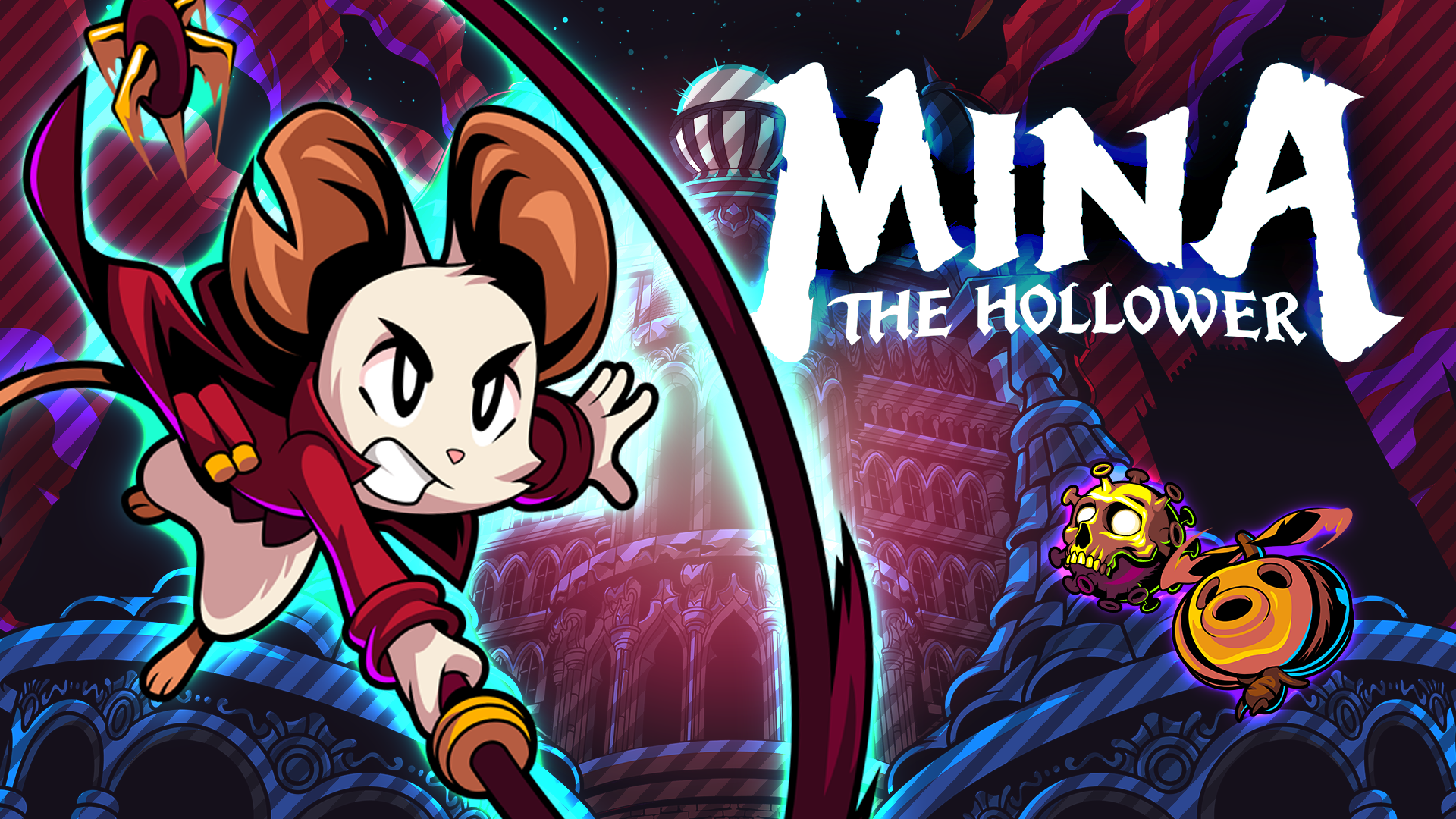
It has been twelve years since Shovel Knight came out. That’s a lifetime in the video game world. Shovel Knight was the game that perfected the genre of “nostalgic game” thanks to, among many other things, a canny understanding of what to take and what to toss. Its main character became a staple of almost every crossover under the sun. It’s enjoyed a bevy of expansions and spin-offs. We live in a distinctly post-Shovel Knight world, but it’s only now that developer Yacht Club Games has released an entirely new game. Not a cameo, not a side project, just something new. That would be Mina the Hollower, which released at the tail end of May after a Kickstarter campaign and last minute delay. It’s a tight, gripping action game, one delighted in hiding tricks and rewards behind its bouts.

Image: Source Gaming. Mina the Hollower shows every new location with an incredible pixel art landscape. Like the rest of the game’s graphics, it’s beyond anything the Game Boy era it references could allow.
Now, I didn’t quite take to Hollower so much, at least not at first. The soundtrack is excellent, but it’s more interested in crafting a sense of intrigue and mystery than the pulsing anthems of Yacht Club’s first game. It’s quite hard, as well, and a bit inscrutable at first. It took me eight days from start to finish, and much of the first day was spent poking around, testing the combat and movement mechanics, and not making what felt like real progress. Afterwards, though? The pace almost never let up. Hollower never stopped being hard, exhausting and unfairly so in moments, but something had clicked. Knowledge, maybe, once the game’s tricks and boons and hidden asides really opened up
MINA THE ARCHAEOLOGIST
There are a dozen ways Mina the Hollower feels like a true follow-up to Shovel Knight, but the simplest is right in the title’s naming convention; it’s a game about its hero. Mina is a Hollower, an adventurer who plows through the dirt for combat. She’s also a master engineer who dotted Tenebrous Isle with six giant electrical towers. Something’s gone awry, though, so she has to sail back and fix each one. Each is guarded by a crazy, pixel-pushing boss with multiple phases and complex movesets, along with plenty of lower tier bosses and enemies that are a feast for the eyes. As this goes on, Mina starts to learn more about the world, the unintended consequences of her design, and the problems that run deeper than any rampaging beast. She’s a fun character: confident, fastidious, and clever. Like Shovel Knight’s forceful personality, which was good for a sidescroller, her problem-solving attitude drives a game about searching, puzzles, and digging up secrets.
Also like Shovel Knight, Mina is a tribute to an era of gaming. It’s most overtly an homage to the classics of the original Game Boy, with The Legend of Zelda: Link’s Awakening as the obvious touchstone. But its retro references honor the entire landscape of the early 1990s console market. One boss is a mashup of Ganon from A Link to the Past and Mother Brain from Super Metroid. Another, Mina’s rival Thorne, is every moody dark knight of the era: Meta Knight, Cecil Harvey, Magus. Restarting each generator involves a sequence that recreates the “fake 3D” effects of the SNES’ Mode 7, where Mina scales a tower with manufactured depth. A haunted train is straight out of Final Fantasy VI. One optional mini-game is a blatant riff on Street Fighter II’s “Car Crusher.” The finale contains an incredible take on Chrono Trigger‘s iconic trial. The game even updates Shovel Knight’s Castlevania and Mega Man references; my favorite is how it responds differently to the path Mina takes, just through an in-game newspaper instead of the grander secrets of Mega Man X. It captures a culture that was mastering 2D right before the rise of the PlayStation.

Image: Source Gaming. Unfortunately, these tower climbing sequences are a bit too fiddly for my liking, and I don’t think they’re implemented perfectly. But they look spectacular in motion.
The similarities to Link’s Awakening and its fellow Game Boy Zelda titles, Oracle of Seasons and Oracle of Ages, still shine the brightest. Mina’s sprite is reminiscent of Link’s chunky, squareish body. The graphics follow the template of the Game Boy, just with far more colors, a modern display to make everything readable, and a control scheme that can use more than two buttons. There are cutscenes with gorgeous pixel art showing Mina steeling herself before each new dungeon, and an optional map that isn’t particularly useful but bursts with detail. Perhaps the most important is the tone. Link’s Awakening’s oddly emotional story and eccentric cast is its heart, and that’s been preserved and expanded. Mina has far more personality than the blank slate Link, so her journey of discovering the underlying problems of her world feels stronger (or at least more conventional. It’s not interested at all in capturing Link’s Awakening’s powerful dream logic).
TOP-DOWN, DOWNTOWN CLOWN-AROUND PLAYGROUND
As an avid fan of Link’s Awakening, I expected this to extend into the gameplay. I assumed Mina would go through dungeons, collect items, and use those to further explore. This is what Link did in the Game Boy Zeldas; it was the formula that defined Zelda for two decades. That’s not the case, though. Instead, Hollower functions more as a top down Soulslike, which is both a natural evolution of Shovel Knight’s gameplay and fairly novel. We’re drowning in big 3D Souls-style games, but there aren’t many that are also top-down platformers. Hell, we don’t have many top-down platformers or action games in general. They have been enjoying a minor resurgence, but they’re often kind of a relic of the Nineties.

Image: Source Gaming. Mina rescues the NPC Rhene in a house. Without the sidestepping available to 3D characters, she fights in a very different way than typical Soulslike heroes.
Mina digs underground for platforming, evasion, or just getting a speed boost. When she’s aboveground, she often has to jump to strike flying enemies with her hammer or whip. When she isn’t, she’s hiding from attacks or sneaking through small gaps. Height is part of the equation at all times. This was a big part of those Zelda games as a way of experimenting with 3D in a 2D setting. It was also, in a lot of cases, games and struggling to use the language of sidescrollers in another context. One of Hollower’s best elements is the overall clarity of its information. I would not say it’s perfect in implementation, and I do think the inherent graphical limitations are part of that, but the platforming and combat are remarkably tight. Thanks to shadows and general animation quality, sprites are crystal clear on whether Mina can hit them on the ground. And in keeping Dark Souls and Bloodborne, the island is chock-full of semi-secret shortcuts once Mina’s fought and dug her way through a grueling gauntlet.
Going even further from Link’s Awakening, Mina the Hollower is aggressively nonlinear. After a short tutorial that explains all of the main mechanics, Mina is sent out to reach all six generators in whatever order suits her. The extremely cool in-game manual gives a loosely recommended order, and having gone through them all, it’s an accurate one. Queensbury Crypt, which came first in the list but which I beat third (largely due to missing a single endgame puzzle and deciding to explore elsewhere), was a lot more doable than Bone Beach or Coltrane Peak, the fourth and fifth and absolute nightmares. Yacht Club does add a few ways to make the intended path a bit smoother to follow; enemies and platforming challenges vary in difficulty in very obvious ways, one route requires a massive payout, and another is built around a giant puzzle tied to all the other levels. But they can be beaten in any sequence, as none of them require or confer some required power-up. In that way, the Zelda game it really follows is Breath of the Wild. The hazards and environments of each area are also unique, so much so that mastering each one is a separate challenge. Nox Bayou’s water physics, Septemburg’s homing lightning, and the totally bonkers secrets of the Astral Orrery all demand study and upend the burrowing mechanics in some way.

Image: Source Gaming. Of course, each area can also distinguish itself by a wild and gorgeously animated boss, of which there are several. Mina’s got her work cut out with them.
Like most Soulslikes, Hollower features a corpserunning mechanic, and it was another thing that challenged me at first. Pretty much every version of this concept works the same way: you die, your currency all falls on the spot, and if you get back to it, you can save it (and if not, it’s gone, and the new currency falls). Instead, Mina has a “Spark” that falls on the ground or embeds in the enemy that killed her. Her Bones are lost if she dies before retrieving it… but they aren’t lost beforehand. They’re still on her person. It’s entirely possible for Mina to slink away to a vendor, or maybe to deposit some Bones in the train that’s tied to both fast travel and the critical path. When I caught onto this, it seemed to go against one of the values of corpserunning, namely that you can always abandon the stash. This does encourage Mina to keep going after what she lost, which I don’t think is great, but the benefits are real. It gave me so many chances to actually use Bones rather than lose them on some doomed runback—though I did try those runbacks, a lot. Sometimes that was on the game, sometimes on me.
DIGGING A PATH
Hollower’s take on healing is less generous. On its face, it seems to combine the most punitive forms that the concept can take. When Mina attacks enemies, she builds up a stock of Plasma that can restore her health, at least assuming she has a Vial to use it. She has only a few on her, three at the start, and generally speaking, she can only refill them at the Underlab, her underground save room that resets enemies and restores her health. However, she can also only collect exactly enough Plasma to fill to the top of her HP bar, so she can’t carry anything extra as a precaution. Additionally, most attacks actually drain the Plasma along with her health, and since Mina has one of the most sumptuous drinking animations in all of pixel art, it’s hard to find times to actually use the stuff before she loses it. For a game that can be tough as nails but usually fair, it’s a strange note. I don’t think it’s successful.

Image: Source Gaming. Mina handles all of these options in the Underlab. She can also buy additional benefits, such as an in-game music player and a tank that refills her ammo.
The way to handle this comes in the form of Trinkets, which are the game’s version of Badges or Charms or whatever a player character wears to alter their abilities. There are a ton, and they bestow wildly unique benefits. Regarding that Plasma issue, one speeds up her animation, while another lets her collect the stuff beyond her health bar’s limit. And it’s not just healing. Alongside Trinkets that give generic buffs to attack or defense, there are ones that help with the platforming, ones that provide risky bonus attacks, and ones that attract pickups. The most impressive of the bunch are the Wallower’s Gauntlets, which lets Mina dig through most walls as well as floors, and it’s not a gimmick that only exists for a few bonus puzzles. I routinely found it near-required for platforming sections across the game, even though it’s totally optional.
This is, by and large, the way Yacht Club has allowed players to overcome the game’s challenge: goodies. Trinkets litter the landscape as the rewards for platforming challenges, boss fights, or getting enough money to buy it off a vendor. Squirreled away behind candles are Sidearms, secondary attacks that are lost upon death but can stave it off in a pinch. They cost a currency called Joules, and Mina can find those in candles and jars and most other places. There are tons of permanent upgrades: boosts to health and Joules, bonus Sparks and Vials, even extra abilities. The Underlab can be upgraded, too, making it easier to save Sidearms after death and test out weapons. And most of these can even be sold to a vendor for a quick profit. This is not abnormal for Soulslikes, but the wealth and variety is incredible and a genuine triumph for agency both in and out of the game’s world. Because Mina’s main abilities are all defined from the start, enterprising players can find the most game-breaking stuff right off the bat or exploit the Zelda II-inspired level up system. More exploratory types can choose to poke at each area a bit at a time before finding something useful.

Image: Source Gaming. This is also how the main weapons work. Mina has a choice of three at the start, and she can find the rest, plus two more, alongside upgrades for all of them. This Casket is hard to use but very cool-looking.
I should also note that unlike many Soulslikes, there are formal accessibility features. Hundreds, actually. Many of these Modifiers do make the game easier, some make it even harder, and they all vary wildly in their impact and scale. I did not use any of them in order to experience the intended level of difficulty, one I found generally good but with a few annoying spikes (then again, it took me forty-four hours for a game whose “average” playtime seems to be a third of that, so maybe I will use a few whenever I play it next). This is something Shovel Knight was generally great with, and it’s always great. That’s not something we saw in many of those Nineties games.
THE SKIN OF AN OLD GAME
I’ve noted a lot of references here. Link’s Awakening, Dark Souls, Kirby’s Adventure. But some of the games I thought of most were the ones that came out after the 2022 Kickstarter campaign where Mina the Hollower started life. When I’d find some impossible puzzle, only for a level half a world away to organically teach me the solution, I thought of Animal Well gating power-ups behind information. When I swiped constantly at an enemy to fill up my vial of magic healing juice and keep it from being stolen, my mind went to Hollow Knight: Silksong, not just Bloodborne. When I finally, after hours and hours of exploration across the land, solved the mystery of the mirrors that had been teased from the beginning of the game, I recalled Tunic hiding secrets in plain sight. This is the Shovel Knight quality that’s most apparent in Mina: the ability to look old but be as new, as relevant as any contemporary title.

Image: Source Gaming. The goofy dialogue, puns, and general calibre of wit elevate Mina the Hollower well over other nostalgic games. There’s virtually no in-jokes or lampshading.
There are a lot of games in the world that may seem like Mina the Hollower at first. They’ll have the chunky graphics and the retro tunes and the paean to the old way of doing things. Almost none of them will hold up quite this well. Some of them will have scripts filled with unimaginative references or insular memes. Some will be just a bit too faithful to the graphical limits of the era. There are many retro-tinged games that are good, but they struggle to capture what made the good old days special. Mina the Hollower dodges these issues and stands above almost all the nostalgic games I’ve played, chiefly because it is a game about the present as much as the past. From its innovations to gameplay to its stunning visuals to its very prescient story about environmental and economic dystopia, it’s a game from and about 2026, not 1993. It is not without its flaws, mostly in a few cruel difficulty spikes, but a vein of forward-thinking ingenuity pulses through it.
Final score: 9/10
Thanks to Cart Boy for edits.

- Back on the Bat Chapter 3: The Black Mask Casebook - September 28, 2026
- Nintendo Direct September 9, 2026: Information and Reactions - September 9, 2026
- The Legend of Zelda 40th Anniversary Direct September 8, 2026: Information and Reactions - September 8, 2026