
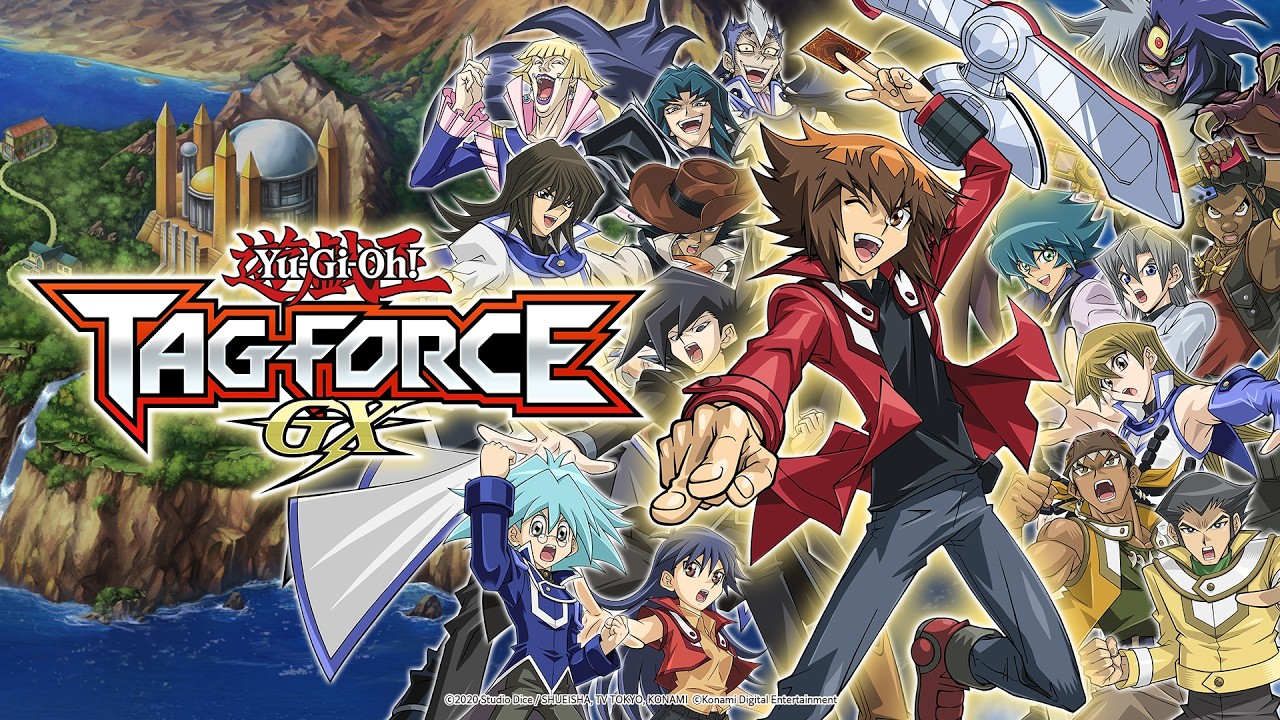
Konami has been doing a solid job promoting Yu-Gi-Oh! Tag Force GX, the 2027 remake of the 2008 PSP exclusive Yu-Gi-Oh! GX Tag Force 3. It was announced during the last Nintendo Direct. It’s reliably featured in big events, like New York Comic Con. A series of Facebook reels by director Yuji Matsumura dutifully delves into the game. Retail copies will come with three promo cards, while pre-ordering it digitally unlocks a few goodies in Yu-Gi-Oh! Master Duel (both games share an engine, notably). Last week, Konami unveiled a creator program centered around the Tag Force revival. I’ve been unable to avoid Jaden Yuki; he’s everywhere.

Image: Konami. Kindly, the English voice cast is back. Since Season 4 of Yu-Gi-Oh! GX was never dubbed and Tag Force GX adapts it, Matthew Labyorteaux and company will finally sorta get to tackle its finale.
I haven’t been happy about that. Well, to an extent, I am; I adore Yu-Gi-Oh! My history with the trading card game is well-documented. And while Yu-Gi-Oh! GX is hardly my favorite era, I still harbor nostalgia for it. Plenty of people were undoubtedly introduced to Yu-Gi-Oh! through GX, too. It warrants celebration, same as any other generation of the multimedia juggernaut. Metroid Ravenous looks ravishing, but Tag Force GX was my showstopper leaving the September Direct. To be honest, I haven’t had the best year, and this remake’s reveal came at the perfect moment. I’ve had the property on the brain, silently hoping for a new video game and another opportunity to write about it (mission still accomplished on that front, at least).
Minutes after Yu-Gi-Oh! Tag Force GX’s unveiling, its Steam page went up. Awaiting us was an equally dispiriting—though, regrettably, unsurprising—revelation: generative AI was used in its development. Specifically, it’s being “utilized to help improve translation efficiency and quality.” Konami insists “all final translations are reviewed and edited by the development team before being implemented,” however.

Image: Konami. To be completely fair, there’s ample time for Konami to address things like the missing spaces in these team names. Though it’s odd seeing Chazz’s Japanese catchphrase, a pun that only works with his Japanese name, instead of his English “Chazz it up!”
I’ve seen some argue that this is “a good use” of generative AI. Ignoring other issues surrounding it—how it steals people’s work, adversely affects the environment, and a reliance on it is linked to a reduction in critical thinking—I vehemently disagree. Machine translations are lackluster, serviceable perhaps for a sentence or two but ill-equipped to handle a massive script. Konami’s toy will make mistakes, causing more work for its underpaid translators. Wait, did Konami hire any translators? That AI disclaimer only mentions “human editors” and “the development team,” leaving me to assume that no professional translator is on the company’s payroll. And that’s a dealbreaker here. For all the praise tech evangelists lavish upon it, generative AI is simply a way for companies to save pennies. Spending money on products that use it feels dirty; I don’t want Konami to shortchange talent or risk tossing out haphazard localizations. For reference, I’m also skipping Crazy Taxi: World Tour, a revival I was excited for, over SEGA’s AI fixation; I’m dreading the day we learn a Sonic sequel uses it.
Writing off Yu-Gi-Oh! Tag Force GX is especially disappointing because the franchise needs more things like it. Admittedly, I don’t follow the trading card game’s competitive scene too closely these days. I know many have grievances with it, though. Where Yu-Gi-Oh! was once a reasonably simple game (that, in fairness, always suffered from dumb balancing issues), it has grown hilariously convoluted. Going first yields the opportunity to spawn a nearly unbreakable board, an overwhelming advantage. If you’re going second and didn’t draw the appropriate hand traps to kneecap your opponent’s plays, the chance to create a competitive field is nil. Especially when you have to weave around dozens of their cards, many of which have effects that’ll negate yours or cause other problems! One turn can exhaustively span twenty minutes, yet a duel may only last two, maybe three turns! Many liken modern Yu-Gi-Oh! to solitaire; there’s limited interaction between players today.

Image: Source Gaming. Warning signs were always present, though. Making it easier to summon strong monsters was a design choice felt as early as “Jinzo,” the iconic trap-negater—which required two tributes in Kazuki Takahashi’s original manga, not one!
None of that is to authoritatively call the trading card game bad or bereft of appeal, to be clear! Aside from sharing the basic rules of its 2000s incarnation, however, it can come across as impenetrable to newbies and veterans who haven’t kept up. Konami is painfully aware; a stockholder famously expressed concerns about its issues attracting and retaining players in 2023.
And Yu-Gi-Oh! is almost exclusively a trading card game today. Previously, each generation of it was accompanied by a manga and anime, outlets that promote the cards while telling their own stories. Many Yu-Gi-Oh! video games adapt them, providing fun ways to insert ourselves into those adventures. Occasionally, Konami even published off-beat experiments that don’t feature any trading cards! Remember The Falsebound Kingdom or Dungeon Dice Monsters? Alternative avenues to engage with the franchise were plentiful.

Image: NAS. Maintaining the game’s fanbase while broadening its reach is a tough balancing act, one Konami struggles with. Multiple formates (including the regularly updated Genesys one), a surprise banlist, and litany of nostalgic products prove they’re trying, though.
Even the supplemental media we do receive these days mostly serves to promote the card game. Fans cheered when Konami unveiled the Yu-Gi-Oh! Card Game The Chronicles animation series, but it doesn’t carry widespread appeal (nobody’s getting drawn into Yu-Gi-Oh! over Albaz lore). Manga publications Yu-Gi-Oh! OCG Structures and OCG Stories occupy a similar position—and haven’t officially left Japan, no less. Yu-Gi-Oh! Duel Links and Master Duel can be entertaining, though the latter is little more than a card game simulator. While Yu-Gi-Oh! doesn’t necessarily “need” an anime, the absence of one is deeply felt. Plus, a new anime could help wean newbies into the game’s newer, weirder mechanics.
More outlets to appreciate Yu-Gi-Oh! are emerging, however. An art exhibition overseas honors the late Takahashi and his cherished property, which Konami commemorated with a pleasant short. A respectable amount of merchandise modeled after Yugi Muto and his buddies hits store shelves. The legacy shows are available on streaming services. Helping celebrate the card game’s twenty-fifth anniversary last year was the Early Days Collection, a compilation of handheld Yu-Gi-Oh! outings. Most importantly, getting a new video game that channels the series’ simpler days is valuable, especially since Tag Force GX isn’t drawing from the original anime. I love my boy Yugi, and highlighting a franchise’s first, most famous generation is always an evergreen prospect; just ask Pokémon. But it’s nice seeing his successor share the spotlight.

Image: Konami / Valve. You also receive a bonus e-book if you pre-order Tag Force GX on Steam. Read this sample and tell me an editor diligently proofread it, though.
Even though I won’t buy Yu-Gi-Oh! Tag Force GX, it is nice more is being done with the brand. And I’ll keep tabs on it from afar; I’m curious what other secrets it may hide. Some are disappointed Tag Force GX includes Synchro Monsters, the Yu-Gi-Oh! 5D’s mechanic. I don’t mind, especially since the original game had them. …Call me biased, but I kinda hope a little modern “Red-Eyes” and “Chaos” support seeps through. “Red-Eyes Darkness Dragon” is stellar but cannot carry its archetype alone, and “Chaos” cards are my favorite.
Regardless, my affection for Yu-Gi-Oh! endures. I think I’ll re-read Takahashi’s manga soon. On YouTube, CONtv constantly streams the anime; I bop in on occasion to bask in the nostalgia. Most importantly, my kid cousin discovered Yu-Gi-Oh! through Netflix, became a fan, and it’s been a lively venue for us to bond. Four years ago, I surprised him at Christmas with an Egyptian God Deck, thrilling him. After unwrapping it and helping him apply his also-new sleeves, he carefully combed through all forty cards, telling his grandpa (my uncle) his opinion of each one. The next several holidays were spent showing each other our collections and sharing stories. Now that he’s older, he’s finally learning the official rules—and we played a few rounds last Christmas, Duelist against Duelist! Recently, I even learned of two hobby shops that are relatively close to my home. Maybe my deck will see more action!
And, hey, I still own The Falsebound Kingdom and Early Days Collection. I should boot up my copies someday…

Image: Source Gaming. What is something you can show, but can’t see? The answer: friendship! Underneath its questionably balanced cards and mercenary nature, the idealistic Yu-Gi-Oh! urges us to connect with folks through games.
Thanks to Wolfman for helping with edits.

- An Early Rumination on Yu-Gi-Oh! Tag Force GX - November 6, 2026
- Character Chronicle: Marta - November 1, 2026
- Continuity Corner: Why Did Ash’s Pikachu Forget Volt Tackle? - October 16, 2026