
EDIT: 10:02 PM EST: I can’t believe I forgot this, but embedded the Direct and accompanying Treehouse Live video.
Splatoon Raiders is an interesting proposition. After three live service shooters, Nintendo is releasing a single player spinoff, something closer to Borderlands than I would have ever expected from the company. In the way Splatoon 3: Side Order was a surprising roguelike, Raiders is a surprising loot shooter. Releasing on July 23, the game has been a known quantity for over a year. It was announced via Nintendo’s Nintendo Today! app, shown in broader Nintendo Directs, and today it got a full show of its own. And we’ve got the news from it.
As a note, some of the information here was already known from prior videos and announcements. For simplicity and clarity, we’ll largely be treating what’s here as-is.
The setting, as has been shown in previous videos, the Spirhalite Islands. It’s an island chain with mystery, monsters, and many things to shoot with ink. You go through the islands, fight enemies, and win loot to make successive runs more survivable.
- Deep Cut, the house band and supporting characters from Splatoon 3, have attempted to fly to and explore this mysterious archipelago before crashing.
- The player character is The Mechanic, Deep Cut’s pilot. They’re the main treasure hunter, with a Deep Cut member—Frye, Shiver, or Big Man—piloting an Exploration Bot as a partner for each level.
- Each island is full of both treasure and enemies. Beating each batch of enemies nets you Spirhalite Shards, the main currency.
- The combat, naturally, doesn’t fix what wasn’t broken; you shoot ink to hit enemies and paint the ground, then swim in ink to refill ammo and move more nimbly.
- The individual stages are designed to be very unique in layout, enemy type, and goals. These include more small and gimmicky Gadget-specific levels, like the bonus levels in Splatoon 3, and larger sandboxes that you fight across. Some also feature multiple underground levels.
The main enemies are the Salmonids, the salmon monsters from Splatoon 2 and 3’s Salmon Run horde modes.
- Many of the Salmonid enemies from previous games are back, as well as new ones. They have a visual indicator of their power: the more covered in salt, the stronger.
- New Lesser Salmonids: Tong Chum (who wield tongs), Spring Chum (who bounce on a spring), Sparky (who explodes).
- Returning Lesser Salmonids: Chum, Smallfry, Cohock.
- New Boss Salmonids: Salty Tongue (a tanky monster), Salivator (a flying monster that creates whirlwinds), Smoker (creates protective fumes)
- Returning Boss Salmonids: Slammin’ Lid, Scrapper
- A new version are Seasoned Salmonids, super hard ones that go beyond the normal danger of Boss Salmonids. Two shown, the Minced Scrapper and Thick-Cut Salty Tongue, have much stronger and wider attack patterns. One, the Big-Stack Stinger, is an evolution of a boss Salmonid from the previous games; I’m not sure if the original is here, too.
- Defeating enemies gives you Power Eggs, which allows the Exploration Bot to dig in lower layers of terrain to keep each run going. Boss Salmonids drop Mega Power Eggs, worth 100 normal ones.

Image: Nintendo. Scrappers were never the toughest Boss Salmonid, but it’ll be great finding new ways to hold them back.
Customization, a standard of Splatoon, has increased even further. It’s primarily accessed through the Hideout, the game’s hub.
- There are “over one hundred” weapons in the game, some of which will be dropped by enemies. The standards are back as well, including Rollers, Brellas, and Chargers. Like in loot shooters, there are duplicate versions that have randomized bonus abilities and different levels of strength.
- Gadgets, high powered weapons, are back. In Splatoon Raiders, players can equip two types at once. Unlike in the mainline entries, they don’t use ink, instead operating off cooldown timers. Also unlike the mainline entries, which bind them to specific weapons, these are only usable on specific Tanks—as you now have an option of what Tank to use during matches.
- There are three types of Tank: Speed, Power, and Tactical. Each gets stranger with use, allowing for up to three Gadgets.
- Speed Tank Gadgets: Blast Boot (attacks with a flying stomp), Dash Bomb (shoot forward with an explosion). Booyarang (which stays in place for a few seconds before rebounding, kinda like that one boon in Hades).
- Power Tank Gadgets: Splatchet (a sweeping arc that can break a Scrapper), Splatellites (a protective ring of ink-dropping discs), Spinwheel (a land-based drone).
- Tactical Tank Gadgets: Shot Pot (an automatic turret), Bombloons (linked bombs that can create an explosive chain), Tether Wail (a chain that connects to your tank and damages any enemy it hits).
- Gadget customization is now a major factor. Each Gadget has a unique selection of possible upgrades, and players can equip multiple at once. The only restriction is something akin to a weight limit, where each upgrade costs a certain number of points and can’t go over a maximum number.
- The Booyarang was used as an example. Upgrades cover things like how much damage is done, how wide the attack is, how long the Gadget stays in the air, how many are fired at once, and other things. Several of these can be found as random rewards off Boss Salmonids. The ability to combine multiple encourages experimentation, as they can synergize in unique ways.
- The Hideout can also be upgraded with new facilities that provide upgrades to the Mechanic, play with Weapons (which can be upgraded or turned into materials), craft new Gadgets, and do other things. Several add targets or rails for players to use as tests. Big Man also provides bits of lore, alongside strategies about enemies you’ve encountered.
- One kind of treasure are Salmonid Relics. They’re found across the game and confer special bonus powers, like a double jump.
Unrelated elements and mechanics:
- When you die, you keep the experience points and items you found. This is part of a broader trend towards RPG systems here, unlike Splatoon’s normal insistence on having even the most basic Weapons and Gear being reliable.
- Because of that, there is an element of constantly leveling up in a way that’s only really been in the campaign modes of the first three games.
- The always important Splatoon Outfits are here, of course. Scanning amiibo also gives unique Outfits; the new Deep Cut amiibo give ones based on their characters.
- There are three difficulty options. In keeping with Nintendo’s preference for unique terminology, it’s Tourist, Raider, and Survivalist. They’re changeable at any time and don’t affect rewards.
- While not a multiplayer-focused game, there is four-player co-op through wireless or online play. No couch co-op, which is probably fair. Alongside playing alongside friends and having rooms, one form of communication is Calling for Help, It lets you ask for help from or provide help to a random player online. Using it causes a cooldown timer after finishing a raid, and providing help gives special rewards.
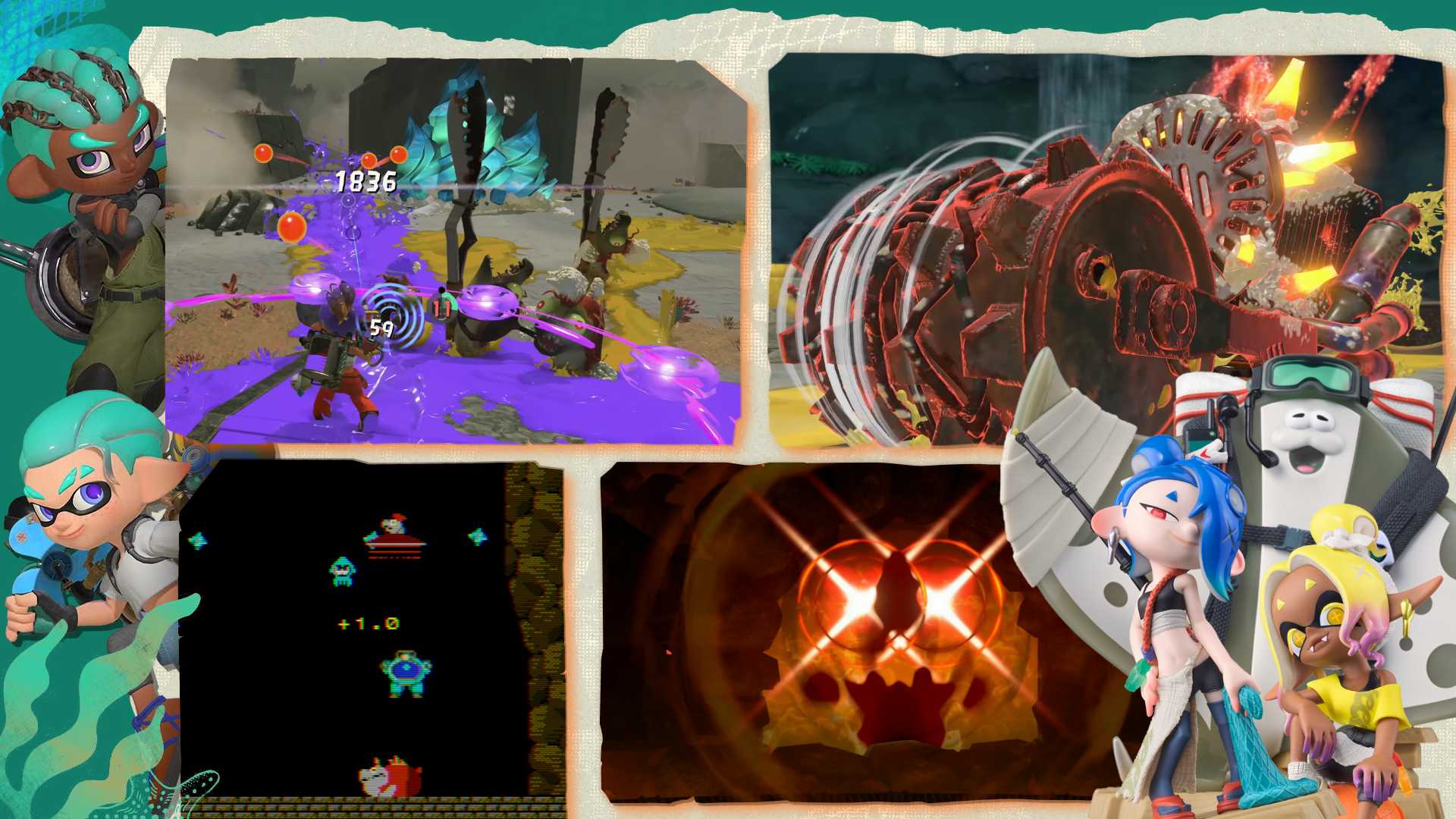
- Before jumping to a thirty minute show by Nintendo Treehouse live, the end of the Direct showed a wide variety of strange levels, mechanics, gimmicks, and an Ice Climber-style 8-bit mini-game.

Image: Nintendo. My MVP: the Roller. I dunno how useful it’ll be given how limited it is in Salmon Run, but I’ll always stand by it.
The Direct:
Wolfman’s Soapbox: I would consider myself a Splatoon fan. I think the mechanics are incredible, the aesthetics sublime, and its approach to live service design thoughtful in a sea of massive creative self-destruction. And yet, I don’t think I could say I’ve ever been much of an active player. I’m pretty bad at multiplayer shooters, especially online ones where the skill ceiling is so much higher than my potential. The only Weapon I like using in Turf War is the Roller, which is a spectacular weapon but one that has limited uses. In Splatoon 3, I found Salmon Run much easier, mostly because I wasn’t shooting other players with these weapons. And despite having a lot of respect for all three games’ campaigns, I’ve never actually beaten one of them. It’s a series I like a lot but have never spent much time in, which is weird when they’re big, full price games.
So I guess Splatoon Raiders could end up being my Splatoon, which is somewhat surprising. The stuff here has almost everything I love about the series: the splatting, the terrain control, the sense of danger, even the Salmonids (the weird pop songs aren’t here—yet). It’s even at a lower price point. I’m not sure if I’ll go out and play it immediately; June was pretty busy as it is. But I also don’t need to buy a single player-focused game at launch in the way I felt I needed to play Splatoon 1 and 3 at launch. I was definitely interested in the idea in a somewhat passive, vague way, but after this show, color me more actively interested.

- Back on the Bat Chapter 3: The Black Mask Casebook - September 28, 2026
- Nintendo Direct September 9, 2026: Information and Reactions - September 9, 2026
- The Legend of Zelda 40th Anniversary Direct September 8, 2026: Information and Reactions - September 8, 2026