
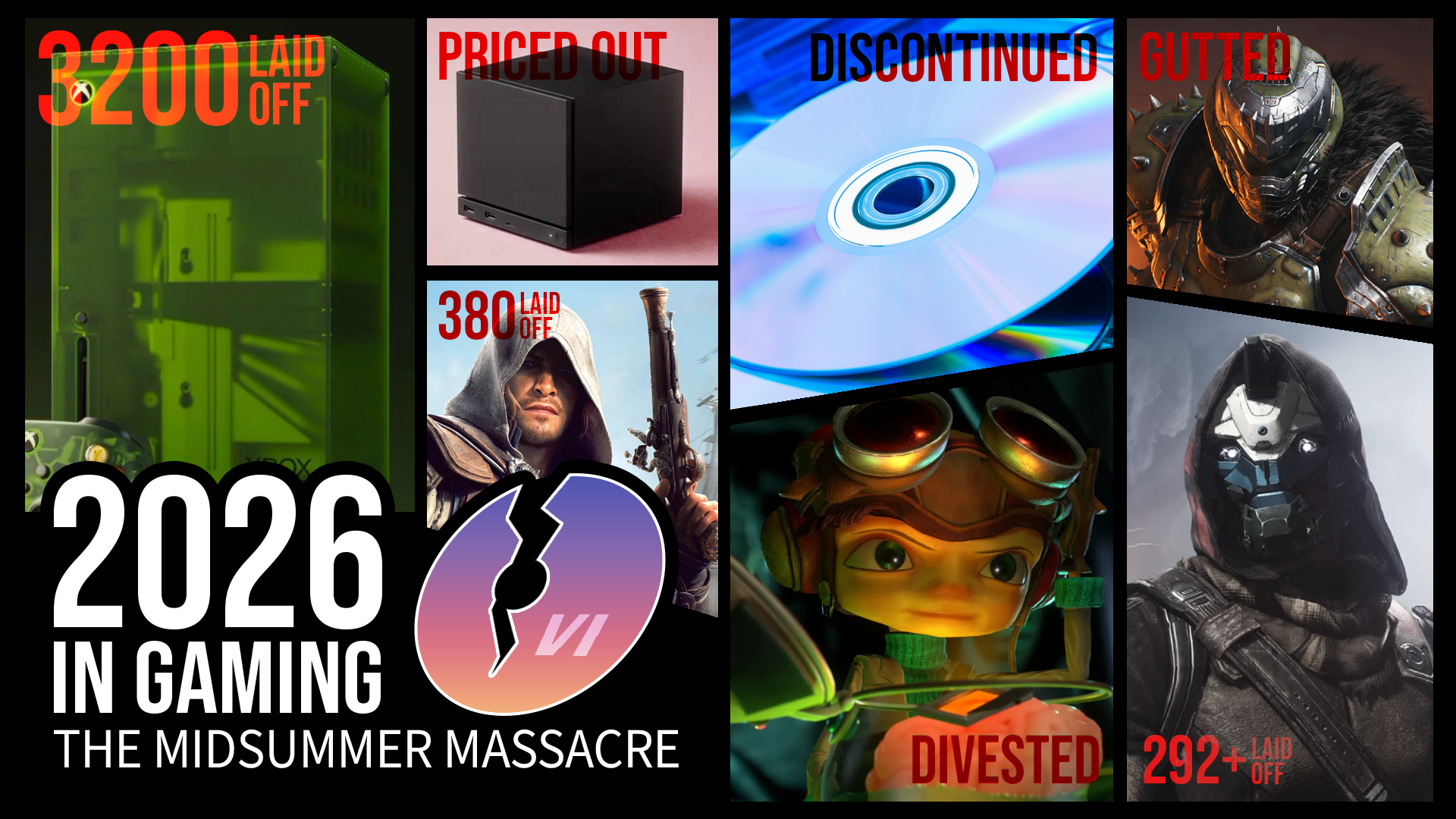
Throughout this decade, the games industry has felt almost cosmically wrong. Tens of thousands of talented developers, artists, writers, composers, QA testers, and more have been laid off. Culturally important studios have been shuttered near-randomly. Mass acquisitions, which ballooned before COVID, have caused incalculable chaos. The price on everything keeps rising due to the proliferation of AI datacenters and its consumption of the world’s RAM. Thanks to pressure by reactionary groups, Steam and Itchio censor adult and queer art from creators who had been made to feel safe. Other reactionaries turn every story into the site of an exhausting culture war. The world’s largest game company is complicit in a genocide. People are robbing stores at gunpoint for Pokémon cards. An explicitly white supremacist piece of trash directed by gaming’s old punching back Uwe Boll—Uwe Boll!—is one of 2026’s most successful films.
At times it feels like horror, our all too late realization of how bad things are, have gotten, always were, and are about to be. But the past several weeks have felt different. It started right after Summer Games Fest, and it didn’t stop before an abominable climax. And along the way, the gaming community has been confronted with issues that would have seemed comical a few years ago. It has been a massacre of firings, price-fixings, and attacks on worker and consumer power. While these are independent stories in theory, I’ve tried to wrangle them all together to understand. Come with me, and let’s try to make sense of all that’s happened.
THE LETTER
It all started the evening of June 10, the day after Summer Games Fest. SGF was well received, and Xbox’s 25th anniversary showcase especially. Three days after it aired, though, enthusiasm began to quell when Xbox’s new CEO Asha Sharma and longtime executive Matt Booty sent a letter to both the entire staff and, surprisingly, the public at large. In “Next 100 Days: XBOX Reset,” Sharma and Booty starkly lay out a series of core problems with their company. Microsoft spent $20 billion on investments (not counting its $69 billion purchase of Activision Blizzard King) but lost half a billion in annual revenue, these investments—an empire’s worth of subsidiaries, studios, and staff—haven’t been supported, Xbox Series S | X and their Game Pass service are both struggling, and hardware component costs have risen dramatically and are expected to keep that trajectory. All issues bar the last can be laid directly at the feet of Sharma’s predecessor Phil Spencer, whose acquisition initiative turned Xbox into an oversized monstrosity drunkenly stumbling from one mass layoff to the next. It’s a sober, unvarnished message epitomized by the three words every journalist quoted: “this cannot continue.”
What isn’t said speaks volumes. Booty doesn’t note that he was a major player in Spencer’s plans. There’s certainly no strategy espoused for what this “reset” would entail. And it ignores one of the causes of the last issue, which is Microsoft itself; it’s one of the AI-chasing tech giants responsible for the “RAMpocalypse” that’s making electronics so expensive. This has always been an unspoken problem, that Xbox is constantly at war with itself. It has hardware that doesn’t sell, buys studios for exclusive titles to make that hardware appealing, fails to get that to work, only to discover that those studios need the money from a multiplatform release anyway. It has a subscription service that cuts into its own profits. And now it can’t even meet the limited demand for its products because it’s competing with its parent company.

Image: Xbox (or, rather, “XBOX,” as it’s now officially called). This classic Xbox logo was the only image that came with the note. It fits; it’s both retro and symbolic of Sharma’s early initiatives.
The note shrouded the rest of June. Over the next three weeks, journalists across the industry would hear news of what might happen. Namely, a “bloodbath” of layoffs, studio closures, and a hubristic attempt to “fast track” sequels to Halo, Fallout, and The Elder Scrolls. This was one of the main themes of the month. We’d hear an update from accredited journalists, economic analysts, Xbox unions left out in the cold, and Duke Nukem Forever co-director George Broussard (okay, yes, he co-founded 3D Realms and has friends at Bethesda). These updates would dot the feeds of IGN, Kotaku, and Eurogamer. It presented a publisher in chaos, with a cruel hand poised to crush many of its most talented workers.
I think the letter is where this starts, this freakish midsummer period of overwhelm and exhaustion. It started with Xbox, and it ended with it, but it was a story filled with several of the world’s biggest publishers and a hell we’ve all found ourselves in. However, it would take twelve days for the next bombshell to drop—and after that, it only ramped up.
THE MACHINE
The Steam Machine was always going to be fun, satisfying, and pointedly niche. It’s a quirky hybrid of PC and console that has many of the strengths and weaknesses of both. You can’t mod it nearly as well as a computer, and it’s not quite as accessible as the most bespoke consoles, but it’s a nifty compromise that expands the range of PC gaming. I’m not going to pretend I was ever interested in purchasing it, but I love its existence. It definitely speaks to me far more than the upcoming Xbox / PC Frankenstein that is “Project Helix,” and I’ve enjoyed seeing people use it online since its June 29 launch. If I was to seriously engage with the PC market, I’d want it to be with that kind of device.
It was also always going to be expensive. This was a machine with a limited appeal, and Valve—whose ownership of Steam makes it perhaps the single safest powerhouse in the games industry—never needed to sell it at a loss. The company was expecting it to go in the $800 range, which is absurd on its face to someone like me (that’s $100 more than the initial price of the PS5 Pro, a cost I found obscene) but incredibly economical compared to an average user-made PC rig. But, as it has since 2025, the RAM crisis struck. On June 22, Valve began pre-orders with the base price: $1,050. And that’s without the controller or more than a half-terabyte of storage. The Steam Machine is also somewhat weaker than the price would imply; testing by sites like Eurogamer show that it isn’t quite as consistent as a PlayStation 5. All this has made the boxy toy as much a punchline and a target of criticism as anything else.

Image: Wikipedia. The Steam Machine. I hope I don’t sound derogatory when I call it “cute.” It’s complimentary.
While the cost priced many fans out of a purchase right from the start, the Steam Machine still sold out almost immediately. Valve developed a convoluted waitlist system to ward off bots and scalpers, one that hasn’t exactly worked wonders, but we face a strange problem. The device is too expensive for most players to buy, which means it’s actively cutting off a large swath of potential buyers and Steam users, but the rich people it has to cater towards can’t buy it anyway. Something that was supposed to be friendly, simple, and inclusive—and very much seems to be that—is now a symbol of runaway excess. It’s not even Valve’s fault. According to an employee, the company’s current “deal” with RAM manufacturers consists of getting random offers and either paying whatever prices are offered or getting blacklisted. It’s why some Steam Machines ship with a 16GB strip of RAM and others two 8GB; Valve doesn’t have a pipeline for standardized materials. I fully believe this, partially because price-fixing in the U.S. is becoming normalized, partially because the main players in the industry were indicted for this exact thing years ago, and partially because there’s allegations of them doing it again.
I do find it kind of tragic that the Steam Machine released this way. Instead of being a comparatively affordable way to enjoy the world’s largest video game catalog or ease yourself into the PC ecosystem, it’s a vanity trinket. If it’s a satisfying middle ground between computer and console, it’s also suffering the current problems of both. But even a company with resources as vast as Valve can’t wait this crisis out. Every console begins aging the second it’s finalized, and we have no idea when RAM will actually be available to someone who isn’t trying to build an AI hegemon. This is also true of PlayStation 6 and Project Helix, which both were intended for 2027 and will be entering a rough market. Because of this, the Steam Machine feels almost like a victim, especially as June’s other players were far more complicit.
ROCKSTAR
On June 24, Rockstar Games began pre-orders for Grand Theft Auto VI. GTA is expected to be the biggest cultural event of the decade. It is so big that almost all other games are avoiding its November 19 release date like the plague. November’s currently a ghost town, while September and October have become a ridiculous pileup. In a normal year, more vulnerable titles like Control Resonant, Fire Emblem: Fortune’s Weave, Hellraiser: Revival, and Silent Hill: Townfall would have to work around major releases. For them and the vast majority of games, the first month is often crucial to maintaining any kind of momentum. That doesn’t seem possible now when the games that are closest to sure things, Wolverine and Call of Duty: Modern Warfare 4, are also running scared. This situation is already setting up dozens of games and teams to take the fall, though that’s not really under Rockstar’s control.

Image: Rockstar Games. Character customization is more important to GTA than ever, so paywalling a huge amount of it is malicious.
What is, however, is how Rockstar and its parent company Take-Two are releasing the game. GTA6 is only coming out digitally, as both an $80 “normal” version and a $100 “Deluxe Edition.” Let’s get the latter out the way. One of the biggest selling points of Grand Theft Auto as a series and especially this new one is its character customization, Rockstar’s comments imply that at least most of this is exclusive to the top tier, and if so that’s gross. It brings to mind the sleazy DLC deals and pre-order bonuses of the Xbox 360 era. The lack of a physical disc might be a greater problem from a macro sense. Pretty much every game store was relying on sales of GTA6, and while they will technically be stocking boxes of the game (with a download code inside), that seems to be already killing traffic. Even taking into account the economic realities that have been strangling retailers for years, this move is going to hurt a lot of people. And yet, no matter how much these decisions have riled up fans, the pivot to digital isn’t likely to be reversed.
There is a lot of value in getting physical games, but one that comes to mind for me is the ability to engage with art without paying a corporation you find unscrupulous or unethical. That certainly describes Rockstar, which has a sordid history of crunch and is currently in a legal battle with employees it fired for attempting to unionize. I was personally planning to hold off a year or two, maybe buy a discounted PS5 copy, and enjoy Vice City that way. I can’t exactly fault Rockstar and Take-Two for not wanting me to buy their game in a transaction that directly excluded them, but a space for buying and selling pre-owned goods is an important part of consumer culture. And if the biggest Triple-A game of all time is going to leave it behind, most publishers are likely to follow suit.
THE PRICE HIKE
Xbox’s warning about increasing component costs was answered on June 25, when the company announced a massive price increase for the Xbox Series, effective August. 1. The 512 GB Xbox Series S is going up $100; the 1TB version and Xbox Series X by $150, and the 2TB Series X is simply being discontinued. I assume the latter is a cost-cutting measure given how bad storage prices are. For context, though, the cheapest model of the newest Xbox is now as expensive as the priciest model used to be. This is also the third time in just over a year that prices have gone up, after May and October 2025. Microsoft is now offering a “Buy Now, Pay Later” payment plan to make it easier. The installments are interest-free, so good on that at least, I guess, but this increasingly tiptoes away from the theoretical point of a games console, which is a device that sacrifices granular, owner-driven direction for something accessible, intuitive, and affordable.

Image: XBOX. The 25th anniversary was marked with the new Series X model, which feels comically extravagant in hindsight.
Given everything we’ve learned about the RAM crisis, we can hardly be surprised. However, it’s a perfect visual shorthand for the industry’s weird economics. The traditional logic is that a console gets cheaper over time as manufacturing costs go down, available software goes up, and sales become more plentiful. It’s also logical that an unsuccessful machine like the Xbox Series would not raise prices three times in a year. But logic means little when RAM manufacturers only care about selling to datacenters. Until companies like Microsoft, OpenAI, and Meta stop fixating on AI, we should expect prices to continue to rise. And if and when that happens, there’s no guarantee prices will even fall back down.
It’s obviously terrible for consumers, not just of video games but virtually all modern electronics (it’s also not the only problem; AI hyperscaling is environmentally ruinous). And the price hike this situation caused was roundly criticized by gamers. But this one is rare among the other controversies on this list simply because it was almost purely mocking in tone. The Xbox Series feels like a joke, its creator is putting most of its games on other platforms, it’s the victim of its parent company’s AI ambitions, and remember, this was after we all learned about the plan to fire hundreds of people. Gamers clowned on it, and given what had already happened that day, they probably needed something cathartic.
BUNGIE AND UBISOFT
In May, Bungie announced the end to development on Destiny 2, one of the defining modern live services. There are financially valid if unfortunate reasons for this; it takes incredible work for a studio to not be crushed by one live service, and Bungie has two. And with Destiny 2 having openly struggled and underperformed for several years, it makes some sense to put more focus on Marathon, which launched in March to critical acclaim but tepid sales. However, while some of the Destiny team transitioned, the bulk—at least 292—were let go on June 25, hours before the Xbox price hike. Again, it led to immediate and angry backlash. Fans have spent the last couple weeks making petitions for Destiny 3 and goosing the Destiny 2 player count to prove the old game more viable than the new one, but it’s all a fait accompli. Neither Bungie nor its parent company Sony would reverse this decision for a game that is probably past its prime, nor were they going to commit to yet another costly, protracted production. Most of all, they weren’t going to rehire the people they axed, the people most responsible for Destiny 2’s twelve years as the world’s most important loot shooter.

Image: Bungie. Although it falls outside this article’s scope, I do want to note the sudden, sad, and anticlimactic end to Destiny 2, which also fueled plenty of acrimony and sorrow.
This was not Bungie’s first go-around with layoffs since Sony Interactive Entertainment bought it in 2022. The studio fired 220 people in 2024 in a restructuring that moved another two hundred to different parts of SIE. In 2023, it fired 100. Part of this is that Bungie was wildly overextended, and that it’s been racked with mismanagement before and since the merger. But this is primarily on PlayStation. In the 2020s, then-President Jim Ryan made the commitment to pivot almost entirely to live services, essentially having his single player studios compete against both rival companies and each other. Bungie’s knowledge in live services was as much an asset in this endeavor as the Destiny IP. And although PlayStation has championed this direction as recently as, uh, one day after the layoffs, it’s been mostly disastrous and led to multiple waves of firings. Even a studio it bought five years ago was recently closed without ever releasing a first party game. This industry-wide chase of forever games has hurt innumerable workers, and new live services like Marathon take it on the chin for symbolizing this. Destiny fans have been very open about antagonizing it, at times even the Destiny developers who work on it, and this doesn’t seem to be helping the situation.
It’s ironic that Destiny 2 is a victim of a trend it pushed, one that punishes its staff for both success or failure. While it’s most notorious for flops like Concord, Highguard, and Redfall, the live service genre writ large is inherently destructive. I suppose that if we have to have them, we need to find ways to let them end softly, and to protect their developers. Give Destiny 2 a fair conclusion and give Bungie’s workers real safety. That level of nuance isn’t popular, though. People like the ones they like and see all others as an existential threat. And… maybe they’re right to be sick of them. Like, just a few days ago, Nintendo announced it would be delisting Mario Kart Tour with no plan for an offline mode. That’s a mainline Mario Kart entry being removed from existence, not providing an offline version is bad for players, and I’ve seen at least one person rightfully upset over it, but the response seems muted overall. Maybe gamers can’t muster up anger over one more free-to-play live service going down.

Image: Ubisoft. Founded in 2019, Ubisoft Winnipeg worked primarily as a support studio on games like XDefiant. Teams like it are necessary for blockbuster game making, but they’re unfortunately seen as disposable and targeted for layoffs.
What’s just as sad is that Bungie didn’t even nab first place when it came to June layoffs. Hours before the Xbox memo, Ubisoft fired about 380 employees and shuttered its Winnipeg and Belgrade studios as a result of restructuring changes. This is the norm for the French publisher. It has been struggling with its biggest series, endured a number of high profile harassment lawsuits, and is navigating a billion dollar bailout from Tencent. For the past several months, that navigation has mostly involved high profile cancelations, firings, departures, and the death of one of its founders. I’m focusing on it less for two reasons: it technically falls outside the purview of this essay, and it got less attention. Gamers expect this from Ubisoft. More cynically, I also suspect they are less invested in Ubisoft after years of bland game design and bad behavior. I wonder if it’s easier to pine for Bungie, the creator of Halo and Destiny, than teams that are not allowed to identify as more than a cog.
Hundreds of other people lost their jobs in June layoffs that got less attention. There were some from companies I don’t even know: Metacore, Strikerz, Keywords San Francisco. Fans worried about Microsoft still witnessed plenty of redundancies, and we all know why. Pandemic-era growth hit a plateau. Price hikes, budget hikes, worsening global economics, and a wealth of content that leaves players spoiled for choice make new projects riskier. The global economy is steadily geared to only a subset of well-off consumers. It’s all bad. And if that’s the case… what was all of this even for?
A DISCLESS FUTURE
If Rockstar going digital-only was a death blow to a dying market, Sony went even harder on July 1 by announcing an end to PlayStation Blu-rays. The electronics giant will continue to produce discs until 2028, at which point all PlayStation games will be digital-only. It’s unclear if this will extend to Blu-rays used for films and television, but given that Sony is already training its factory workers to transition to microlenses, I’m guessing so. It certainly signals an end to the history of optical discs. Coincidentally, Sony paired that with an ostensibly unrelated announcement that the online stores for PlayStation 3 and Vita will be shutting down. These have received the largest backlash of all, one that took somewhat longer to cool. In comments and calls to the PlayStation hotline, Sony’s most intense fans were very loud about wanting to have discs as objects, collectibles, and a way to preserve what they buy.
Now, physical ownership is not a golden path to preservation. Discs degrade, machines break down; my PS4 died at the start of the year, and Sony’s repair team had to extricate my copy of Elden Ring. Most DVDs these days are already barely more than a gussied up code (Sony is actually good on that issue), and there’s nothing stopping the publisher from simply patching out your ability to access its contents. Sony itself did that in 2024 for every physical copy of Concord. Many preservationists have also noted that physical copies aren’t enough on their own, and industry leaders like Sony already antagonize preservation in other ways. What physical copies can provide is a form of consumer control, however limited. By removing this, there’s little way to actually own something you buy; it’s all licenses that can be revoked at any time. And Sony is well aware of this, because on June 26, it announced that 551 films would be deleted from users’ PlayStation libraries due to expiring licenses with Studio Canal. No refunds, no path to ownership, no way to hold onto your data, no blithe apology.

Image: Sony. I don’t know if it’s actually “ironic” that Sony was both a visionary in optical disc development and one of its killers, but it is sad.
There are other problems, too. While Microsoft is allegedly working on a way to allow players to get digital copies of their Xbox discs (according to a leak that was conveniently published hours after Sony’s announcement), there’s no guarantee it will be finished or that Sony will attempt something similar. All three console manufacturers are invested in preserving digital backwards compatibility, but with the PS6 almost assuredly being an all-digital device and no confirmation it might support external disc drives, we don’t know how or even if our PS4 and PS5 Blu-rays will make the trip. And that’s for us as consumers; even more than GTA, this is atrocious for the secondhand market and could be a death blow for retailers—not that they were doing great beforehand. While most PS4 and PS5 discs only carried a fraction of their game’s content, removing even that possibility puts only more pressure on increasingly expensive storage. There may be other aftereffects we can’t foresee, like the very real possibility that prices will be elevated and discounts given less frequently without a need to compete with stores.
The logic is simple, if a bit cruel. Excising physical games from the marketplace is bad for users, hobbyists, resellers, and creators, but it’s great for companies like Sony and Take-Two. This completely guts the resell market, of course, but it also keeps stores from getting their cut and removes the cost of discs, boxes, and shipping (something that has substantial environmental benefits, at least). And ultimately, this is not purely a corporate-driven choice. Over eighty percent of PlayStation sales are digital. It’s even more extreme on Xbox. And with hardware prices getting worse than ever, abandoning a disc drive is an easy cost cutting measure. Still, even with those numbers, tens of millions of Blu-rays are sold each year, so it’s not that niche a market.

Image: Source Gaming. Despite my love of physical releases, my PS4 / PS5 library is mostly digital. This news makes me unsure of whether to double down or get more discs.
I’ve accepted that my lifelong memories of thumbing through the bins at EB Games, Gamestop, and the DVD section of my local record store are in the past. I’m not here to mourn them. I am sad for preservation and consumer choice and the companies that specialize in physical releases like Limited Run Games, but I always knew they were on shaky ground. I think what hits me is the recognition that so much of the art I consume can’t be tangibly held—just rented. I don’t like living in an era where we’re bound to subscriptions and ever-changing licenses and the mercy of corporate whims. Within the past twelve months, I bought or received a Blu-ray of Superman, a cartridge of Donkey Kong Bananza, and the 1,100 page anthology The Weird, and all of them come with a lifespan, but I have them. I hate and fear the entertainment industry’s eagerness to snatch that away.
This has been a major refrain since the console generation started: a broadside against consumer power and access. Players are told to accept elevated pricing, a loss of control over what they pay for, and choices that’d be considered unacceptable years ago. Sometimes, the reasoning is fair. I was shocked to realize that even Valve is at the mercy of an electronics cartel, because even the biggest game store in the world is still “just” a store. Other times, it’s at least understandable, like recognizing that most companies would rather you buy digitally and cut out the distributor. But this is still extraordinarily bad overall, and it’s no wonder fan rancor has been so loud and nasty.
MICROSOFT
But if anyone was trying to appease the fans, it was trillion-dollar Microsoft. Much like Phil Spencer before her, Asha Sharma has been aggressively catering to Xbox’s most dug-in audience. Days, maybe hours before announcing a real PS5 port, the 25th anniversary showcase revealed that Gears of War: E-Day would be an Xbox exclusive—something that probably makes poor financial sense, definitely hurt Microsoft’s relationship with Sony, but got a big crowd reaction. The publisher gave away hundreds of Xbox Series Xs before a lavish Fan Fest in defiance of its struggle to account for both demand and supply. Full physical releases of Halo: Campaign Evolved and the Switch 2 version of Oblivion Remastered have been turned from good, consumer-friendly choices into potshots at PlayStation. Xbox, as it always does but rarely so successfully, was operating in the realm of vibes.
…Until it wasn’t. That can last only so long when your company loses money on every dollar it spends, and with the cost of Spencer’s spending spree nowhere near recouping, the company brought out the knives. The morning of July 6, a week after Sony’s announcements and days after Microsoft’s fiscal year ended, Sharma announced the firing of 1,600 people and a promise that another 1,600 would follow them at some point within the next twelve months. It’s the bulk of a 4,800 person reduction at Microsoft. This is the fifth Xbox mass firing since the Activision purchase, after two rounds apiece in 2024 and 2025. It came with another memo, one more pointed about the cataclysmic failures of Spencer’s defining initiative.

Image: Bethesda. Blade was always going to have a tough row to hoe, but its fate—and that of its studio—seems more precarious than ever.
In exactly one way, this could’ve been worse. At least five studios were negotiating for their survival, and all five are tentatively alive. Double Fine Productions (Psychonauts, Keeper, Kiln) and Compulsion Games (We Happy Few, South of Midnight) are gaining their independence and even keeping their IP, the lack of which doomed Lionhead Studios in 2016 when Microsoft refused to let go of the Fable property. Ninja Theory (Hellblade, Enslaved: Odyssey to the West) and Undead Labs (State of Decay) have been sold, though we don’t know to whom. Arkane Studios (Dishonored, Deathloop, the upcoming Marvel’s Blade) is still in negotiation due to aspects of French labor law. Although the other four probably suffered or will suffer cuts from this transition, at least they’re existent. That being said, I do think it’s fair to call this relative mercy a PR move, a kind Sony, Rockstar, and Valve did not attempt. Reactions to mass layoffs focus on the explicit closures and cancellations, and having neither lets Microsoft appear almost magnanimous. This is perhaps what saved Obsidian Entertainment, which was allegedly also on the chopping block until the last minute. Then again, that didn’t save a quarter of its staff.
But this was 1,600 people, a number that may or may not count the roughly 300 at the studios that escaped. With another 1,600 coming up and no indication that it won’t feature full closures. We don’t have a clear picture of exactly who’s been fired and which teams were gutted the worst, but it’s widespread. Bethesda seems to have been hit the hardest; Elder Scrolls Online might have lost half its team, which is why the MMO’s content roadmap is now “shifting,” and id Software’s 185-person staff was cut by 136, the day before it released Doom: The Dark Ages’ DLC. The person who spearheaded Xbox’s stellar Backwards Compatibility program is gone, which leaves me concerned about that disc plan. If we count only the current losses, this is more people fired than every 2026 layoff I referenced combined. If we count the full 3,200, with the understanding that no one left knows if they’ll be in that second batch, it’s astronomical and almost certainly the single worst mass layoff in gaming history. And these people are coming into an atrocious job market made bad by companies like the one that let them go.

Image: XBOX. I’m sure this has happened before, but this might be the highest profile example of making a trailer for a company. The Senua trailer at the Xbox showcase was marketing to other publishers as much as it might have been for “the fans.”
These numbers are only part of the story. It omits how IO Interactive just closed a studio after Xbox pulled out of an then-unannounced partnership, as well as the cost to indie teams off an apparent pause on new Game Pass deals.There’s also the organizational changes; Minecraft developer Mojang and Candy Crush steward King will now be reporting directly to Sharma so she can take a more active role in Xbox’s biggest cash cows. We can’t forget Microsoft’s shady strategy of allegedly announcing Ninja Theory’s newest game while planning to sell it off. And it all leads to how the publisher—which claims it’s not reducing resources, only reallocating them—will be spending this newly-freed capital. All signs point to pumping out its main franchises at the expense of everything else. What’s left of ZeniMax and Bethesda, for instance, will put their focus on the biggest IP they brought to Xbox: Fallout, The Elder Scrolls, Doom, Wolfenstein, and Quake. Despite this, the teams making those very games have been cut to the bone. This won’t help new entries in those series be “fast tracked,” but neither would throwing more bodies at the production. It’s a Silicon Valley vision best encapsulated by Sharma’s new goal: a billion players a day playing Xbox.
I have to make a confession: my first reaction was a sigh of relief. Independence or sale does not make those four companies safe, but none of them were safe anyway, or a good fit. Double Fine came closest, since its only job was to make quirky stuff for Game Pass, but it never felt at home. Compulsion was similar, with games that couldn’t help Microsoft’s increasing fixation on the largest stuff in its catalog. After it was bought, Ninja Theory was wildly miscast as a maker of showy, 2020s-style blockbusters instead of the scrappy indie studio that could punch up against them. Undead Labs, mired in a notoriously toxic workplace culture that Microsoft barely tried to fix, didn’t even release a game in its eight years under Xbox. Arkane, which was bought by Bethesda before Bethesda was bought by Microsoft (and, I should be clear, is still very much in danger), has struggled within both publishers. This is certainly better than being fired, their ownership of their work is unexpectedly good, and I’m happy that I might be able to support at least some of these studios without breaking my ongoing boycott of Xbox.

Image: Double Fine Productions. I won’t say “set up,” but we were all definitely inclined to think Microsoft was about to fully destroy Double Fine, one of its best studios and one of the few that functioned well after its buyout.
But I can’t help but think of how even this feels kinda… wrong. Like, the bare minimum should be that these studios were guaranteed their freedom and their art. I was scared Microsoft would throw Double Fine’s brilliant staff to the wolves while clutching the rights to games like Psychonauts, Grim Fandango, and Brütal Legend, games made years before that acquisition and to which it holds no artistic claim. I woke up, saw the barest level of decency, and cared about that first, not the shocking number of redundancies. At least for a moment, that weird Xbox messaging—and it very much is messaging—worked on me. It didn’t last, and I think my reaction of relief to disgust wasn’t an uncommon one, but I still feel uncomfortable.
CONCLUSION
It hasn’t stopped, you know. The bad decisions and ensuing fury. The horrible monetization of Ubisoft’s Assassin’s Creed Black Flag remake and Microsoft’s overpriced retro Call of Duty ports are in the same boat. The aforementioned delisting of Mario Kart Tour got criticism, if nowhere the same white hot rage. By now, nothing in these stories should surprise us. They’ve happened before, many times, and their causes have been well established. The reactions they got were no less predictable. But that hasn’t made mid-2026 any less of a gut punch. We experienced about a two week period where a “worst gaming story of the year” was happening at least once and often multiple times a week.

Image: Ubisoft. The layoffs haven’t stopped, either. 51 Ubisoft Barcelona employees who worked on the just-released Assassin’s Creed Black Flag remake were let go, an act which has led directly to a strike.
A few commonalities hold. First, for all the wealth these companies have, they and every other gaming corporation are largely at the behest of tech powerhouses with seemingly no limits. Every main story here and most of the smaller ones can be traced directly to the RAM crisis. As long as that continues, and as long as prices keep rising as a result, this will not stop. For this I have no solution save perhaps political action.
Second, note how these companies accounted for the anger their choices were always going to cause. Microsoft’s messaging around the layoffs seems grossly deliberate; it does something stupendously bad but adds just enough of a cushion to appear kind. Valve has generally tried to be clear about why it’s selling a console for a thousand dollars, which mostly fits the Steam Machine’s image. But while Bungie had a stock corporate message about its leadership’s decision to fire three hundred people—and a somewhat ghoulish URL for it—Rockstar and Sony didn’t even have that. There’s an unspoken disinterest in cushioning the blow, a blustery fan reaction that suggests they didn’t need to, and an implicit disdain for the idea that they should.

Image: Rockstar Games. There’s also a finality to these decisions. Unions at Bethesda and Ubisoft are fighting back against the layoffs, but the other stories are likely irreversible.
Finally, while all of these are responses to problems, none are solutions. One of Rockstar’s motivations might be to curb yet another high profile leak, but the game’s still gonna percolate out in some capacity. Sony is looking for areas to cut, but the PS6 is going to cost a ton even without a disc drive. Ubisoft and Bungie aren’t poised to inherently make better or even cheaper games by firing their talent. Microsoft represents this best; the June 6 memo announcing the layoffs offers only meaningless jargon. Every proposed initiative has instead come through leaks, each one generic, uninspired, and pitching to the crowd. Fans have been clamoring for Obsidian to make a follow-up to Fallout: New Vegas, and they may get it, just from a terribly reduced staff. Quake will be rebooted, but from an id Software that’s now a fifth of its former size. Even the Steam Machine’s cost, probably the most justifiable thing here, is only staving off the RAM crisis.
People latched onto “this cannot continue” because it acknowledged that things are cosmically wrong. But acknowledgement is not enough, neither are hard choices, and most of these are not even that; they’re simply corporations doing what they already wanted—gutting staff, stiffing consumers, removing features they find distasteful—and justifying it later. The actions that brought these companies to this midsummer massacre and the responses they’ve made show an institutional unwillingness to learn. Hopefully someone does before the next thousand people lose their jobs.

- Back on the Bat Chapter 3: The Black Mask Casebook - September 28, 2026
- Nintendo Direct September 9, 2026: Information and Reactions - September 9, 2026
- The Legend of Zelda 40th Anniversary Direct September 8, 2026: Information and Reactions - September 8, 2026








Part of me feels like the accelerated destruction of so many gaming industry staples was caused by the tariffs, and AI. The other part of me thinks it was inevitable and those things (which still has obviously genuinely affected these companies), just gave them a convenient excuse to go forward with the cull much like Walmart’s 24 hour stores during covid.
The industry seems desperately broke, but I don’t really understand how. For such a greedy industry, that has been oh-so good at hedging their bets, you’d think all these companies running cheap releases, excessive DLC, and pay to play bs would have money to spare. To be fair, I don’t really know much about the economies of this industry, but with the robust spending of the last decade I assumed shit was better off.