
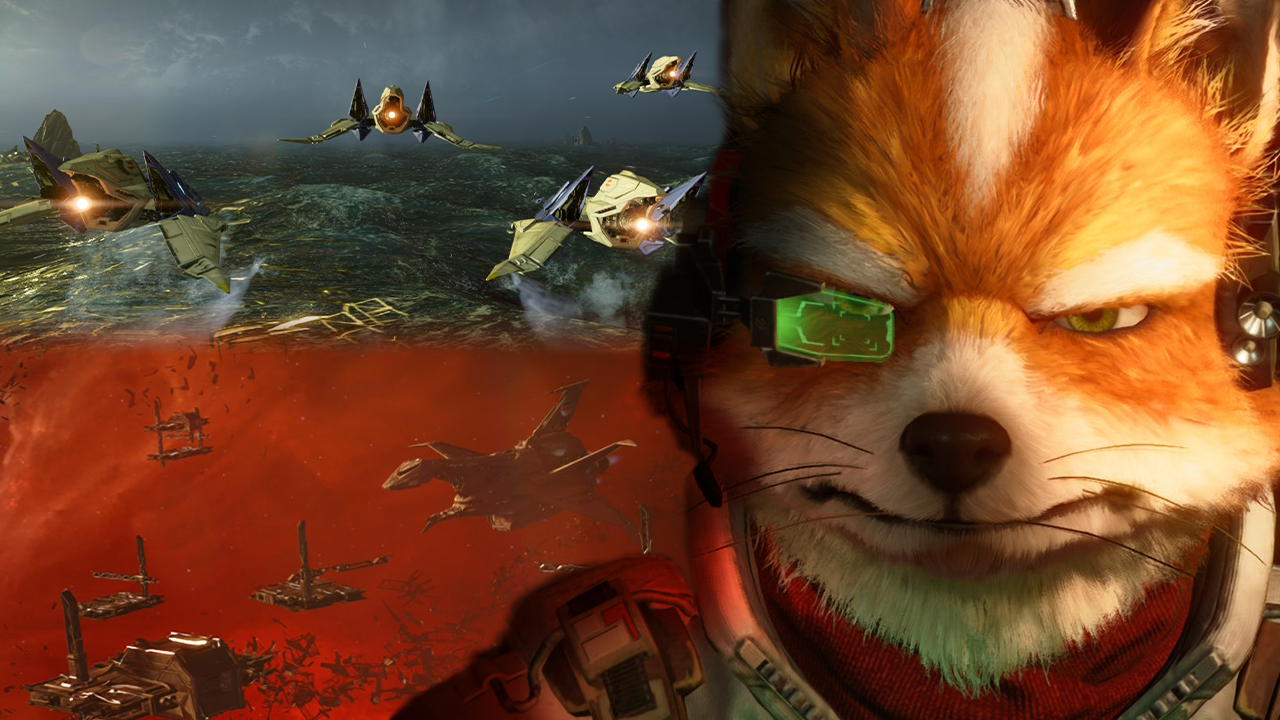
This copy of Star Fox was provided to Source Gaming by Nintendo.
Ace flyboy Fox McCloud flies his Arwing over the toxic seas of Zoness. The planet has been despoiled by the forces of mad scientist Andross, and the galactic government has promised Fox’s mercenary crew top dollar to clean the army out. The rest of Team Star Fox is right there with him: hotshot Falco Lombardi, old hat Peppy Hare, and the charmingly ineffectual Slippy Toad. Backed by Zoness’ own avenging pilot Katt Munroe, they tear through Andross’ fleets and crush his mech overseer. But Fox messed up. This was a stealth mission, and he got spotted before shooting out all the enemy searchlights. Had he avoided detection, he might have gotten the chance to approach Andross’s base through the spacefield Sector Z. For now, he’s routed to planet Macbeth and a train line that needs dismantling. This is the kind of mission Star Fox lives for. Developed by Velan Studios, the team behind Knockout City and Midnight Murder Club, the latest installment in Nintendo’s rail shooter franchise is a pulse pounding adventure. Fox flies on rails across planets and spacescapes, finds hidden routes to Andross’ lair on Venom, and battles bosses in a free roaming mode.

Image: Source Gaming. Zoness, in all its toxic glory.
Perhaps you’re already familiar with Zoness. Star Fox is, improbably, the third retelling of the Nintendo 64’s seminal Star Fox 64 in fifteen years, after Star Fox 64 3D in 2011 and Star Fox Zero in 2016. Add in the fact that Star Fox 64 was itself a remake—of the original Star Fox from the SNES—and this is Nintendo’s fifth take. It is arguably the most notable thing about this release. There are by my estimation ten Star Fox games, and half are about the time Fox stopped Andross and his gigantic head from conquering the Lylat System. Unlike a lot of games that get remade or remastered today, Star Fox 64 is also widely available via the Nintendo Switch Online subscription service, and it’s aged about as well as any 3D pioneer from the late Nineties. I played it for the first time less than two months ago and found it entirely playable, if clunky and hard.
SHE’S A REMAKE
While the sheer number of times Nintendo has gone back to this particular well is eye-watering, Star Fox fits neatly into the genre of modern video game remake. Like the ones of Shadow of the Colossus, The Last of Us, and Paper Mario: The Thousand-Year Door—and unlike Star Fox 64, which actually did make several radical changes—the game is concerned with protecting the original text. It has the same levels, the same architecture within those levels, and the same secrets and hidden paths. Almost every song has gotten a fantastic new arrangement. While I’m not a fan of this method of game making, especially given 64’s availability today, there’s a reason it’s popular in a climate that caters increasingly to remakes and remasters. Old fans get something that’s exactly like what they remember but (usually) prettier, and newcomers get something that’s (usually) more forgiving and less abrasive.

Image: Source Gaming. The boss of Area 6 fires its imposing and very cool death ray.
And Star Fox certainly gives both kinds of players that. It’s stunning in motion, with all sorts of skyboxes, explosions, and space debris. The war-torn capital city of Corneria presents a level of destruction that was barely hinted at on N64, while the blizzard on Fichina and the pulsing neon letters of the deep space sectors pop incredibly well. Star Fox has always been something of a show pony for Nintendo’s (and now Velan’s) visual artists and technical wizardry, and this latest entry lives up to the standard. That fidelity even extends to GameChat, as players with a camera can superimpose a shockingly receptive AR filter of most of the main characters over their face. I do not own a Switch 2 camera and cannot incorporate that into this review, though if you also lack one, I highly recommend looking up footage of the feature and its combination of sophistication and comedy potential.
More important is how fluid and easy to handle it is, especially compared to its predecessor. What colored my experience with this game most of all is the simple fact that I had a very hard time with Star Fox 64. I mentioned its reputation as one of the Nintendo 64 games that have aged the best, but I still found it challenging to play and to parse (this might have been partially due to the emulation, but it does have the mild jank that virtually all early 3D titles did). The qualities people love about it largely didn’t work on me. By contrast, Star Fox feels natural to me in the way that 64 feels natural to other Nintendo fans. It’s great on the thumbs, super intuitive, rather responsive, and viscerally fun to control. The biggest problem is the biggest problem of the original game: the dogfights against Fox’s dastardly rivals in Team Star Wolf that never live up to their potential.
There are places where the shine does go a bit far. Before the main campaign even begins, Fox is sent through a tutorial that’s somewhat cloying, very long, and aggressively disconnected from the main game. Star Fox 64 had this as well, but I found it more tiresome here, partially because Corneria is at least somewhat organic at teaching the basics. Characters are also much more liberal about hints for the secret exits that let Team Star Fox snake across the Lylat System. I did not find a single one in my time with Star Fox 64, but with only a little goading, my first Star Fox run took me to the super-hard secret final boss—even if Fox missed out on getting to Sector Z along the way. That openness with secrets isn’t a problem for me, but it does speak to the game wanting to talk in places where the original chose to stay silent.

Image: Source Gaming. The classic Corneria secret, preserved and more directly explained.
The value or lack of value of all of these changes is incredibly subjective (at least outside of an Easy Mode, which is a pretty definitive boon). I found the bombastic visual overhaul far more compelling than the rough polygons of the first game, probably because I came into both expecting a certain level of bombastic blockbuster spectacle. Someone who’s less invested in that will probably find those changes superfluous at best, since they’re incidental to the high scoring element or the actual mechanics. More risible are the new redesigns of the cast, which shoot for an extreme layer of naturalism. Once again, I like it; I don’t care about how similar it is or isn’t to previous depictions of these characters, but their strangely realistic animation is appealing in a way I can’t easily explain.
WHAT’S NEW, KATT MUNROE?
What’s important here for the longtime fans is the new stuff. The biggest addition is a sizable increase of cutscenes and dialogue. Star Fox has always been Nintendo’s most overtly cinematic franchise—Fox is probably the publisher’s most prominent non-silent protagonist—and the extra material gives us more time with the cast. I wouldn’t say it’s great, or inherently on par with the extremely limited writing of the 1997 game. There’s little in there that will challenge or add to character dynamics that have been clear for decades: Fox and Falco are rivals, Slippy is the kid sidekick, Peppy is parental, and Star Wolf is the kind of fun villain team-up that always liven up superhero crossovers. Star Fox already keeps the character dynamics that evolve across the route Fox takes. Nothing’s really lost; it’s just supported with stuff that doesn’t match what was already there. Probably the most representative change is the acting; it’s far more naturalistic, in line with modern tastes, and… definitely less fun. Character designs aside, I don’t think Star Fox could be called campy, which isn’t necessary for this kind of thing but might have added to the pulpy energy.

Image: Source Gaming. Team Star Fox’s new designs. I like that they make Falco all the pricklier.
That shift is interesting, because while the performances are more standardized and the main campaign’s content near-identical, it’s attempting to recreate Star Fox 64 at a moment in time that doesn’t really have room for that kind of game. The most obvious part of this is that rail shooters are no longer a prominent and lucrative genre; neither are score-chasing, Double-A mascot action games that expect its players to go through the campaign multiple times. Like most rail shooters, Star Fox exists for replays. It’s short—an average playthrough lasts only a few hours, give or take a few dozen deaths on Venom II—but it’s filled with alternate paths that alter the plot in small but appreciated ways. Wherever Fox goes, he takes the story with him. When his pals are shot down and have to cool their heels for the next mission, the dialogue mostly reflects that. The game has the scoring system, but it’s these routes that actually make this work.
This idea of getting your money’s worth is central to Challenge Mode, a replay tool that also acts as a sort of in-game achievement system. Each level in the game gets unlocked after they’re completed in the story mode, with their Challenge version offering slightly unique enemy types and patterns. Each has a few optional missions, like hitting a certain number of targets, shooting down a particular enemy, or going through the secret exits in a way that functions as another hint system. Get them all and the level gets a selection that’s even harder. They’re perfectly fine but feel less exciting, more like an olive branch to fans who just wanna fly around Solar or Meteos again. It’s certainly far better to have it than not, but I do wish more had been done with it, because it’s fairly paltry. The same is true of the asymmetrical co-op that requires mouse controls.

Image: Source Gaming. The biggest surprise with the multiplayer is that it made the campaign’s Star Wolf battles easier and more fun for me.
The final way to play is in the multiplayer, and that’s the one area that has been totally overhauled. Instead of quiet dogfights and third person shooter sequences, Battle Mode is a four-on-four arena for Star Fox and Star Wolf to duke it out. Fox (or whoever; I almost always chose dirtbag sniper Leon Powalski) flies around a space with his buddies, earning points with kills and gimmick challenges. Corneria has towers to defend, Fichina drops meteors full of collectible ore, and Sector Y throws in pirates with cargo to tow. It’s fairly simple: only three levels, not many options, and no splitscreen, the lack of which is one of Star Fox’s biggest flaws. But it’s really fun, even against bots, and I found myself going back for mission after mission. What Battle Mode really reminds me of is Star Fox 64’s era, one where multiplayer modes weren’t so onerous that they’d throw development off course, so expected that they’d siphon important resources, and so expensive that they’d eventually be abandoned. It is, in some ways, the most Star Fox feels like a relic, and I say that as a compliment.
IT’S NOT UNUSUAL, TO BE REMADE BY ANYONE
If we go about this in the most clinical, “hardware appliance review” way imaginable, Star Fox is a limited product. It is an incredibly faithful remake, and while I can’t speak to how it stacks up to Star Fox 3D and Star Fox Zero in that regard, it’s not particularly interested in being much other than that. It doesn’t tease a sequel, it doesn’t tell its own story, and its staying power will be dependent on Nintendo’s willingness to support Star Fox in the long term—something the company hasn’t shown for over twenty years. At least from a distance, this feels like a game that exists not to challenge assumptions or explore new tech or make a statement, but to rescue an IP (and, perhaps, to capitalize on Fox’s charmingly bizarre role in The Super Mario Galaxy Movie). Questioning its purpose is valid. So is noting Nintendo’s weird fixation on this one story, a fixation that at least borders on comedy.

Image: Source Gaming. Solar was one of the levels I missed in Star Fox 64. I quite enjoyed it here.
However, as someone who struggled through Star Fox 64, I found soaring through Star Fox almost revelatory. With few exceptions, everything felt better, like looking through just-cleaned glasses. If it’s a paint job (and I don’t think that’s all it is), it’s an exceptional one. The game was a delight to play, and to replay, and to replay again as I went through secret exits and crazy planets. I’ve judged it by its highs and lows, its new ideas and lack thereof, but in the end, I gotta trust my instincts. Star Fox is great. Let’s hope it gives Fox a new lease on life, a new story… and maybe that we’ve seen the last of this one.
Final score: 8/10
Thanks to Hamada for suggestions.

- Back on the Bat Chapter 3: The Black Mask Casebook - September 28, 2026
- Nintendo Direct September 9, 2026: Information and Reactions - September 9, 2026
- The Legend of Zelda 40th Anniversary Direct September 8, 2026: Information and Reactions - September 8, 2026