
Ever since Awakening in 2012, and especially the spectacular Three Houses in 2019, Fire Emblem has slowly become one of Nintendo’s premiere series. It’s also a series that has historically struggled with maintaining its momentum, most recently with the somewhat less commercially successful and far less creatively successful Fire Emblem Engage. But now we’re getting Fire Emblem: Fortune’s Weave. The series’ Switch 2 exclusive is connected to Three Houses and showed a lot of potential in its trailers.
Ahead of the game’s September release date, that potential was shown through its own dedicated Nintendo Direct, which has become the standard for major Nintendo releases. It turns out that Fortune’s Weave is shaping up to be a massive and wildly ambitious game. So read on to find out everything in this show.
The setting is the Dagdan Empire, a kingdom referenced in the lore of Fire Emblem: Three Houses, and particularly its capital city Dagsion. The year is 1449; assuming the dates are the same, that’s almost three hundred years after Three Houses, which was set from 1180 to 1185:
- The Empire is organized around the Heroic Games, a massive gladiatorial event. The ruler and “divine sovereign” Solel will allegedly grant one wish to the winner.
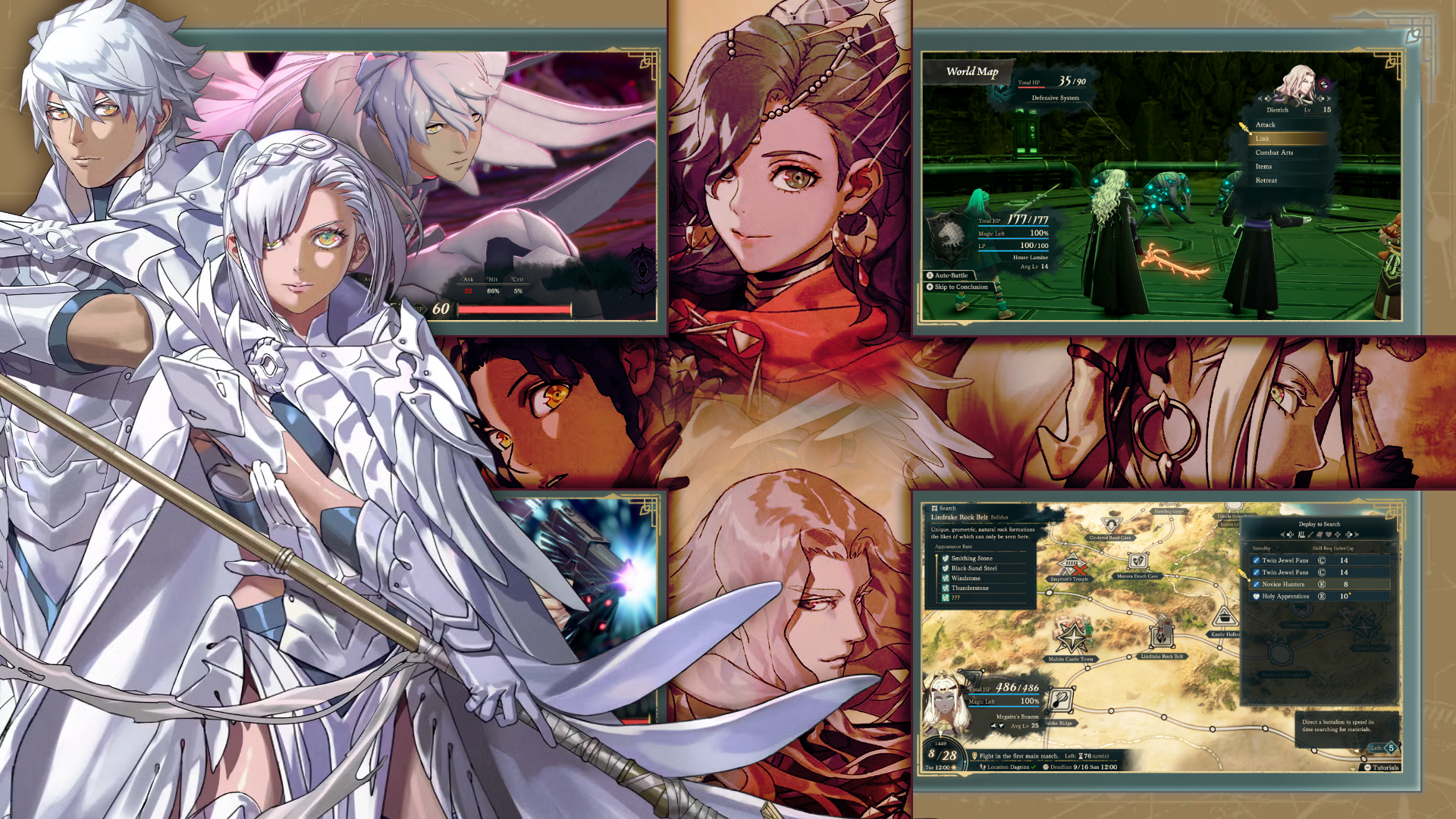
- The story has four heroes. Who you pick alters the story, and each comes with their own supporting cast.
- Cai is a fifteen-year-old whose father has been imprisoned for crimes; he wants to win the games to save his father. His main party are his childhood friends.
- Deitrich is a foreign warrior who has been stranded in Dagda after a sea monster capsized his ship. Obsessed with battle, he learns of the Games and enters to slake his bloodlust.
- Theodora is a ruler from the southern desert kingdom of Saramis whose people worship a hated goddess. She and her retainers have entered the Games to both protect her people and redeem the Keeper of Death and Night in the eyes of the empire.
- Leda is a musician “born into prestige” whose father was slain by the killer Bertrand. After learning that he aims to participate in the Heroic Games, she and her allies join simply to kill him along the way.

Image: Nintendo. Aesthetically this does look like a reasonable step up from Engage and especially Three Houses, but that’s always been secondary to what makes Fire Emblem special.
Basic Gameplay:
- Each match features that classic Fire Emblem tactical strategy. You pick your crew, move them across the map, and fight until you’ve completed multiple conditions (the main one being to defeat the leader of the rival crew).
- Also classic to Fire Emblem are the various Weapon types: Swords, Gauntlets, Spears, Axes, Bows, Magic, classic arms like the Levin Sword, Gauntlets that look like “modern” guns, and more. These generally follow a balancing structure where weapons are good at certain types of units, though it’s not clear if the classic “swords / lances / axes” dichotomy has returned.
- Certain kinds of terrain on each tile also have their own features, like forest that increases dodge rate and structures that can only be flown over by a pegasus. Adjacent allies also provide stat buffs.
- Weapons have durability, a standard of the series, and Combat Arts degrade them faster for a powerful attack.
- Blaze Arts are new moves that “consume your soul” in exchange for a super powerful attack. Cai has an energy ball, Deitrich teleports, Theodora hurls giant rocks, and Leda summons monsters and buffs allies. Their downside is that they lose health in response.
- You can turn back time to previous turns with Fortuna’s Blessing, a quality of life feature that was introduced in Fire Emblem: Shadows of Valentia.
- Classes return; these define stats, usable weapons, range of movement, and weaknesses to particular weapons. These include Shido (“Master of Swords”), Bardingers (“Mounted Knight”), and Bishop (“Holy Mage”). There are three types:
- Beginners are the five basic classes, given to new and inexperienced party members. Gladiators are about hand to hand weapons, Diviners use magic, and Ornius Riders ride ostriches.
- The ten Specialty classes have more specific abilities as units grow as characters. Armored Knights have heavy armor, Wing Soldiers ride a pegasus, and Charioteers can strike multiple units in a straight line.
- Advanced classes are the most powerful, wielding better stats and unique skills. They might combine the skills of multiple advanced classes or combine new rides. Cataphracts are heavily armored horse riders, Guardians have spears and white magic, Elephant Riders are “overwhelmingly powerful,” and Dragoons ride flying wyverns.
Between matches, you have downtime to prepare for the next match. These are timed in the vein of Three Houses’ Garregh Mach sections, as you only have a certain number of available “turns” before the next one starts.
- The Arena lets you train for experience points, once per week. This gives you new moves and access to stronger weapons, which makes it potentially more compelling than its counterparts from older Fire Emblem games.
- Match Days lets you Spectate matches to research your opponents’ skills.
- The Shopping Arcade has several venues for you to buy or enhance weapons.
- You can also volunteer to work at one of the temples of Temple Row, a district of seven places of worship for different religions. Each one provides a different blessing for your units during the next battle.
- Certification Exams let you move a character from one class to another. Like in Three Houses, there’s a chance of it not working, and the likelihood is depending on the unit and the class they’re attempting to move to. You can also Reclass units.
- Townsfolk can also offer timed quests. Some of them are from random NPCs; others may be from major supporting characters.
- Recruiting NPCs is also important. Some of their requirements are more intensive than others, but most seem to involve improving Support Points between your character and them through various activities and facilities.
- Inns let you pass the time, offering some of your available turns to get experience and random materials. It also holds the Support Conversations that drive the character dynamics and relationships.
- Perhaps the most important facility is the Pale Raven’s Perch. You can use this to swap heroes, because you can play all four stories in parallel!

Image: Nintendo. The main cast of Fortune’s Weave.
The Broader World
- The continent is also explorable, but every move on the World Map costs time. Exploring lets you meet new merchants, gather information, improve abilities, and fight random Skirmishes on the field.
- The world map also features Dungeons full of weapons and treasure. They’re full of enemies, and the Turn-Based Clashes with them act like traditional RPGs.
- Characters have Hero-Specific Talents; Theodora can recruit new soldiers to gather materials and fight, Deitrich can sniff out hidden enemy groups, Cai can capture animals, and Leda can perform to get materials.
- Like Three Houses, Fortune’s Weave also features a five-year timeskip, though this is where the story starts. In 1454, Dagda is under the apocalyptic threat of the demon god Balor, and the four heroes who defined the games have disappeared. Sothis, the progenitor goddess who died centuries before the events of Fire Emblem: Three Houses, intervenes by calling the story’s “true protagonist.” This character has two choices: fight the demon dragon on their own (a deliberately near-impossible challenge) or use the time traveling powers of the goddess Fortuna to change the fates of the four heroes in 1449. They’re the aforementioned Pale Raven.
- This character’s name is “Eshmel,” but this isn’t referenced in the Direct itself.
Release Details:
- As had been announced previously, this comes out September 17 as Nintendo’s second $80 game (albeit physically; it’s $70 digitally as part of the publisher’s initiative to account for the cost of cartridge production). The Fire Emblem: Fortune’s Weave Dagdan Collection releases the same day. Pre-orders are available now
- Following this presentation, Nintendo Music added select tracks, which Nintendo has done for many of its major new releases.
- Nintendo Today! will also add a new theme based on the game tomorrow. It will also continue a practice the app started several weeks ago of regularly releasing information about many of the characters, including their English voice actors. The most exciting of these for me is Dave Fennoy, who played Lee Everett in Telltale’s The Walking Dead and will be playing Theodora’s retainer Bonaventure.
- On September 15, an “Ask the Developer” series featuring the game will be published.
The Direct:
Wolfman’s Soapbox: Well, now I feel a lot more confident about pre-ordering this physically months ago because Amazon was selling it at the digital price and not the full eighty dollar price.
As someone who mostly came into the series through Three Houses, and as someone who subsequently enjoyed Fire Emblem: Awakening and very much did not enjoy Fire Emblem Engage, I’m now reasonably excited for Fortune’s Weave. The connections to Three Houses aren’t necessarily mind blowing (though they are interesting, especially the implications that this is a sequel and not a prequel), but a lot of the rest of it is. It’s all the darker and more intriguing story, the massive scope, the aesthetic changes, and especially the story structure. If this was simply a return on the multiple playthroughs trope, where you pick one of four characters and replay the game three times to see the story, that would be one thing. That’s an evolution on what Three Houses did, and it’s a good way to do a grand RPG with narrative ambitions. Letting you switch between them on the fly like in NieR: Automata, positioning this as the preamble to a massive story, doing the Breath of the Wild thing where you can apparently fight the final boss whenever… these are really cool! There’s potential for something that breaks the JRPG mold even in an era of pretty ambitious JRPGs.
There are also potential pitfalls, of course. It’s not entirely clear if, say, all four characters share the same pool of turns between big battles. We don’t know what happens if you only stick with one character, if they end up recruiting the vast majority of party members, or if any are exclusively to one of the leads. The importance of the Games’ inevitable endgame isn’t clear as well if all four end up being the most memorable heroes (though I guess that matters less with the timeskip). The “true protagonist” remains a nonentity, which is crazy when they’re explicitly called the “true protagonist.” And Fire Emblem, like all series with big ambitions, has historically had trouble with reusing content, something that seems at least a bit inevitable when dealing with a world of this scale. That being said, I don’t think they all needed to be answered here, and I do look forward to finding out these answers for myself.

- Back on the Bat Chapter 3: The Black Mask Casebook - September 28, 2026
- Nintendo Direct September 9, 2026: Information and Reactions - September 9, 2026
- The Legend of Zelda 40th Anniversary Direct September 8, 2026: Information and Reactions - September 8, 2026