
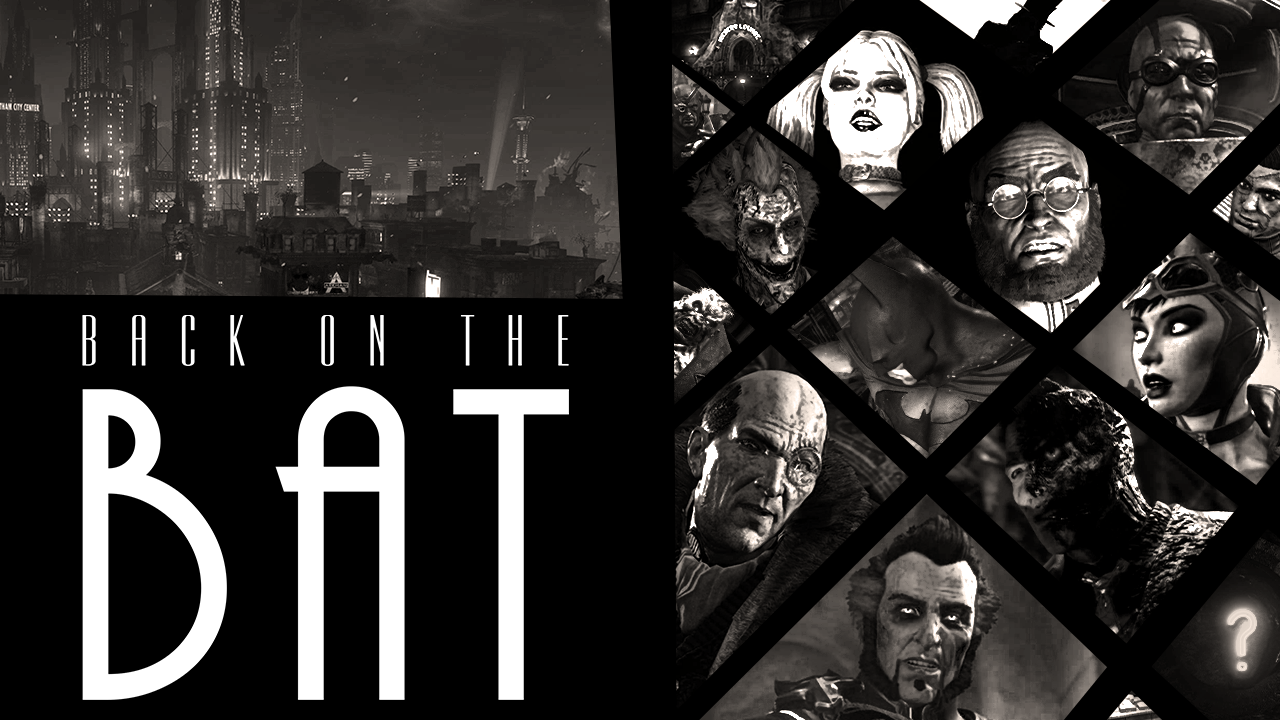
Welcome back to “Back on the Bat,” my patrol through the dirty, dark alleyways of Rocksteady’s Batman: Arkham video game series. Today it’s time to talk about 2011’s Batman: Arkham City, one of the main events in a year of gaming that was not without its charms but was also drowning in blockbuster bloat. Fortuitously, Arkham City itself is also both charming and bloated, so it gives us a good peek into gaming culture at the time.
In our last issue, Rocksteady was on top of the world. From the moment it came out in 2009, Batman: Arkham Asylum was hailed fairly unanimously as not only the best superhero game ever made, but the ideal of what a superhero game should be. It “made you feel like Batman” by making a game where almost everything existed to make you an unstoppable, unflappable crusader. You could argue that much of video game history is about trying to provide fantasies with increasing fidelity, content, and precision, but few had done it this well—and almost none had done it with a character as big as Batman. Nowadays, we can get our superhero games as narrative adventures or RPGs, but as the Marvel Cinematic Universe was starting up, no genre felt more right than a big, blockbuster action game. When Rocksteady released Batman: Arkham City in an incredibly fast turnaround time of two years, it was operating from an incredible position of power.

Image: Source Gaming. Arkham City in Arkham City.
It didn’t hurt that Arkham Asylum rode an unparalleled wave of Batmania. Most important by far was The Dark Knight, the record-breaking movie event of 2008 (and which informs Arkham City aggressively, most strongly in its Hans Zimmer-aping soundtrack). Lighter takes on the DC Comics hero were also represented by the delightful Batman: The Brave and the Bold, which had begun setting Diedrich Bader up as the next go-to voice for Batman. And anyone actually reading comics could enjoy Grant Morrison’s bombastic Batman saga, which was tearing up the sales charts for its crazed plotting. Notably, all of these stuck Batman in an unusual place; Brave and the Bold brought back Silver Age aesthetics, Morrison’s run was built on stuff that had been banned from the canon for decades, and Christopher Nolan turned the Caped Crusader into a soldier in the War on Terror. Arkham Asylum followed these not through story, but by trying to fulfill that fantasy in ways that actively ran against accepted design standards. Most critics, players, and programmers would be skeptical of a game that biased itself in their favor so obviously, but the two pillars of easy combat and stripped-down stealth worked. This kicked off a sea change in how blockbuster games were produced, though the results of that wouldn’t be apparent by Arkham City‘s release.
If Arkham Asylum was a less witty Batman: The Animated Series, Arkham City is in line with Jeph Loeb’s Batman: The Long Halloween and Hush, with a soupçon of No Man’s Land in the mix. After presiding over the Joker’s riot in Arkham Asylum, loathsome and doddering Warden Quincy Sharp has somehow failed upward enough to become Mayor and institute the “Arkham City” program. Several blocks of city streets in the middle of Gotham City have been walled off into an open air prison à la Escape from New York. With scarce resources allowed in and a bitter winter cold, the ghetto has become the site of a three-way gang war between Two-Face, the Penguin, and a deathly ill Joker. Almost all the supervillains from the last game and plenty of new ones have been sent there alongside every Blackgate Prison inmate, a few news reporters, various other “political prisoners,” and even billionaire playboy Bruce Wayne. Because an original character like Sharp couldn’t actually be the villain; he’s only the puppet of Hugo Strange, a Golden Age bad guy whose gimmick is that he knows Batman’s secret identity. Trapped behind enemy lines, it’s up to Batman to suss out Strange’s ominous “Protocol Ten,” find a cure for the disease killing him and Joker both, and put out every other fire.

Image: Source Gaming. It’s a big risk putting the onus of this game on (at best) a C-lister, but Hugo Strange has always had a lot of potential. I don’t know if the game fully realizes it.
The setting shows the main change brought to the table: an open world. Arkham City is nowhere close to the largest sandboxes, but it is markedly bigger than Arkham Asylum’s cramped Metroid map. The number of Riddler’s challenges have also exploded to match, over four hundred in total. While there are several very cool interior spaces—the most notable being a chemical plant, a natural history museum, and a “city of the future” buried underneath Gotham—most of Batman’s time is out in the open. The appeal is clear; it adds the rooftop duels and last minute rescues that weren’t possible in Arkham Asylum. Batman saves civilians and the occasional Blackgate thug from assaults, dashes across the tops of buildings, and gets to pose while surveilling his city, not just one spooky complex. It was the selling point of the game, and why wouldn’t it be? This was 2011. Going open world was all the rage, seemingly the only accepted endpoint of game design.
You can see it in the villain headcount alone, which has ballooned from eight to a whopping twenty or so. Everyone from that game bar the Scarecrow and Killer Croc is back to some degree, which means that outside those two, the story gets to have pretty much every classic Batman villain and change. They’ve not given equal weight, though. Many of them are part of sidequests that expand that sensation of “feeling like Batman:” teaming up with Bane, tracking down Deadshot, solving multiple serial murders, and getting gassed by the Mad Hatter. Others are little more than cameos; Two-Face heads up one side of this massive gang war, but he gets dispatched within minutes so he can be the last man standing in the postgame. Robin appears for exactly enough time to feel like marketing for a spin-off that doesn’t exist. I was stoked about seeing Azrael when I first played the game in 2011, because it was the Azrael who debuted in the Morrison run as “BatGhost” (or “Bat-Devil,” as I guess he’s now called by DC fans) but he’s only around for a goofy environmental puzzle. This is inevitable when going big, and that consequence is true across the board.

Image: Source Gaming. While this Penguin is very edgy, Nolan North’s performance really elevates him from insufferable into very entertaining.
The main problem with Arkham City, which is still good fun, is that the shift to that outdoor lifestyle actively weakens both of the gameplay pillars that made Arkham Asylum work. Predator Mode is still strong when it’s indoors (it actually has a lot of fun new features that limit dominant strategies from the last game, like how Inverted Takedowns are harder to pull off), but the outside levels aren’t made for it like they are in something like Metal Gear Solid 3 or Hitman. Those are also more optional, with Batman usually able to grapple away. Since he also starts the adventure with almost all his gear from the last game, that Metroid-like feeling of amassing powers only comes from new, less fun, and largely situational upgrades. And while the interior levels get to feature crazy rooms full of unique, colorful architecture, the overworld is largely similar. The chemical plant where Joker’s holed up in is cool, but there are few substantial differences between the grimy, sad streets of Park Row and the grimy, sad, slightly older streets of the Bowery. Mostly glass ceilings over the streets.
With the stealth mostly relegated to the interiors, the game puts the bulk of its chips on the Freeflow Combat. And it’s still fun in a base way, but Rocksteady still hasn’t solved the core issue, which is that its combat system simply isn’t designed for depth. It is designed to make you feel effortlessly cool. That’s totally fine when it’s just a palette cleanser, but now it has more attention than ever. A lot of Batman’s time is spent in fights with huge numbers of goons, and it can be exhausting going through one after another. There are a couple new enemy types, but each one is just a generic thug who happens to be immune to all but one move. One guy may wear body armor that can only be hit with an instant knockout combo. Another may carry a knife and force you to backstep with an incredibly awkward button prompt. These don’t give the combat any depth; they just act as weird quicktime events. This lightly undercuts the power fantasy these games are built around but don’t add anything in its place. It’s a kind of illusory complexity. The most substantial addition is that certain thugs can be interrogated for the locations of Riddler Trophies if you save them for last, which can force you to be a bit more precise, but overall the experience constantly feels slightly overstuffed.

Image: Source Gaming. I’d say that the combat was still the same, but the weird high level enemies and extra focus is a problem.
There are definitely good changes that come out of the pivot. Batman’s a lot more mobile; he can chain glides and grappling, Just Cause style, to get around Arkham City with grace. Some of the Detective Mode puzzles are a bit more involved than just following trails. A few optional stories are neat, or at least add a small palette cleanser. And it does feel cool to climb around the city. However, it’s fairly unfocused in the way that’s endemic to narrative-driven sandboxes. The sidequests feel, as sidequests in most open world games do, like padding you complete in bunches before getting to the “real” story. Why is Batman gating upgrades for himself behind Assassin’s Creed-esque platforming missions? Why is Riddler both a pointless diversion and a dangerous threat who’s got a half dozen people kidnapped? And why does his sidequest demand beating so many challenges, some of which are quite imaginative but are still drowning in identical “Batarang this thing” missions?
One of the benefits of Arkham Asylum’s tighter design was that you were constantly moving through a story. The story wasn’t particularly well-written, but there was a general arc, and that impacted stuff like the difficulty curve and the overall sense of progression. That’s really only true in Arkham City in smaller amounts, particularly the plot critical stealth sequences that do up the challenge a bit each time. The mobs of bad guys get larger, and more of those high level enemies join in the fun, but that largely just makes fights longer, not more interesting. And that dangerous level of scaling extends to the plot.
I mentioned that the story is reminiscent of the work of Jeph Loeb, the towering comics scribe whose comics have influenced Batman storytelling for decades. Loeb is not a good writer; he was propped up by good artists (most notably the late Tim Sale, with whom he worked on The Long Halloween and Superman for all Seasons) and the inherent fun of superhero mysteries with big casts. The Long Halloween, his best and most influential work, was about a serial killer operating during the ascendency of Gotham’s supervillain class, Hush was about a murderer with ties to Bruce Wayne, and his run on Incredible Hulk was about the enigmatic and tiresome Red Hulk. However, his mysteries were never well written, well plotted, or built around anything but their twists. They often relied on cheap misdirection and newcomers with an almost Poochie-esque quality. In the worst cases, like the secret identity of Red Hulk, his conundrums were both patently obvious and actively impossible to solve. I have no idea if he’s been reusing his tricks for his ongoing Hush sequel, but it would not surprise me. We should expect no more from the man who gave us Ultimatum.

Image: Source Gaming. Both Rā’s and Talia feel slightly incidental to the story, which is strange when they’re crucial to the plot.
I don’t think Loeb was involved in Arkham City—at the time he was running Marvel’s Netflix shows, a period in which he spurted racist invective on the set of Iron Fist—but the style that inspired three Batman movies and dozens of stories is all over this plot. The focus on Two-Face and Penguin evokes The Long Halloween. There are cameos for Hush and Loeb’s terrible, Hannibal Lecter-inspired Calendar Man. But mostly, it’s that mystery. Like in those stories, Batman kinda ping-pongs from one villain to the next before the plot largely reveals itself. He meets Two-Face and Catwoman, then the Joker and Harley Quinn, then the Penguin and Mister Freeze, then ex-Green Lantern villain Solomon Grundy, then Rā’s and Talia al Ghūl, before an absurd conga line of final reveals. Turns out Hugo Strange outfitted the Joker with weapons to cause a riot, thus giving him political cover to slaughter every convicted criminal in Gotham! Turns out he’s been working for Rā’s, who stabs him before dying from a self-destruct sequence! Turns out Joker, who stole Mr. Freeze’s miracle cure before killing Talia, was Clayface all along! Turns out the real Joker didn’t use the cure and dies! Other than the bold choice to off DC’s most overused character, these twists are haphazard, clumsily threaded, and largely out of nowhere. I love Clayface, but pinning the final twist on a C-lister who may as well have not existed until that final boss fight is nuts.
The part I remembered the most from 2011 was Strange’s demented speech at the climax. As Batman prowls through one of the bigger Predator Mode rooms, the professor crows through the intercom about how he’s gonna ship Arkham Cities across the DC Universe off this public policy failure, all part of a plan to wipe the unworthy off the face of the Earth. I’ve spent years envisioning Strange as Lyle Lanley in “Marge Vs. the Monorail,” schlepping to Metropolis and saying they should buy a downtown prison for their supervillains. “I’ve brought Arkham Cities to Blüdhaven, Jump City, and Nanda Parbat, and by gum, it put them on the map!” In 2026, I can’t say I’d be optimistic of Americans’ ability to understand that this would be bad, but it’s so utterly contrived and cockamamie. Like, even for comics. It doesn’t help that the game is weird about which prisoners get empathy. In large sections, the main takeaway seems to be that open air prisons are bad not because they exist to starve a population to death, but because an innocent person might be sent there.

Image: Source Gaming. While a lot of Arkham City is less imaginative and interesting from a mechanical standpoint, the Mister Freeze fight is genuinely brilliant.
Thankfully, the same villains that make the plot screwy are also part of the game’s biggest improvement. Arkham Asylum’s bosses were almost comically bad, and City does work to make them more interesting. They often feel very Zelda-like in how they require specific moves or tactics, and while the last game’s terrible Poison Ivy fight tried that to poor effect, it’s a lot more pleasing here. Grundy has electrical diodes that need to be destroyed before you can beat on him. Penguin is little more than a stealth sequence, but that alone is novel as you evade his pilfered ice gun. The highlight of the entire game, the battle against would-be ally Mister Freeze, is a far grander bit of sneaking that takes away your best moves. You can tell Rocksteady was invested in rectifying this issue. These parts are extremely “gamey” in the way a lot of blockbuster games were trying to stamp out (a practice that often involved excising bosses altogether, a move that wouldn’t work for a superhero game), but they make the fights appealing beyond the fact that they feature characters I’ve enjoyed in cartoons. It’s super cool seeing Mister Freeze take away the high level strategies you’ve relied on for hours.
However, for every good one, there’s a rock stupid counterpart. The hallucinatory Rā’s al Ghūl duel is definitely the nadir, but there are several that are just generic bouts. Joker is exactly like every normal enemy, only notable in that Detective Mode reveals the Clayface twist by his conspicuous lack of a skeleton. Clayface himself is kinda dopey as a final boss on top of the near-randomness of his appearance; Batman has to chuck freeze bombs at him in a way that never feels right. A returning Zsasz gets a platforming challenge that’s weirdly finicky. While most of the stealth boss fights are good, a postgame one with Two-Face is pretty aggravating in how it endlessly spawns in new goons. And it’s all limited by the fact that other than Penguin—who’s played by Nolan North in a shockingly effective casting against type—and Catwoman, the newcomers don’t have a lot of charm. They’re all growly and dour and po-faced in the way that would plague sullen DC stories like Injustice and Batman vs. Superman.

Image: Source Gaming. In practice, fighting as Catwoman is not significantly different to fighting as Batman. It does feel a bit unique, though.
While Arkham Asylum was very much a complete package, with little notable bonus content, Arkham City commits to its size with DLC and pre-order goodies that are appreciably packaged into the Return to Arkham remaster. Batman has about nine bonus costumes, from cool picks like Batman Beyond and the then-new Batman Inc. to the dopey Sinestro Corps. outfit from Geoff Johns’ dreadful Green Lantern cycle. None of them are from anything older than the late 1980s, which is telling. There was also a bonus mode where you play as Harley Quinn that I didn’t touch, largely because Tara Strong’s “sexy baby” Harley voice is and has always been grating. The real meat are the Catwoman episodes, which the remaster drops in and out across the adventure before letting you switch characters in the postgame. Catwoman also explores Arkham City, but she has fun new weapons and wall crawling mechanics, specific Riddler trophies, a fun attitude, and about 80% more rape threats from henchmen.
That last one’s indicative of a mild but very real tonal change in the game. Asylum was super gritty, but it was also filled with a lot of charm, camp, and… I guess “timelessness,” like it could be slotted into most Batman incarnations. City is more nasty. It’s grimy and sleazy, with clunkier and edgier dialogue across the board (I did not need a transphobic joke less than half an hour in, Rocksteady). Like, Penguin’s “monocle” is the bottom of a beer bottle jammed into his face. It has silliness, to be sure—there’s still a century-old underground steampunk utopia, and Batman, as he is oft wont to do, fights a shark—but it’s mostly a darker story without much to show for it. Even with a great opportunity to examine Batman’s ethics and feelings, it largely sits back. The end game does give him a moral quandary, that he wants to rescue Talia from the Joker but has to stop this terrifying mass murder, but it’s a moral quandary Oracle and Alfred instantly solve for him. And after all that, the postgame features one of the most mawkish scenes I’ve ever found in a video game: a button prompt where you press X so Batman can silently mourn his dead parents in Crime Alley.

Image: Source Gaming. I still remember seeing this for the first time. I could not believe something this maudlin was in the game.
I did enjoy Batman: Arkham City, but even when I first played it, the flaws were obvious. This was a game way too enamored with the potential of open world design, like virtually every game studio and critic at the time. Even its fairly small sandbox is bloated, and it didn’t account for the ways that sandbox would affect its gameplay. But it also came out early enough that we weren’t drowning in bland, overstuffed open world games. The novelty was still there (it’s also fast-paced; the main plot is not that much longer than Asylum’s campaign), and much of what made the writing distasteful was simply normal at the time. Most critics, and seemingly most fans, took these changes in stride. Many of the latter were more than happy to jump on anyone who expressed even a mild frustration with a game where playing as Catwoman gets you inundated with threats of sexual violence. I made those complaints myself years later in the comments of some article circa 2015, and lemme tell you, there were still Batman: Arkham fans who’d go to bat for that dialogue.
Given the game’s reception, it’s hard to imagine Rocksteady feeling a need to fix the issues I found. If they did, I wouldn’t know; while I played City at launch, it disappointed me, enough that it was the genesis of my slow, personal backlash to open world games. I returned the game to Gamestop for a few dollars of store credit, kept Asylum, but wouldn’t touch it or another Batman game until this year. Of course, I’ve certainly heard things about Batman: Arkham Knight and Suicide Squad: Kill the Justice League, mostly bad things. But the latter is outside the scope of this series, thank god, and as for the former, we’ll get to it when we get to it. Like Batman and those damn Riddler trophies.
Thanks to Cart Boy for edits.

- Back on the Bat Chapter 3: The Black Mask Casebook - September 28, 2026
- Nintendo Direct September 9, 2026: Information and Reactions - September 9, 2026
- The Legend of Zelda 40th Anniversary Direct September 8, 2026: Information and Reactions - September 8, 2026