
Over the course of my life, I’ve seen a lot of superheroes. I’m an owner of at least one Jack Kirby omnibus, I’ve rolled my eyes at dozens of fights between Wolverine and Cyclops, I got Superman in 4K for a birthday present. And although I consider myself a lapsed fan and only liked a fraction of the genre at best (I don’t care for the MCU, bounced hard off The Boys, and gave up on comics altogether around 2012), I’m fascinated by how it moves. And that’s because of three things. First, superheroes are both incredibly mercenary and a potential avenue for more prescient, experimental storytelling. Second, their adaptations are really useful for examining what people want—or at least what marketing executives want people to want. And most importantly, superheroes are, at their core, imagery. Both intentionally and not, they’re a goldmine of aesthetics and symbols. And aesthetics and symbols mean a lot to me.
Similarly, I find superhero video games interesting, even if I almost never play them. Ever since Superman graced the Atari in 1979, superheroes have headlined a wild menagerie of games. It’s a genre of imagery that somehow includes Dispatch, My Hero One’s Justice, Scribblenauts Unmasked, The Wonderful 101, and Marvel Tōkon: Fighting Souls. A few are great, some interesting academically; most merely occupy space. But one stands as especially striking. It took one of the biggest pop culture heroes in the world and did everything it could to put players in his shoes. It included the aesthetic of his comic books, movies, and shows, but the aesthetic it cared about the most was the feeling that came from play. And it was flawed, and the ways it attempted to correct those flaws became a story in its own right.

Image: Source Gaming. The Dark Knight surveys the Botanical Garden of Arkham.
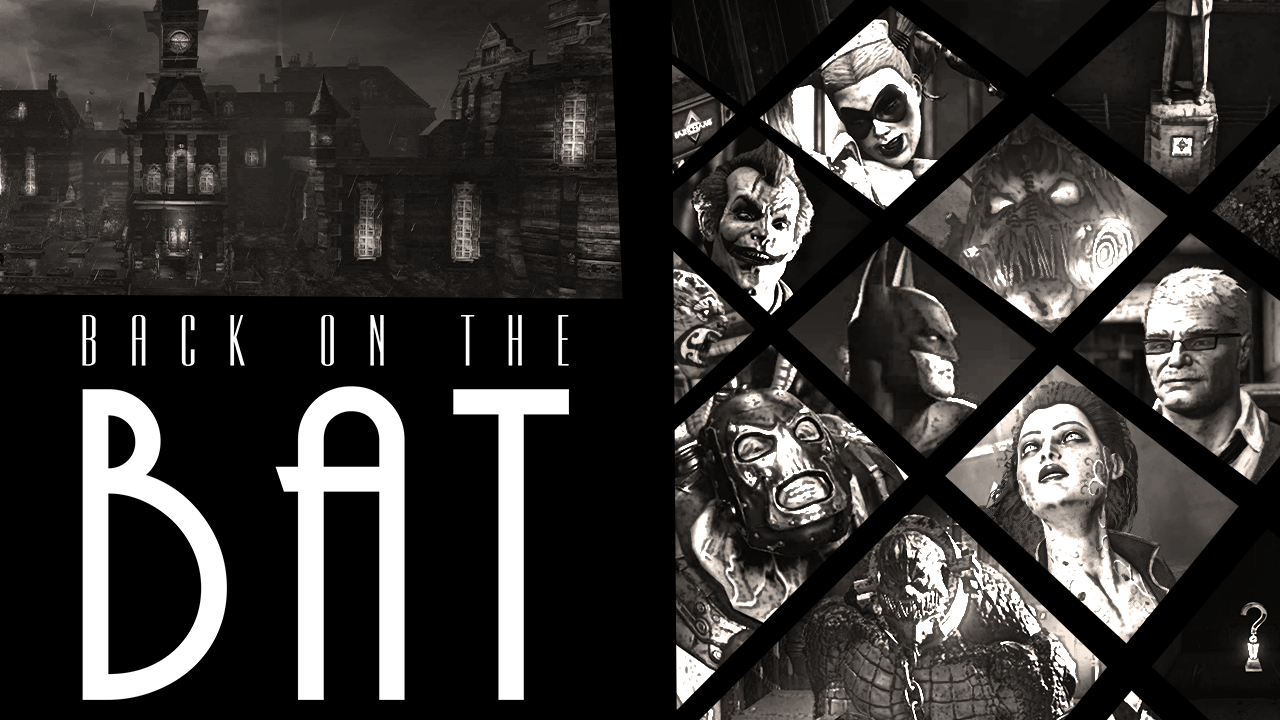
Welcome to “Back on the Bat,” a short series where I talk about the Batman: Arkham games. From Arkham Asylum to Arkham Knight, we’ll examine the work of Warner Bros. developer Rocksteady, who spent a decade’s worth of work on the Caped Crusader. I’ll dive into the games’ mechanics, their levels, their stories and tone, the way they adapt DC Comics lore, and how they lived and died off their own collective success. And there’s nowhere better to start than in 2009 with Batman: Arkham Asylum.
Taking its name and nothing else from Grant Morrison and Dave McKean’s seminal Batman: Arkham Asylum: A Serious House on Serious Earth from 1989 (though its style seems pretty clearly informed by Morrison’s eight year Batman epic, which ran contemporaneous to the Arkham series), the game is all about trapping Batman in a madhouse. After some unseen adventure, the Dark Knight deposits the Joker in notorious Arkham Asylum, only to discover that this was the supervillain’s plan all along. He escapes, Harley Quinn frees a literal army of goons who had been conveniently shipped over from Blackgate Prison, and it’s up to Batman to wrest back control, one room at a time. It’s complicated by the escape of several other supervillains, each of whom has taken the opportunity to carve out one chunk of the hospital for themselves.

Image: Source Gaming. Batman pouncing on a goon, Mario-style.
If you were to make a Batman beat-em-up, you’d be hard-pressed to find a better setting. Arkham in this game is a massive place, filled with tons of rooms, varied level design, and gritty visual flourish. Its old structure and crumbling basements are only a half-step away from being villain lairs in their own right. Plus, it’s constrained; there are a few big outdoor areas for you to glide around, but it gets that the best Batman location is tight, theatrical, and just a bit spooky. Being turned into an island adds to the isolation; Gotham City and any aid are far off in the distance. It’s also, surprisingly for the times, a Metroidvania map. Batman routinely gets new gadgets to improve exploration, as well as a goofy skill tree that is ignorable outside of one very cool move. Asylum is one of the better examples of a 3D search action title, even if it’s mostly linear and not particularly invested in the complexities of backtracking.
Along with some more unique sequences and rudimentary puzzles, the two pillars of the gameplay are the “Freeflow Combat” and “Predator Mode.” The first is, well, combat, where Batman throws down. It’s very simple but stylish, and it has a lot of comic book flair. More interesting is the second, which starts whenever enemies show up packing heat. They’ll tear Batman to ribbons in seconds, forcing him to endure a Game Over screen where the closest supervillain makes fun of him. You deal with these guys through stealth, primarily through sneaking, silent takedowns, and leaping between wonderfully omnipresent gargoyles. It’s a reverse horror game where all parties are seconds away from defeat, and many of the best moments involve you slowly whittling down a cadre of maniacs, one terrified victim at a time. That’s partially due to well designed rooms that allow multiple approaches, and that focus on tight, interior spaces, but also to a bunch of techniques that bias the system in Batman’s favor.

Image: Source Gaming. Detective Mode is extremely powerful; it lets you see enemies, gives you information, and is required for puzzles it also trivializes.
The single most important and enduring element of Arkham Asylum is its dedication to its own shallowness. The fighting largely consists of one button to punch and one to counter, with a huge window and big indicators on the thug who’s about to wallop you. Attacking rockets you from goon to goon for each nonlethal KO. The animation for getting hit is almost imperceptible, enough to let you pretend it never happened. Each Predator sequence is a rush, especially when you string a baddie up from a gargoyle, listen to them scream themselves into unconsciousness, and watch his friends suffer panic attacks. You have a “Detective Mode” that shows enemies behind walls and tracks otherwise-invisible evidence, as well as an infinite supply of Batarangs. It fits the character like a glove. Ever since The Dark Knight Returns cinched his place as DC’s main character, Batman had slowly become more and more overpowered, eventually earning the semi-derisive nickname “Batgod.” Batman never gets outsmarted; Batman never takes a loss. Asylum captures this, adding just enough threat to keep the fantasy. After all, if guns weren’t an issue, there’d be no reason to stalk the bad guys.
Calling this shallow isn’t a criticism. This is Asylum’s strength: its focus on giving you the most immediate power fantasy of being the Dark Knight. Across the ten to fifteen hour campaign, you almost always “feel like Batman;” those last three words were in every review at the time for a reason. Every punch lets you be the guy who turned a mud pit into an operating table in Dark Knight. Every “Inverted Takedown” lets you do one of Batman Begins’ heroic jump scares. Nothing else matters, and nothing else should. Excess junk like mini-games, sidequests, and high level fighting game complexity would only sully the flavor. The success of this approach caused a pivot amongst cinematic blockbuster games, which since Asylum’s release have followed these general tenets of simple mechanics and immediate empowerment. You can see it in Spider-Man’s combat, The Witcher 3’s “stink trail” tracking quests, and the general trend of tools that tell you exactly what you need to know. I’m rarely a fan of this approach, but when it works, it works, and it really works in Asylum.

Image: Source Gaming. Batman about to deck a henchman in the final boss fight. The game is really good at making basic battles look cool.
The biggest concession to content are the Riddler challenges. They’re a mix of collectible trophies, novelty chattering teeth to Batarang, and puzzles that involve exploring and scanning references to other Batman villains. These are fully optional—Riddler is far from Arkham Island and only wants to annoy you—but they’re clever and highlight the strong graphical palette. Getting them all also leads to the best win in the game; Batman gets enough data from all of Riddler’s transmissions to simply narc on him to the Gotham PD. It’s not that fun to go back to old rooms just to scan a nod to Maxie Zeus or the Ratcatcher, but, again, it’s completely optional outside of a short tutorial and a neat bone thrown to fans. I enjoyed finding them, even the ones to crappy characters like Hush. And if you want 100% completion, one of the conditions are optional maps that tell you the general location of each thing.
Unfortunately, not all the shallowness is in its favor. The story ultimately only exists to get you into Arkham and wreck shop, which I think is fine, but it’s also full of mysteries that don’t land and a bland attempt to flesh out the history of the asylum. More problematic is the writing, which is rough, especially in 2026. Rocksteady made hay out of getting Batman: The Animated Series legend Paul Dini to write the game, and his wit comes through in smaller beats, but the final product rarely transcends the standards of late-Aughts game writing. The non-villain supporting cast is entirely forgettable, Batman speaks almost exclusively in video game protagonist clichés, and attempts to probe his and Joker’s relationship are half-hearted at best. The game has the gall to not only have the hero say “it’s over” and the villain respond with “I’m afraid it’s only just begun,” but to have them say it right before the ending climax.

Image: Source Gaming. The writing’s at its strongest when it’s Joker riffing on TV, complaining about your progress, and reacting to you in Predator Mode. It falls off a cliff during cutscenes, however.
The plot, such as it is, is this. Arkham psychiatrist Penelope Young has been torturing and experimenting on various prisoners. Her most notable victim was Bane, as she had been turning the Venom—the steroidal gunk that makes him super-strong—into a “Titan” mutagen. It turns you into Bane, but, like, more. Unbeknownst to her, Joker was her main financial backer, and this scheme is all to get the formula after she tried cutting ties. Much of his screentime consists of impeding Batman’s progress in various ways: blowing up elevators, blowing up Young, infecting Poison Ivy with Titan so she starts destroying the island, or freeing the more dysfunctional supervillains. What are they gonna do, not terrorize everyone? This is a textbook example of the “all the baddies show up” model of Batman caper that got big in the 2000s and, like last year’s Superman, gets a lot out of a world that’s already established. You could set this in pretty much any Batman universe (and unlike Superman, it is very careful not to rock the boat when it comes to character death or backstory. Everyone with a Wikipedia page makes it out alive). It even has the kind of adorably stupid twist endings that comics employ, thanks to a post-credits tease that randomly picks between one of three bad guys.
Also surprisingly bad are those bad guys. Not counting Riddler, seven supervillains came to the party: Joker, Harley, Killer Croc, the Scarecrow, Bane, Poison Ivy, and Zsasz, an obnoxious and edgy D-list serial killer who is at least relegated to short, simple beats. To buff the roster, Joker also routinely drops in giant, Titan-addled monster henchmen (which he also turns into as the final boss after, again, saying “I’m afraid it’s only just begun”). The problem is they don’t fit this model of game design. You almost never need to dodge in normal encounters because the best way to dodge is just to bash someone on the other side of the room, but when it’s only you and the famously sturdy Bane, you suddenly have a verb you’re not used to using and a moveset whose limitations are a lot more apparent. The basics of him and the mutant henchmen never really evolve or expand; you just Batarang, dodge, and repeat. Croc is an overlong stealth mini-game with instant Game Overs if you fail, but it’s also so simple that the sequence is kinda numbing. Ivy follows the mold of a Legend of Zelda boss, with an arena and enemy design that do not fit the game’s mechanics. These are beloved and iconic characters, and also Zsasz, so it’s surprising going through the adventure and repeatedly finding them to be the worst parts.

Image: Source Gaming. Poor Bane, my favorite Batman villain, became the standard bearer of the “matador boss,” that extremely bad mid-Aughts enemy that would charge you again and again.
To some extent, this is a byproduct of the mechanics. They’re not easily suited to big, showy battles, or even characters who simply last longer than a couple of punches. It’s also part and parcel of the Seventh Generation of consoles, whose biggest games were wrestling with and often abandoning boss fights altogether. I think it’s telling that none of them involve Predator Mode, instead defaulting to punching one guy or employing a genre shift. I think that betrays one of Asylum’s best features, which is how much time it generally affords both the combat and the stealth. But also, there’s nothing forcing these to be bad, and having better boss fights was the best thing Arkham City did. One of my takeaways with this playthrough was that a team battle could work really well with this system, maybe against the Terrible Trio, Batman Beyond’s Jokerz gang, or a general DC group like the Royal Flush Gang. The closest is a goofy, Musical Chairs-style brawl where everyone has to repeatedly climb off the floor before it’s electrified, and even that’s still against normal dudes.
Plus, Asylum shows hints of this during the Scarecrow sections. On three occasions, Batman gets hit with Fear Toxin and has to spend a few minutes riding the high out. These trips have the requisite and perfunctory scenes of Batman having nightmares about his parents’ murder, along with some cool camerawork that sticks him in a series of shifting and slightly sickening Dutch angles. Those are fine enough, but things get really good when the rooms literally degrade into 2D platformer levels, where you hide behind scenery and evade a giant, hallucinatory Scarecrow. Those also have irritating instant kills, but the imagery we get out of them is more than worth the annoyance. The collective sequences are the most interesting use of a supervillain in the game; they might be the most memorable Scarecrow has ever been.

Image: Source Gaming. The demented Scarecrow level is the closest Arkham Asylum gets to Batman’s more surreal, abstract side.
Also good is its wide palette of Batman aesthetics. Overall, things are very gritty, capturing both The Dark Knight from the previous year and the grisly Batman comics of the day. The walls of Arkham are covered in cracks, grime, blood, and Joker graffiti. And it also posits itself as a loose successor to BTAS by reuniting several DC Animated Universe actors, most notably Kevin Conroy, Mark Hamill, and Arleen Sorkin. But other Batman flavors also sneak out, especially since the game goes to great pains to give the villains their own space. The surreal, meta stuff with Scarecrow in particular comes closest to Morrison’s takes on the property, with the villain weaponizing the game itself. Easter eggs reference a ton of DC lore. The wittiest dialogue, the litany of insults and tantrums Joker spews over the intercom, is reminiscent of Cesar Romero and Frank Gorshin on Batman ’66. It’s froth in a wave of camp that a similar Batman project might have tried to expunge just a few years earlier, and even with the graphic imagery, I don’t believe that’s accidental. A game that wasn’t attuned to the value of silly Batman wouldn’t give you experience points for attacking chattering teeth. It wouldn’t have you spray explosive gel in cute little Batman logos. This game is goofy, which is good.
I do think the designs are a bit of a letdown. Batman’s got the standard post-Dark Age suit, but his hyper-beefy sausage link body is very silly (though it is cool how his costume steadily degrades over the course of the night). Croc lacks any charm and looks like a monster modded in from a less interesting IP. Ivy’s new “costume” is shameless even by the standards of superhero male gaze. Bane is… I mean, it’s not the worst design he’s been saddled with. Strangely, my biggest bugbear might be Joker. Asylum’s body models are generally very emotive, but his movements are far too stilted for Hamill, whose best quality as a voice actor has always been his elastic, animated energy. And, of course, that’s ignoring his hideous final boss form. The cast as a whole feels caught between the iconic look of the cartoons, the shockingly violent stories being told by the likes of Morrison, Tony Daniel, and Brian Azzerello, and the realistic grit of late-Aughts gaming. I think they thread the needle well enough, but this is important. One of the main themes of the Arkham series is its struggle to handle that balance.

Image: Source Gaming.
Part of this came from Rocksteady, whose vision for the Dark Knight openly skewed to the darker, edgier end. Part of it is that this was, again, on brand; two years later, Daniel would help kick off the “New 52” with a comic about the Joker cutting his own face off. But this is also just what high end games were like then. We don’t get references to Robin or Superman, lest the game risk looking kiddy, but Batman has Oracle around as the “girl on the line” that is somehow no less omnipresent now than it was then. Those gritty graphics were the style at the time, though they were also significantly more polished than almost everything else on the market. There are loose and extremely tolerable quicktime events. You collect audio diaries of all the villains. It may have been very forward thinking—the dynamic camera alone still kinda feels ahead of its time—but it’s also very much of its day, in ways that are mostly pleasant.
And perhaps nothing was as of its time as possible as the slow, wet fart of an ending. Playboy millionaire Bruce Wayne saves the day, of course, but only after a bevy of terrible fights against Croc, Ivy, various roided-out monster henchmen, and the mohawked, long-fingernailed Joker. Hoo boy, were they exhausting. There are a few cool bits, like when giant plants start tearing apart the island (albeit never in a way that impeded my search for every Riddler challenge), but Arkham Asylum is cut by its own desire for a bombastic superhero climax. It’s also by this point that those two gameplay pillars reveal themselves as fundamentally uneven. Predator Mode can innovate simply by having unique room layouts or gimmicks, like gargoyles laced with dynamite or “suicide collars” that trigger an alarm when you knock out a thug, but the combat doesn’t match it. Its innovations come mostly from having an enemy type that requires exactly one type of action to beat. A thug with a taser who can only be defeated with a dodge, for instance. The fighting is always fun, but it’s inherently hollow. And the reliance on Detective Mode does lead to a game that spends much of its time in various shades of black and blue, not unlike the fate of the aforementioned taser-wielding goon.

Image: Source Gaming. Introducing Psychopathic Records’ newest signee! Really, though, how the hell did this design pass muster?
Even with that sour note, Batman: Arkham Asylum was a huge deal. It was a marquee release for the Xbox 360, PlayStation 3, and Warner Bros.’ WB Games division. It secured numerous Game of the Year awards and helped pave the way for the next decade and a half of Triple-A game design. And while it added no narrative content to the Batman canon, it did end up loosely influencing the very Grant Morrison run that loosely influenced it, as that “you feel like Batman” element everyone loved inspired the frenetic Batman Inc. Replaying it in 2026, why it got big is crystal clear. Thanks to polish, game feel, a neat genre mix, and a laser focus on immediate gratification, Asylum let players feel cool at every opportunity. Bar a few very notable issues, like bad writing and crummy bosses, it was about as good a Batman game as could be. But with its success came sequels, sequels that had to go bigger, darker, and more daring. Next time, we’ll see how that worked with Batman: Arkham City.
Thanks to Slink for suggestions.

- Back on the Bat Chapter 3: The Black Mask Casebook - September 28, 2026
- Nintendo Direct September 9, 2026: Information and Reactions - September 9, 2026
- The Legend of Zelda 40th Anniversary Direct September 8, 2026: Information and Reactions - September 8, 2026