
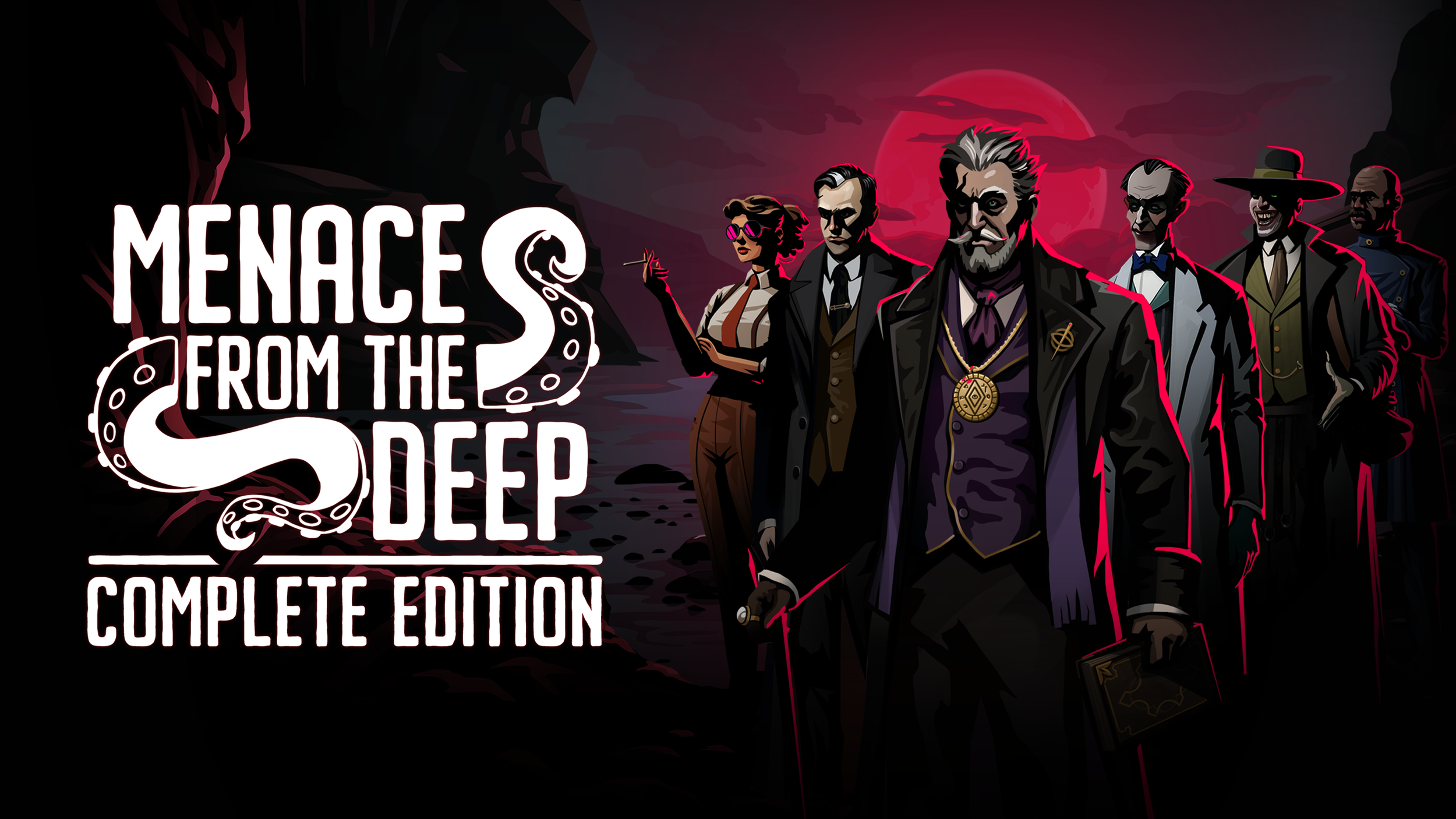
This copy of Menace from the Deep: Complete Edition was provided to Source Gaming by Feardemic Games.
Roguelike deckbuilder Menace of the Deep released in 2024 on Steam. Now, two years later, Flat Lab’s Lovecraft-inspired game of murder and intrigue has hit consoles, with its The Rift of Sanity expansion in tow. How does it fare on Nintendo Switch? Is it addictive in that classic roguelike way? About how many gorgeous grotesqueries does it have (several. The answer is several, and they all look very cool)?
Before we go any further, it should be said that Menace of the Deep may feel very familiar to players, particularly any roguelike fans. Its deckbuilding structure is openly inspired by Slay the Spire (note: I have not played Slay the Spire, so I can’t compare their gameplay, though I also don’t think that would be particularly helpful), while its aesthetic bleeds Darkest Dungeon, albeit with a bolder comic art tint. It is, by design, derivative. The biggest distinction it has from those two games is the extent of its reverence to the Cthulhu mythos, something that isn’t in short supply in this industry. Because of that, the game feels geared more towards fans eager to try something like their favorite deckbuilder, which is cool.
SHUFFLING THE CARDS
Menace from the Deep has a classic Lovecraft premise, albeit with less racism or endless narration by men failing to describe the indescribable. Video games don’t pay by the word, after all. The town of Innsmouth is shadowed by Eldritch beasties, and a Secret Society has set up shop to scope out the town and save the day. That structure means there isn’t a conventional protagonist. You play, while never described as such, essentially the invisible organizational force of this institution. You’re the one who controls the main character for each run, and you’re the one who decides on if and how to drive the permanent progression, but otherwise you have no impact in the story. Cutscenes between the leaders of the society instead play out as you break through milestones of play time and battles won, all showing their inner machinations. I think this structure works quite well. I didn’t feel any emotional connection to the characters, all of whom are fairly stock character types for this brand of weird fiction, but I never felt its absence either.

Image: Source Gaming. An early battle. The Detective character’s dog helps the early game, but it’s liable to be killed early on.
Of course, the runs are the real story. You pick a character from a class, pick their deck or customize your own, and drive a car through several levels. Each one has a series of around fourteen stops before you hit the boss at the end of the level. Some are fights, some offer a creepy merchant or an encounter that can help or hurt you, some are gas stations to make sure you don’t end a run prematurely, and some might give items to boost your abilities. Relics give permanent upgrades, Abilities function as last ditch efforts and are fueled by a rare resource, and Consumables are one-off. Like with any other roguelikes where you pick between a few locations, the onus is on the player to figure out what they need. You’ll probably want to hit the Museum up early for a Relic or a rare card, and while going to a Motel can restore a bit of your health, you might be better served using the trip to upgrade that card instead. There aren’t a lot of ways to upgrade characters, but cards? Almost every one of those babies can level up into something better.
That happens pretty quickly once you start getting into a string of battles. Each one—against bewitched locals, alien behemoths, or a mini-boss guarding a Relic—is long and intense. With the amount of health each foe packs, you’ll be replaying cards again and again, enough for them to upgrade after you’ve won the battle and whatever cool goodies come with it. Like with Slay the Spire, enemies’ intentions are telegraphed, so you know whether to press an attack or build your defense. That’s also true for any allies you summon or find along the way, all of whom operate on their own.

Image: Source Gaming. How the “map” works. Players get three options for where they can go and do that until the run invariably ends. Each option has something of value, even the fights.
The characters you get for each run come from wildly divergent classes. Detectives attack one-on-one and get a cute dog that mostly exists to keep them safe at the start of the run. Professors summon monsters and unleash status effects; they’re my favorite. Cultists gain Bloodlust with every attack. Abominations, the deliberately hard to use character, repeatedly shapeshift and force you to pivot on the fly. While you’re allowed to make your own deck from the start, each class gets six premade ones that are wildly different even within their niche. Some are offensive or defensive in nature, while others are all about inflicting status ailments like trauma, poison, and bleeding. Once you stack a few of those together, even a tentacled monstrosity from beyond will start to bleed out.
PAIR OF TWOS
For all of this, though, the general feel of every fight was similar, no matter who got picked. I found Menace from the Deep to be oddly conservative in its gameplay, constantly demanding hyper-defensive play while often denying you the option. Enemies hit hard, there are barely any options to heal, and the options on offer only refill a fraction of health or sanity. If you see a big number over the character signifying the damage they’re about to take, the only move you have is to play every card that adds Block, the shield stat that keeps monsters from reaching your flesh (but also gets halved every turn, requiring even more Block cards). And if you get that number without any Block cards in hand, your run might be doomed. This is why, despite trying almost all of the characters and decks on offer, I kept defaulting to the Professor’s Rat King deck. It summons rats who do the fighting for you and potentially divert your foes’ attention, allowing me to use Block cards that can be upgraded to heal by even a single hit point. Given that individual fights can last upwards of ten minutes, that security was appreciated.
Perhaps this is just intrinsic to the horror theme. Enemies are hard, but they’re also the best way to improve your cards, and they might guard desperately-needed gas stations or motels. Menace from the Deep does provide some nice options, like how Encounters will always show you the results you’ve picked in the past. But its overall difficulty curve is punishing, sharp, and surprisingly fast. On multiple occasions after Act II I’d go from near-full health to death in the first couple turns, not out of poor performance on my part but simply because the damage scaling shot up—often past the level of my Block cards, if I even had them on offer. This is where the permanent progression comes in. Each level has Warehouses flush with one kind of resource, and those resources can unlock cards, improve character health, and increase slots for your gear. And yet, I largely exhausted most of the options within a few hours of a roughly forty hour experience. Getting past the second level is so hard that it was a struggle to get any of the third and fourth resources, but it took barely any time for me to get all the wood and bricks I needed. So the overall balancing is strange.

Image: Source Gaming. I don’t think that the story brings the game down, not in a tangible way. But it’s also not great, and I do wish the writing and acting were both a bit stronger.
I feel bad dinging a project that’s both good and under the radar for things that are in no way dealbreakers, but there are times where the seams show. The cutscene acting is almost uniformly bad (and weirdly evocative of the legendarily bad voice work of the mid-Nineties), giving the game a camp charm that undermines the intended horror. While the UI was probably fine with a mouse and keyboard, it’s often hard to hover over important terms and items on a controller, and the visuals make it hard to parse what’s being highlighted. There were a couple occasions where the game picked what I wanted to do at a gas station or museum before I got the chance. It’s also weird about onboarding and dumps information on you a bit too quickly. Frenzy, a main mechanics that alters the damage you deal and take, doesn’t seem to be clearly explained anywhere. Moments like these, and there are a lot of them, are just a bit frustrating because the core loop is quite strong.
SAVING THE BEST HAND
For much of my time with Monster from the Deep, I found it… fine. It’s a perfectly serviceable roguelike deckbuilder, just missing something. It is ultimately great at giving that itch to do just one more run, even though your last one took almost an hour, but it was also slightly frustrating and tiring. That was, however, before I found the final boss, and I’m going to spoil it simply because it alone is worth the price of admission. It’s Cthulhu, of course, with more HP than maybe all the prior bosses and mini-bosses put together. Your private eye, scientist, or lunatic will be lost to the cause. Except it isn’t the end, because Cthulhu keeps all the damage it’s accrued for the next fight, and the next after that. Maybe it’ll take twenty rounds with the big guy, and maybe the subsequent runs that end before you reach him do often feel like kind of a waste, but each chunk of health you slice off is special. And this is what made Menace work for me. If you spend the game acting as this invisible force, this reveals your real character: the collective might of every soul crazy enough to stop the unstoppable. The twist fully upended my time with the game and gave the end game a real jolt.

Image: Source Gaming. I don’t want to show the specifics of the Cthulhu fight, so here’s the Professor building a very good run against an even grosser monstrosity.
Beyond its incredible final twist, Menace from the Deep is a game like other games. It is not a significant innovator, something I suspect Flat Lab is fine with, and they deserve to be. Innovation and originality are not the be-all and end-all of art. However, it does lack some of the spark of the games it’s following, and on its merits I wouldn’t recommend it sight unseen, the way I have with other roguelikes. Instead, I’d say it’s good for all the deckbuilder fans out there. A second course with tentacles, Kabbalistic imagery, and BDSM gear. If you’ve exhausted every card in Slay the Spire, if you’ve mastered every deck in Inscryption, this will probably be for you. It has the juice.
Final score: 7/10

- Back on the Bat Chapter 3: The Black Mask Casebook - September 28, 2026
- Nintendo Direct September 9, 2026: Information and Reactions - September 9, 2026
- The Legend of Zelda 40th Anniversary Direct September 8, 2026: Information and Reactions - September 8, 2026