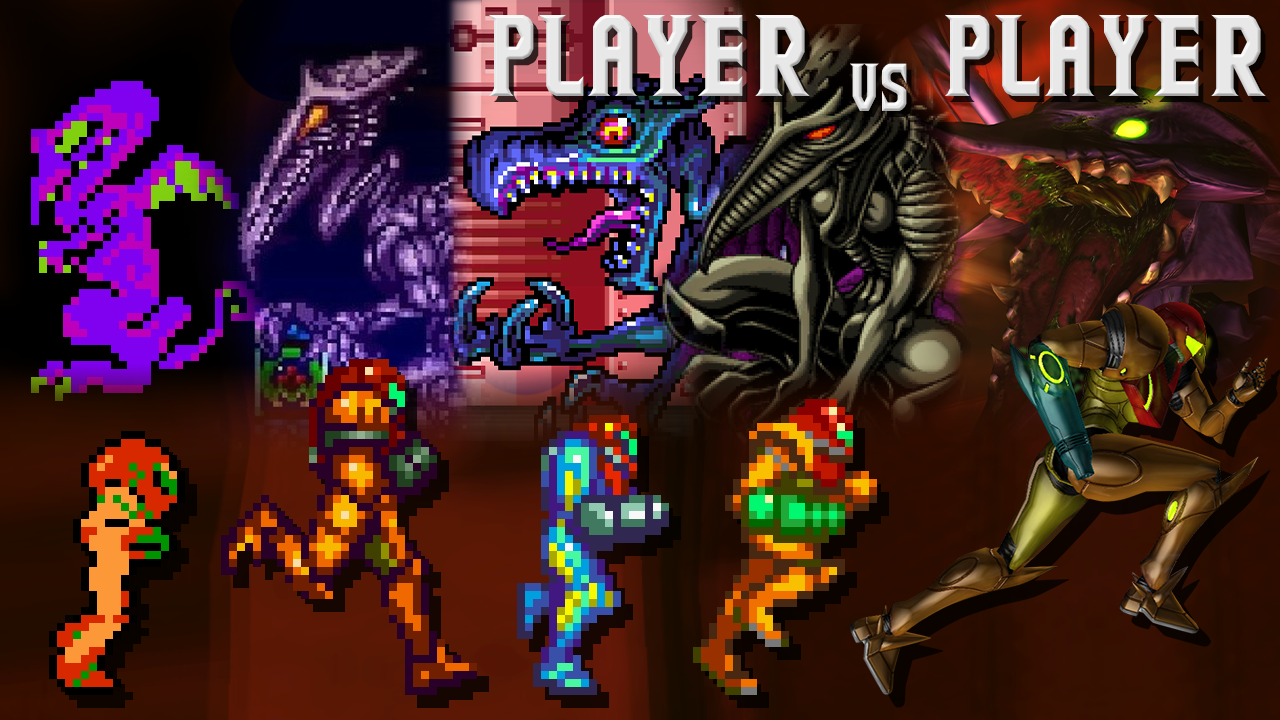
So, before I write my first “Player vs. Player” in over a year, let me go over why I make them in the first place: when it’s hard to think of reasons I enjoy a character, this series gives me an excuse to lay it all on the table. We toss in their rival or nemesis to make things more interesting, but that’s the gist. Beyond our title characters, though, there’s also a game I want to verbalize my thoughts on, simply because I just played and liked it more than years of slander prepped me for… Metroid: Other M is weird, doubly so for its odd bunch of characters. Samus Aran’s monotone narration, dubious rapport with her former boss, and weakness in the face of our other subject doomed this game on arrival. On top of her resulting hiatus, I believe fans’ scathing feedback led to an overcorrection in later entries, but I’m getting ahead of myself. My Metroid journey started in less divisive waters, after all, so let’s do the same here!
 |
Metroid: Zero Mission and Samus Returns are solid remakes that paint the clearest picture you’ll find of their lead: she’s powerful, quiet, sometimes ruthless, but we never question her heroism. The former teases her fond memories with her Chozo caretakers, and she caps off her Metroid purge in the latter by sparing their last hatchling. Fans enjoy these glimpses behind the mask, especially since they only add to how awesome she is! Among Nintendo’s batch of lovable heroes, it’s neat having one that kicks ass like she does. Despite its age, Super Metroid does the best job getting us behind her motivations: having left the Baby Metroid’s fate to someone else, she lets the worst possible group get their hands on it. More than saving the infant she’s grown attached to, Samus is determined to take responsibility for her indecision. Honestly, I wish she fumbled like this more often, since we can empathize with that more than her usual bounty hunter schtick.
As for said worst possible group, I’ve never thought much of the Space Pirates. These nutty aliens hardly seem capable of large-scale villainy, so it’s easy to write them off as yet more animals to gun down. Mother Brain’s menace and smarts are clearer, but less so than with, say, Star Fox’s Andross. Kraid is always satisfying to fight, Phantoon gives off some much-appreciated eeriness, but only one Space Pirate is truly “PvP” material. We all love Ridley, right? His parent company has many abhorrent villains, but there’s something so fun about a no-nonsense dragon who’s in it purely for the love of the game. But I’m worried his and Samus’s charms really are that easy to pin down; do we only like them for being cool and unique? Everyone knows Ridley killed Samus’s parents, but do we only respect their history for making the series darker?
 |
If we’re being harsh, we could argue Ridley’s a bit of a one-trick pony. He tends to show up early, snarl at the camera, then wait for Samus to gather all her abilities and deal with him. The GBA games and beyond tried refreshing him with new variants—Neo, Mecha, Omega—but each left less of an impact than the last! You can feel the latest entries tiring of his routine, since Dread and Prime 4 gladly replaced him with new threats. I wonder if this has anything to do with his divisive showing in Samus Returns? He sorta forced his way into a plot he had no place in, but I didn’t mind it. I was one of many whose first Metroid was this game, so finally getting a chance to fight him outside Smash was neat! Moreover, he’d never been a final boss before; it cleverly reflected his submissive nature, but he deserved the honor at least once.
Mind you, Ridley’s grievances are nothing compared to the smoke Samus caught in the early 2010s… For some context, Retro’s Metroid Prime series made the prior decade a great one for the bounty hunter, between its beloved trilogy and outsourced spin-offs. A sub-series made by and for the West perfectly coincided with gamers’ cries for edgier Nintendo content, but they also pioneered a Samus whose differences did Japan’s no favors. Retro’s was eternally stoic and less blatantly sexy, which subtly clashed with the 2D games. It finally exploded when Prime went dormant and Japan took its wildest swing yet with the heroine. We can debate Other M’s actual quality all we want (don’t worry, I plan to), but a flawed Samus never stood a chance. Granted, the English localization goes much further than “flawed,” but the deck was stacked against her!
 |
| Prime made Samus’s visor an important tool, while Other M uses it to keep her expressions on screen. This only makes sense to me, but the way she hides her face to lock in echoes another Prime… |
The West’s Other M presents Samus as stiff, immature, and weak. It’s worth considering her narration’s context—she’s probably recounting the Bottle Ship incident for the court—but it still motivated fans to look beyond the English version. Personally, I’d pair any playthrough with a fan translation off YouTube; it gives you the best experience for the least effort! This obviously wasn’t an option at launch, but so far removed from then, I think it’s fine to judge the game under a different lens. What we find isn’t an all-timer narrative or anything, but it’s enjoyable enough. The cutscenes look great, Samus’s old comrades Adam and Anthony are nicer to have around, and her arc’s better aspects finally shine through! Uncompromised, I have an easier time respecting Yoshio Sakamoto’s attempt to humanize a character he’s been so involved with.
 |
| Adam is reasonably polarizing, but Anthony deserves more love! It’s cool having an ally who doesn’t worship Samus on reflex, and his surprise save is one of the best parts of Other M’s ending. |
That’s fine and all, but what good is there to parse from Other M’s Ridley encounter? The way Samus freezes up when faced with her usual rival is beyond infamous, but I appreciate how the game plays with their dynamic. In entries like Prime, Samus starts her quest at a deficit, then uses her resourcefulness to work her way back to strength. Conversely, Ridley tends to assert his dominance early on and wait for his nemesis to find him. Other M turns this on its head; Samus enters the Bottle Ship with more weapons and skills than ever, but lets her mentality drag her down. Ridley returns to life as a defenseless chick, then outsmarts and evades the party until he’s ready to take them on directly. Samus’s reaction is overblown, but it adds to how thoroughly the tables have turned. And the battle itself is pretty fun, even if my favorite is Prime’s Meta Ridley fight—punishing his cheap tactics feels so rewarding!
 |
| The way I see it, Other M reps each 2D Metroid with a boss: Ridley for the first, Queen Metroid for the second, Phantoon for Super, and Nightmare for Fusion. I’m not immune to pandering! |
On the topic of Other M’s bosses, now’s a fair time to vouch for its gameplay. In general, the obligatory Wiimote isn’t enough to handle this game’s mix of character action and first-person sleuthing. Turning your controller around mid-combat to whip out missiles is clumsy and the lack of an analog stick is rough, but there’s something to be said about the panic it inspires. The occasional jumpscares were effective! Admittedly, I grew up with Super Mario 64 DS, so it’s possible I’m just numb to D-pads in 3D. That aside, when you’re simply probing the cleared rooms, their aesthetics and cleverly hidden upgrades are worth appreciating. As much as I love the first Prime, Samus taking a more active role in our spelunking gives it a unique flavor; her stylish dodges and finishers add much to our limited moveset. We’re made to share her feelings of weakness, however, like when Ridley’s mid-stage pins us or an obstacle demands an unauthorized tool. Okay, maybe the latter overdoes it… If I wasn’t examining this game as the 2010s one-off it currently is, all these imperfect ideas would annoy me more than they do. But since we recently got a Prime 4 that plays it safer than I’d hoped, I’m more open to enjoying Other M for its oddities.
 |
In other news, Smash deserves a place in every “PvP” involving its fighters. Ridley’s two boss battles in Brawl were many players’ introduction to him, but his prolonged jump to the playable roster was something special! Director Masahiro Sakurai’s gripes with his height were the stuff of legends, which is why many don’t know what to make of the downsized newcomer. First of all, having seen the MultiVersus devs struggling to make Iron Giant work, I’m convinced massive characters are more trouble than they’re worth. Ultimate Ridley’s smaller frame and clumsier flight hardly embody his boss fights (Super’s unkillable tank and Prime’s divebomber are nowhere to be seen), but he still feels like Nintendo’s premier psychopath. His brutal smash attacks and Skewer down special are some of my favorite moves to land; it feels like I somehow got the Mortal Kombat character I’d been waiting for! The gnarly redesign and remixed boss theme are the cherries on top, though I’m partial to his Meta Ridley skin and Brawl song, respectively. Overall, his inclusion is one of the brightest spots in a game that’s lost some of its luster…
 |
| In Ultimate’s E3 build, a few recolors stood in for Meta Ridley. As much as I like his selection in the final game, it would’ve been nice if they all made the cut. |
Samus’s dual role in modern Smash—classic and Zero Suit are their own things—is neat, but if my Ultimate shade is any indication, you’ve caught me at a particularly Melee time in my life. I’m nowhere near good, but landing even the shortest combos is some of the most fun I’ve had with the series in years! Fox is a safe main, but I always switch to Samus when it’s time for a pace breaker. Simply put, this game makes everything about her classic kit more satisfying; the wimpy Morph Ball everyone laments in Ultimate has so much utility here! Although her up smash and forward air won’t score any kills, their coverage is uniquely useful in a game this fast. And those awkward kicks fans are so quick to criticize? On top of matching her focus on defense, they actually fit a child of the bird-like Chozo really well! I clearly have a newfound love for this game’s fighter design, and think any character blessed to be in Melee is richer for it.
 |
Speaking of the Chozo, their complete absence from Other M is one of its weirdest aspects. It probably would’ve felt off to bring up Samus’s monk-like upbringing, then turn around and show her days as a Federation firebrand, but that just proves there’s some dissonance at work… Thankfully, Dread returned to this neglected thread in a big way. The new Power Suit and animations ensure Samus is at her slickest, and it’s great seeing her interact with living Chozo. “Interact” is the keyword here, since there’s no point returning to her roots if they don’t elicit reactions. Every fan of hers locked in when she accepted Quiet Robe’s request in his native tongue, and the rage Raven Beak got out of her felt so appropriate. The dude ravaged her tribe and played with her like a lab rat; he deserved worse than assimilation and death by Hyper Beam. Needless to say, we’re free to add Samus’s character to the list of things Dread nails.
 |
Now, if we could keep the spotlight off Ridley and discuss a modern Samus I didn’t care for, let’s talk Prime 4. I liked it well enough, but its lead’s seeming lack of a soul pairs badly with her fellow castaways. Her apathy toward this Federation crew reads like Retro staying far away from anything that might resemble Other M. It’s at its worst with Sylux, though, since this man is a hazard that needs immediate attention! She reaches out to help him after winning their shootout (I know she’s the good guy, but it’s like she doesn’t even register him as hostile), then lets him ruin the Viewros escape for everyone but her. Essentially, Prime 4 ends like Super starts: Samus’s uncertainty gives the villain a chance to overpower her and harm others. But this time, Prime producer Kensuke Tanabe wanted the game to end like this! When I said I wanted Samus to fumble more often, this isn’t what I had in mind!
 |
| Sol Valley approaches Other M levels of disdain, but I like Vi-O-La and its matching Suit. At the very least, the former ought to be in that Mario Kart game allergic to DLC… |
So, Dread gives Samus an all-star villain and Prime 4 a questionable one, but where does that leave Ridley? As previously alluded to, it’s in his nature to play second fiddle to the actual bad guys; I’m not surprised recent games grew tired of that. The Space Pirates aren’t very relevant in the last two entries, after all, and their scaly higher-up has no reason to appear without them. Metroid’s willingness to try new villains is partly why its world sticks with us, even if this leaves our favorite in the dust. Thankfully, Smash does for him what it’s always done for Captain Falcon, Sheik, or Roy. They belong to Smash as much as they do their actual series; that’s a fair place for a personality as strong as Ridley. I’m glad he’s always around, I’m glad he got an amiibo, and I’m glad other Metroid games can bench him with no fear of pushback; Ultimate’s to thank for all that!
Altogether, you might think I mourn Other M and wish it wasn’t treated so harshly. There’s truth to that, but I’m also sure its hate benefited the series in the end. Separately, Metroid’s 2D and Prime branches are masterful; it’d be a shame if either lost ground to such a confused game! Sure, things looked grim during the hiatus, but Dread practically guarantees a bright future for the series’s classic style. For my own satisfaction’s sake, it even honors Other M in the form of themed artwork, Adam’s resurgence, and Samus’s enduring agility. Despite my mixed opinions on it, I’ll always be glad it gave me a reason to yap about Samus and Ridley. They’re in this perfect limbo between Nintendo’s mascot- and story-driven sides, which I think is fun! They’re inseparable from their Other M selves, like how—if I could reuse a previous analogy of mine—Daredevil is from his campy 2003 movie. To answer my opening question, I know one reason I love these sorts of characters: it’s satisfying to look at all their disparate versions and handpick aspects you enjoy. Nowhere is that clearer than with my favorite bounty hunter, courtesy of her memorable Melee moves, Other M athletics, Dread Suits, Prime 4 gadgets, Federation relationships, and so much more!
Thanks to Cart Boy for helping with edits, and Slink for the header.
 |
| If nothing else, Other M copies are cheap and demand little more than a Wiimote. For those curious, it’s definitely worth a chance. |

- Dream Smasher: Edelgard - September 10, 2026
- Player vs. Player: Samus & Ridley - July 5, 2026
- Dream Smasher: Sylux - March 28, 2026