
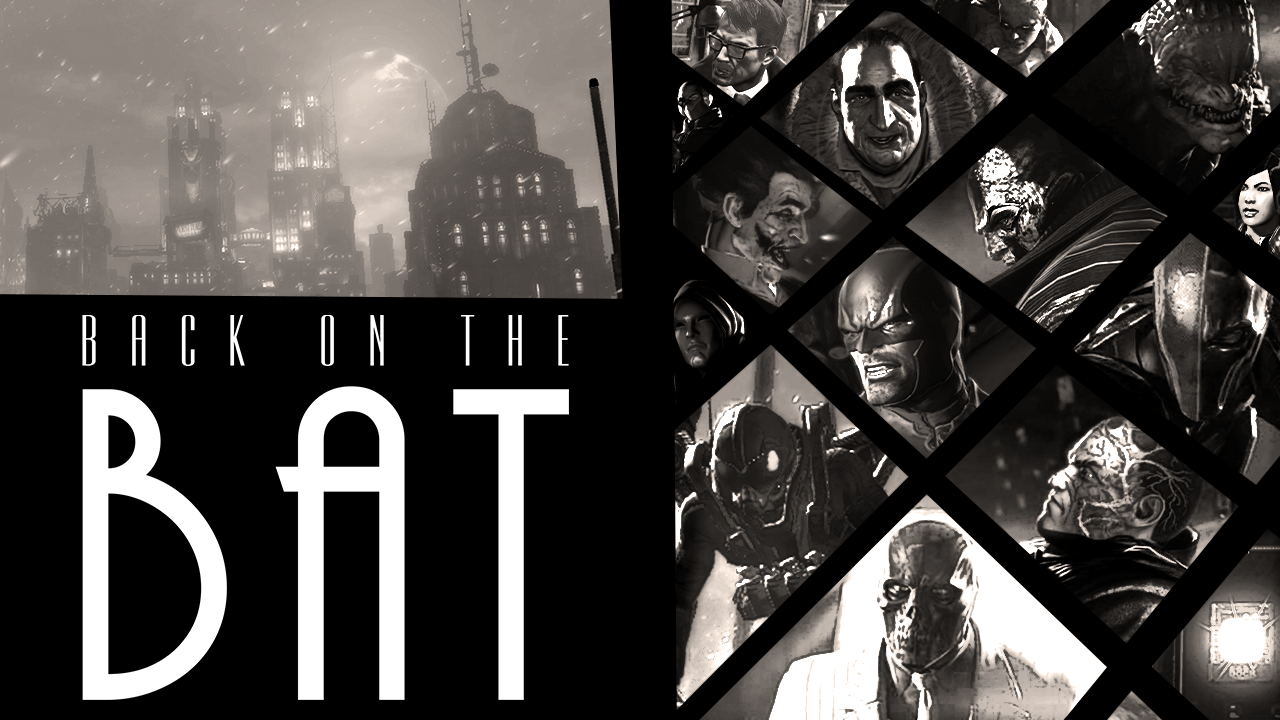
The story of Rocksteady’s Batman: Arkham Trilogy is a tidy one. A Warner Bros. studio makes a DC Comics tie-in that did a few things so well it upended the entire games industry, only to make two sequels who suffered as they got bigger and bigger. It’s simple. You can track the mechanics, the level design, the villains who got picked, and the structure. And if you want to play them to come to your own conclusion, the Return to Arkham Collection gives you all three in a neat and very well-treated package. I’ve bought it on sale for six bucks, twice. It is easy to access, regularly discounted, and has at least the bulk of all three games’ bonus content for free. The barely functional Nintendo Switch port of Arkham Knight aside, you’d be hard pressed to find many major blockbuster trilogies that have been treated better through re-releases.
But there’s an Absolute Batman-sized hole in that story. Between 2011 and 2015, Warner Bros. Montréal made a Batman: Arkham prequel. Batman: Arkham Origins was a major 2013 release; it was one of the last big PS3 and Xbox 360 games before the start of the eighth generation of consoles. It got reviews that were good, if not as reverent as what Arkham Asylum and Arkham City got. And yet, it’s been almost scrubbed from the canon. Its Steam version does still exist, so it’s not a lost game, but Warner Bros. hasn’t re-released it and often acts as though it doesn’t exist. Common discourse on the series largely excises it from the conversation. The only reason I’m able to play it at all is because Microsoft went out of its way to provide backwards compatibility support for the 360 version. A testament to a cult classic status.

Image: Source Gaming. Grappling through downtown Gotham.
It’s unfortunate that we almost have to approach Arkham Origins this way, like it’s some virtual Black Casebook hiding Warner Bros.’ secret shame. I don’t know if it’s not included in the collection because Rocksteady didn’t want to acknowledge or remaster a game it didn’t make, or for a reason beyond its control, but the exclusion makes it this black sheep. Admittedly, it did that for fans in one way. While Arkham Asylum dined out on being Kevin Conroy and Mark Hamill’s big Batman: The Animated Series reunion, neither are here this time around. Batman is played by voice acting giant Roger Craig Smith, who had contributed some miscellaneous voices to the last game. Smith is one of our finest voice acting leads—just before this game he had been Ezio Auditore, Chris Redfield, and the best Sonic the Hedgehog—but his Batman is less singular. He’s generically growly in the vein of Smith’s many one-off Regular Show roles.
Similarly, the game looks like a downgrade after the remasters. While I found Arkham City at times unpleasantly lurid, it was also full of color. Arkham Origins (which pointedly did not get a nice remaster, just the performance bumps that come from Xbox’s program) presents a duller Gotham City. City’s three districts are still there, as well as a few more on an island to their south, but they’ve got simpler graphics. The backgrounds are flatter; the textures simpler. But honestly, I like how dressed down it is. Origins reminds me most of all of those late PS1 and early PS2 games, like Max Payne and Silent Hill, that made levels so barren that they became haunted. Throughout the story, the Gotham Police periodically air a curfew announcement to explain why you never see civilians, but it’s almost unnecessary. No Gothamite would be so foolhardy as to willingly go outside on Christmas Eve.

Image: Source Gaming. Origins‘ basic graphics create a strong sense of isolation, quiet, and eeriness. I wonder if a more radical remaster would dilute that.
WB Montréal had, I would say, three main challenges with Origins. The first is my overall issue with the series, namely that it’s shallow, with simplistic combat that gets blander the more of it there is. This wasn’t an issue for most critics, but unfortunately, many of Arkham City’s problems have returned unchanged. The stealth sections are fun but in no way an evolution, and the combat is markedly weaker. It keeps the giant brawls that made Arkham City exhausting, but the actual movement is more finicky and less smooth. It’s much less easy for Batman to magnetically snap to enemies, so I repeatedly did takedown attacks not on a stunned goon, but the air next to him. I think this was a deliberate choice to force players to be more intentional, and I did eventually get better at rocketing Batman around. The late game also becomes more tolerable through a new weapon, the Shock Gloves, which give Batman a temporary combat boost and let him pound through those annoying high level enemies.
The sandbox is similar. Batman glides around, creeps over railings, and Batarangs radio receivers. The main stylistic differences with the island from City are a blanket of snow, a lack of graffiti, and how Amusement Mile hasn’t yet crept down to take over the now-flourishing Industrial District. Collectible challenges and items dot the map, though they’re less numerous. That made the experience easier for me, since Gotham feels slightly more like an unfriendly space and slightly less like a checklist. At the same time, both games exhibit a stupendously weird example of ludonarrative dissonance, because I routinely avoided fights… as Batman. I would answer whenever the police band announced a gang war or an armed robbery to keep up appearances, but I almost never fought people unless I had to. The required fights were plenty. If these games are about obsessively making you feel like the Dark Knight, they failed to make me want to throw down at every moment.

Image: Source Gaming. Batman fighting some henchmen as he’s captured by a TV crew. Unfortunately, I couldn’t get a shot of the first few seconds, where we see the fight from the perspective of the news crew’s camera.
If there is one addition that feels revealing, it’s the towers. Batman now has fast travel across the city’s six or so districts (as well as the Batcave, which means we finally see Alfred Pennyworth onscreen), but those are unlocked by entering towers that have been captured by the Riddler—or rather, Enigma, which I guess was Edward Nygma’s original alter ego in this universe. Finish the mini-dungeon, and the Batwing can drop you off there. Liberating towers had already become a symbol of open world bloat by 2013 thanks to annual Assassin’s Creed sequels, and while the fast travel is helpful in a sandbox so large that a giant bridge exists just to hide a loading screen, it’s not vital.
The second issue is the characters. There are about ten or so Batman villains I’d consider core to the franchise, and all of them were used by the second game in this four game series. That isn’t to say there aren’t other good villains, just not ones who mattered back in 2013 (and some of those, like Clayface and Hugo Strange, were also in City). Origins responded to this by digging deeper, wider, and into the previous well. The new Batman villains are almost entirely more obscure, and they’re complemented by returning characters and baddies from the wider DC Universe. Collectively, they’re the supporting cast in Batman’s first big outing: a demented Christmas whistlestop tour in which he meets most of his greatest foes in one night.

Image: Source Gaming. Black Mask and Killer Croc, now with a much more tolerable design.
While chasing gangster and steel industrialist Black Mask through a silly tutorial in Blackgate Prison, Batman fights off Killer Croc. He beats him, of course, he’s Batman, but not before discovering that Croc is only the first of eight world-class assassins Black Mask has hired to snuff out the Dark Knight: the Electrocutioner, Deathstroke, Lady Shiva (or “Shiva” as she’s known here), Copperhead, Deadshot, Firefly, and Bane. As Batman deals with each of them in term—or doesn’t, as a couple only appear in sidequests—he’s trying to track down Black Mask and uncover the rise of an all new villain. Of course, a few separate lunatics have also decided to come out of the woodwork to make the night even more special.
It’s an eclectic group, the assassins. The Electrocutioner is a character and name so stupid that Batman: The Animated Series didn’t even adapt him. Anarky, an anticapitalist sidequest villain, is a similar mixture of forgotten and forgettable. This game is easily the highest profile appearance that any take on Copperhead—this version is a female legacy character who ended up coming into the comics—has ever had. These are not the bad guys you bring out until you’re several games deep; none even got referenced in Arkham Asylum. Firefly is a lot better on that front as a proud C-lister, but… you can see why WB looked outward. Deathstroke is both the Teen Titans’ archenemy and DC’s most notorious professional jobber, and Birds of Prey harasser Shiva isn’t far behind him. Those two are the right characters for this plot, but they do add a level of import that the others can’t match.

Image: Source Gaming. I was surprised that Deathstroke, the biggest new name here, was dispatched early on.
And that’s just the newcomers. Croc, Deadshot, and Bane were in the last game, of course, as were the Penguin, Mad Hatter, and Riddler. Mister Freeze also heads up the expansion I neither bought nor played. I was a bit put off finding out that so many villains came back after assuming we’d have a mostly new slate, but it’s understandable. After all, this is a prequel. Arkham Origins is letting us see how this whole “Arkhamverse” got started, whether or not Arkham Knight follows any of it up. But it is a bit strange running around the same map, dealing with many of the same villains.
The quality of their individual fights is closer to the dregs of Arkham Asylum than the fitfully improved ones of Arkham City. Deathstroke is mostly an awful quicktime event battle, Deadshot’s stealth fight goes on for way too long, and the best part about Bane’s grueling battles are simply that they have checkpoints. It’s the gameplay once again struggling to handle the idea of a foe you can’t take down in one hit, though I don’t think there’s any one boss as actively bad as the ones in the first game. There are a couple I quite liked, too; my favorite is the bonkers bridge duel with Firefly, in which Batman dodges a flamethrower, throws a glue grenade at a guy with a jet pack, and grapples onto him in midair.

Image: Source Gaming. It has some issues of its own, but as essentially a redo of the Poison Ivy fight from Arkham Asylum, the Firefly fight is pretty cool.
This lineup is probably best represented by our overarching villain. I’ll concede that at least today, Black Mask is reasonably cool. He was the best part of the basically fine Birds of Prey movie as a Frasier Crane-esque serial murderer played by Ewan McGregor, and his spree killer Absolute Batman incarnation is delightful. Rock on, Party Animals. But back in 2011, he was a hotbed for the worst instincts of gritty Batman writers. He’s a Dick Tracy-esque gimmicky gangster, a sadistic torture-murderer, and someone with a weird Freudian complex, all traits done better by other Batman villains. In this, he’s mostly a mystery the game doesn’t care to solve.
That’s largely because of issue three: the clown in the room. One of the only daring plot beats of Rocksteady’s first two games was killing off the Joker. If Batman takes up way too much of DC real estate, Joker smothers it, to the point where a Batman story without him is almost radical. Any sequel would have to go on without him, and I suspect it’d be the better for it. That was probably never in the cards for WB Games, since the option for reimagining Batman and Joker’s first meeting was always going to be too tantalizing. So naturally, Joker is secretly the main villain. He’s been Black Mask all along, having captured and usurped Roman Sionis up until his reveal in a daring bank heist. This is presumably why Amusement Mile took over the Industrial District in Arkham City; the original boss was pushed out and Joker turned it into a hell.

Image: Source Gaming. Batman and Joker in the final showdown. As in Arkham City, Joker’s barely a physical threat.
This take on the first Batman / Joker conflict is fine. Joker seems like a serial killer, then a gangster, then a killer of far greater scale than anything Gotham has seen before. Batman growls, solves the mystery, and repeatedly holds up his “no kill” rule even in a final conflict engineered to kill at least one person. It works a lot better than the Rocksteady games, which in retrospect got all their dramatic weight out of Conroy and Hamill. I wouldn’t say it’s great. Perhaps that’s just because recreations of this conflict are anticlimaxes by design. We’re seeing the start of a perpetual conflict, and there are only so many times you can see that. Many writers have told this story, and Arkham Origins’ version isn’t particularly unique.
Origins is weird as a prequel on the whole, though. Batman only feels weaker and scrappier insofar as the combat is clunkier; his initial kit has more gadgets than he had at the start of Arkham Asylum. He lacks some of the informational dominance he’s known for, like a backdoor into the country’s criminal database that he has to steal from the GCPD, but he also has a supersonic jet and a device that digitally recreates crime scenes. And just going by the plot, it’s abundantly silly. This is literally a story of how Batman met James and Barbara Gordon, the Joker, and a dozen other supervillains for the very first time all on Christmas Eve. Joker meets Harley Quinn right after he’s arrested for the first time! There’s even an inexplicable post-credits tease where Amanda Waller—played by her Justice League Unlimted actor CCH Pounder—shows up to induct Deathstroke into the Suicide Squad. So Superman probably doesn’t exist, but Task Force X and magical eternal life pits do.

Image: Source Gaming. In yet another origin story, this game shows the first time Barbara Gordon not only met Batman, but began giving him instructions over a secure line.
And yet, there are times where this works. Rocksteady’s Batman was largely at the end of his journey, a couple notes aside. He rarely felt challenged emotionally. WB Montréal’s take is noticeably rougher and more interesting for it. Bruce is certainly smart, but he’s more angry and raw. He routinely orders and ignores the advice of the long-suffering Alfred until Bane invades his home and leaves his butler for dead. He scoffs at the idea that either Gordon could help him, and it doesn’t feel like pithy irony that he’ll rely on them in future games. He’s obsessed with being terrifying, boasting that he’s made every criminal grateful for the sun. He struggles to handle Joker, something that’s admittedly less singular when he’s also meeting all these crazy assassins. It’s not just him; Bane is so much grander and cleverer than his dopey Asylum incarnation. This may simply be the studio’s writing, which eschewed Paul Dini and is largely more charming (I’m a big fan of the one random goon talking about French-Canadian hip-hop), but it gives Origins an identity of its own.
The GCPD is probably my favorite example of this, and not just because it has the best dungeon. As in Arkham City, thugs are part of rival factions, and in Arkham Origins, one of those factions is the Gotham Police. Maybe it’s because Gordon is only a captain and hasn’t cleaned up the department, or maybe it’s because we’re in a city that’s only about to learn that Batman is real, or maybe it’s because of something else, but it works. Narratively, it means Batman is hunted by the law, which reaches a peak when he has to sneak through GCPD headquarters. Thematically, it shows why the city needs him: the cops are thuggish, cruel, and corrupt. On a meta level it connects to DC stories like Gotham Central, which ended with the revelation that the “good cop” heroes are the exception in a department of graft and racist violence, as well as The Batman and its thrilling police station escape nine years later.

Image: Source Gaming. Some of my favorite bits in these games involve Batman stalking chatty, blissfully unaware bad guys.
The ending of the whole thing is kinda bad, though that’s hardly unique. After that duel with Firefly, Batman rescues a beaten Alfred and goes full circle by storming Blackgate Prison once again. There are some very large brawls, another battle with Bane, and then a third battle with Bane that goes full stealth. It’s very much in the vein of Arkham City’s excellent Mister Freeze fight, but the inconsistent mechanics deflate the whole thing. After that, there’s the return of Croc for about five seconds, a final confrontation with Joker that falls into button prompts, and a scene of Gordon giving up his distaste for a vigilante whose morals are far greater than he realized. Some of it doesn’t land, like Bane getting memory wiped so he forgets Batman’s secret identity (the story does set this up, but it’s still an easy out). The mid-credits tease of Warden Sharp establishing Arkham Asylum as a rival prison is silly. But I did find this to be far better as a conclusion than Arkham City’s crazed plot twists and Arkham Asylum’s own terrible boss fight. It’s the most these games have felt like a story.
The side content is similar to the last game, though I think it’s handled somewhat more effectively. As in Arkham City, there were small vignettes for different supervillains amid a sea of tiresome Riddler challenges, a couple of which gain new bonus abilities. What feels different is that the stories and gimmicks feel slightly more geared to their characters. Mad Hatter, as he did in Arkham City, largely recreates Arkham Asylum’s Scarecrow sequences in a single mission. Anarky has race challenges that build on Zsasz’s timed missions from the last game; they’re atrocious, but they do capture the scope of his vision. Penguin and Black Mask have generic things to destroy, Shiva introduces the “blood trail” style of “puzzle” that drove the last two games, and Enigma runs the towers and his Enigma Caches, this game’s take on the Riddler Trophies. These are, by and large, no less simple or bland as the sidequests in City, but I did find them more specific and better for it.

Image: Source Gaming. Deadshot is unfortunately (and perhaps ironically) a bullet sponge, and his fight does get old, but the appeal of a stealth boss hasn’t gone away.
There’s also a weirdly functionalist element that goes along with. After or right before ending a major plot point, boss fight, or dungeon, Batman will suddenly find a clue for a new sidequest. He solves the alleged murder of Black Mask in Lacey Tower, and brainwashed goons announce the Mad Hatter’s crime spree. He meets the Joker for the first time and leaves Gotham’s main bank, and Shiva shows up with a deadly test. He hogties Copperhead and chucks her in the back of a van, and he discovers two threads: someone’s about to blow up a helicopter, and the just-deposed Black Mask is planning to claw his way back to power. Arkham City did this a bit, and it’s not exactly subtle, but it works well enough. It’s in keeping with the way a couple of the new powers, like the Shock Gloves, are stuff Batman steals off his enemies.
Some of what I like comes from stuff you can’t call deliberate on WB Montréal’s part. For instance, Xbox’s backwards compatibility tech doesn’t seem to work well with the screenshot feature, whose photos of these games are often murky and hazy. It doesn’t do well with certain colors, particularly black. It’s annoying for me as a journalist, but it actually gives Origins more of a visual identity, where any mostly dark picture is smeared, opaque, and kinda cool. Similarly, I never engaged with the divisive multiplayer mode, which got many of the biggest complaints. And although there were many technical issues, I did smile at some of them. It was kinda fun to start one of the last Predator sequences of the entire game, maybe the last, only to realize that an entire platoon of Joker henchmen had become entranced by the stair architecture.

Image: Source Gaming. Arkham Origins gets to have its own “batbreaker” moment, but the murkiness makes Bane look almost dreamlike.
After I started this project, I got multiple comments from people about Batman: Arkham Origins. Some feel pretty strongly that this might be the best of the four games, in spite of its place as a red-headed stepchild. I was skeptical, and after playing it, I’m not willing to go quite that far. Origins is still a fairly standard open world game, and it’s pretty janky and unbalanced and slightly lacking in color. It lacks Arkham Asylum’s single minded purity, which I’ve found to be the best quality of this series. But it also shows a version of the series that I like a lot more. The writing is less sleazy, the characters more fun, and the plot the best of the three games I’ve played by quite a bit. Maybe this is because this is a new experience for me, or maybe it’s because I got back into reading comics after finishing Arkham City, but I liked Origins quite a bit. Arkham Knight has a tough row to hoe after this.
Plus, you can beat up corrupt cops as Batman. Now tell me I shouldn’t rank it high just on that.

- Back on the Bat Chapter 3: The Black Mask Casebook - September 28, 2026
- Nintendo Direct September 9, 2026: Information and Reactions - September 9, 2026
- The Legend of Zelda 40th Anniversary Direct September 8, 2026: Information and Reactions - September 8, 2026