
EDIT: March 2: made a couple minor rewrites in the sixth, seventh, and fifth-to-last paragraph, added a few additional links, and corrected a reference to Starfield‘s PS5 port.
EDIT: 12:30: added a couple minor grammatical changes. Our apologies.
EDIT: 12:14: corrected one misspelling of Spencer’s name as “Spender.”
On February 23, Phil Spencer retired from his position as CEO of Microsoft Gaming, the trillion dollar company’s video game division. Since 2014, he held a couple official titles, all of them colloquially called “Head of Xbox.” His retirement ends a four decade career at Microsoft; he started as an intern in 1988 and joined Xbox in 2001. President of Xbox Sarah Bond, Spencer’s protegé and his most obvious, natural successor, also quit days earlier. Instead, he was succeeded by Asha Sharma, who joined the corporation in 2024 as President of CoreAI. We found out about all this through a leak reported on the 19th by IGN that spurred Microsoft to announce the news early.

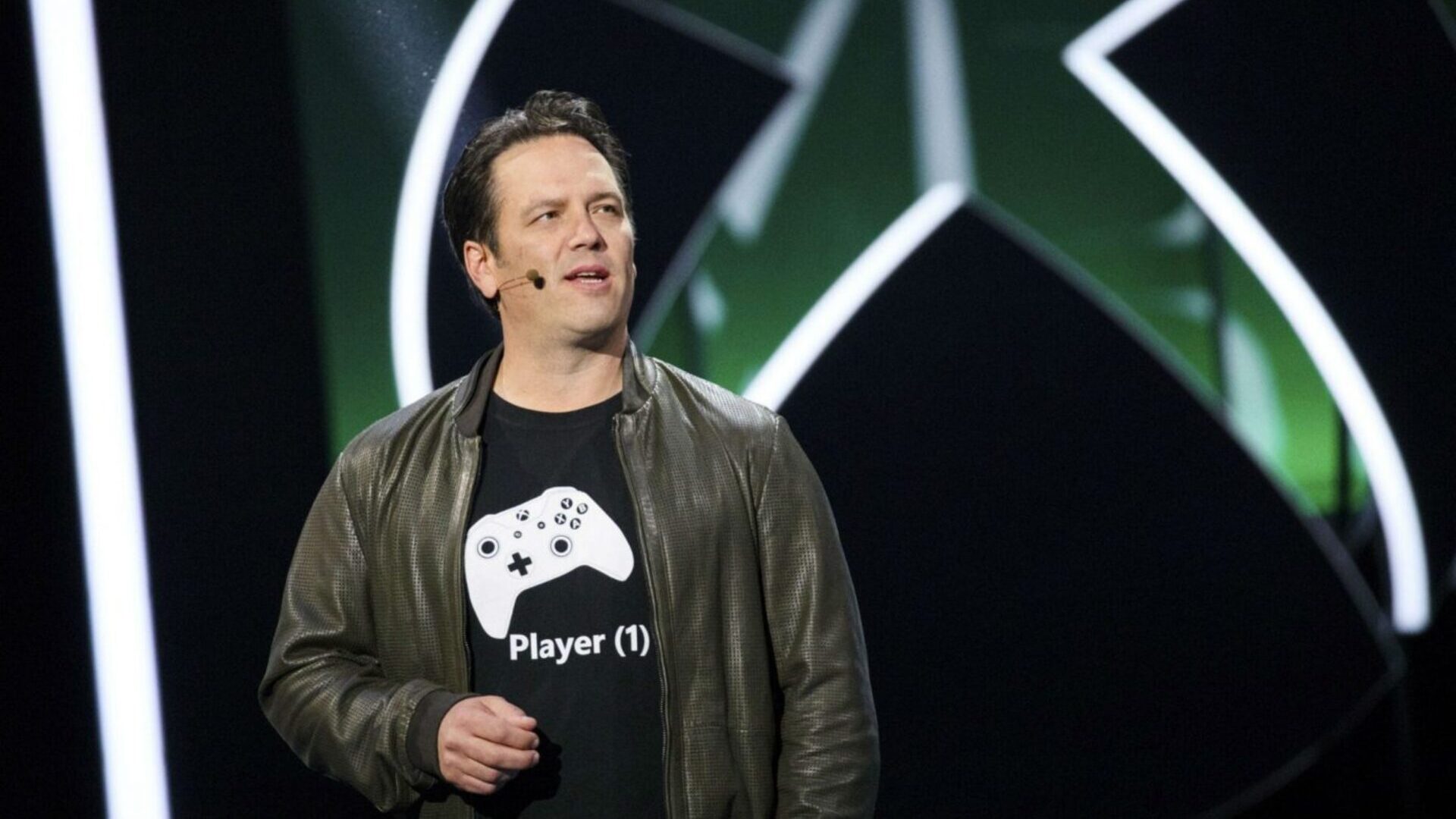
Image: Microsoft. Phil Spencer at E3 2018. Most of the other images were taken from other press sites; unfortunately, Source Gaming can’t afford the cost of the originals from AP, Getty Images, or Shutterstock.
This is not what big business resignations are supposed to look like. When Nintendo of America announced the retirement of ex-President Reggie Fils-Aimé (someone lower on the ladder than Spencer, who was responsible for the making of Xbox’s games as well as their marketing), it came months in advance. It was momentous. When Sony announced the retirement of Jim Ryan, the fool PlayStation CEO who tried to turn the company’s entire catalog into live services, it at least tried to pretend it wasn’t pushing him out the door. According to Spencer, he started talking about retirement with Microsoft CEO Satya Nadella in the fall of 2025, but announcing the near-immediate resignation of the “Head of Xbox,” on a Friday afternoon? With the brand’s 25th anniversary right around the corner? It lends itself to conspiracy theory, especially since Bond’s departure went barely mentioned by people she worked with for years.
I want to talk about Phil. His leadership, his legacy, his public persona. Because it’s a fascinating story, one without an easy theme or throughline. It’s also one I took years to acknowledge. Before I became a journalist at Source Gaming, I was just Wolfman Jew: Nintendo fan. To me, Spencer and the other members of Microsoft’s executive class embodied the dregs of what Brian David Gilbert would later call “business gamer fashion.” Every E3, they’d walk out in ill-fitting, Xbox-branded outfits to announce games and hardware; sure, they were rich, but they were gamers. Like you, you slob. He was indistinguishable to me, merely a symbol of what I’ve always taken to be the gaming elite’s tacit disrespect for the rest of us. However, he made serious in-roads catering to Microsoft’s core fanbase, far more than his unpleasant predecessor Don Mattrick.

Image: Dualshockers. Microsoft’s 2014 E3 show, the first one after Spencer took over Xbox. The company likes its big, bombastic live shows, though there were few announcements of note. One of the biggest, Scalebound, would be canceled years later.
By the time I had been recruited to the SG team in 2015, Spencer had been in charge of Xbox for about a year and a half, and times were tough. Xbox One had launched in 2013, poorly. It was plagued by bad messaging, a high price, a pathetic slate of exclusives, the exodus of Halo maker Bungie, but also something more concrete. While Microsoft has always positioned itself as this dominant pillar of gaming—the first Xbox was codenamed “Midway” so they could be the plucky Americans shooting down Sony and Nintendo—it isn’t. And Spencer and other executives admitted as much during a trial that would define his career. The first Xbox squeaked by the GameCube to earn second place in the sixth console generation, and the Xbox 360, their most unambiguous success story to this day, finished dead last against the Wii and PS3. The brand was borderline toxic in core regions and had only a few notable IPs. Microsoft’s promotion of their new machine was bad, but what Phil inherited was far more severe: a white elephant that seemed to exist as a vanity project for Microsoft.
Initially, Spencer focused on communication and a “gamer-fist” attitude. He released a version of Xbox One without the pricey Kinect, cutting the price by $100 while also removing a controversial piece of tech. He fought for timed exclusives like Rise of the Tomb Raider and cross-play with Sony and Nintendo’s systems. He supported a rather incredible level of backwards compatibility for Xbox and Xbox 360 games. He openly recognized Microsoft’s missteps of the late Aughts and 2010s, like the failure to groom its IPs and make new ones. The man was happy to talk a lot, candidly, and to fans as often as journalists. It’s an unorthodox personal brand for an industry built on corporate secrets and public, pro wrestling-style rivalries. The latter of which he still practiced, of course. Man took shots at Sony like a champ.
It was here that Phil Spencer cultivated his public persona: the gamer executive. He loved playing Xbox games and kept his profile public to prove it. In 2023, the most intense year of his career, he logged 917 hours across 82 games (something Kotaku calculated as almost twenty-three work weeks). In 2024, he slowed to a paltry 650. And that doesn’t count the games off his platform, as he eagerly played and talked up products made by his rivals. The man adored his Switch. Gamers, and not just those on “Team Green,” saw him as authentic and one of their own instead of some distant suit. Again, this was a man who lived in ugly branded hoodies. This was a deliberate tactic aimed at the most hardcore Xbox fans, but I do think his enthusiasm and friendliness were real.

Image: AP via The Guardian. Sarah Bond, Phil Spencer, and then-Xbox Game Studios lead (now COO as of Spencer’s retirement) Matt Booty were the public faces of Microsoft Gaming for years.
But it wasn’t enough. Xbox One kept flailing while PlayStation 4 soared. The Halo games made by 343 Studios (later rebranded as Halo Studios) came nowhere close to the acclaim of Bungie’s original titles. Sequels to Gears of War and Forza were not bad, but they were outclassed in a new era of blockbuster games. Sony largely killed its experimental, quirky side and put all its eggs into the Triple-A basket, leading to a lineup of The Last of Us, Ghost of Tsushima, the God of War reboot, Horizon Zero Dawn, and Marvel’s Spider-Man. If the modern gamer wanted polished, cinematic, prestige experiences, one house had it all, and it wasn’t Xbox. Almost every third party title of note was on PS4, to say nothing of Steam, now secure as the default way to play on PC. And after the disastrous Wii U, Nintendo bounced back with Nintendo Switch, which offered both portable comfort and the best first party slate in their entire history. Spencer’s initiatives were valuable—well, maybe not the idea to make mid-generation console upgrades and then call them “Xbox One S” and “Xbox One X”—but they didn’t make the console appealing to people outside the core audience.
In one of his many candid interviews, Spencer would call this the “worst generation to lose”, because this was when it crystallized that personal accounts would last between consoles. I was able to get most of my digital Xbox 360 games back on Series X, but there was little reason for the average PS4 owner to not stay with Sony, simply because we could feel confident our libraries would transfer to PS5 and beyond. When I bought a PS5 after my PS4 died this year, it was painless to log in and download my old games, even if their save data was lost. Missing the mark here meant Microsoft was competing with a backlog it could never beat. And the decisions Phil made came out of this understanding.
A year before the Switch launched, in 2016, Microsoft closed acclaimed Fable developer Lionhead Studio and fired its staff. It was a shocking and ghastly moment. Microsoft funded the first Fable and acquired Lionhead in 2006 with the intent of having its own, exclusive RPG franchise. But after dining off three successful Fable titles, it signed the studio’s death sentence by forcing it to make an ultimately unreleased live service, a model that’s disastrous at the best of times and for which the talented single player team was woefully ill-equipped. This closure was notorious, and Spencer acted with some degree of humility. In the Microsoft-produced and borderline propagandist documentary Power On: The Story of Xbox, he and Bond treat it as a failure to never, ever repeat, because their jobs aren’t just to sell hardware and software. Their jobs are to support the people who make their hardware and software. It’s the kind of self-affacing moment that made Phil so beloved.
Put a pin in that.

Image: Microsoft. Spencer at E3 2017 announcing Xbox One X, “the world’s most powerful console.” Although mid-generation refreshes have become controversial now, he released several, all with somewhat confusing and very similar names.
It was in 2017 that Spencer released his game-changer. Xbox Game Pass had an indelible hook: Netflix for games, years before Netflix’s mismanaged attempt at the same. You could pay a shockingly cheap subscription and get access to Microsoft’s entire catalog, plus a few extras that would grow in number. The value is both obvious and kind of a feint. The reason Microsoft can make “Netflix for games” was because it has more money than Nintendo, Sony, and most of the industry put together. It’s the reason Xbox has always sold its hardware at a loss. They could accept fewer sales because they cost nothing to their parent company, just like how they could pay licensing deals to studios willing to take a hit on profits. It did nothing to save Xbox One, but it was great for subscribers and furthered Spencer’s image as a man of the people. While Nintendo and Sony released their own services afterwards, they’re small by design because these companies depend on direct sales. But as a white elephant with near-infinite resources, Xbox could build itself around Game Pass… for better and worse.
Xbox Series S and Series X launched in 2020 against PlayStation 5 and as the cornerstone of Spencer’s vision. There were two models (the cheaper, weaker, vastly more popular Series S was for casuals, the disc drive-enabled Series X for longtime fans), something he cared about. They were filled with the accessibility systems he championed, alongside some of the company’s best backwards compatibility efforts and a silly naming convention. And they were made largely with the intent of being Game Pass machines. Their architecture was built around supporting it, selling it, using it. And there were some success stories. The current commercial highs of SEGA’s Like a Dragon series came partially from Western Game Pass users boosting Yakuza: Like a Dragon, a game you could play on PS4 but whose next gen version became a shocking timed exclusive. The service was a beneficiary of COVID, which caused massive spending spikes across the industry. Game Pass would grow in popularity. But it softly plateaued alongside poor hardware sales and was nowhere near the three billion subscribers Microsoft has openly targeted, and that drove Spencer’s single most important—and notorious—initiative.

Image: Microsoft. Xbox Series S | X were, in many ways, a substantial improvement over Xbox One.
In 2014, months after Phil became “Head of Xbox,” Microsoft acquired Minecraft developer Mojang Studios. In a vacuum it fell into the company’s history of publishing PC titles like Age of Empires II, but the scale was shocking; it bought the studio that made “the world’s most popular game.” It couldn’t retroactively make Minecraft exclusive to Xbox and destroy its popular PlayStation port, and it’d release the game on Nintendo systems the next year, but the meaning was clear. Having failed to tend its garden, Microsoft would simply buy what it could not create. It would make Game Pass “the best deal in gaming” come hell or high water.
In 2015, they bought the Havok physics engine. In 2016, it was Mixer, a Twitch rival that was probably doomed to failure and died in 2020. In 2018, Ninja Theory, Undead Labs, Compulsion Games, Playground Games, InXile Entertainment, and Obsidian Entertainment. In 2019, Double Fine Productions. There were reasons for each one; Double Fine had a track record of quirky critical darlings, Obsidian that Fallout: New Vegas cred, Ninja Theory could make those cinematic prestige games, and Playground already made the Forza Horizon series. It also ensured that companies’ intellectual properties and back catalogs were fully owned by Microsoft, with no fear of licensing deals or expiration. If you wanted to explore the catalog, there was now Pillars of Eternity, Psychonauts, Hellblade, State of Decay, plus anything and everything those companies would release. Some of those were exclusive, some not. Psychonauts 2 wasn’t, thankfully.
These were eclipsed in 2021, when Microsoft purchased Zenimax Media for a then-unheard of $7.5 billion sum. It owned Bethesda, id Software, MachineGames, Zenimax Online, Arkane Studios, Tango Gameworks, and more. Zenimax was already too big for its own good, but it was bleeding money and desperate for an investor. This gave Xbox some of the biggest gaming IPs in the world—and the power to make them exclusive. This was Spencer’s master plan: to have unilateral control of The Elder Scrolls, Doom, and Fallout. He was cagey about this publicly, assuring that every release would be treated differently, but in private Spencer demanded exclusivity across the board, even for things that were being coded as PS5 games first.

Image: Microsoft. Starfield spent years as Microsoft’s biggest, most grandiose killer app before failing to stick the landing.
There’s no case study more demonstrative than Starfield, Bethesda’s follow-up to Skyrim and Fallout 4. It was built for PlayStation 5 and planned as a timed exclusive, Microsoft canceled the PS5 version after the acquisition (which likely cost badly in development time, on top of having to pay off Sony to void the contract), and positioned it as the ultimate exclusive. Bond called it “one of the most important RPGs ever made” before its 2023 release. You… probably know the punchline: a severe delay, an impressive twelve million sales, middling reviews, and barely an impact. Bethesda is currently making an entirely new PS5 port that’s poised for success, but this entire process was absurdly wasteful. Months before launch, Spencer whined about the discourse in that “worst generation to lose” interview. “There is no world where Starfield is an 11/10 and people start selling their PS5s. That’s not going to happen.” It’s accurate, and honest in the way that made Phil appealing, but it’s also convenient after he spent considerable time, labor, and money on a medium-defining game that would end up not defining the medium.
And all of this was, again, eclipsed in 2023 with the near-$70 billion purchase of Activision Blizzard, whose properties include Call of Duty, World of Warcraft, Overwatch, Diablo, Candy Crush, Crash Bandicoot, and Tony Hawk’s Pro Skater. This was an even more bloated conglomerate that should’ve been hit with an antitrust lawsuit years ago. It was also the most outside resistance Spencer faced, as the U.S. Federal Trade Commission attempted to stop what would obviously lead to a consumer-unfriendly monopoly. The result was a trial filled with stark revelations, like how Microsoft had never turned a profit, that Sony’s opposition to the deal was made in bad faith, and that it and Nintendo opposed putting Game Pass on their systems because it depresses sales. Did you know Phil had this paternalistic vision of buying Nintendo as an act of kindness? It was a trove of industry drama that embarrassed and exhausted every party, including Microsoft’s executive and legal teams. No one came out looking good.
Probably most unnerving was what motivated Spencer in the first place: the exposés revealing that Activision Blizzard was a hotbed of sexual abuse. He, like most industry leaders, pledged vague and ultimately surface level support for the company’s victims. He, unlike most leaders, took mere days to seek out embattled Activision CEO Bobby Kotick to start talks for a purchase. He saw a company wracked with rape culture and collapsing shares and saw an opportunity. This part has gotten overshadowed by the juicier discoveries, but I want it on the record that Phil was a shark, and that the acquisition was his baby.

Image: Getty Images via The Guardian. Then Xbox CFO (now Zenimax COO) Tim Stuart, Spencer, and Microsoft CFO) Amy Hood walking to court. The Microsoft / FTC case was a massive public embarrassment for every major games industry player.
All of this is dangerous, particularly Game Pass. It’s not just that it eats into the profits of the games it carries, and games not even on the service, or that the licensing deals are obscenely expensive, or that it costs Xbox over a billion dollars a year. It’s destructive on a far wider scale, demanding unsustainable growth. Some games needed it; Pentiment, my Game of 2022, would likely not have been greenlit otherwise. But most studios need hard sales, especially as perhaps the only leverage they have over the publishers funding them. Without that, a studio is entirely dependent on the largesse of the higher ups, and whatever enthusiasm they have at that moment for diversifying the service’s portfolio. It only works as the dominant method of consumption, which is why Spencer was intrigued by the Epic / Apple Trial of 2021. One outcome might’ve allowed him to push Game Pass onto other consoles.
If Phil expected the purchase to cause a mass exodus to Xbox, he was wrong. It barely moved the needle; while Microsoft hasn’t given sales numbers since 2015 (something that blatantly undercut his image of transparency), third party sources have made it clear that the thing doesn’t sell. Which is somewhat odd for me, as it was after the acquisition that I bought my Series X. Not for any Activision games to come, nor for Game Pass, though I’d experience the service two years later. My best friend recommended it because Microsoft was doing cool stuff, like the backwards compatibility and ambitious Double-A games. Pentiment mattered to me. Those stemmed from Phil’s vision of Microsoft. Since then, I’ve enjoyed my Series X for hundreds of hours, but I can’t deny that its value has ebbed. Its ability to capture photos has gotten markedly worse, which is bad when I use screenshots for my journalism. Its exclusives were uninteresting, and the one that actually got me to buy the thing was ported to everything under the sun months later.

Image: iPhone in Canada. Microsoft released collages of IP after each big acquisition. I’ve always found these upsetting; it’s almost willful pride in the company’s artificiality.
Ever since the Mojang buyout, major acquisitions have become one of the main tropes in the games industry. It’s perhaps epitomized by Embracer Group, which might have the largest number of purchases even as it keeps selling and closing its holdings. It and others exist for this model, like Krafton Inc. (who bought Tango Gameworks after Microsoft axed it and is currently being sued for screwing over the directors of Subnautica 2), Tencent Holdings (which constantly invests in and closes studios), or Saudi Arabia’s Public Investment Fund (whose role is to astroturf the image of the Saudi regime and bought Electronic Arts for that purpose). Sony got in on the action by buying Bungie, Bluepoint Games, and Firewalk Studio, only to shut two down. Acquisitions are probably inevitable to an extent, but these are ridiculous. They’re also racked with layoffs and closures as the owners try to offload the cost of the buyout.
Many of these would have happened without Spencer’s gluttonous behavior; it is the only business model Embracer or Krafton know. And Microsoft had this history, as it famously bought Rare in the early 2000s to snipe one of Nintendo’s partners. But Spencer supercharged the practice with the sheer size of his purchases and probably spurred other companies on. Sony bought Bungie to help their horrible pivot to live services, but it might’ve not been so eager without the possibility—a very real possibility, it turns out—that Microsoft would get there first. This was something Spencer and fellow Microsoft exec Matt Booty considered, that they could simply outspend everyone else.
This is important because while Microsoft won the case, and there’s no chance of an antitrust suit, the acquisition has become a festering, self-inflicted wound. For one thing, Spencer’s plans for exclusivity failed. The trial ended with stipulations that Call of Duty stay multiplatform, but all of these series would have died if they went from being on every platform to being on one, the least popular, and the one that encourages you to not buy games. Call of Duty: Black Ops 6 had a huge launch, but it took a $300 million hit off its day-one Game Pass release. The cost of the purchases and trial, and the worth of Activision’s holdings, have also significantly elevated Xbox in value, which means it’s no longer a “rounding error” on Microsoft’s books and faces intense scrutiny. This is why all Xbox products since the fall of 2023 are required to have unusually high returns on investment, even though they’re also required to be free via a subscription service. Phil failed to consider that his spending spree might have consequences.

Image: Polygon via Bloomberg. Spencer in 2024. By that point, the ramifications of his initiatives had started to pile up, and his persona had lost some of its shine.
More pertinently, he also apparently failed to learn from the closure of Lionhead a decade ago, because Microsoft is one of the most egregious sources of layoffs and closures in an era defined by them. Under his twelve years of stewardship, and especially the last three, Xbox has closed several studios and fired thousands and thousands of workers. The most impactful to me was Prey developer Arkane Austin, who spent years toiling away at Redfall before the Zenimax buyout; Spencer could’ve stepped in afterwards, but he didn’t. The most symbolic example would be The Initiative, which was formed to lead the charge in the cinematic blockbuster space. Spencer and co. repeatedly called its long in the works reboot of Perfect Dark “the first AAAA game.” Quadruple-A! It was positioned for years as this mythic title before it and Rare’s Everwild, which was similarly stuck in development hell for years, were unceremoniously canceled. These projects should have been better managed, or at least killed before their teams committed too many resources, but Spencer repeatedly took a hands-off approach that hurt the people under him. Killing Lionhead was a gross dereliction of duty. Killing Arkane, The Initiative, Tango, Roundhouse, Raven, to say nothing of the thousands culled from every other studio, is insanity. Especially when Spencer wouldn’t stop talking about wanting to make even more goddamned acquisitions.
This chaos and self-destruction defined Spencer’s tenure, not his persona. The “high impact games” (a term Booty used when justifying shutting down more vulnerable studios) never met the moment. Game Pass ballooned in cost and actively worsened its lowest tier. Hardware prices spiked, too, alongside a stupid new Series X model, and some electronics stores stopped carrying them. Microsoft did its physical media dirty, either as a cost cutting measure or some perverse desire to build its image around Game Pass. Some studios have simply abandoned Xbox due to poor sales and expensive dev kits. Two hundred developers at Candy Crush studio King were fired after training the AI tools that replaced them. Halo Infinite, built and sold as the ten-year future of Halo, sputtered out and ended support after four. Some leakers theorized that these were given from on high against his protestations, like the impossible demand that every product have a thirty percent profit margin, and he certainly had no control over the geopolitical events affecting the industry as a whole, but he was the face of Xbox. And, and I need to be clear on this, so much of this was on him. He wanted the laissez-faire touch that fostered gross mismanagement and toxic environments. He wanted his parent company to spend $70 billion to own Call of Duty. He wanted a cannibalistic subscription service.
In a bit of supreme irony, the one success of post-acquisition Microsoft is also the one that has likely killed its viability as a console manufacturer, and that’s going multiplatform. Since the Activision merger, Xbox has abandoned exclusivity to become the biggest third party publisher in the world. Ports of games that were envisioned for PS5 to begin with and day-one multiplat releases like Indiana Jones and the Great Circle, Fallout 4: Anniversary Edition, and The Elder Scrolls IV: Oblivion Remastered are huge, topping the PlayStation charts and being the “one more thing” in a Nintendo Direct. This breaks the golden rule of the “console war,” which is that you can’t sell a system without exclusives. Halo, or at least a remake of Halo 1 that sounds deeply suspect, is coming to Sony. Everything Microsoft publishes now is planned from the start for PC, PlayStation, and often Nintendo Switch 2. This was the point of “This is an Xbox,” an incoherent marketing campaign to let you know that Microsoft Gaming is everywhere. It’s not a bad thing—it’s good for games to be available, and people aren’t buying Xboxes—but it symbolized something that was true before Spencer had power, which is that this is a ship without a rudder. His schemes only perpetuated that.

Image: Windows Central, which published this image the day of the announcement. The site often releases and “leaks” information from Microsoft directly, and it went out of its way to prop up both Sharma and Spencer.
In the end, I don’t think my cheap, cynical, ignorant first impression of Phil was entirely wrong. He was an advocate for boons to the industry, a passionate fan—though to what extent that aided him as a businessman is unclear—an executor of the industry’s most wantonly destructive behavior, and a man who often failed to care enough. He was business gamer fashion, in all its shaggy glory. It’s hard for me to feel empathy for his comically abrupt exit or the mild decline in his public standing, to say nothing of his role in one of the most villainous corporations on the planet. Microsoft’s involvement in the genocide in Gaza led me to stop buying Xbox products altogether, so that Series X is mostly an Age of Mythology: Retold machine now.
But he’s gone now, him and Bond, who seems to have been thrown under the bus in his place if Microsoft’s favorite leakers are any indication. It’s probably not a coincidence that Spencer’s replacement comes not from Xbox but Microsoft’s AI ambitions. Asha Sharma has come out against “AI slop” (though she might be a natalist who believes AI can stop America’s birthrate decline, which is troubling), but I don’t know how well you square that circle with Satya Nadella, whose obsession with AI as a magic affirmation machine is leading Microsoft to commercially and environmentally ruinous ends. My guess would be to expect far more AI integration at every level of Xbox, from marketing to UI to games “made” by AI, like their hellish “remake” of Quake II that Spencer claimed would aid in game preservation. Perhaps that won’t matter to Microsoft’s most dug-in fans. Perhaps they’ll have already left.
Regarding Xbox’s future, I’ll leave it to others to theorize, but let’s end on the hero of our story. Phil Spencer was a man on a mission. His vision of Microsoft as a gaming hegemon was sincere, powerful, and deeply terrifying. Going by his public comments and private actions, he genuinely believed that this was righteous. That led him to do things that were good and bad for consumers, and things that were dire for his workers. It also led him to create a friendly public image that deflected a lot of fair criticism. His most notable projects worked against him and have probably left Microsoft Gaming in dire straits. And, in the end, he was just a cog, following the gears of a machine whose incoherence started far before and above him.

- Back on the Bat Chapter 3: The Black Mask Casebook - September 28, 2026
- Nintendo Direct September 9, 2026: Information and Reactions - September 9, 2026
- The Legend of Zelda 40th Anniversary Direct September 8, 2026: Information and Reactions - September 8, 2026








Great article! I primarily knew Spencer as a guy who would appear and be pleasantly enthusiastic on Direct-style Xbox presentations. I liked that Xbox pushed backwards compatibility and accessibility, which led me to buy an XSX, but the last few years have been discouraging; the significant price increases to Game Pass and Microsoft’s role in Gaza suffering finally led me to cancel my subscription and stop buying anything for the platform in 2025. I like Spencer’s vibe, but – at the end of the day – that’s not enough to overcome the bad stuff that’s gone on at Microsoft during the 2020s.