
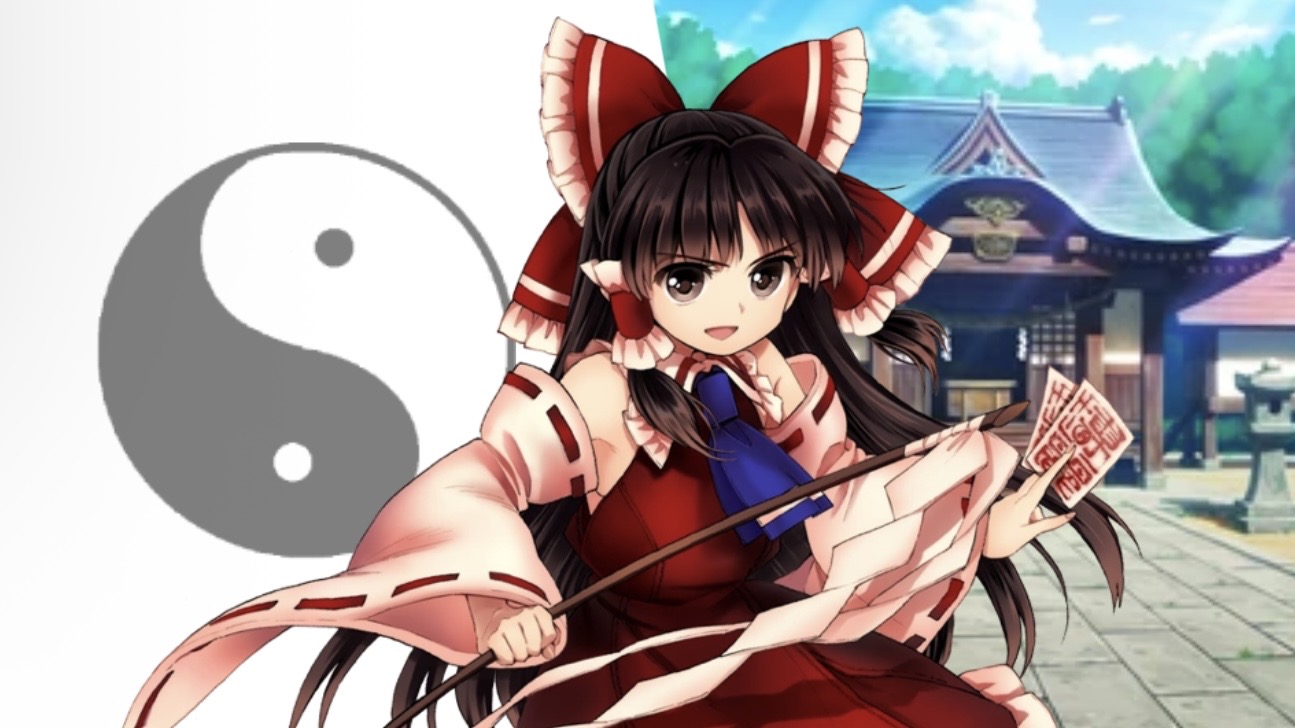
This guest Dream Smasher was created by Nano on Bluesky, and thanks to Cart Boy for help with edits.
Independent games have been a boon for the medium. While the big publishers are important, it’s invaluable that smaller developers have space to express themselves. And in both quality and fanfare, their work can rival and even succeed Triple A games! Two topical indies these days are Deltarune and Hollow Knight: Silksong; the former is taking the internet by storm again thanks to its new chapters, while the latter finally released after years of anticipation. Unfortunately, I’m going to have to skip the Silksong hype for now, because I’ve barely started the original. Why didn’t I hop on the Hollow Knight train sooner? Well, I’ve been stuck in Gensokyo, trying to get through over 30 entries of Touhou Project shoot ’em ups!
Many Super Smash Bros. fans have been wondering when the crossover fighting series will finally let an indie game hero stand alongside its all-star cast. While many indie darlings managed to gain fame immediately with one breakout entry, let’s instead explore a character whose legacy has been steadily building for almost three decades. Touhou Project is possibly a name you’ve heard in passing, whether it’s through Smash Bros. discussions, getting bombarded by funny little Koishi fumos in the SG Discord server, or from Source Gaming’s “All Content” video from way back when. Touhou has been ingrained in internet culture for longer than many popular indies—including Undertale and Hollow Knight—have even existed.
A brief summary of Touhou for those unfamiliar: They’re vertical shoot ’em ups where players dodge a swarm of bullets, often by grazing incredibly close to them. The end of each stage entails a Spell Card duel, pitting players against bosses with more involved and complex attack patterns. Alongside the shmup games, several spin-offs and manga have been released, the most notable of which is a fighting game series by Tasofro / Twilight Frontier. Pretty handy for developing a moveset! Now, despite the countless number of Touhou characters that have captured the hearts of many, there’s one who stands above the rest and deserves our attention.
Who Is Reimu Hakurei?
 |
(Courtesy of @CreaksTweets)
Situated on the boundary of Gensokyo is the Hakurei Shrine, a small Shinto site housing its resident miko, Reimu Hakurei. Although she possesses immense natural power, Reimu leads a carefree lifestyle and often neglects her training. That is, until an “incident” occurs. Whether it is a red mist veiling the sun, an eternal winter, or the four seasons running amok, these supernatural events threaten the balance of Gensokyo. Reimu is invariably the one to investigate, subduing youkai, humans, and even gods with her sharp intuition, purification gohei, and treasured Yin-Yang Orbs. While her easygoing nature makes her generally well-liked, she maintains a firm professional stance toward youkai. Ironically, because many of the youkai she defeats end up loitering at her shrine, human visitors are scared away… as are their donations, leaving Gensokyo’s hero in a state of perpetual poverty.
Reimu is typically the most straightforward playable character, featuring a smaller hurtbox than her peers and amulets that automatically home in on enemies. These traits make her an ideal choice for beginners, and one that experts can still appreciate for her simplicity. As a trade-off for her ease of use, her shot power is generally lower than that of other characters. While she is rarely the sole playable protagonist, Reimu has been the face of the series since its inception, so much so that it’s also known by the name Project Shrine Maiden. Series creator ZUN named it after its protagonist, so it’s only fitting that she remains at Touhou’s forefront. Sorry, Marisa; I doubt you’ll be stealing the spotlight this time…
Importance to Nintendo & Series
 |
Due to its unconventional nature, several Touhou releases have been at doujin conventions, with ZUN personally distributing copies to the public. That’s about as independent as your game can get! However, this does mean Touhou hasn’t had much history with consoles in general. This has been shifting in more recent years, though! Touhou games are finally releasing on Steam, while Urban Legend in Limbo saw a PS4 release; these breakthroughs reflect a growing focus outside of the doujin market, culminating in a few spin-offs—namely Antinomy of Common Flowers and Sunken Fossil World—appearing on the Switch. The latter even gained new Switch-exclusive content before other platforms! While the relative lack of official games on Nintendo consoles is a notable hindrance towards her case, this never stopped gaming icons such as Cloud and Joker in the past. Besides, Kazuya doesn’t appear in any non-Smash Switch games; the rules aren’t as rigid as you’d think. And, sure, Reimu is a more niche name in places like the United States, but that didn’t stop Hero or Terry from making the cut, either.
While not being commercialized in ways most video games usually are, Touhou’s influence on the indie scene, particularly in Japan, can’t be understated. Not only has the series proven successful enough to spawn over 30 official games and counting, the lax guidelines on fan content have caused conventions to become dominated by derivative games, manga, and music arrangements. The games themselves have had a massive influence on the shoot ’em up genre and its perception, as Touhou is one of its longest-running names. One notable pair of games that take inspiration from Touhou are the aforementioned Undertale and Deltarune. They’re viral in a more in-your-face kind of way, but Touhou looms over those two in countless areas, such as the way they blend bullet hell elements with RPG combat. Toby Fox’s musical career actually started with arrangements of Touhou music, and the same is true for popular Japanese music groups that went on to compose for proper anime shows. With over two dozen official games and countless fan works bolstering characters from an otherwise niche genre into stardom, it’s no surprise Reimu has become an unconventional gaming all-star.
Colors & Design
 |
Touhou is rather infamous for its character designs being inconsistent throughout the series. This can range from a character’s eyes changing colors to the one time Cirno randomly showed up with a tan! Appearing in almost every work, Reimu is no exception to this phenomenon, with the most notable discrepancies being her hair changing from black to brown, and her ribbon changing from yellow to blue.
I decided to make her Smash design sport black hair and a blue ribbon, which actually appeared in only one game: Legacy of Lunatic Kingdom. The black hair was consistently used in every mainline entry from LoLK all the way to Touhou 19. While the same is true for the yellow ribbon, it appears blue in the game Phantasmagoria of Flower View. This one’s a multiplayer versus game, so Reimu gets a palette swap with a blue dress and yellow ribbon. Since this is prime alternate costume material for Smash, I decided to let the default outfit wear the blue ribbon, while Beimu dons the yellow one. I also let the latter dye her hair brown, sneaking in both.
 |
After those two, Reimu’s next four colors reference other recurring playable characters from the series. Going in order, we have ordinary magician Marisa Kirisame, elegant maid Sakuya Izayoi, half-ghost gardener Youmu Konpaku, and rival shrine maiden Sanae Kochiya. Reimu’s seventh color harkens back to her PC-98 days, dying her hair purple. Lastly, her final color is a rather deep cut, so props to anyone who recognizes it!
 |
How Would She Play?
Reimu’s stats and properties:
- Weight: ∼ Meta Knight (80)
- Height: ∼ Corrin
- Overall Speed: ∼ Duck Hunt
- Walk Speed: 0.78
- Initial Dash: 1.8
- Run Speed: 1.78
- Air Speed: 1.092
- Fall Speed: 1.37
- Jump Height: ∼ Pit (31)
- Multi-jumping? No
- Crawling? No
- Wall jumping? No
Reimu’s genre of origin naturally fits her into the zoner archetype. Almost as scary as manju! While she boasts several powerful projectiles, this doesn’t mean a shmup character can do nothing but fire bullets everywhere. If you haven’t noticed, the shrine maiden is usually seen with a black rod, featuring white streams and an ever-growing size. This is formally referred to as a gohei, something used by real-life shrine maidens in Shinto rituals. Reimu’s isn’t just for rites, however, as she uses it as a powerful melee weapon, granting disjoints on many of her attacks. The end of the gohei with the streams even has a tipper, encouraging Reimu to fight from a distance, but attacks that spin the weapon deal consistent damage throughout. Basically, Reimu’s a staff wielder, an area Smash is lacking in. She possesses a lot of innate strengths, courtesy of her range and zoning, but her meager training results in her up-close game and K.O. power being rather underwhelming.
 |
An essential feature for making the bullet patterns dodgable in Touhou is your character’s hurtbox being smaller than their sprite. In Smash, this small hurtbox comes into play…exclusively for incoming projectiles! Like how Bowser Jr. has two separate hurtboxes for the Koopa and the Clown Car, Reimu sports a unique hurtbox in Smash that affects the damage she takes from projectile attacks, depending on where they strike her body.
 |
The red box denotes her regular “outer” hurtbox, while the white box in the center of her body denotes her “inner” hurtbox. If a projectile collides with Reimu’s outer, she’ll take reduced damage, but absolutely no knockback, with the projectile phasing right through her. However, this is far from a free shield to carelessly armor through every projectile, as her inner hurtbox in the center is also non-standard. If a projectile strikes Reimu’s “weak point” in the center, she’ll take 1.2x damage and knockback, with Special Zoom occurring if the projectile is strong enough. Needless to say, a particularly strong projectile hitting this weak spot can spell a whole lot of trouble for Reimu if she fails to Graze it!
As a reminder, Reimu can only Graze past projectiles. She uses a completely normal hitbox with no sweet spots or damage multipliers for punches, kicks, sword swipes, Joker’s gun, Final Smashes, etc. Despite this, though, should she wanna take the fight up close, this quirk is great for closing the gap.
Projectile-heavy characters have to be smart with their bullets, as a competent Reimu player can maneuver through their waves of danmaku like a spring breeze. However, one well-aimed Charge Shot can very well end your run. Projectiles with wide hitboxes like Leaf Shield and Gigaflare would be harder for Reimu to dodge, while grounded projectiles like the Ice Climbers’ Ice Shots would be about as effective as Ice Sign “Icicle Fall.”
Boxing Ring Title: “Shrine Maiden of Paradise”
 |
 |
 |
| Series Icon | Stock Icon | Kirby Hat |
| Move Type | Description | |||
On-Screen Appearance
|
Reimu swoops in from the corner of the screen, reminiscent of the ways Touhou bosses typically make their entrances. |
|||
Stance
|
Reimu’s idle animation from Touhou Hisoutensoku, complete with swaying dress and streams. |
|||
Idle #1
|
Reimu taps her gohei on the ground twice. Unlike Palutena’s idle, she does it horizontally with the tip of the weapon. |
|||
Idle #2
|
Reimu takes a look around her surroundings, wondering which direction the incident spawned from. |
|||
Walk
|
Reimu walks nonchalantly, with her eyes closed and gohei over her shoulder. |
|||
Dash & Run
|
Reimu floats through the air. This lowers her inner hurtbox a bit, so be careful! |
|||
Crouch
|
Reimu sits down and keeps her gohei positioned upright. |
|||
Jump
|
Reimu’s grounded jump is a rather standard one, as is her flip-based midair jump. |
|||
Damage
|
Reimu tilts over while making a shocked expression directly at the camera. |
|||
Shield
|
Reimu guards her head by pulling up one of her ofuda. |
|||
Dodge
|
Reimu sidesteps out of the way, no rolls required. |
|||
Floor & Edge Attacks
|
Reimu strikes foes with her gohei from both sides as she gets up. Her ledge attack also strikes with this weapon, but spins it briefly, like her upcoming down tilt. |
|||
| Neutral Attack:
Slap / Gohei Punch / Miko Kick
|
A quick slap attack from her left hand, followed by a punch using her gohei-holding hand, and finishing off with a kick. Based on her basic jab from Hisoutensoku, but the second hit uses a different animation to flow more naturally. |
|||
| Forward Tilt:
Gohei Poke
|
A forward thrust of her gohei. This move has fairly considerable startup, but deals respectable knockback, particularly if the tipper connects. |
|||
| Up Tilt:
Sealing Sweep
|
An upwards sweep of her gohei, covering a wide semicircle around herself. |
|||
| Down Tilt:
Sealing Spin
|
Reimu twirls her gohei across the ground, making for a more committal version of Palutena’s down tilt. |
|||
| Dash Attack:
Sealing Slide
|
A sliding kick, which has its roots all the way back to the first Touhou game, Highly Responsive to Prayers, where she can slide into her bouncing Yin-Yang Orb to deflect it. |
|||
| Forward Smash:
Hakurei Amulet
|
Reimu launches a golden amulet forwards. Like Mega Man’s forward smash, this move is uniquely a projectile. It’s even a multi-hit, with the last hit being the launcher. The size and distance of the move increase the longer the move is charged, with a fully charged version traveling a similar distance to Mega Man’s and being about the size seen above. |
|||
| Up Smash:
Ascension Kick
|
A powerful somersault kick that briefly lifts Reimu off the ground. All three of her smash attacks are rather weak compared to most others, but this one’s the strongest of the bunch. |
|||
| Down Smash:
Border Slam
|
Reimu slams downwards, causing barriers to rise up around her and launch foes directly upwards. This attack is also a multi-hit that damages opponents multiple times, but wants for launch power. The range of this attack is obviously reduced compared to the reference move, by the way. |
|||
| Neutral Aerial:
Youkai Sealing Circle
|
Reimu twirls her gohei around herself in a circular motion. Unlike, say, Byleth’s neutral air, this one’s more about getting enemies off you than starting combos. |
|||
| Forward Aerial:
Aerial Sealing Spin
|
Reimu twirls her gohei in front of herself, using an animation similar to her down tilt. Since she extends the weapon beyond her hand, this move’s range is especially good. |
|||
| Back Aerial:
Shrine Cleaner
|
Reimu swings her gohei behind herself. This serves as one of her most reliable K.O. options, and her strongest aerial, but it’s still somewhat slow. |
|||
| Up Aerial:
Float Kick
|
Performs an upwards kick. This gives her a bit of a vertical boost in midair (like K. Rool’s up air, but much cleaner), but it stops doing so if used more than once without landing. |
|||
| Down Aerial:
Dive Flip
|
Reimu flips, then kicks downwards. While it gives her a bit of momentum, it’s not as fast or long as other stall-and-falls in the game (more like Link’s down air than Toon Link’s), so using it offstage isn’t a death sentence. |
|||
| Grab:
Capture
|
Reimu grabs the opponent with her free hand. Reimu’s throws are generally best for making space or starting the occasional combo. |
|||
| Pummel:
Hakurei Pummel
|
Reimu spiritually pummels the opponent, engulfing them in energy rather than whacking them. |
|||
| Forward Throw:
Ofuda Stun
|
Reimu places an ofuda on her opponent, stunning them in place, before stepping back and kicking them forwards. |
|||
| Back Throw:
Reverse Ofuda Stun
|
A variation of the above throw, but this time Reimu teleports past her opponent and kicks them backwards. |
|||
| Up Throw:
Air Toss
|
Reimu tosses her opponent upwards, leaving them vulnerable to her wide-reaching aerials. |
|||
| Down Throw:
Dimension Rift
|
Briefly teleports before divekicking into her opponent, using a similar animation to her down aerial. |
|||
| Neutral Special:
Amulet Sign “Hakurei Ofuda”
|
Reimu points using her free hand, launching a wave of up to five amulets. How many projectiles she releases depends on how long the special button is held, but more cards drawn will increase the move’s end lag. Generally, these weak pellets are great for disrupting foes and setting the pace, like with Falco’s Blaster. In the Touhou games, one of Reimu’s strengths as a shot type is her shots being able to home in on nearby enemies. To reflect this, her neutral special’s shots tend to lean toward enemies they’d otherwise graze. |
|||
| Side Special:
Shinto Treasure “Yin-Yang Orb”
|
Reimu’s side special has her unleash a big Yin-Yang orb onto the battlefield, which is easily her largest projectile. When launched, Reimu’s orb sinks and bounces a few times. It’s a bit slower than Dedede’s Gordo, but lingers on stage longer. Obviously, given the size of these things, only one can be on screen at a time, and given the startup time on this attack, they aren’t meant to be unleashed mid-combo. They also bounce off surfaces they touch. If the orb is hit by an attack that deals 2% or more, it will be reflected back to Reimu. However, if Reimu attacks it again, she can bounce it back into her control, similar to the primary gameplay loop of the very first Touhou. As you can imagine, that makes Reimu’s dash attack especially good at rallying! |
|||
| Up Special:
Innate Dream
|
Reimu’s up special has her turn invisible with a teleport (similar to the one from her down throw) and take to the skies, allowing her to fly for about a second. The player’s tag also vanishes, making it hard for opponents to track Reimu’s recovery path. There are, of course, several downsides to this move, a significant one being that it doesn’t have any offense whatsoever. Unlike the original Spell Card, Reimu isn’t invincible, meaning she can be hit out of the move! The startup and end lag that occurs when Reimu uses the move is also notable, allowing opponents to strike back if they catch Reimu entering or exiting her flight. She also becomes helpless after exiting the move and sports less airtime than previous free-flying up specials. Reimu also can’t grab the ledge while invisible, so make sure you land safely back on stage or reappear just in time to grab it. After landing, the move needs a few seconds to recharge, so instantly using it again gets you a much worse version. |
|||
| Down Special:
Dream Sign “Duplex Barrier”
|
(Template courtesy of @TemplatesForSmash.) Reimu’s down special is a bomb, a powerful Spell Card attack that she only gets a limited supply of. Reimu’s UI features three stars, representing the amount of bombs she has in stock. Upon using one, Reimu summons a square-shaped border that spins around her for around four seconds. The spinning square deals five multi-hit strikes, dishing out big damage to foes and sending them flying with the last hit. While the move is in motion, Reimu is invulnerable to all forms of attack. Even better, this move destroys any projectiles that touch it, making it a great panic button if you think a Charge Shot or Shadow Ball might strike your sweet spot. Although Reimu’s invulnerability is instant, the explosion itself gives foes a moment to react, and this move is further kept in check by its limited ammo. It’s less than Wonderwing’s, after all, but Reimu at least tops it off upon losing a stock. |
|||
| Final Smash:
Love Sign “Fantasy Seal”
|
Reimu captures her opponents with a barrier-shaped vortex. Anyone caught in the attack is suddenly pelted by rainbow stars from…it can’t be! Marisa Kirisame, ordinary magician and Gensokyo’s number two, isn’t content with sitting out of the action entirely, so she steals the spotlight for this Last Word. After the starry onslaught, Reimu flies into her Final Smash proper, weaving through Marisa’s danmaku without taking a scratch. She then begins to fire off her signature move: Spirit Sign “Fantasy Seal,” a barrage of rainbow-colored orbs. Before the orbs leave Reimu’s side, the camera cuts back to Marisa, who fires her own signature move: Love Sign “Master Spark,” a massive laser that blasts right into the opponents in tandem with the orbs from Fantasy Seal. By the end, victims see nothing but colors and the dreaded “Continue?” screen as they’re launched into the blast zone. |
|||
| Up Taunt:
Oriental Ritual
|
Reimu swings her gohei from side to side, as if she’s waving a flagpole. |
|||
| Side Taunt:
Carefree Exterminate
|
Reimu rubs her hands together, then strikes a confident pose with her hands on her hips. |
|||
| Down Taunt:
Spiritual Ofuda
|
Reimu gives an annoyed expression, based on one of her portraits in Embodiment of Scarlet Devil. Unlike the game, though, her raised hand features an ofuda. |
|||
Victory Pose #1
|
Reimu sweeps the area around herself with a broom. It’s always important to keep the Shrine clean, even when you’re not there. |
|||
Victory Pose #2
|
Reimu does a similar flagpole-waving animation to her up taunt, before ending with an outstretched pose. |
|||
Victory Pose #3
|
Reimu throws a barrier that stamps onto the screen the moment it shades, covering the camera with a graphic of herself that remains there during the results menu. Unlike the origin, the stamp says “Spirits Dispersed!” to match Smash a little better. |
|||
Victory Fanfare
|
A more triumphant arrangement of “Player’s Score,” the Game Over theme used in every game since the tenth entry, Mountain of Faith. |


Closing Thoughts
As more independent games hit the big time and hijack the internet overnight, it’s only natural we’ll see more of them entertained as Smash newcomers. That being said, many indies still get glossed over by the general gaming sphere, even if they’ve built a passionate fanbase. Both inside and outside the realm of Smash, I feel like people have a tendency only to look at the big indie games. To be clear, they are worth our attention! But this is a massive space with a wealth of wonderful, worthwhile characters—and an eastern rep like Reimu deserves a spot in this discussion. With an enduring legacy and passionate fanbase, ZUN’s shmup superstar shouldn’t be dismissed or underestimated.
But before you go, we gotta talk more about Touhou music! There’s legitimately too much to include, but since “Dream Smashers” don’t come with extra content, it seems like I only have room to squeeze in one last song. I could use this space to talk about how viral fan-made remixes exposed Touhou to countless people—to the point they’ve become its musical identity to outsiders over the songs from the actual games—but I want to flip the script on that. Let’s overthrow the strong with this powerful final boss theme: Kobito of the Shining Needle ~ Little Princess!

- Dream Smasher: Edelgard - September 10, 2026
- Player vs. Player: Samus & Ridley - July 5, 2026
- Dream Smasher: Sylux - March 28, 2026