
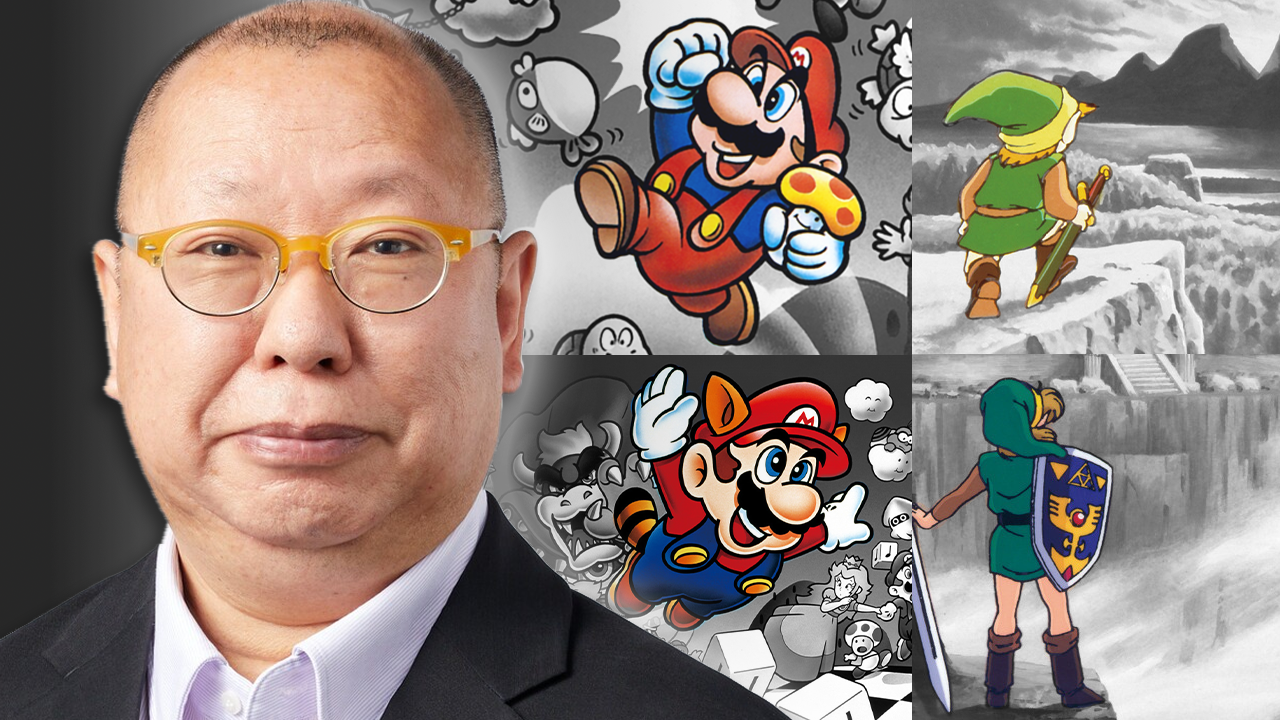
In January, the Source Gaming team got together to celebrate the career of Nintendo producer Kensuke Tanabe. Now, we do it again for a Nintendo producer of even more renown. It’s not surprising that these are happening—the company has a true “old guard,” many of whom are at and even past retirement age and have seen Nintendo’s previous console through to the end. Tanabe is 63. Our subject for today, producer Takashi Tezuka, is 65. He formally retired today… at least, that’s what we thought.
In actuality, Tezuka has not left Nintendo! In the kind of last minute swerve every gamer knows, despite Nintendo making a statement in their May fiscal report that indicated that he would be leaving the company, last night the man clarified that he’s merely stepping down from his role as Executive Officer to act as a production producer. According to president Shuntaro Furukawa, he intends to still be involved with game development. We only found this out about twelve hours before our intended publication and had to scramble to make edits. So what was a relatively serious piece is still that, just with a bit of a lighter air. We’re not seeing the end of one of Nintendo’s leading lights, just one phase of a rather remarkable life.

Image: Source Gaming. Devil World is representative of a different era of Nintendo’s game design. It’s very arcade-y, something that would be slowly phased out in the years after Super Mario Bros..
For much of his time at Nintendo, Tezuka was relatively unknown to the public. His friend and colleague Shigeru Miyamoto was the celebrity, the face of Nintendo. It was only really in the mid-2010s that the company began to put Tezuka forward as an important part of their history, and for fans to realize the depth of his contributions to the medium as a whole. While he came into the gaming world as an outsider with virtually no understanding of video games—he didn’t know the unstoppable icon Pac-Man, even while making the Pac-Man homage Devil World—he quickly became an important creative leader in the company. He helped direct Super Mario and The Legend of Zelda in powerful, inarguable, and definitive ways. Unlike Tanabe, he didn’t have his hands over the entirety of the Nintendo character stable; he worked on other Nintendo franchises in limited capacities, but his home was always the Mushroom Kingdom. This was especially true when he was promoted out of directing into being one of Nintendo’s main executives in the 1990s, a role that somewhat constrained his ability to contribute to development. Across a forty-two year career, his time as an active designer and director only comprised around eleven. Because of this, his handprint is most apparent from the middle of the Eighties to the middle of the Nineties, but what a mark. And that isn’t to discount his work since, particularly within Mario’s modern sidescrolling adventures.
As we did with Tanabe, we have decided to come together to highlight ten games that show the history of Takashi Tezuka. These are powerful, important, influential games, and in all but one of them he was a critical creative figure. I think they show, at least to some extent, the kind of artist and designer he is. And, hopefully, we’ll see that continue in his new role.
Super Mario Bros. (1985)
When Tezuka started working at Nintendo, initially as a part-timer while in college, he did sprite art for the original Punch-Out!! from 1984. After graduating and joining the company full-time, he became assistant director on Miyamoto’s Devil World, contributed to Excitebike, and very quickly fell into the Eighties Nintendo job of taking multiple roles at once. He’d be learning programming on the fly one minute and drawing arcade cabinet art the next. But nothing compared to the production of Super Mario Bros., a game that was both the breakout of Nintendo as a whole and a culmination of all their work with the Famicom. The level select system from Excitebike inspired the Warp Pipes. The conveyor belts and springs came from the Donkey Kong games. This tribute was built by a core team of eight, including Tezuka and Miyamoto as co-designers, Toshihiko Nakago and Kazuaki Morita as the main programmers, and Koji Kondo as composer after his work scoring Punch-Out!! and Devil World. With precious little in the way of memory or power, the team viewed the production as a puzzle: how to get the most out of the sound channels, how to free up just a bit of memory, how to design levels with a complexity far greater than they had attempted. For such a formative and iconic game, it’s fascinating how it was treated as largely an engineering problem.

Image: Source Gaming. The color limits of the Famicom were very strict. Super Mario Bros. team used a number of tricks to make the game more colorful.
Tezuka was instrumental not just for planning the game—he and Miyamoto literally drew the levels on graph paper for Nakago and Morita to implement—but stuff that would be core to the Mario brand. For one thing, he was the one who suggested that Mario be the main character at all off the sales of Mario Bros. He was the one who suggested that Bowser be a turtle to connect to the Koopa Troopas, instead of a riff on the villain of Alakazam the Great. It’s all but impossible to imagine a different version of Bowser; it’s certainly impossible to imagine Mario not being at the front of this creative and commercial explosion. These would not be the last decisions of his that sent a Nintendo series on a path that seems inevitable in retrospect.
– Wolfman Jew
The Legend of Zelda (1986)
Nintendo kept the dream team together with the following year’s The Legend of Zelda. Only producer Hiroshi Ikeda left, and two new programmers, Yasunari Soejima and Tatsuo Nihiyama, joined the development staff. The Legend of Zelda would prove far more complicated a game to make than Super Mario Bros., with Miyamoto and Tezuka both lamenting that they constantly butted up against the limitations of the Famicom. They were driven by an idea to make a game that was entirely the opposite of Mario: not about reaching the end of a level, but finding the level; figuring out what they needed to do next. Little did they know that they would end up creating what would eventually become their biggest critical darling.
This time, Tezuka is listed as co-director, having a larger hand on the finished game. As with the previous game, Tezuka and Miyamoto shared art duties, with Miyamoto providing the sketchwork for every sprite, and Tezuka drawing the layout of the entire Hyrule map.

Image: Source Gaming. It’s astonishing to imagine Mario and Zelda being made almost in tandem. That’s not really possible anymore, for many reasons.
He handed it off to Nakago, who copied it to game data 1 for 1. Something went awry however, and Tezuka accidentally only implemented half of the map. Nakago recalls approaching Tezuka with this and him responding half-heartedly, “What?! Oops, I messed up…” This mistake ended up being a boon, as Miyamoto felt the smaller map size made for a better game, and they used the space saved to implement the Second Quest.
It’s kinda funny reading old interviews where they casually drop that the finished state of a game was caused in no small part by an accident. That kind of thing rarely gets out these days. But if the land of Hyrule was originally twice the size with the same amount of content, I would say that Miyamoto was right. Sometimes, mistakes can work out for the better.
– AShadowLink
Super Mario Bros. 3 (1988)
The kinds of imagery from the early days of Nintendo often feel like urban legends or strange fairy tales. Objects and creatures like the Magic Whistle, Chain Chomp, and Goomba’s Shoe seem to tease some kind of inscrutable private mythology; they feel right in the way something personal feels right. That’s certainly true for Boo, a monster that jumps between painfully shy and dangerous. Tezuka was inspired by a moment where his normally quiet, reserved wife exploded on him for all the time he spent at work. It’s a story that’s become part of Mario mythology, in the way. I’d hazard a guess that if a Nintendo fan knows Takashi Tezuka’s name, they probably know that story.

Image: Source Gaming. Mario being chased by a Boo in Desert Land. Boo would quickly become a fan favorite enemy.
But really, that’s what SMB3 feels like writ large. It’s a game that feels almost mythological in its secrets and aesthetic choices. However, as with Super Mario Bros., as with Zelda, these were the work of experimentation and engineering. Tezuka wanted Mario to have a melee attack, he and Miyamoto both wanted him to fly, and those mutual interests led to Mario getting a Raccoon Suit that’s both striking and curious. The checkerboard imagery was a leftover of a prototype he had for giving the game an isometric perspective. On top of being director, he was also one of the main sprite artists in a game filled with memorable, at times haunting pixel art (he’d give up this role afterwards, feeling outclassed by other developers). Tezuka was mastering an era of gaming where the space to convey a message or a mood was very limited. Nintendo’s prototype- and engineering-based approach turned out to be a great fit for this era, and it allowed striking imagery to work with a solid core. I think that’s why Super Mario Bros. 3 endures.
– Wolfman Jew
Super Mario World (1990)
For the first time in the series, Tezuka served as solo director for Super Mario World. He worked tirelessly, making many of the enemies and mechanics that would define the game and become series staples. Previously, he had been in charge of drawing all of the enemies, but now the development team was 10 large, and he was able to better distribute some of that work to his peers.

Image: Source Gaming. An increased interest in cinematic feeling was a big part of Super Mario World.
One of the previously mentioned series staples introduced in the game, and definitely the largest and most beloved, would be the iconic Yoshi. Yoshi was first made as a concept for the original Super Mario Bros., and the drawing of the Mario sprite riding a dinosaur was taped at Miyamoto’s desk for 5 long years. With the move to the Super Famicom, they were finally able to realize that idea. In a way, Yoshi serves as an evolution of the Kuribo’s Shoe from Super Mario Bros. 3, mechanically filling a lot of the same functions, but with his cute demeanor and ability to swallow things whole, he has made his way into the hearts of millions of players.
– AShadowLink
The Legend of Zelda: A Link to the Past (1991)
After Super Mario World, Tezuka moved on to be the solo director of A Link to the Past, another series first, which was released exactly one year later down to the date. He joined the development halfway through production, putting the game as starting sometime in 1990.
A Link to the Past was a breakthrough title for the Zelda series, returning to the familiar top-down exploration gameplay of the original The Legend of Zelda after its sequel Zelda II: The Adventure of Link was, to quote fellow series creator Miyamoto, “sort of a failure.”

Image: Source Gaming. A Link to the Past would serve as an early template for the classic Zelda formula.
One of the most innovative ideas of A Link to the Past is its two overworlds, a Light and a Dark World. Kensuke Tanabe, who we’ve previously written about, was the one to come up with many concepts for the game’s scenario, including this one. This came about after they had to downscale their efforts, as they had initially planned to make 3 entire overworlds.
Tezuka and Tanabe both shared a vision of a more story-based Zelda, remarking that one of the key things was to make players have an emotional connection with Link. As he grew on the adventure from humble villager to hero, the player would grow too. It may seem rudimentary these days, but A Link to the Past is one of the defining games that codified how to handle this level of storytelling through cutscenes and gameplay progression.
-AShadowLink
The Legend of Zelda: Link’s Awakening (1993)
While Nintendo initially saw Link’s Awakening as a way to port A Link to the Past onto the Game Boy, the project veered wildly into a seemingly implausible direction. Inspired by Twin Peaks, which took Japan by storm and was radically changing TV history, the team created a cast of eccentric weirdos who could be charming and suspicious in equal measure. Instead of Ganon’s latest return, the story was a surreal mystery. Mario and Kirby characters inexplicably patrolled the dungeons. This direction not only made Link’s Awakening a masterpiece but irrevocably altered its series’ trajectory. From the very next game to today, Zelda would follow this charter of strange characters and settings. It’s been a secret sauce for the franchise, allowing it a personality few fantasy games match and the ability to easily incorporate drama, horror, comedy, and a shining weirdness. Fan favorites like Hestu, Skull Kid, Midna, and Beedle can trace their role directly back to this game. So can the hazier, spookier moments, things like Ocarina of Time‘s Bottom of the Well and the grand cutscenes of Twilight Princess.

Image: Source Gaming. Tezuka only worked on Link’s Awakening DX, a Game Boy Color port that added colors and a bonus dungeon, in a supervisory capacity. However, it’s the default version of the original today.
And that stemmed from Tezuka directly, because he was the one behind this change. As director, he gave the team instructions to make a Zelda game without the Triforce, or Zelda, or Hyrule, and the result was what he’d later describe as “almost a parody” of the series he helped create. It’s not abnormal for a franchise to become self-aware or meta, especially these days, but the Zelda team made Link’s Awakening emotionally resonant in a way few Game Boy titles were and few self-referential games have been since. The creativity on display is still stunning whether in its original or its reissues for Game Boy Color and Nintendo Switch (neither of which he was heavily involved with, but both of which retain these qualities perfectly). Tezuka’s decision ensured that Zelda would stay weird and weirdly emotional in the decades to come.
– Wolfman Jew
Super Mario World 2: Yoshi’s Island (1995)
While the idea for Mario to have a riding companion came from Shigeru Miyamoto, who had wanted it ever since 1985’s Super Mario Bros., it was Tezuka who finally implemented the idea. He was the director of Super Mario Bros. 3—where the idea was revisited—and Super Mario World, which saw the introduction of Nintendo’s best character ever (in my opinion): Yoshi. It was during the creation of Link’s Awakening that colleague Shigefumi Hino came to Tezuka with the idea to give Yoshi his own spin-off title and it was Tezuka flesh this out. It was he who suggested many of Yoshi’s unique traits, like the Flutter Jump. Feeling that they had hit a peak with the 2D sidescrolling genre, they wanted Yoshi to be a game that was much easier for newcomers to platformers, while providing a twist not seen before. The result of all this was one of the best games Nintendo has ever made… in my opinion.

Image: Source Gaming. Yoshi’s Island, wth its gorgeous and unexpected visuals.
For Tezuka’s career specifically, Yoshi’s Island is a landmark as it was the final title Tezuka ever took the director role in. He was technically an Assistant Director on Super Mario 64, to Miyamoto, and he wasn’t the only Director for Yoshi’s Island but it’s his last credited role in this position. Starting with the launch of the Nintendo 64, Tezuka would move on to more managerial and supervisory positions instead. Given how late Yoshi’s Island was in the SNES lifetime, to me this really cements Tezuka as an important figure of Nintendo’s legacy era. He would remain in the company for 30 more years after this point, but his biggest contributions to Nintendo’s games themselves happen specifically in the NES, SNES and Game Boy eras. He was one of the most important players in that era of Nintendo and it’s fitting that the SNES best title would also be his swan song.
– NantenJex
Star Fox 64 (1997)
The farther we go down this list of games, the higher Tezuka’s position was when he worked on them. It’s no surprise he started playing a subtler role when the Nintendo 64 hit, since that system marked a point where lots of series found their own voices. In a way, the third dimension helped games deviate from the framework our man fostered. Consequently, we find less of his personal touch in the likes of Super Smash Bros., Paper Mario, and Star Fox 64, which all coincided with his new supervisory role. Even so, all these genres show how much bigger Nintendo’s scope got throughout this generation, and Tezuka’s part in that deserves celebrating!

Image: Source Gaming. By this point, Tezuka had left active game development. His role shifted into supporting productions and staff.
If I could gush about Star Fox for a moment, it’s a part of the N64 picture I find especially important. I only recently got into this particular series, but between Assault, Melee, and even the Galaxy Movie, Fox and friends have been all I can think about… 64 hit me hardest, though, courtesy of its replayable structure, unforgettable voice acting, and novel ideas. Protecting your teammates adds so much to the experience, the Star Wolf fight on Venom thrilled me in ways other games rarely do, and the Lylat Wars host one of the tightest Nintendo stories out there! Even though I love this series enough to look forward to the incoming remake, here’s hoping it works to be its own thing. I have nothing but praise for its inspiration, and appreciate everyone involved.
– Hamada
Super Mario Maker (2015)
While Tezuka’s time in the director’s chair was over, he remained an active producer at Nintendo, supporting games—most notably the 2D Mario games—and staff for what would end up being the majority of his career. And he’d mostly go unnoticed by fans until the hype cycle of two 2015 games, Super Mario Maker and Yoshi’s Woolly World. Nintendo actively used him to promote the games in Nintendo Directs, E3 floor shows, and interviews. He continued this role in the main Mario sidescrollers released since then: Super Mario Run in 2016, Super Mario Maker 2 in 2019 and Super Mario Bros. Wonder in 2023. However, from 2015 onward, he also repeatedly stressed that these were a product of the company’s old and new employees alike. Nintendo likes to think of itself as a continuum, where the creative leads regularly mentor the staff members who will eventually take their place. That was part of his post-designer role.
As a producer of Mario Maker, he helped greenlight the project in the first place. The tools team of the 2D Mario games (who normally make the suite of development tools that the main level designers use) pitched him the idea of turning their systems into a full game as it is—conveniently, it dovetailed with his interest in making a Wii U follow-up to Mario Paint. He recognized that an official Super Mario creation game would have more mass appeal than that game’s loopy creation tools, but that it could also allow him to incorporate those very tools in a way that encouraged experimentation and creativity. That’s certainly true in the final release and its sequel, which feel like toys as much as serious level editors. Due to his profile being elevated and his own role in the marketing, we know more about his involvement than we do for something like Star Fox 64. But Mario Maker is important as both a towering example of the Nintendo magic he spent decades on and the thirtieth anniversary title that brought him into the limelight.
– Wolfman Jew
Super Mario Bros. Wonder (2023)
In many ways, Super Mario Bros. Wonder feels like the culmination of that managerial phase of his career. After the increasingly tepid response to the New Super Mario Bros. games, and after players and journalists repeatedly joking that we’d never need another Mario game after Mario Maker, here comes this volcano of creativity. And once again, Tezuka was at the center. The team was eager to reinvigorate the secrets that defined Mario’s first adventures and have since become perhaps too familiar over the years. In a discussion about an item that could alter Mario’s cross-level movement in the vein of the Warp Pipe or Vine, he argued that it should instead alter the level itself. Enter the Wonder Flower, which drove the entire game and symbolized its spirit. He directly suggested that every level should have one, allowed the game to go without a fixed budget for a time as the team figured the mechanic out, and pitched a few of the 2,000 proposed Wonder Effects. His proposal that players could change the difficulty of a level with the press of a button got rejected, though plenty of features in the final product do just that. And his idea of having live commentary went through multiple forms before coming to life as the Wonder Flowers. Yep, he was partially responsible for one of Nintendo’s most controversial characters.

Image: Source Gaming. Despite the limits of his executive position, Tezuka still enjoyed being a creative figure in the Mario games, and you can see his influence on Mario Wonder.
Every major Nintendo game is also a culmination, ever since Super Mario Bros. Ocarina of Time, Skyward Sword, and Breath of the Wild are as much examinations of every Legend of Zelda game that came before as they are explorers and innovators. Wonder feels like that, too. It’s not just in all the winks and nods and cameos, several of which come from games Tezuka worked on. The gorgeous art direction and character redesigns feel both nostalgic and forward thinking. The old ideas that are there and the ones that are missing are the result of that cross-generational development. I think the “Nintendo magic” fans identify comes partially from this element, and nurturing it was a major part of Tezuka’s job.
– Wolfman Jew
In his op-ed about the man for Polygon, Oli Welsh notes that in at least one way, Takashi Tezuka was an artifact of the old way of doing things. Not in his personality or his sensibilities or his values, but simply in his origins. It’s not impossible for someone with little or no knowledge of games to enter the industry; outsider art always exists. Nor is it impossible for someone like that to join the mainstream. But every path for someone to come in as an outsider and define the medium within one year has been thoroughly blocked. Everyone who’s going to work in gaming knows at least what Pac-Man is. Mainstream development is aggressively stratified against anyone without at least some experience. It would be ridiculous for it not to be. But Tezuka entered a field so new it had largely escaped his awareness and, within a decade, programmed and directed several of the most influential games ever made. You can see his effect on Mario and Zelda and gaming as a whole, like roots from a tree.

Image: Source Gaming. Excitebike was one of Tezuka’s earliest games. Like most of the pre-Super Mario Bros. Famicom titles, it was simple but addicting.
And then, after a decade of making “one of the greatest games ever made” several times over, he moved into a position that was maybe less creative and definitely less direct. And he still kept working. His fingerprint may not be as clear in the 2010s and 2020s as it was in the Eighties and Nineties (the 21st Century game he probably had the most involvement in was Super Mario Run, which we ultimately found less compelling than he did), but he was still part of the Nintendo ecosystem. At least to some degree, he touched the likes of Animal Crossing and Pikmin 4, games two decades apart.
To me, at least, this is the story of Takashi Tezuka: a man who has had two acts in a life as one of the most important game developers in history. The outsider who quickly led Nintendo’s charge, and the executive who contributed behind the scenes. I learned a lot writing and organizing this list, and I hope you did as well. If you have a favorite game or story of his, please mention it. And to Tezuka-san, thank you from us. You made the world of gaming just a little more colorful, and we’re very excited to see what this third act might bring.

- Back on the Bat Chapter 3: The Black Mask Casebook - September 28, 2026
- Nintendo Direct September 9, 2026: Information and Reactions - September 9, 2026
- The Legend of Zelda 40th Anniversary Direct September 8, 2026: Information and Reactions - September 8, 2026