
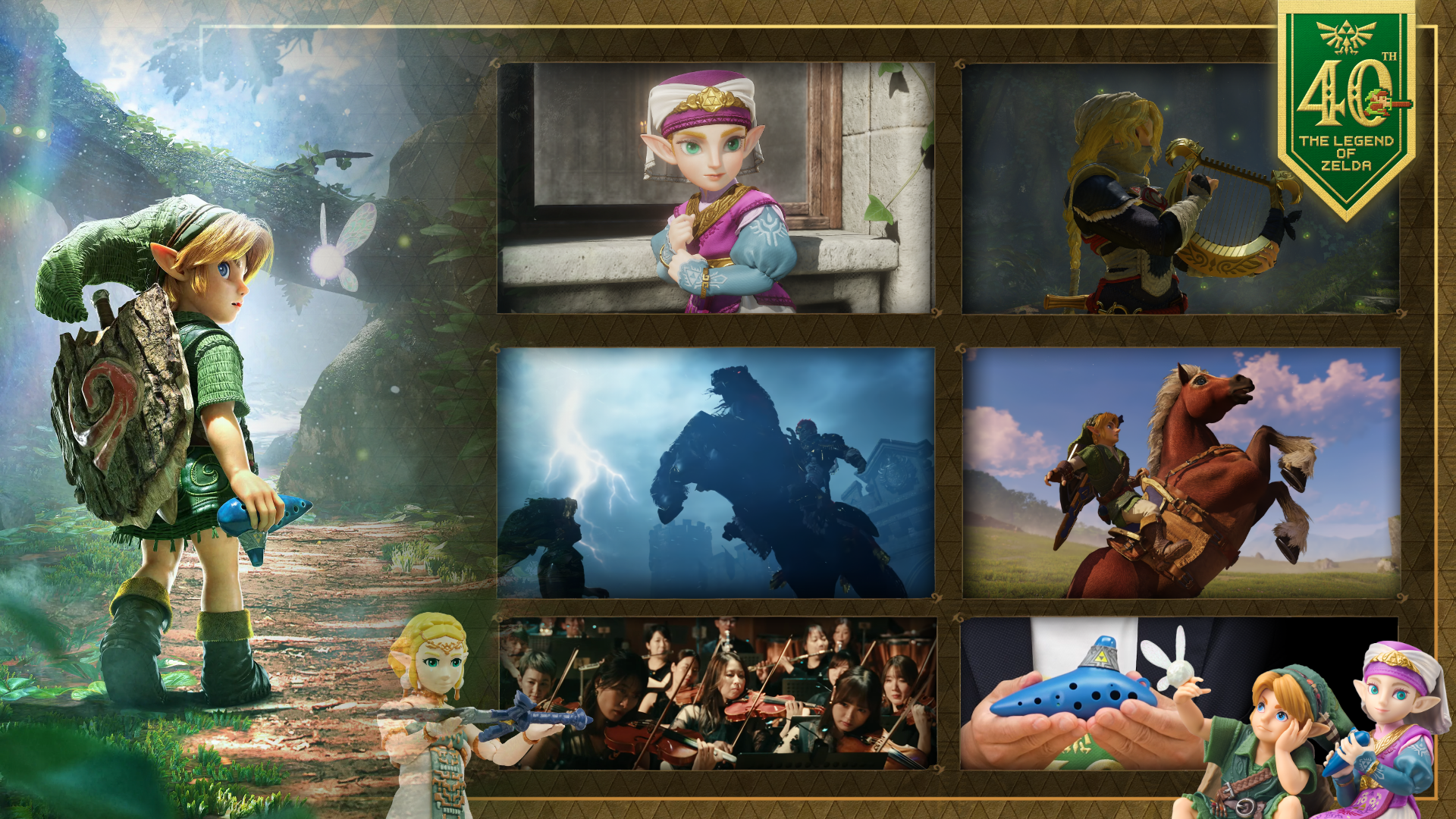
EDIT: 5:30 P.M. EST: A YouTube video compiling the HD footage available on the official Japanese The Legend of Zelda: Ocarina of Time for Nintendo Switch 2 website has been added to the videos of note section, along with other minor article edits.
On February 21, 1986, Nintendo released The Legend of Zelda. Since then, the collective adventures of Link, Zelda, and Ganondorf have grown to become one of gaming’s most storied series, innovating and mastering across genre, dimension, art style, and direction. But Zelda’s fortieth anniversary had gone with barely a mention by Nintendo. Until now, it seems. A full year after Super Mario’s 40th was celebrated last September as the start to a Nintendo Direct, Zelda’s getting its own introductory show to kick off a general presentation covering Nintendo’s fall plans. However, instead of being part of the show itself, it got to stretch out a bit a day in advance.
Make sure to come back tomorrow to learn about the September 2026 Nintendo Direct, but for now, here’s what we saw at the Zelda show, hosted by longtime Zelda designers Shigeru Miyamoto, Koji Kondo, Eiji Aonuma, and Hidemaro Fujibayashi.

Image: Source Gaming. Young Link and his awesomely detailed ocarina.
Like with Mario, the 40th Anniversary came with a trailer for the upcoming Zelda movie. Also like with Mario, it was just a seconds-long teaser trailer with no footage of any kind. Actually, it’s even less interesting than that Mario one.
- Its title is, unsurprisingly, The Legend of Zelda. Release date: April 30, 2027.
- The film lacks a subtitle because it’s not an adaptation of any particular story, but an original plot “based on the many stories, ideas, and concepts of the series.”
- The Triforce is involved in some capacity.
- No other details were shown, including actors who’ve already been confirmed by press outlets such as Variety.
Nintendo Museum, which opened last year, will have some cosmetic changes that will coincide with an update to the installation.
- The tickets will change to a The Legend of Zelda 40th Anniversary theme, and the museum will also have a history board featuring each title in the series.
- Starting November 5, the museum will feature a new photo-op “around the Master Sword and more.”
- Fall 2026 will coincidentally also see the opening of the Super Family Restaurant. Conveniently, a statue of Breath of the Wild Link (that looks just like the one from E3 2016) will be stationed there, alongside statues and figures of other Nintendo characters.
The show started with a recording of an all-new orchestral production, a medley of the series that focused on the wielders of the Triforce: Zelda, Ganondorf, and Link. After discussing the music of the Zelda series, Koji Kondo announced The Legend of Zelda 40th Anniversary Concert.
- The music will feature “a variety of music,” so presumably going across the series.
- Throughout 2027, the concert will tour in Japan, the United States, Europe, and Australia.
- The Japanese schedule is as follows:
- Tokyo Garden Theater, Tokay, January 23.
- Fukuoka Civic Fall, Fukuoka, February 6.
- Sapporo Cultural Arts Theater Hitaru, Hokkaido, March 3.
- ROHM Theater Kyoto, Kyoto, April 3 and 4.
- K-Arena Yokohama, Kanagawa, April 27.
- The U.S. tour begins February 22 in Chicago, the European one April 3 in London, and the Australian one May 13 in Melbourne.
- Ticket sales begin later this month; “more cities and countries to be added.”

Image: Source Gaming. An early cutscene shows off the art direction.
The bulk of the show was dedicated to the remake of The Legend of Zelda: Ocarina of Time, a game built to be a 40th anniversary title. Before a trailer ended the Direct, Aonuma played through various early areas: Kokiri Forest, Inside the Great Deku Tree, Hyrule Field, Castle Town, and Lon Lon Ranch.
- Release date: November 5, 2026.
- The most notable part of this, game, at least for longtime fans, are the graphics. While the environments definitely lean into a samey Unreal Engine look that the June teaser trailer implied, the character designs are almost toylike. Characters are slightly chunky, with very untextured skin and hyper-detailed clothes. Link looks like an action figure. This was a deliberate attempt to represent the goal of the project, which was to create a nostalgic and rose-tinted depiction of Ocarina of Time.
- It’s deliberately and unsurprisingly very faithful in its levels and overall structure. Unlike the wildly open Breath of the Wild and Tears of the Kingdom, it sounds like it’s keeping the more linear progression of “classic Zelda.”
- The focus was primarily on showing the differences between versions:
- As is expected of remakes like this, the music has been remixed.
- While every area keeps the generally same structure, every area that was shown (except possibly Lon Lon Ranch, which was barely featured) has been redesigned. Some rooms and puzzles are different, and the architecture has been expanded. Castle Town’s back areas are much more well defined, while Kokiri Forest has much more elevation.
- Camera controls, yo.
- There’s a dedicated jump button, instead of the automatic jumping of the original 3D Zelda games.
- Swimming is more naturalistic, and there’s an air meter—though I’m not sure how much it’ll affect the game given the way the Zora Tunic works.
- Link starts off with a 200 Rupee limit, not the cruelly restrictive 99.
- The UI is largely similar to the other HD Zelda games. Link swaps between items the way he does in Breath of the Wild, though presumably with fewer options. The main changes are mostly stylistic, like how Link’s Hearts are softer than the sharp red sprites of the Switch-era games. Items have been separated into “Equipment” and ‘Items” menus, the latter of which looks unique. Link can switch between them as he switches items in Breath of the Wild. NPCs also speak in word bubbles as you walk around, like modern Nintendo games.
- This means that the most controversial part of the original game—the constant use of the Iron Boots in the Water Temple—appears to have been simplified, much as it was in The Legend of Zelda: Ocarina of Time 3D. Link can take them off without having to go in the menu.
- Navi’s barks have been rerecorded. Her lines have also been rewritten to be… actually helpful.
- Due to processing speeds, the combat is smoother.
- Along with the new rooms, at least some puzzles have new solutions. The notorious spiderweb in the central room of Inside the Great Deku Tree can now be burned.
- For me, at least, the nicest change is to the aiming. It takes the third person approach that Twilight Princess brought to the series, instead of the immobile and claustrophobic first person perspective.
- “Threads of Time” is a new feature that chronicles what you’ve done in the critical path and acts as a guide for the next part. It also comes with a tapestry of the plot that grows over time.
- The loading screens have been kept for nostalgia.
- While rolling is still here, Link will run out of his roll if you hold A to move much faster.
- The day / night cycle no longer pauses in towns and buildings.
- The Ocarina of Time is compatible with Nintendo Switch 2’s microphone. It can respond to voice and instruments, including a bonus (and fully usable) Ocarina of Time peripheral. There’s a Playable Ocarina and an Electric Ocarina of Time.
- Link can jump onto ladders, instead of having to climb them from the bottom.
- The cutscenes are fully voiced. Ganondorf definitely sounds like he’s still voiced by Matt Mercer.
- According to the Nintendo press site, “the first print run of the physical version will commemorate the release with special packaging that features textured foil cover art, available while supplies last.”
Breath of the Wild director Hidemaro Fujibayashi announced that Zelda Notes, the strange app that gave hints and help for the Nintendo Switch 2 Editions of Breath of the Wild and Tears of the Kingdom, will be compatible with Ocarina of Time.
- Today’s Record tells you your accomplishments on particular days, saving screenshots automatically.
- Gossip Quests provides clues for environmental puzzles. They get points you can spend on songs for the Play Ocarina mode. The app will pull up an image of the Ocarina of Time (and maybe the basic Fairy Ocarina), and you can play those songs.
- Notably, these include songs that aren’t normally playable, like the themes for towns and races. You can also just listen to them.
- You can also make your own songs and share them online via QR codes.
- Ocarina of Time Quiz asks “over 2,000” questions about the game. You can retry quizzes with in-game rupees, which can be ported into the game.
- There will be more features to some degree.
There was some merch announcements, of course:
- Nintendo Today! was updated a day after the Zelda presentation to change some of the Zelda art. It will also be used to release updates about The Legend of Zelda film, as well as digital collectible cards, not unlike those from The Super Mario Galaxy Movie.
- Nintendo Museum Official Book Vol. 2 will be available November 5, 2026/
- The Mineru’s Construct amiibo, which releases September 17, was referenced.
- LEGO The Legend of Zelda set was announced: Link & Epona.
- Alongside the previously announced “Heroes of Hyrule” toys of Zelda, Link, and Ganondorf, Hasbro will also be releasing an “Electronic Master Sword.”
- Huzzle, which has made multiple Legend of Zelda products, will be releasing a The Legend of Zelda Masterpiece Color Edition and Premium Gold Edition Huzzle of the Master Sword and Triforce.
- New amiibo of Young Link and Young Zelda were announced. They unlock in-game masks of Link and Zelda’s polygonal 1998 faces.
- Leaked back in August there will be a (gorgeous) Ocarina of Time and 40th Anniversary-themed Nintendo Switch 2 model. Releases October 29. In addition, there will be a 40th Anniversary Pro Controller and screen protector.
- The title screen theme of Ocarina of Time will be added to Nintendo Today!
The Direct and videos of note:
Wolfman’s Soapbox: When the Ocarina of Time remake was announced, I was skeptical. While it’s certainly aged, I think it’s a fine and eminently playable game, a zenith of N64-era design sensibilities. I love Nintendo to death, but I wasn’t confident of their willingness to make a more radically different version, or at least one that followed the vision of the brilliant and very powerful Resident Evil remakes. Plus, we just had a remake of a Nintendo 64 game, and the “Unreal Engine fan game” look of the (very short, barely there) teaser trailer didn’t inspire me. That look is not one that endears itself to me.
I think what makes it work is the character designs. I know that they look a bit weird and awkward, but the action figure look really does it for me. It feels nostalgic, and silly, and very toyetic, which is the part that the Unreal look doesn’t go for. Seeing them in this pretty standard HD level where everything is way more brown than green or blue or whatever does make the space pop just a bit. And I think that fits the game as a whole, which is more different than I was expecting. There are solutions and problems unlike the ones I’ve gone through maybe a dozen times. It’s not as much as I’d like, at least so far, but it is more than I was expecting. I like it.

Image: Source Gaming. The surprisingly short Phantom Ganon.
Other than that, this was definitely slight for someone wanting substantial news on games, but I also found it that entertaining in its own way. Spending so long on apps and introducing multiple playable ocarinas was fun; the latter had the kind of silly, galaxy brain Nintendo magic that Zelda has often had and which this presentation otherwise lacked. That Pro Controller looks incredible. The lack of anything of note for the movie’s a bit annoying, and I was kinda hoping for Twilight Princess on Nintendo Classics, but I enjoyed this well enough. In some ways, it reminded me most of all like those early Nintendo Directs, the ones that were mostly just briskly-told updates. “Here’s some things we’re doing. Here’s this new game you wanted to see in motion.”
Now, onto the general! That’ll presumably give people more of what they want.

- Back on the Bat Chapter 3: The Black Mask Casebook - September 28, 2026
- Nintendo Direct September 9, 2026: Information and Reactions - September 9, 2026
- The Legend of Zelda 40th Anniversary Direct September 8, 2026: Information and Reactions - September 8, 2026








Got a lotta info of the OoT remake as expected (the game looks gorgeous) but its a bummer there was nothing new on the movie besides the name and some minor details on the plot. Oh well…