
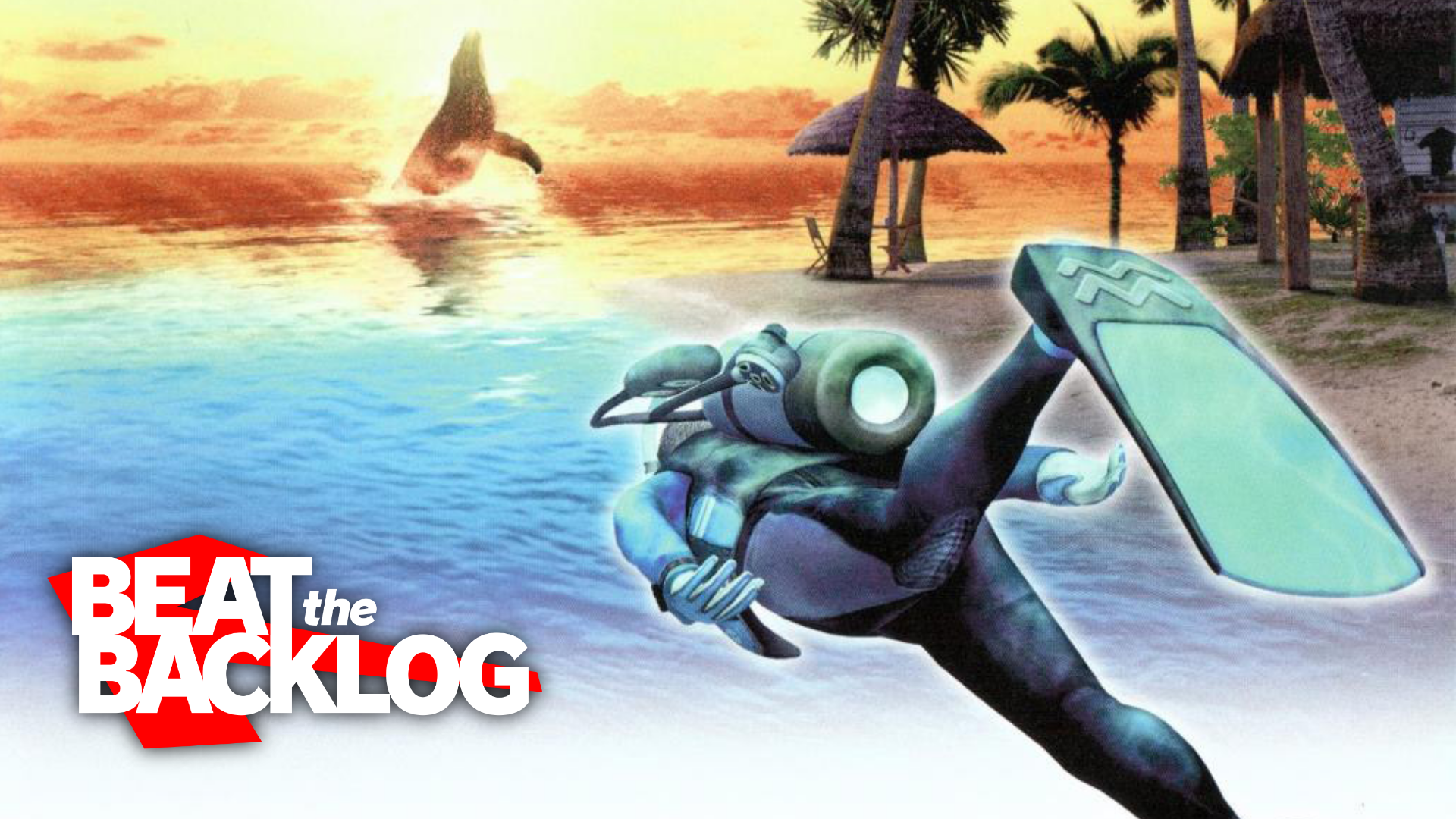
“Wii would like to play” was a perfect slogan. During the seventh generation of gaming systems, Nintendo expanded the medium’s reach through “casual” software that looked alien next to anything found on Sony or Microsoft’s cutting edge consoles (at least initially; they later made half-baked efforts to capture the casual demographic). Nintendo accomplished that through unique, intuitive controls: swing your Wii Remote to play golf, or use the Nintendo DS stylus to solve puzzles, read mystery novels, or raise virtual dogs. Many of these games conveniently carry the Touch! Generations label, and our subject for today, Endless Ocean: Blue World, was released under it in Europe.

Image: Nintendo. Europeans know this diving sim as “Endless Ocean 2: Adventures of the Deep.” While I regrettably skipped the first, I hear it’s a relaxing experience that sold surprisingly well.
After creating a barely customizable avatar (which you can freely tweak later), Blue World makes a promise: you’re on an adventure, a search for long lost treasure—and are on the cusp of discovering it! Cheesy vocal music by Celtic Woman beautifully sets the tone as a wealth of wildlife swims by. You’re on a humble boat surrounded by your colleagues, all of whom praise your accomplishments; we’re no fish out of water, apparently! This cold open grabs your attention while conveying that this Endless Ocean has grander ambitions than “just” offering the calming exploration of its predecessor.
Unsurprisingly, Nintendo and Everblue developer Arika’s seafaring escapade employs a simple control scheme. Aiming the Wii Remote guides you, and you’ll swim in that direction while holding the B button (Blue World makes no use of the Nunchuk accessory; it even tells you to disconnect it before starting). Your oxygen tank perennially depletes while underwater, and you lose air faster the deeper you go. Occasionally, you’ll encounter aggressive wildlife, the touch of whom also reduces oxygen. However, you can upgrade your oxygen tank by spending in-game currency you’ll accrue by playing through the campaign and tackling side quests. Longer story sequences automatically refill your tank at specific points, while one late game labyrinth drops down “refill stations.” Blue Ocean isn’t punishing.

Image: Nintendo. It is home to plenty of sea life, however! Small descriptions of each critter are included, and you can feed, pet, and—in a few specific cases—ride them. Think of Blue World as an interactive virtual museum.
Clicking the A button on any wayward fish, mammal, reptile, or bird lets you inspect them. Doing the same on glowing spots in the wilderness yields a picturesque look at little ecosystems that may house fish and, if you’re lucky, collectible coins. Pressing the 1 Button reveals the map; it appears in full color while stationary, but it turns partially translucent when you begin swimming so you can see where you’re going. Maps start with an outline of the area but get filled as you explore. Most locations only have one diving location by default, and you’ll discover the rest by surveying the area. Completing maps increases your rankings and yields in-game currency, so even swimming aimlessly can prove fruitful.
Advancing through the story yields a handful of handy tools. Clicking on the D-pad brings them up and allows you to shift through them. An underwater pen lets you leave messages. The pulsar can heal injured or calm agitated fauna. Feel free to offer fish food; some require a snack before you unlock their trivia pages in the encyclopedia. Taking photos is done with the camera, a fun side activity, and you can even save the keepers to an SD card. The Sea Whistle lets you interact with the wildlife, including your own aquatic companions. Near the onset of Blue World, you befriend a dolphin and can tame other majestic beasts later; hitching a ride on them is faster than swimming solo.

Image: Nintendo. Each tool’s introduced through a tutorial, and they’re doled out slowly as to never overwhelm. An optional side activity is managing an aquarium, a neat extra I nevertheless mostly ignored.
Locating story-critical metal objects and optional buried treasure is done by scanning surfaces with the multisensor, the handiest tool. Its light turns blue if you’re in the general vicinity of something, yellow when you’re close, and red when you’re right on top of it. Then the treasure—or “treasure;” not everything salvaged is valuable—emerges and clicking on it adds it to your inventory if there’s enough space. You can purchase larger bags, and one particular diving buddy increases your storage by five units.
Most people in the intro can join us underwater. When Blue Ocean properly begins, you’re a new recruit at the humble R&R Diving Service. It’s ran by Jean-Eric Louvier, a grizzled former diver whose experience and knowledge proves invaluable. His only other employee is Océane, his 14-year-old granddaughter. The missing link between them is the late Matthieu, Jean-Eric’s son and former pupil who lost his life trying to uncover the fabled Pacifica Treasure. The “Song of Dragons,” an ominous jingle heard throughout Blue World, is the key to unlocking it, and along the way we’ll meet a wealth of other sea-lovers. Chief among them are rival excavator Gaston “GG” Gray and aquarium head Dr. Hayako Sakurai, who eventually join the team. Where GG helps carry stuff, Hayako translates ancient murals. Everybody contributes, even if you’re the ace whose talents ultimately nudge R&R Diving Service across the finish line.

Image: Nintendo. A danger sign appears when you’re near something hazardous. You’ll see it incessantly while swimming through Brazil’s claustrophobic, piranha-infested river.
There’s plenty more to do in Blue World beyond its campaign, and I imagine most players will dabble in its side missions to earn extra cash. Most are simple: give tours to novice divers (going the extra mile for them yields generous tips), locate and heal fish, find missing objects, or take photos for magazines. Talking to your pals at the hub is how you accept these tasks. While all of this nicely furthers the game’s sense of awe, the feeling that every dive can yield a new discovery, too much of it feels like busy work; completing Blue World isn’t enticing. Still, it’s nice that there’s reason to keep working for R&R Diving Service. Treat it like an Animal Crossing; make a little progress every day when you’re unwinding until you’ve had your fill.
Anyway, Nineball Island is our base of operations. It’s a humble hub that’s home to our house, a table, dock, and boat. The table holds all the essentials: a radio, a notebook to save (you can also save while on the boat between diving excursions), the camera and photo albums, and books that log our accomplishments, side quests, and documented fauna. Using the radio summons Nancy, hairdresser, goods vender, and treasure appraiser extraordinaire. Some of her wares are effectively essential—good luck surviving the endgame dungeon without buying better oxygen tanks—but many are purely for cosmetics. You can even decorate the island, although customizing it lost a lot of its appeal after Nintendo terminated the Wii’s online services. You used to be able to invite friends over to your digs, take a dive, and even chat together through the Wii Speak peripheral, delights I’m unfortunately unable to savor.

Image: Nintendo. An enigmatic blue bird leads a side quest chain where you search for its seven hiding spots across the world. It’s one instance where the game’s day-night cycle matters beyond the visuals, too.
Diving alone is still a treat, though. Each of the six chapters unlocks a new area, most of which house sub-stages; in total, there are thirteen maps. Situated near Nineball Island, Gatama Atoll is the first one and a pleasant primer, an open seascape whose mandatory sub-map is a deep chasm (its second sub-area is wholly optional and accessing it requires two reef-themed accessories). The basics are taught here, animals are rarely aggressive, and it looks gorgeous. Ciceros Strait, the second region, ramps things up; there’s less space to maneuver, sharks cross your path, and this is where the cocky GG debuts and pushes us to hone our skills. Afterwards, we gain access to more visually striking, dangerous areas: two arctic seabeds, a murky river within Brazil, and Egypt’s fabled diving grounds. Sub-stages usually force you through tight corridors, ones rife with treacherous lifeforms. Altogether, Blue World hosts a commendable amount of variety despite over ninety percent of it being spent underwater. The two submerged, labyrinthian castles in particular are begging you to explore, to solve their riddles.
That’s the key word, exploration. Blue World’s threadbare plot and cast are at best serviceable, and the treasure’s overarching mystery and the Louviers’ familial drama consequently lacks impact. Similarly, the depth of the gameplay never matches the depths of the ocean floors you’ll plunder; this is, again, a simple game. But that’s fine because Endless Ocean’s core appeal is in sightseeing; à la fellow Wii luminary Xenoblade Chronicles, locations are introduced through title cards and are rewarding to uncover. Finding elusive creatures even evokes its Unique Monsters, though wildlife here rarely makes a violent beeline towards you. The animal buddies help you reach isolated corners of the ocean, like when my dolphin sidekick Hamada (named after my dear colleague and friend) moved a boulder that was blocking my path. Appropriate for a museum, Blue Ocean even feels educational; you’ll learn about icebergs and climate change’s impact on them, for an example. And Akira has an eye for the big, sweeping moments as well as the little pleasures, in watching fish go about their day or nibble on grub. While the graphics show their age, Blue World’s atmosphere is impeccable, and I’m glad I finally experienced it.

Image: Nintendo. As someone who loves aquatic ambience, a whole game built around it speaks to me. Endless Ocean champions nature!
Endless Ocean never became an industry staple. In fact, it fell into dormancy after Blue Ocean, only reawakening in 2024 through the surprise release of Endless Ocean Luminous. Sadly, the property probably doesn’t carry a broad enough appeal to become a Nintendo mainstay. To be honest, I gotta be in a specific mood to savor Blue Ocean, whereas I can easily pick up and play, say, Donkey Kong Country or Pokémon Puzzle League. When that mood does strike, however, nothing’s quite as satisfying as taking a long, stress-free swim. I’m glad Endless Ocean resurfaced, and I hope it keeps doing so—it occupies a unique niche within the Nintendo ecosystem, one that should never get lost to time.

Image: Nintendo. Blue World isn’t the biggest hit hailing from Nintendo’s bold blue ocean strategy, but it’s pleasant and I look back on my underwater adventures fondly.
Thanks to Slink for helping with edits.

- Continuity Corner: Why Did Ash’s Pikachu Forget Volt Tackle? - October 16, 2026
- The Donkey Kong Bananza Hype Cycle – A Retrospective - July 17, 2026
- Beat the Backlog: Sonic Blast - July 9, 2026