
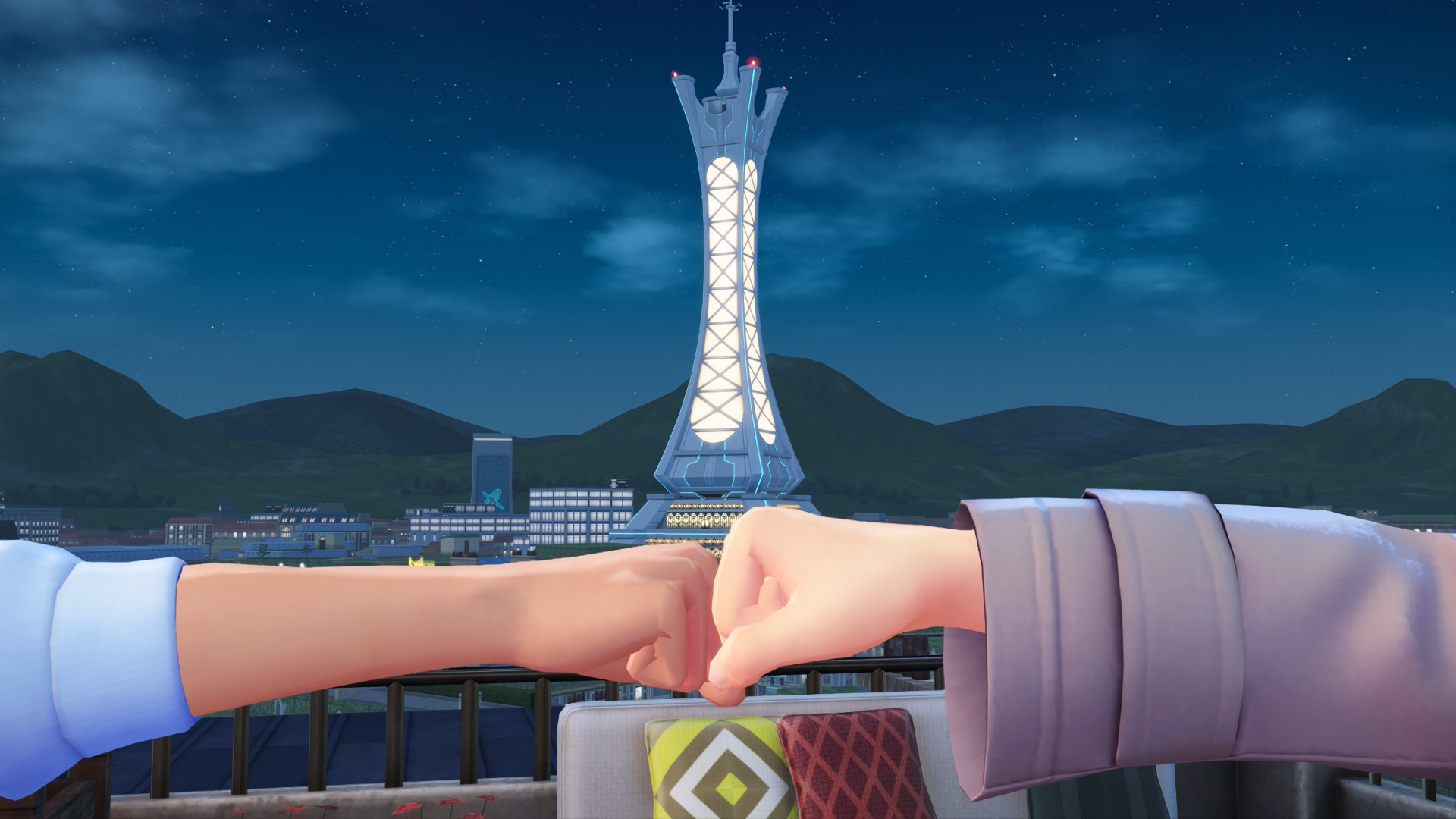
This review copy of Pokémon Legends: Z-A – Nintendo Switch 2 Edition was provided to Source Gaming by Nintendo. Thank you to Hamada for editing & proofreading.
PROLOGUE – A Kalosian Memory Link
More than ten years ago, on January 8th, 2013, Pokémon X and Pokémon Y were announced for the 3DS. A day that I remember all too well. Unaware of Nintendo Directs at the time, I caught the announcement after the fact during Mouse Squad, in my final semester of middle school. I excitedly tapped away on my new iPhone 4 to my good friend, Usai-Senpai, about how a 3D Pokémon game felt unbelievable. I recall latching onto Chespin being the cutest, despite my opinion later changing with Fennekin as my starter. However, part of that excitement also put me face-to-face with unexpected, unavoidable change, as it cemented that Pokémon Black 2 and White 2 were truly the swansong of the 2D sprite-presentation. As a thirteen-year-old, I had experienced change with the moving of apartments and passing of family, but to experience such with my lifelong obsession – that felt unbelievable.
The sixth generation of Pokémon was probably the first time I developed a sense of being critical of the series. Despite the range of new designs presented, ranging from nice to extremely captivating, its national Pokédex provided the smallest amount of new monsters to catch. This felt like a huge drawback that instilled concern for future creative possibilities from Game Freak, although that worry was for naught. Years later, and still today, I think X and Y performed well in making the series momentarily more fun with the inclusion of Mega Evolution and connecting players near and far with the P.S.S. system. However, its story did not remain as present in my mind as the titles prior and even later, thus feeling like its weakest asset.

Image: PhantomZ2. Trainer ID of my original Pokémon X copy.
Before Pokémon Legends: Z-A’s release, I restarted my twelve-year-old copy of Pokémon X for a refresher. Although I didn’t finish in time, it felt comforting to return to Kalos. Even with the EXP Share on, I thought that the potential for challenge popped through due to my team composition. That challenge could also be due to not having an extra powerhouse with Speed Boost Torchic with a Blazikenite at my side. Returning to Kalos also brought me back to design aspects of the series that I really missed: caves and routes that consistently challenge the player with wild Pokémon and eager, unavoidable Trainers, and the need to manage my Pokémon’s movesets due to HMs for progression. The music and architecture of Pokémon X is also unique, unlike anything else within the series, making Kalos stand out and, at times, evoke the feeling of other JRPGs, like Final Fantasy (WS).
However, part of its story blemishes were ever more present when returning. I appreciate the early seeds of having companions travel alongside me within the Santalune Forest, something that wouldn’t return in similar execution until the end of Pokémon Scarlet and Violet. However, the presence of Tierno, Trevor, Shauna, and Calem throughout the journey is incredibly abrasive, spawning my dislike for all of them. The first three are too nice in a way that not only feels handhold-y, but also in a manner that pushes the player up while zapping any sort of interesting personality that they could have. Calem, although not a jerk, is cut-throat and plain in a way that makes me want nothing to do with him. And as for its antagonist, Lysandre, he’s quite an eccentric man. Passionate about making the world a more beautiful place, but expressed so abruptly, unasked, that it makes you wonder if anyone else is aware of this literal walking red flag.
On the other hand, Kalos’ world-building was also captivating. Generation 5 introduced a narrative that I still find mature, asking the player how they view the world and coming into personal conflict with someone who differs, yet is so similar. Pokémon X, although not complete in presenting its region, still features many pieces that represent the idea or directly mention the notion of both war and mortality. With many tourists visiting its land, interested in its wonders, the player’s journey will also feature their discovery of these ideas as tackled within the world of Pokémon.
But, since I didn’t finish my playthrough before Pokémon Legends: Z-A’s release, I won’t continue to speak on Pokémon X more than I can. Continued analysis and experience would be best explored at a different time. Doing so momentarily provided some context to this brand-new journey in Kalos. One that fans have been curious about for over a decade.
STORY – Five Years in Twelve
Sometime, not that long ago, a young Trainer conquered the Kalos region’s League and put a stop to an evil organization known as Team Flare. Led by Lysandre, they intended to utilize a device known as the Ultimate Weapon, seeking to turn the world into a more beautiful place through selective immortality or extermination. Although some harm was caused to the region and its inhabitants, ultimately, Kalos was saved from such a destructive plot. However, a new threat has befallen the region.
At the center of Kalos lies Lumiose City, a Paris-inspired home to cafes, restaurants, boutiques, and now Pokémon. After the defeat of Team Flare, an urban redevelopment plan went underway to reshape the city to one that now serves as a home for both people and Pokémon. However, when it was time to rework the Eiffel-shaped Tower that lies at the city’s heart, the Prism Tower, it began to emit a pink aura. This drew the attention of an overwhelmingly tall old man and his strangely colored flower Pokémon. With his presence, he initiates a search for “the strongest Mega Evolution user in the city,” thus cutting to our arrival, five years after the events of the games that were released twelve years ago.

Image: Source Gaming.
There are questions to be had about how The Pokémon Company marketed the game. Certain characters didn’t show their face until around the final third, but their implementation was still fantastically impactful to the narrative. One returning character that I was absolutely excited to see didn’t leave as much of a mark on the narrative as I would’ve liked, despite her presence on the box art. But that’s about the only downside that I could make note of, narrative-wise. As progress through the adventure was made, I was constantly left wondering what would happen next. Part of me wonders if more aspects related to the narrative should’ve been shown, or just different parts overall, but then that would’ve taken away from the surprise when I experienced them. Pre-release marketing clearly affects the perception of the story once experienced, not in a detrimental way, but one that just leaves me very curious.
Veterans of the series may wonder why I’m omitting certain details regarding the story and backstory. The fact of the matter is that any new Pokémon game is someone’s first. Unlike Legends: Arceus, which served as a prequel to the Generation 4 titles, Legends: Z-A is a sequel that, I’ll state from the get-go, treats its story incredibly well. Some details and events from Pokémon X and Y are restated for those who have never played them, as well as those who did, as a refresher or clarification of the dual-title aspects. However, players who missed out on Pokémon X and Y would not be able to fully enjoy call-backs, special moments, or writing quirks that make Legends: Z-A’s story more special as a follow-up. Thus, I will simply share that Pokémon Legends: Z-A is a title that stands as one of the best, writing-wise, across the mainline titles. The events that unfold are captivating, the humor is more pronounced than in any other title within the franchise, and the diversity of characters in terms of personality and appearance truly captures the varied and realistic experiences of inhabiting a city.
GAMEPLAY – Shifting Legends
With 2022’s Pokémon Legends: Arceus, the series saw a more appropriate shift to an open-world format with beautiful, sprawling open zones to traverse, observe, and attempt to catch wild, ferocious Pokémon. However, unlike Hisui, where the concept of a Pokémon Trainer was unfamiliar, the modern time period of Kalos is abundant with them, thus shifting the experimental focus of Pokémon Legends: Z-A to the battle system. Instead of the series’ usual turn-based format, battles now occur as a real-time action system, where positioning and timing are key. Send out a Pokémon to travel beside you, and when locked on to another, command it forward or from a distance, depending on the attack category. Naturally, opposing Pokémon will fight back, and rather than relying on stats of accuracy or evasiveness, knowing when to lock off and walk a Pokémon out of an incoming Brave Bird will be very important to survival. There’s much more to consider, such as utilizing the invulnerability of switching out, attacks with an A.O.E., or a Pokémon’s capability to fly or levitate. In instances of tackling Rouge Mega Evolutions, this title’s form of bosses, utilizing an entire team or just your strongest Mega Evolution-capable Pokémon, won’t be the only factor to success. Knowing when to return teammates to ensure their safety and the player’s own, in addition to timing the utility of Mega Evolution, further highlights the action and strategic aspects of the gameplay loop.
Although a Pokémon League isn’t present, the main challenge within Legends: Z-A comes from the Z-A Royale! When nighttime falls, a random sector of Lumiose City is picked as a Battle Zone, where many Trainers are waiting to duke it out for points and the opportunity to climb the ranks to become the strongest. This is where a classic aspect of the series returns, one that Pokémon Scarlet and Violet left behind: eye contact! Although there are quests during day and night that provide the opportunity to battle against other Trainers, those within Battle Zones don’t hold back at all – as getting caught within their gaze means it’s time to battle! Thus, avoiding their sight by carefully crouching, walking, and hiding behind corners or within bushes to gain the battle advantage with a surprise attack will be key. This is where, to my surprise, Pokémon Legends: Z-A became a stealth-action game. Within Battle Zones, and even when attempting to combat wild Pokémon, I found myself constantly keeping a low profile to quickly take out opponents with super-effective moves that barely allowed them to fight back. Messing up would not only be startling, but could potentially lead to fatal moments that saw even my strongest teammates faint. All of these new aspects of the battle system combined tended to make Legends: Z-A quite difficult in a way that isn’t just left up to the type of Pokémon used. Its challenge relies a lot on how well the player can react and coordinate with their partners. However, difficult doesn’t mean unenjoyable. This new system was incredibly fun to experiment with, and with more experience, multiple playthroughs, and even online battles, I could see more skillful execution that eases said challenge.
The other radical difference from any other Pokémon title is that Legends: Z-A takes place solely within Lumiose City. As part of the city’s redevelopment plan, specific zones have been established within which Pokémon inhabit. With a map that always informs you of which Wild Zones you’ve cleared or how many you have left to see, in addition to the fact that Lumiose City’s Pokédex is modestly sized, aiming to complete the Pokédex within this game is quite a persuasive task. Reaching that goal is given more interest thanks to the rewards that the current Pokémon Research Director grants over the fifty milestones. However, the more tantalizing aspect of this environment is less about how Pokémon are incorporated within it, but more about how the player traverses it. Climbing up ladders or scaling tight scaffolding to reach rooftops, dodge-rolling off their ledges in hopes of reaching others, and completing side missions to unlock elevators for easier ascension. Getting lost within Lumiose is a pretty easy task, given that a lot of the buildings towering above are of frequently re-utilized design and textures. However, that blemish isn’t as detrimental when there’s so much to stumble upon when traversing down open streets to narrow alleys and coming across a bridge that I never noticed before, or passing by a sudden shopping district, with very little left in my wallet after entering.
This is greatly appreciated after Pokémon Scarlet and Violet, which mostly failed to create an enjoyable, vast open world; partially due to the urban landmarks of Paldea being generally barren and lacking interaction. Legends: Z-A could and should have taken its own interactive landmarks within Lumiose City further. Its initial inception on the Nintendo 3DS featured many buildings that you could enter, with various extra tidbits of info that shape the city, and the fact that it served as a central connector to a bigger region to explore. While making the outside roads, streets, and even the roofs of Lumiose lively with Pokémon and people, which have over a hundred side missions to interact with, helps bring the city to life, I can’t help but feel as if something is still missing. As someone who lives within a city and holds memorable experiences with Pokémon’s previous urban areas, like Goldenrod, Slateport, Castelia, and Hearthome, the lack of plentiful indoor areas was disappointing. The characters that are part of the journey, those special and just common mobs with surprising remarks about their dislike of Pokémon’s forced implementation, help Lumiose feel like a grounded depiction of the various perspectives, lifestyles, and qualms of urban denizens. Some of the side missions that led to interaction with a Starmie, Surpluff, and many others, or the way that Pokémon reacted to my presence, rekindled or erupted a love that I couldn’t have ever expected. Taking my own or someone else’s Pokémon to a cafe and spending a fancy cup of whatever with them helped further bring to life an urban Pokémon adventure. The manner of exploring the city from the ground and up high also assists in treating this city like a city. But, with certain aspects such as boutiques reduced to simply being menus after clicking on their door, similar to the portrayal of shops in Scarlet and Violet, only 2/3rds of capturing the urban lifestyle are successfully performed.
Despite that disappointment, Pokémon Legends: Z-A is still a captivating improvement in capturing how an open world can be conveyed within the world of Pokémon. For some history in my perspective on these efforts from the past six years, 2019’s Pokémon Sword and Shield’s Wild Area was the first step to incorporating open-world elements, which unfortunately took away attention from making the linear routes that still connected Galar interesting. However, that did turn around when The Isle of Armor and The Crown Tundra DLC expansions were focused solely on Wild Areas, incorporating a desire to explore those lands with a decent story and new Legendary Pokémon, both static and roaming. As previously mentioned, January 2022’s Legends: Arceus took players to the beautiful wildlife of a Sinnoh of old, tasking them with interacting with Pokémon in brand-new ways due to their more violent nature. While there was a lack of ability in the player’s “Trainer” being able to scale up mountains on their own, the utilization of Ride Pokémon on water, mountainsides, in the sky, and on basic treks enforced the capabilities of humans and Pokémon like never before. On the flip side, late 2022’s Pokémon Scarlet and Violet didn’t hold me strongly to its open world due to certain changes that are fully explained within my review; there still was an interesting engagement with traversing the world on Miraidon’s back, climbing up mountains, coasting on water, and gliding over the skies. That similar utilization of a Ride Pokémon, in addition to adapting the ability to freely let out Pokémon to start battles from Legends: Arceus into the Auto-Battle and Synchronization features, was well welcomed for budding future ideas. However, Scarlet and Violet’s Paldea region was still largely plagued by a lack of personality due to locales featuring buildings of very few that could be entered, the full removal of wild encounters, while also lacking aspects in player and wild Pokémon interaction that were present within the previous game released within the same year, and other factors.
All of this would make one think that the developers of GAME FREAK are learning and improving sequentially from title to title, but that isn’t necessarily the case. Since the mainline’s shift to 3D and a change in the game industry overall, with the unignorable presence of mobile games, added streamlined aspects and mindset of design for the Pokémon series have led to instances of reduced challenge or extra tasks that many, including myself, have had fun with, such as the Battle Frontier and Pokémon Contests. Additionally, the concept and development teams between each game shift, not just in terms of what they’re available to do but regarding what they need to learn and build upon as part of honing their craft. Thus, features present from one title to the next, even if released within the same year, may have slight design differences that make all the difference, potentially in a negative light. However, after over twenty years of the JRPG franchise’s stardom, Pokémon has recently undergone incremental and radical changes, leading to more challenging and enjoyable experiences. Pokémon Legends: Z-A does not feature everything that it should, as both the latest mainline title and as a sequel to Pokémon X and Y. There should be the further utility of rideable Pokémon, like Kalos’ Gogoat, or even roller skates, but especially additional clothing presets, as all were present within the original X and Y. But, despite those missing aspects, Legends: Z-A’s core is very focused, amazingly executed, and presents a new way for the franchise to progress. Real-time battles that finally take aspects of what could be desired from watching the anime, utilizing stealth to gain tactical advantages, vertical escalation, and platforming without the need for Pokémon. Those newly implemented aspects make me greatly excited to see how GAME FREAK can fuse these newly introduced elements with what was successfully executed within Legends: Arceus in the future.
PRESENTATION – Almost a Full Wardrobe
As soon as the game starts, Pokémon Legends: Z-A presents a level of increased quality in cutscene direction, character animation, and scale. Which is why it becomes ever so glaring that the games do not feature voice acting. As a series that targets many demographics of various languages, the inclusion of new options for text is always fantastic for more people to be able to play in their native language. Having to then also voice act for each language, similar to the way that the anime has multiple dubs, but in a timely fashion that still allows for the games to release worldwide at the same time, that is a grand task that I’ve only seen Netflix productions achieve. Nonetheless, the more impressive that GAME FREAK gets at providing the series with entertaining and heart-string pulling narratives, the emptiness that sits between the background music and sound effects becomes more present.
Speaking of music, this is possibly one of the most diverse and beautiful soundtracks that I’ve heard! Constantly through different battles, story events, and even casual strolls through Lumiose City, I found myself always enjoying the tunes at play. Whether remix or entirely brand new, nearly every track held me captive in its presence in either intense awe, bewilderment, or absolute shock. Even more shock went across my face as the credits rolled and I saw Shinji Hosoe and Ayako Saso of SuperSweep made contributions, both famous for the soundtracks they’ve composed for other franchises, such as the RIDGE RACER and TETRIS: The Grand Master series. From sporty nighttime battle themes to Lumiose’s smile-inducing main melody, unexpected electro swing, and piano playing full of sorrow. Pokémon Legends: Z-A does not hold back in targeting a myriad of emotions in the player.
While I did mention the improved character animation, there’s a lot more to be said about the character designs within Lumiose City. Diverse in physical builds, height, skin tone, and clothing, the marker of fashion as previously established within the series from Pokémon X and Y has returned fantastically. The style of the character designs, in terms of their 3D modeling and lighting, reminds me much of Pokémon Sword and Shield. Not only were colors within that game similarly vibrant in light, but present was always a rim-lighting on character models that I found visually irritating. However, unlike that title from six years ago, Legends: Z-A shakes up that style choice by changing the color of the rim-lighting based on the environment and time of day. Simple changes like that made moments of seeing myself pose after battles all the more special. I wish that feeling could’ve transferred to every moment of changing clothes.
Not every piece of clothing is for everyone; we’ve all got our different styles, but the ability to customize our outfits beyond their initial tailoring is what makes fashion so fun. Thus, how Legends: Z-A decides to limit its line of clothing is incredibly frustrating, as it disallows such customization without good reason. While it is fantastic that players of any gender or body type can wear any set of clothes, certain styles of clothes omitted such as dresses or skirts, are greatly frustrating. Understandably, given a free camera and a lot of vertical ascension, Lumiose City primarily sells skorts, gracefully fleeted and frilly in the front, but disgustingly hemmed and seamed like shorts in the back. There is ONE skirt option within the town, but it forcibly features the tackiest bagged leggings under it, with an obtuse color-strip that makes it hard for me to incorporate into my wardrobe. Furthermore, there IS a system for mixing and matching clothing options. For instance, by purchasing a black crop-top with a purple undershirt and a gray crop-top with a pink undershirt, I could then later customize the outfit set to instead wear a purple crop-top and pink undershirt. However, for some reason, if I purchase that same clothing style but from a completely different brand, such as the Pancham styled crop-top, I can not cross-style that with the previously mentioned crop-tops and colors. I can only cross-style with clothes of the same brand, and that extends to cardigans, skirts, sweaters, biker jackets, and even socks. And, as previously mentioned, there are no extra clothing presets within the game despite the original X and Y featuring slots for five extras.
Out of every other critique I do have for Legends Z-A, this is the one that makes me the most infuriated. Not simply because there was a basis already set, not because there is a lack of good clothing options (even though there could be way more, including hairstyles, eye shapes, and eyebrow styles), but because I loved the customization in X and Y. Being able to finally showcase my trainer as an extension of myself after years of being relegated to just the base player character designs was a dream come true. Almost all of the character designs before that possibility were amazing, I will never take that away, and honestly, I still love some of the designs more than anything GAME FREAK’s design team has made since. However, that sense of overwhelming happiness I felt when putting together the perfect outfit of a black bob haircut, punk black socks, and a Sparkly Pink Bolero Dress, or gray sleeveless turtleneck and white frilly skirt will never leave me. That same feeling was tapped into again, but even stronger, and knowingly so, when I put together the first outfit in Legends: Z-A that I actually liked. This game’s customization isn’t bad, but numerous times, there have been baffling decisions, oversights, or a lack of options regarding customization, here and across the series, that I need them to stop making.

Image: PhantomZ2. Favorite outfit presets in Pokémon X, which are not available in Legends: Z-A.
CONCLUSION
Removing the upcoming Pokémon Champions from the picture, Pokémon Legends: Z-A may be the final mainline game releasing on the Nintendo Switch. Fortunately, the journey within Lumiose City isn’t over yet, as its DLC, Mega Dimension, will release on December 10th – only a month away. However, as potentially the finale of the ninth generation, this title was exemplary of the various experimental pursuits that GAME FREAK aimed for with the series. Hopefully, they use what they’ve learned across this title, Legends: Arceus, and the good parts of their other Nintendo Switch outings to have their first exclusive Nintendo Switch 2 game be something just as special.
Pokémon Legends: Z-A – Nintendo Switch 2 Edition: Pokémon Legends: Z-A does not feature everything that it should, as both the latest mainline title and as a sequel to Pokémon X and Y. Despite that, its core is very focused, incredibly written, amazingly executed, and presents a new way for the franchise to progress. – Phanah Daiyaluun

- Onimusha: Way of the Sword | Review - September 30, 2026
- PRAGMATA | Review - June 11, 2026
- Pokémon Pokopia: Discovering a New You - April 27, 2026