
This copy of PRAGMATA was provided to Source Gaming by Nintendo and CAPCOM for review purposes.
“Freedom. Our Freedom.”
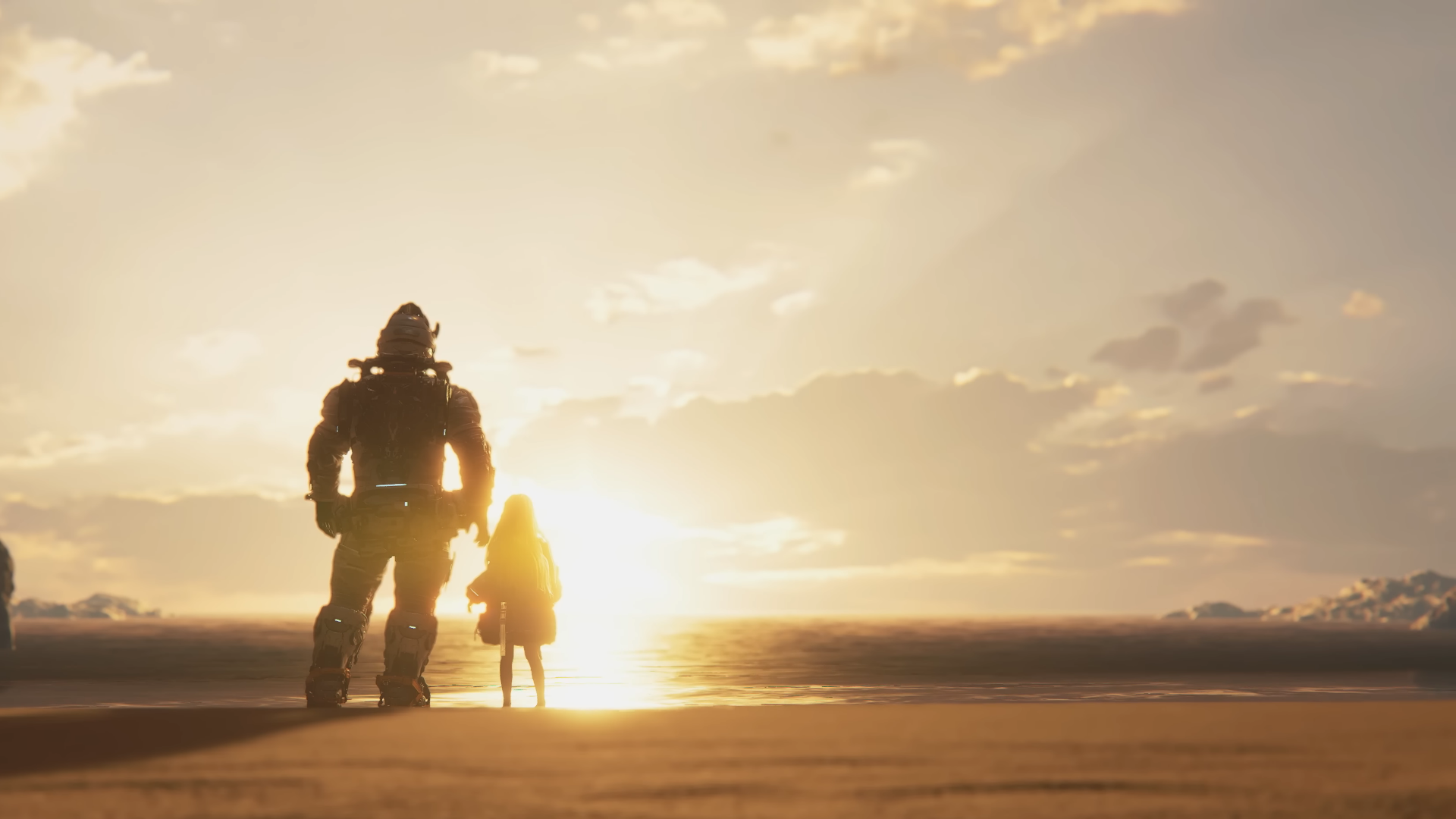
On June 11th, 2020, those were the final words Hugh shared with Diana on the moon, as they watched the Earth from the moon. At this time, CAPCOM announced PRAGMATA with the expected release window of 2022. After an ambiguous delay and then sudden re-announcement in 2025, PRAGMATA’s return grew immediate curiosity and interest with a trailer about the progress of Advanced Generative AI in the game’s world, a combination of futuristic and familiar but distant environments, and a unique fusion of game genres, as operated through Hugh and Diana at his shoulder. Now, after a long wait and a brand new console to play it on, PRAGMATA is here to take us to the moon.
Story – Crash Awakening
On the moon lies a base called The Cradle, and at its center lies a gigantic spire, all operated by the Delphi Corporation. The spire is a luna-powered 3D printer known as a Lim Replicator, capable of printing almost anything. However, any attempt to communicate with those stationed at The Cradle has failed, causing a response team to be sent.
Hugh Williams, a member of the response team, is just as surprised as his coworkers – not just because of the base’s desolate state, but because of the sheer capability of the Lim Replicator. Utilizing a special fusion of other materials and extractions from the moon called lunafilment, this replicator can 3D-print anything and even repair itself, playing a major role in creating this entire base, but at the cost of stability and durability. As the crew begins to make progress with the assistance of a Walker, an AI humanoid equipped with plasma blades, the durability of The Cradle is tested.
With a sudden moonquake, a crane crashes into a window within The Cradle, sending two members of the response team hurling into the stars. Although a hatch closes to prevent the entire team from being sent away, a pipe gives way above the final two, with the captain sacrificing himself to save Hugh. Despite now being the sole survivor of his unit, he isn’t safe as the floor begins to collapse under him – sending him to The Cradle’s depths.
Finally awakening from the fall, Hugh opens his eyes within the depths as a young girl sits at his side, repairing his suit to full capacity. Why’s a kid here? Whose child is this? How can he get back home? All of these questions are asked, but without the time to spare for answers, as The Cradle’s A.I. administrator, I.D.U.S, identifies Hugh as an unregistered guest. Thus, to remove him, the same Walkers built to help are now turned against him. Hoping to protect himself and this young girl, Hugh aims, but it’s this young lass who’s his savior. Raising her palm in the Walker’s direction, she creates a visualizer that allows her to hack into the bot’s matrix, making it further susceptible to Hugh’s firearm.
With the two now cooperating to defend themselves, they quickly take an emergency tram that directs them to a safe space known as The Shelter. Amidst their transportation, the two finally take the time to get to know each other. Hugh is, well, we know who he is already. However, this girl is “…D-I-03367, a state-of-the-art Pragmata created here at the Cradle…” with life-saving protocols. Does she know what’s going on here? No, not at all, but rather than have her repeat what she does know, that she’s D-I-03367, Hugh gives her the name Diana. Repeating it multiple times herself, smiling and screaming it at the top of her voice, the two arrive at The Shelter and prepare for their next steps to find a means of contacting Earth and, hopefully, returning Hugh home.
Without delving into spoilers, PRAGMATA, in its short narrative, builds a genuine bond between its dual protagonists, Hugh and Diana. From the get-go, Diana’s carefree, questioning, and accidentally reckless personality immediately comes out, like that of an actual child. In response, Hugh’s unease with now being responsible for a little one is very clear, but he still takes up the task – not just to get home, but for both of them to return to Earth.
As the scale of challenge grew with each step of their journey, I truly felt Hugh and Diana’s reliance and need to protect one another, which heightened the dual-control-scheme gameplay at hand. Additionally, as The Cradle is home to a few of Earth’s locales recreated to provide relief from homesickness to those within. Encountering such recreations also provides an opportunity for Hugh and Diana’s relationship to grow into that of an uncle and niece or of father and daughter, as he explains to her what life on Earth is like.
PRAGMATA also deserves a lot of praise for its treatment of the conversation about Artificial Intelligence. Though there are instances where the appraisal of A.I. by Delphi higher-ups in holographic recordings can be quite on the nose, conversations of its assistance or drawbacks by staff, via scattered emails, paint a better picture of what life on The Cradle was like. While life back on Earth was irreplaceable, the replicators allowed staff to ensure The Cradle could still feel like home. However, with the increased implementation of the I.D.U.S System and androids, humans were moved to positions that began to make them feel hollow.
Furthermore, the strongest factor within the conversation of A.I. is Diana herself. As stated, she has the visage of a child, but that extends to her behavior as well. However, despite her capabilities as an android being always present, the humanity she expresses is never denied. Early in the story, Hugh tells her that the value of eating a meal isn’t just for nutrition, but for the warmth that it brings to people when shared. From moments like that, she grows her own desires and interests, her own form of self-expression. Hang out in The Shelter with her for some time, and she’ll surprise Hugh with many different crayon drawings, none that look mangled or devoid of care, like the AI-generated images we’re forced to see online. Her existence as an AI does come to the forefront at times, such as suggesting that she’ll efficiently replace Hugh’s fallen teammates. However, those moments serve as teaching experiences for Diana. It’s never to reduce the humanity she shows, rather to make her more aware and empathetic – to grow her humanity.
While I think this aspect of PRAGMATA’s narrative is fantastic, I think the pace at which it unfurls should be longer. What made my playthrough twenty hours long was my aim to 100% the game before rolling credits; going through it in a straight shot would’ve made half of that time. Where PRAGMATA feels weakest in its narrative is with the antagonist and their makeup. The character and their motives aren’t abruptly introduced; they’re built up and given a proper reveal, and the ties they have to the entire reasoning behind the setting’s purpose are clear. However, the implication of their motive and where it comes from is sort of a twist, and by the time it’s unveiled, well, the final boss is not too far after. If more of the core secrets that lie at the game’s resulting conflict were built up throughout the game, rather than at the final area, perhaps that would make it feel more impactful.
Gameplay – Hack n’ Shoot, Literally.
In Hugh and Diana’s efforts to get to Earth, they must traverse through multiple facilities within The Cradle, while fighting off I.D.U.S security bots. Although Hugh is equipped with a light firearm at first, even later weapons such as funnel drones, piercing lasers, or shockwave shotguns won’t be enough when fighting off the lunafilment androids. Not alone, at least.
With Diana on his shoulder, a unique enemy matrix will appear on the rightmost side of the screen. Traversing to its goal with the face buttons will reveal the android’s weak points, allowing Hugh to deal damage worth a fair fight and pin down their glowing weak spots. In some cases, hacking will slightly stagger them, providing a chance to create distance and fire away. However, skilled players can make far greater use of this dual-combat scheme by hacking and shooting simultaneously. Additional weapons, such as the previously mentioned funnel drones, a stasis net to freeze or a riot blaster to knock down enemies, allow for crowd control while hacking, checking the area for items, and providing a break to heal.
Additionally, Diana will also see hacking upgrades with the use of Hacking Nodes that can be set before leaving The Shelter and picked up from defeated enemies. These nodes allow for various effects such as multihacking nearby enemies, confusion that leads to friendly fire, weakened defenses, and more. Depending on the player’s current growth within the game, they’ll be able to carry at least two hacking nodes that will then appear on the matrix, where passing through any will activate their effects. Thus, it sparsely limits the extent to which the player can take control of the game’s combat.
In fact, that level of freedom is where PRAGMATA both shocked and impressed me the most. Although the game truly starts after Hugh and Diana leave The Shelter for the first location, the game never shies away from the option of a tactical return. Across the different sectors of each area’s level are ladders that allow the player to return directly to The Shelter, without penalty. But it can be ignored if one is looking to continue where they already are. In the Shelter, players will recover health, have the choice to upgrade each part of their arsenal, and then have the choice to restock or alter their weapon loadout, hacking nodes, and stat modifiers. When ready, the player can return to the area they just left or to any earlier level within the game. This doesn’t mean the level of challenge becomes easier; it just means the access to preparation and playstyle versatility is always available.
The ability to essentially fast travel through finished levels also encouraged me to try 100% completing PRAGMATA, all upgrades, collectibles, challenge rooms – everything that I could. No matter which area Hugh and Diana are about to depart for, the map will list which collectibles are in the vicinity, immediately raising my awareness of what to look for. Although I didn’t actually achieve this, knowing that I can easily just go back in and do it doesn’t feel as overwhelming a challenge as it does for other games.
Through everything that PRAGMATA has to offer in its gameplay, there were only a few things that disappointingly surprised me or caught me off guard. From playing the PRAGMATA Sketchbook demo, one aspect to remember was how it timed the player on how fast they could make it through the demo. Given that aspect, I was hoping that there would be something that also pushed that style of play within the main game. However, that wasn’t really the case. Rather, it feels as if PRAGMATA was designed for the player to take it slow or stay within the bounds of what’s set, despite the demo emphasizing otherwise. There weren’t many, if any, opportunities to skillfully skip past where enemies would obviously spawn in or gaps in level design to progress where not initially intended. Such confines also feel present when I want to move quickly, like when I want to open a chest. Even if Hugh is technically looking at it, if the chest and any other interactables are not within the camera’s view, they can not be interacted with. It feels like a pacebreaker in what otherwise can be quite a beat-to-beat game.
Finally, I had a few issues feeling completely comfortable in PRAGMATA’s default control scheme. As I don’t own a Pro Controller 2 to go along with my Nintendo Switch 2, the Joy-Con 2, when attached via grip, feel far too close together and still too thin separately for a title that utilizes almost every input. Thus, the surprising solution to make the game comfortable was to play primarily handheld, with motion controls. With a sizeable gap between my hands to avoid the feeling of touching myself, and one less stick to worry about, during combat, PRAGMATA not only became a more fun title to play, but also more stellar visually! Looking up at enemies that hover or physically tower over Hugh as they step closer provides an immersive way to interact with the game and emphasizes how impressive its presentation is.
Presentation – This Beautiful Danger Zone
Despite being stranded on the moon with androids attacking at almost every point, PRAGMATA’s setting is still one that I can’t help but want to continue being in and wonder about. A pristine futuristic base as the stars and Earth lie outside of it, to gaze upon from any wall-eating window. The instances where it stops being just a facility and homes an imperfect recreation of Times Square, part of my home in New York, or the seaside view only available on Earth – the scale is unbelievable and captivating. I only wish that I could have also seen how the staff who no longer remain moved and interacted within it, wholly. That isn’t to say PRAGMATA failed in delivering that, as it wasn’t the goal or of much importance, but it’s to say that I’m curious to see more in general.
This visual mass is still wonderfully captured on the Nintendo Switch 2. When playing docked, I often couldn’t believe what I was looking at. CAPCOM’s capability of fitting such layered detail on the platform after most of their RE Engine titles missed the console’s first iteration. Even in handheld mode, the game still looks amazing. Although there were instances of textures and lighting becoming distorted when viewed from a distance, and running too fast between areas caused frame drops and short loading instances, I was still impressed. That may have to do with how I engaged with PRAGMATA, mostly as a handheld and motion-controlled title, but I think that’s how most people should play it. Controlling the game so close to one’s own vision, and body movement matching the situation at hand and in hand. While docked mode allows PRAGMATA to shine in environments and characters, handheld mode truly emphasizes the video game aspect more than I could have imagined. I wonder how else I could have experienced it had the CAPCOM also provided a Mouse Mode playstyle. Hopefully, they will consider adding one in a future update.
Speaking of character, David Menkin and Grace Saif as Hugh and Diana, respectively, were absolutely fantastic. At every point in time during the journey where the two would interact as part of a cutscene or by surprise when walking between area sectors, I always wanted to hear more between them, to have their bond grow. They truly bring PRAGMATA to life as its narrative focuses on the adoptive familial relationship that is so alive within. However, PRAGMATA’s soundtrack didn’t stick with me afterwards. While in the moment, it ranges from tense to somber music with a combination of ambient and futuristic tracks composed by Yasumasu Kitagawa that made me go, “Oh wow, that’s really nice,” I couldn’t manage to remember a single track other than maybe the title screen. It may be due to my lack of interaction with music akin to how PRAGMATA sounds in my day-to-day, or it could be due to the tracks coalescing into one sound, as part of the game’s identity. I know how PRAGMATA sounds, but I can’t assure that I could repeat its sound with my own mouth, as I can with many other games.
Conclusion – The Shuttle Home
From a surprise announcement nearly six years ago to the moment that the credits rolled, PRAGMATA was a fantastic title to see unravel. Each of the trailers that refrained from showing too much, or at least in a clearly concise manner, truly allowed for the gameplay and most of the narrative to be incredibly surprising. Although PRAGMATA could’ve been a bit longer to support a stronger presence for the game’s antagonist and further intertwining the weight of the conflict, outside of our protagonists’ trek back home, that isn’t where the heart of the game truly lies. PRAGMATA’s heart lies in the relationship between Hugh and Diana and how their familial bond deepens the cooperative context of the gameplay. Thus, with a heightened experience provided by playing handheld, with motion controls, on the Nintendo Switch 2, PRAGMATA stands as one of CAPCOM’s best and most unique titles for the platform and their general library.
PRAGMATA: Although the story could've been a bit longer to support a stronger presence for the game's antagonist and further intertwining the weight of the conflict, PRAGMATA's heart lies in the relationship between Hugh and Diana and how their familial bond deepens the cooperative context of the gameplay. – Phanah Daiyaluun

- Onimusha: Way of the Sword | Review - September 30, 2026
- PRAGMATA | Review - June 11, 2026
- Pokémon Pokopia: Discovering a New You - April 27, 2026