April’s consequential Nintendo Switch 2 Direct set the pace for the system’s first calendar year, kicking 2025 into gear with a duo of racing games. In addition to EPD 9’s Mario Kart World, Masahiro Sakurai is back at the wheel with help from Bandai Namco for Kirby Air Riders. In tandem with Nintendo Software Technology still-updating F-Zero 99 and F-Zero GX as a launch title for the GameCube Nintendo Classics, we’re being spoiled with the widest selection of Nintendo racers since the Nintendo GameCube.
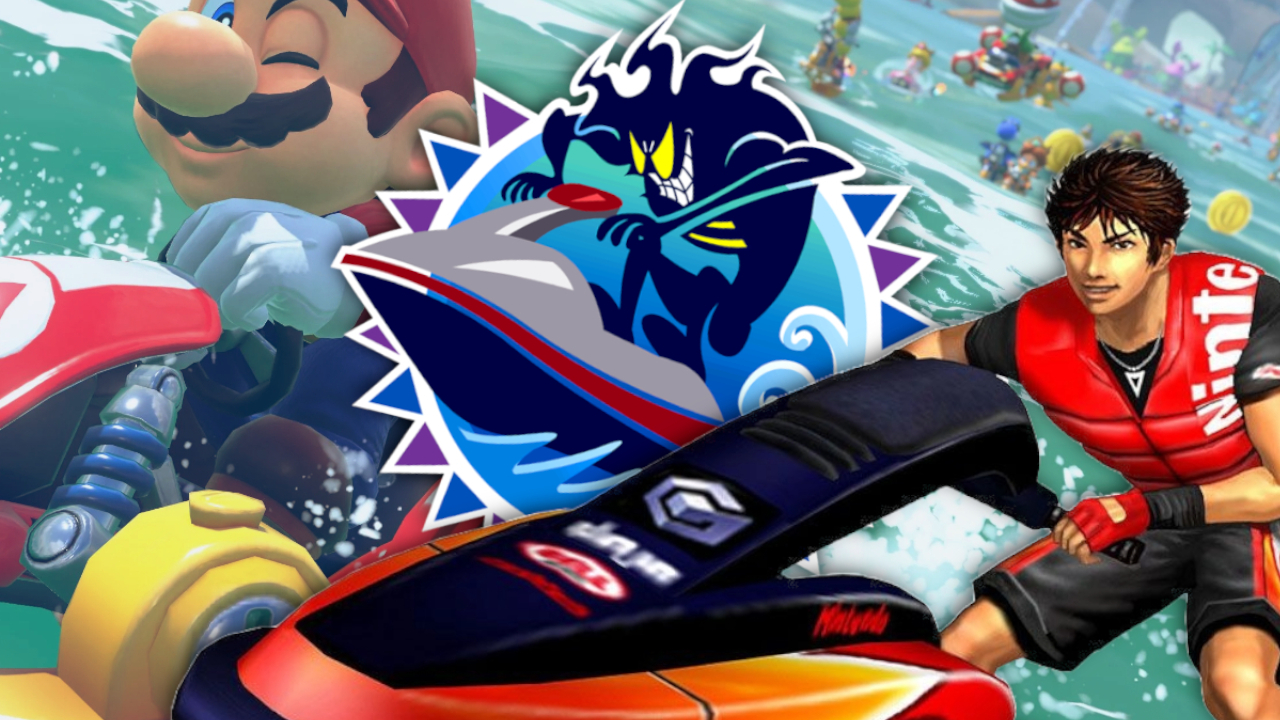
And, Nintendo is keen to invoke even more racers than it’s releasing. In the Mario Kart World Ask The Developer column, Shintaro Jikumaru, Planning Team Lead, noted that the new jet ski-style racing is “something this game has in common with the Wave Race 64 game.” What better way to rubber stamp a new feature than to cite one of Nintendo’s most timeless titles?

Wave Race 64 and its sequel Wave Race: Blue Storm are great games that have been on my mind as of late. They’re annuals; summertime classics. Like my beloved Wii Sports Resort, some games just feel like the season; a pair of flip-flops haphazardly strewn by the door and ice sweating through a glass.
Like Wave Race: Blue Storm spinning in a GameCube, it’s in the way the waves move, the way your jet ski skips across the chop as you careen around the tracks. These are the sorts of games you’re supposed to play after you’ve just mowed the lawn, the smell of freshly-cut grass intermingled with the imagined smell of salty digital water. It’s funny, then, that the only Wave Race game to actually release in the peak of summertime is the often-forgotten Game Boy original (both when it launched in North America in 1992 and when it finally hit PAL territories in 1997)!
Of the Wave Race trio, I find myself particularly interested in Nintendo Software Technology’s (NST) Blue Storm. Not just because of the season, but because it and Mario Kart World feel in sync right now, as we dive into the Nintendo Switch 2 generation.

Unlike Mario Kart World which evolves its franchise, Blue Storm was a very iterative sequel. Like Wave Race 64 before it, the game sees you zooming around elliptical racetracks slaloming between red and yellow buoys as you alternate between passing them on the left or the right. In Blue Storm, you weave between the hazards to build up a turbo meter — your best chance to catch a good break and overtake your seven rivals on the track.
It’s easier said than done, given that Blue Storm doesn’t handle with the same nimble feeling of its predecessor. But its sense of speed is unmatched, putting the “jet” in jet ski as you white-knuckle the GameCube controller, your racer gripping their handlebars for dear life, as each turbo’s explosive power skips you along the waves.
The game is simple, and the appeal lies in its seat-of-your pants sensibility. Dynamic waves toss and and jumble you, turning each corner into a physics-propelled see-saw endeavor. The thrill lies in each time the underside of your jet ski slaps against the chop, but it also lies in the game’s variety, seeing you travel the globe and each body of water therein, from the arctic depths to a city’s narrow waterways. Of course, all this praise more-or-less fits onto its Nintendo EAD developed N64 predecessor too.

But that’s irrelevant — Blue Storm doesn’t upset its series’ established formula as it’s mainly a technical showpiece. The novelty of its wave technology doesn’t match 64, sure, but you’ll find few titles on GameCube that look better. Top to bottom, it’s perhaps the wettest game ever made. Every UI button makes a literal splash, overflowing with the early-2000s gaming industry’s love of beveled edges and aquatic theming that could be perfectly rendered by then-bleeding edge hardware. Miiverse has turned good looking water into a community in-joke, but NST’s renditions of lakes, lagoons, and the open tides are truly amazing.
As your jet ski glances along the water’s surface, schools of fish and sea turtles lazily pass you underneath. Coral dots the sandscapes and the northern lights twinkle on arctic seas. The game is a beauty, its shimmering reflections so brilliant that they feel (manta)ray-traced. Blue Storm is a fiddly beauty, given the rigidity of its controls, but when you can feel the sea spray through your TV screen and have to hold yourself back from diving through the glass into those well-populated shallows, do you care that the game feels as stiff as the waves that buffet your racer? I certainly don’t.
You can indulge in this fantasy because the GameCube was a very powerful machine. It was (and still feels!) as cutting edge as each of the system’s vertices. And NST was there at release with Blue Storm’s bells and whistles (like the totally extra but very splashy interactive loading screens) to show you what the system could do.

An example of said ‘splashy loading screen’
The Switch 2, like the GameCube, is being sold on its power and appeal to the core gaming audience. The system is being marketed with vocab that feels uncanny for a modern Nintendo console. We’re hearing of 4K patches and 120hz screens, 120fps and HDR. Terms like these haven’t belonged to Nintendo in any meaningful way in decades. Nor has an exclusivity deal rang of The Capcom Five or Metal Gear: Solid The Twin Snakes quite like FromSoftware’s 2026 Switch 2 title The Duskbloods. Late President of Nintendo Satoru Iwata’s philosophies that introduced casual gamers into Nintendo’s audience with the DS and Wii, that foregrounded hardware novelty, feel oceans away. But look closer, and you’ll see that we’re dealing with both a very new Nintendo and a very old one, or more aptly, we’re seeing continuity between the last pre- and first post-Iwata consoles.
So Mario Kart World, being the marquee launch title for its new system, found itself posed with the same question that Blue Storm was: what can new power, rather than new hardware gimmicks, offer the player? The games’ answers are parallel, but meaningfully different. If Wave Race suggested that the answer was “what you already love but more beautiful,” then Mario Kart World suggests that its answer is “what you already love but more ambitious.” The game begins a new chapter for the series, taking its engine apart piece by piece to soup it up with new ideas.
The most obvious are its interconnected open-world and 24-player races. Both features were cited by EPD 9 in the aforementioned Ask The Developer column as core to the game’s design, but also as sticking points early in the development process which began on Switch 1. That World, if it had indeed been released on Switch 1, would have compromised on either scale or frame rate to accommodate the aforementioned features. A continued refrain in the roundtable interview is that thanks to the new machine’s power, there are no compromises.

Much has been made about Nintendo ‘compromising’ its creative spirit by releasing such an iterative machine while focusing on power, but that’s an ahistorical analysis. The GameCube’s trick was that titles like Wave Race Blue Storm and Super Smash Bros. Melee, iterative and excellent sequels, comprised only one dimension of the console’s library. GameCube is beloved because it illustrated how power enables creative gameplay opportunities. Teams were empowered to imagine the 100-man scrambling armies of Pikmin or Metroid Prime’s wildly detailed contiguous planet of Tallon IV. Now, Nintendo is poised to revisit that earmarked page in its playbook.
Most recently, Kazuya Takahashi and Kenta Motokura told IGN that Donkey Kong Bananza began on Switch 1 similar to Mario Kart World and, like World, Bonanza’s playful ideas could only be realized on Switch 2 hardware.
“When destruction is your core gameplay, one really important moment that we wanted to preserve was when a player looks at a part of the terrain and thinks, can I break this?”, Takahashi said. “Because that creates a very important surprise that has a lot of impact for them and that was something that was best done on Switch 2.”

If Switch 2’s opening pair of major exclusives are any indication, we’ll spend the generation loading into games that make good on the promise to use new power in novel ways. To imagine new futures for our favorite mascots and series. And yes, it’s more enjoyable to imagine them in 4K (see Metroid Prime 4: Beyond for proof). But better graphics aren’t the point, don’t let the broader industry convince you of that. For Nintendo, fidelity is just a perk of Switch 2 chasing a much higher technical standard than its predecessor.
Switch 2’s emphasis on power isn’t in keeping with the last twenty years of hardware design, but it finds harmony — and more importantly a fresh well of design opportunity — in ideas older than that. When I think of Wave Race: Blue Storm in its context, and Mario Kart World and Donkey Kong Bananza in their context, I see two halves of a coin forged and then reforged almost twenty-five years apart. I see power as the opportunity to increase fidelity, and more importantly power as the conduit to realize creative ambition. Moreover, I see continuity between these two systems. One that I hold dearly, and one that I’m coming to love just as much.
- This article was written by Abram Buehner, Senior Editor for Lost In Cult and Co-Host of Back Log Banter. It was edited by NantenJex and WolfmanJew.

- The Tides From GameCube to Nintendo Switch 2 – Guest Article - July 23, 2025
- Featured Content: Smash Ultimate: A CRITICAL Retrospective - March 1, 2024
- Featured Content: How Paper Mario Lost Its Way (Until Recently) - January 31, 2024