
Thanks to AShadowLink for helping with edits.
The SEGA Dreamcast is a venerable machine, one many, including Vice President hopeful Tim Walz, harbor affection for. I always feel a twinge of sadness when I think about it, though. After countless misfires and notorious company infighting, SEGA’s future was riding on it: another failure would force them to exit the hardware market. Which… well, that’s what happened. Industry newcomer Sony quickly became a powerhouse with their PlayStation console, and the losses incurred by SEGA’s commercial failures proved fatal. Ultimately, their final console had only a mere eighteen months at retail before SEGA restructured itself as a third-party publisher. Admittedly, I was happy about this at the time, as I only owned Nintendo systems growing up and now they would score SEGA games. Only with age can I truly appreciate their cataclysmic fall from grace.

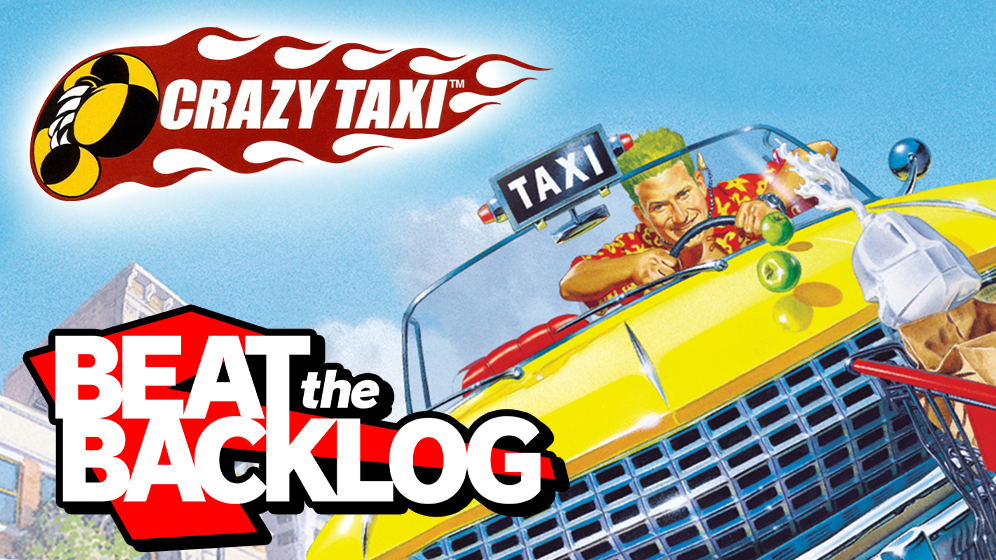
Crazy Taxi hit arcades in 1999 and the Dreamcast the following year. Versions of it have since graced computers, the GameCube, Game Boy Advance, PlayStation 2, PlayStation 3, PlayStation Portable, Xbox, Xbox 360, and smartphones. Appropriately so, Crazy Taxi gets around! (Image: SEGA)
None of SEGA’s desperation shined through the Dreamcast’s software lineup, however. While the business side of the company was basically on fire, their development studios were firing on all cylinders, delivering a wealth of bold, fun titles. Alongside the popular, franchise-redefining Sonic Adventure games, Sonic Team delivered ChuChu Rocket!, Samba de Amigo, and a Phantasy Star revival that pioneered online gaming on consoles. Jet Set Radio and its sequel are cult classics, as are both Space Channel 5 titles and Skies of Arcadia. I’ve seen people praise SEGA Bass Fishing and Virtua Tennis. The Shenmue duology is so revered that the mere announcement of the third game’s Kickstarter campaign wound up one of Sony’s big E3 reveals a decade later.
And, of course, there’s Crazy Taxi. It’s probably the most famous SEGA franchise hailing from this era, one they regularly reference in crossovers; taxi driver B.D. Joe, one of its protagonists, usually acts as its face. It’s also gotten a few follow-ups, mobile spin-offs, two failed movie attempts, and a high definition remaster for the Xbox 360, PlayStation 3, and Steam (note: this review’s based on the 360 version). It inspired later games, including The Simpsons: Road Rage—which was so similar that SEGA pursued legal action. And after years of dabbling in it, I’m finally tackling Crazy Taxi properly.

Several of my friends like Crazy Taxi; Walz might as well. The sense I got was that it’s a fun game to kill time with and, if you’re invested, has enough depth to power longer sessions. (Image: SEGA)
Crazy Taxi is a score attack game built around racing. You aren’t racing other racers, however; you’re a taxi driver racing against the clock, since your patrons only give finite time to get them to their destinations. If you take too long, they recklessly jump out of your car. And these jittery jerks fuel Crazy Taxi‘s score attacking: they give you money once you’re done escorting them, and if you do so quickly they add a bonus. Should you excite the thrill-seekers, they’ll even toss in tips! Once you’re done playing a session—which can span three, five, or ten minutes—you’re given a rank: No License, E License, D License, C License, B License, A License, S License, AWESOME! License, and finally the coveted CRAZY TAXI! License. Naturally, the more cash you earn, the better your rank.
The default controls are simple: pressing B shifts you into drive, A puts you in reverse, holding down the right trigger makes you accelerate, and holding the left trigger makes you brake (an alternate control scheme moves accelerate to A, brake to B, reverse to the left trigger, and drive to the right). Use the control stick to move around, and pressing Y honks your horn. Mastering the controls—which is mandatory if you seek anything higher than an S rank—is where the real challenge lies.

Watching people throw all caution to the wind and dash out of your speeding car is funny, even if it means you wasted valuable time. Surely waiting an extra six seconds is better than braving injury on such a steep incline? (Image: SEGA)
Of course, the people you pick up also affects your score heavily. Those surrounded by a green cursor are generous with their time limit and money. People with a light green aura are a little stingier on both fronts, while those flaunting yellow are even stinger. Unless you’re nearly out of time or are planning your routes carefully, avoid orange and especially red customers—they‘re remarkably impatient and cheap, though their destination is always nearby.
Once a passenger’s onboard, a small window displaying their destination graces the screen and a large, green arrow on top of it guides you. A timer appears and tells you how much time you have left. Plus, a Fare Meter keeps tabs on how much money you’ll collect after successfully dropping your client off. As you approach the glowing drop-off zone, the arrow turns red, so you’ll start braking. Once you’ve stopped moving and are within the neon rectangle, your passenger will graciously exit. Then you start searching for a new customer, of which there’s no shortage. Rinse and repeat.

Crazy Taxi isn’t a Dead Rising, but meticulously planning your routes and the order you pick up passengers is an important skill here, too. The better you know the roads, the better prepared you are to make a fortune. (Image: SEGA)
Now, the game has two maps: a larger one for arcade mode and a more compact one for the original mode. The former is basically a roadway that loops across a small island, while the latter better resembles a real city, with streets weaving together throughout. But succeeding in them requires learning their layouts, hidden shortcuts, where affluent passengers are situated, and abusable set pieces. Both maps contain a litany of ramps with which you can impress your clients, for example: launching your car into the air will yield tips.
Another part of the package is “Crazy Box,” a series of mission-based challenges. By default, nine are available, which are evenly split between three levels. Clearing all three missions in one level yields its bonus S mission, and the final challenge tier unlocks after finishing all of the previous missions. One final, daunting test unlocks after finishing those three. Missions can be a breeze or brutally difficult; 1-3 is a simple “pop all the balloons” deal with a fairly generous time limit, whereas 1-S barely gives you enough time to knock down seventy bowling pins.

Earlier iterations of Crazy Taxi feature product placement. Like Pikmin 2, its absence in modern releases isn’t a dealbreaker, but I do miss the added touch of realism. Losing some of the original’s music is a shame, too. (Image: SEGA)
Your reward for clearing “Crazy Box” is a new vehicle, a motorbike. A few other secrets grace Crazy Taxi, too, including an expert difficulty where you aren’t given the luxury of the guiding arrow or destination indicators. You can also, at least in the HD re-release, adjust the rules to your liking and upload your high scores to an online leaderboard. Some versions of the game also have cheat codes, a nostalgic detail I miss in modern titles. And driving through the cities can yield some fun discoveries, like a handful of weirdos who try hailing taxis in bizarre, out-of-the-way spots. One pedestrian hangs out underwater!
On a technical level, Crazy Taxi shows its age. The draw distance isn’t the best, stage geometry is simple, character animations are stiff, and their blocky models are reused throughout the game. Still, Crazy Taxi looked nice for the time and holds up well enough; the bold colors still pop. Besides, you’re supposed to keep moving, not sightsee. The punk rock soundtrack furthers that energy, too.

One small annoyance is that achievements don’t stack, meaning you’ll have to play each map at least four times to get each of their ranking-based achievements. Not a big deal, though, since you’ll probably replay them anyway. (Image: SEGA)
If there’s one big flaw with Crazy Taxi, it’s that it can be kinda obtuse. Each driver has different stats, information the game barely mentions. Performing well in the main game and “Crazy Box” requires mastering all of the advanced maneuvers, techniques the game only briefly explains in its help section (the tougher “Box” missions are basically designed to force you to master them). The guiding arrow can actually be confusing to follow, particularly on the original map; it strictly points towards your destination, not a clean way to get there.
Sure, Crazy Taxi isn’t immaculate; it isn’t one of those ageless classics I’d recommend to anybody with even a passing interest in the medium. But it is fun! SEGA’s roots lie in arcades, in energetic games that are fast and “cool” and have bright visuals and champion score attacking; Crazy Taxi is a pure distillation of that. Dashing down ersatz San Francisco is thrilling, even more so than in fellow Dreamcast refugee Sonic Adventure 2. Causing property damage by blasting through populated tourist attractions while panicked pedestrians leap out of my way—don’t worry; they always jump in time—is silly fun. Creating a large combo chain by narrowly dodging other cars is exhilarating. And after finishing a round, I usually want to give it one more go to see if I can earn a little more money. Honestly, I wish I booted Crazy Taxi up sooner, particularly after the stiff car chases of L.A. Noire.

Netting a decent combo by dodging cars in quick succession is always satisfying. A used car lot in the arcade map is actually a great, relatively safe place to build one up. (Image: SEGA)
And Crazy Taxi’s formula is ripe for iteration: new maps, drivers, and maybe a few new mechanics are enough to make for an engaging fling. And it is getting a new lease on life! SEGA announced a litany of reboots during its 2023 Game Awards “Power Surge” trailer, including a new Crazy Taxi! While I’m unsure how suited the series is to an open world, multiplayer-centric approach, I am eager to see it—and it’s exciting knowing that these lunatic taxi drivers are returning.

If you just want to “beat” Crazy Taxi, you merely require an S License; the credits play afterwards. That isn’t sufficient for me, however, and I hope to attain the loftier ranks someday. (Image: SEGA)

- Continuity Corner: Why Did Ash’s Pikachu Forget Volt Tackle? - October 16, 2026
- The Donkey Kong Bananza Hype Cycle – A Retrospective - July 17, 2026
- Beat the Backlog: Sonic Blast - July 9, 2026