
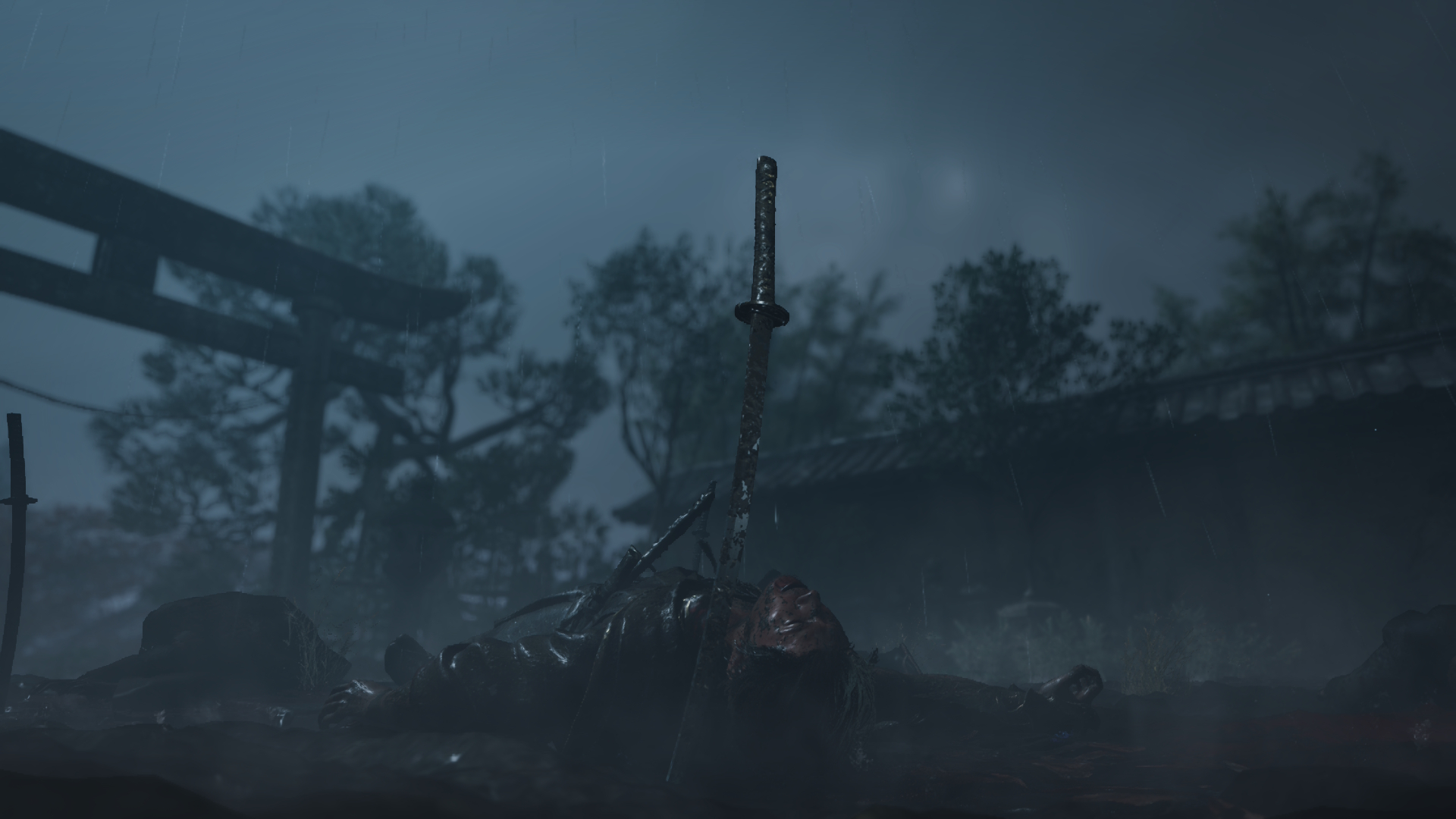
This copy of Onimusha: Way Of The Sword was provided to Source Gaming by NINTENDO. This review contains major spoilers and visual imagery of blood from the game.
“To live is to suffer.”
Ripping the band-aid off, Onimusha: Way of the Sword was a title that I went into eagerly, hoping it’d deliver a third dosage of CAPCOM greatness this year. Alas, I walked away feeling as numb as possible towards it. From unsure beginnings to confused halfways, it all built up to an excruciatingly brutal ending. Perhaps, this is what it means to be “filtered,” the one instance where a gametruly was too hard for me to stand persisting through. However, the title constantly extolls that “living is suffering” and “you have to learn to love the challenge.” Onimusha takes pride in its difficulty, though victories feel unrewarding; you’ll exhale exasperated sighs, facepalm and bang your desk, or stare blankly as you ruminate on the frustrating ordeals you’ve endured.
Before covering the layers of excruciation, propping up the game’s delights is in order. CAPCOM one again illustrates that they know how to make their most detailed worlds and character models maintain their glisten on the Nintendo Switch 2 hardware. Having streamed part of my playthrough in a Discord call, hearing a friend who played the PS5 version say they could barely notice a difference felt great. Of course, this is when playing Onimusha: Way of the Sword docked, as the handheld experience does feature a noticeable lower resolution. Looking back at screenshots does present the game as scuffed and lifeless, but the experience when playing is anything but. Thankfully, for this review, most of my playthrough took place at the… safety of my own desk. Additionally, although the game would normally be fixed to 30FPS on the Switch 2, CAPCOM provides an option to play with the FPS uncapped. By the measuring of Open Surprise, the game averages at a framerate of mid-40s, but amidst gameplay there were only a few instances where I noticed it struggling—and even then, only barely.
In between moments of pure anguish, Onimusha: Way of the Sword also sports some beautiful views, ranging from the blood river of an underground castle to the crevices between trees. Finally, I truly do love walking through bushes and heights of bamboo within the main area of Eastern Kyoto. While it may sound strange to compliment such a small, probably unthought of detail to the average person, many action games steer clear of sprouted foliage on their paths. It really makes Way of the Sword stand out, bringing the potential for further exploration alive. However, a lot of that potential gets squandered due to a multitude of features and design choices.
By default, there is an objective marker at the top left of the screen. Thankfully, you can turn it and an entire list of other UI elements off. What spurred me to turn the marker off is how its presence persists even when other UI elements fade from view. Having it loom over the screen not only lessens the world’s immersive nature, but it feels unnecessary for areas of Onimusha that are incredibly linear. However, what can’t be altered is how attached the camera is to Musashi’s back. The lack of a field of view slider or preset camera distance settings means that every instance where beautiful vistas are meant to be taken in could only be adored through the game’s photo mode. Traversal and combat wasn’t any better, as I had to constantly double or triple check if I was going in the correct direction. Enemies that I’m expected to fight often wound up sitting just out of view. To which, as a partial tangent, grew more excruciating due to the motion sickness and headaches that incurred as my playthrough progressed.
I could not say for sure why it was, but whenever I was forced to traverse through gray areas full of malice structures, doing so pained my eyes. Aggravating the issue further was how easy it is to accidentally backtrack through the structures, as they easily blend into one another. Even the game’s built-in motion sickness setting failed to help. Enabling Motion Sickness Reduction turns off the motion blur, camera shake, and turns on the centering dot—however, the latter’s cursor is identical to the one used for locking onto enemies, causing my eyes to rapidly shift from the center to the enemy. It’s disorienting, especially when the two dots closely overlap. However, Onimusha: Way of the Sword didn’t just leave my eyes confused on where to go, but its entire direction scrambled my mind of what to expect throughout the experience.
Those familiar with my previous reviews likely noticed the vastly different direction this one has going for it. Usually, I’d start with the game’s narrative, characters, and their goals. The easiest way to describe Onimusha: Way of the Sword in those terms is by explaining that it focuses on Miyamoto Musashi, an arrogant and mostly self-serving swordsman who faces death and rises back up after being “gifted” a gauntlet. Without a way to remove it, his only option is to become wrapped within its web of conflict as the boundary between the land of the living and the Genma-infested depths of Hell will soon break. Way of the Sword starts out very strong with Musashi taking on a school of samurai unaided after killing the head in a duel. Most of that is admittedly pre-rendered cutscenes spliced between tutorial sequences that begin to raise the questions. “Okay, so when can I play? What is this game supposed to be like?”
After meeting a fellow gauntlet-wearing samurai, Takamura, Musashi is directed to go to Kiyomizu-dera Temple to clear the place of the malice that is seeping from Hell and infecting parts of Kyoto. Alright, so this is a stage-based action game; I can work with that! Some tutorials still lurk about, one of which awkwardly during a brawl to introduce blue souls for the special Oni Weapon meter. Why not give it its own dedicated scenario instead? The stage is quite linear as well, stiff in a manner that neuters my ability to enjoy its scenery and scenario; again, the camera doesn’t help. Once I got to the first encounter with Ganryu, a rival samurai who also gained a gauntlet, over an hour in, it finally felts like the game is opening up. I’m having fun! It’s difficult; I feel like I’m finally being tested on my understanding of the mechanics, but after the sixth time, frustration is starting to flare up. But, finally, on the seventh time… Ganryu is defeated! Now to progress to the rest of the stage, enter the Oni World, stop a giant genma that was feasting on souls, and after several attempts of unrecorded tries, head back to Takamura to report! Onto to the next stage, right?
Instead of introducing the next stage, Onimusha: Way of the Sword unveils that this open area of Eastern Kyoto will expand as you clear out more malice. For the next six hours, this was the game, throwing the entire tutorial sequence out the window. And, honestly, this formula also gets incredibly grating. A majority of the time wasted here is spent on progression-stopping horde fights called Rifts, where a black and red orb fills the sky, usually raising two waves of enemies to be cut back down. Most of these instances feature breakable malice plants fogging the area with a red cloud of DoT damage covering the terrain. In many cases, a boss awakens for the second-wave fight, and this gets used an annoyingly repetitive amount. I couldn’t tell you how many times I groaned after being told by Takamura that, “Hey, things are really getting serious now,” only to be distracted with many more halting rifts.
That’s what makes this entire game so frustrating; it meanders around and takes forever to develop its characters or maintain tension. As stated, I was in Eastern Kyoto for six hours focusing primarily on story quests, only helping citizens from wild Genma attacks about four times. That assistance usually consists of hacking two enemies in six slashes or four bow shots. That means I didn’t get to the next stage until about seven or eight hours in. At that point, Way of the Sword decided to highlight Okuni, a dancer propped up as the next generation after Takamura’s death. Now, she carries cultural importance—Okuni is based on Izumo no Okuni, the founder of the Kabuki dance style—but her presence throughout the story lacks substantial weight. She has some back-and-forth with Miyamoto that did make me chuckle; I understand her disdain for him at the same time. A lack of care for the world around him, but he gets the gauntlet, whereas she would’ve put it to better use to save her missing friend. It’s clear what her story serves, but because of how late it is introduced into the already dragging experience, it comes off as more annoying.
Sure, Ganryu is on the game’s cover illustration; he must be important, right? Well, he doesn’t appear again until hour fourteen; he’s absent from the game for thirteen hours! After that point he does appear more as a force to be cut down, but only after the second encounter against him as a sudden forced loss scenario, which really aggravated me for reasons I’ll explain later. Takamura only stays in Eastern Kyoto, so you only interact with him when returning for the next mission. Shizuka, the Oni inside of Musashi’s gauntlet, has the opportunity to be a more interesting character, since the two chat based upon the player’s combat performance. It’s through her, and Okuni’s dead friend, that Musashi learns to be a less selfish person who values those around him. However, hearing repeated dialogue and line after lines with each boss attempt winds up making me numb to her presence as well.
There are two different moments where the game almost feels like it’s beginning to wind down, so I checked YouTube to see how long the playthroughs of others were. I have no idea if they cut out their deaths or not, but their playthroughs were fifteen to seventeen hours, whereas my playthrough concluded at thirty-two. Deaths aside, because I died A LOT in this game, Onimusha: Way of the Sword is as excruciatingly painful as it is bland. After talking to a friend, who had a much easier time against bosses, I was shocked to hear that she also finished at thirty hours, but I finally felt sane to hear that her experience was just as bland as mine. Rather than any sort of consistently fun experience, the amount of meandering left me frustrated. I can see the things happening on screen and I can tell what emotions they’re supposed to evoke, but I feel nothing for the bland cutouts that, I think, I only spent about five hours total with. The game wants to say, “Hey, you went to quite a number of locations; just look at the areas on the fast travel list,” but three of them are really just part of one entire linear sequence, and then the main one, Eastern Kyoto, feels like it exists primarily for making the game longer. I almost forgot the Oni Realm was a location, as set up in the tutorial, because the narrative only takes us there about three other times: one of which is for about eight minutes and the other for a 2v1 boss fight (the coolest part of the entire game).
But I haven’t yet tackled the game’s main draw: the action. What matters most of all is timing, not how many times you swing Musashi’s sword or with how many hands. Thus, Onimusha: Way of the Sword is more defensive than action, trying to usher players to take turns away from the enemies. Dodge with A to keep Musashi safe from attacks, but to also counter grabs when an enemy’s hand glows blue. If the enemy swings their blade, parry with L at the right moment to get a few swipes in and lower their stamina. Alternatively, deflecting with L+B will keep up the enemies’ offense but will decrease their stamina by greater amounts, allowing Musashi to tackle the staggered foe’s body for a greater amount of souls. When feeling especially bold, press an attack button right before an enemy’s would hit and Musashi will perform an Issen, a strong slash that takes out heaps of health and stamina. If the player can perform all of these well, in succession, the game is probably a cakewalk.
If you’re like me, though, Onimusha: Way of the Sword quickly becomes a questionable game of trial and error. The question in mind being, “did I do what I did the first time, right this time?” No matter what strategies I employed or how well I understood an enemy’s patterns, the game just feels like a piling black mass of agony. When I see a visual indicator for a grab, I press A to dodge when they get close. Actually that’s not true; out of instinct, at every instance of a grab, I double-tap A and probably about 65% of the time, I get grabbed. When an enemy’s weapon glows purple for a strong attack, I wait for them to get close and prepare to parry or deflect it (because just blocking will be broken through). Maybe about 45% of the time, I got hit. That is a lesser amount, but both grabs and purple attacks deal attack sequences that not only takes out a lot of health regardless of how well my previous performance was overall, but also depletes souls from the Oni Weapon Meter and later unlocked Awakening State Meter. So rather than just facing the punishment of inching closer to death, if not straight up dying, the opportunity to recompose or retaliate is also stripped away. That’s also without including the buff that bosses get upon stealing your souls, further ontop of the armor already coating some like Benkei, preventing their health from being chipped away until about a full stamina bar depletion. And if you did survive, better be on your toes because all item animations take a second for Musashi to use, but under a second is about how long a boss will take to attack again. Mistimed and died? Do the entire boss fight over, no checkpoints, and also watch the prolonged animations with quotes for the grab and purple attacks again; they don’t get skipped on retries. Half of the game’s boss cast are also reused.
Patience was tested, not just for my turn to strike back, but of my sanity. To touch again on the second Ganryu boss fight, I had a hard time fighting against him and the new tendriled Oni stemming from his back. I truly thought that by this point, I might be near the endgame. I wanted to get over this hurdle so badly, and after a few attempts, a night’s worth of sleep, and then another slew of attempts, I decided to use sole revival item in my inventory. It asks if you want to use it when you die, and I said yes, so I could put Ganryu to rest once and for all. Finally, I deplete his first health bar to make way through the rest of the fight. But then the HUD disappears, as we’re still fighting, even while I’m still using items and deflecting his attacks. Suddenly, I get hit by an unavoidable slash and a pre-rendered cutscene ensues, declaring me the loser of this battle. I got pissed off, put my hands in my face, and proceed on. Maybe about two hours later, I realize that the game allowed me to use my revive for a fight that I’m never supposed to win, despite the HUD declaring that this is a two health bar fight, and my tolerance for the game is now at rock bottom. The only time it hit lower was when the final boss uses a purple attack that you’re instead supposed to Issen or dodge, instead of parry or deflect as taught.
I wish I had stopped playing so much earlier, but I couldn’t. Not just because I often have to do so for reviews, but I can never really sit well with myself leaving a game unfinished. For example, during the summer, I played Cave Story for the first time, luckily doing exactly everything to get the True Ending because the game made me curious enough to explore and do so. When I got to the Blood Stained Sanctuary, however, spending two days dealing with the adrenaline-raising gauntlet led to chest pain and stomach aches; I knew I shouldn’t be doing this. I gave it another day of attempts, another day of heart throbs and grovelling after I already told myself, “I should stop.” The idea of intentionally leaving a game unfinished, especially near the end, ate away at my brain.

Image: Source Gaming. Musashi’s response to Takamura’s teaching.
How much is one meant to suffer? Sure, it is possible for a game to pick up and get a lot better, in the same way a show or film can. However, the difference is that a game is something you feel with your own body as it responds to each vibration or command it prompts you for. Once you stop playing, the physical feeling persists. Thinking about what you could do better, what to try next, or motioning your own inputs. In my case, with Onimusha: Way of the Sword, my eyes and mind are still undergoing stress from a game that touts its meandering and challenge as a fun experience. Hours of time poured away for an experience that could’ve been cut short at an earlier point when feeling firmly that this title was not an enjoyable experience to me. This was a suffering that could’ve been prevented.
With two other fantastic titles under CAPCOM’s belt this year with RESIDENT EVIL requiem and PRAGMATA, I hoped Onimusha: Way of the Sword would provide another sharp experience. Instead, the company closed 2026 with a dull and painful title that left my face buried in my hands. While its Nintendo Switch 2 iteration is impressive on a technical level, it leaves out any sort of enjoyment that was desired.
Thank you to Cart Boy for proofreading and editing this review.
Onimusha: Way of the Sword: While its Nintendo Switch 2 iteration is impressive on a technical level, Onimusha: Way of the Sword meanders about and leaves out much of any enjoyment that was desired for it. – Phanah Daiyaluun

- Onimusha: Way of the Sword | Review - September 30, 2026
- PRAGMATA | Review - June 11, 2026
- Pokémon Pokopia: Discovering a New You - April 27, 2026