
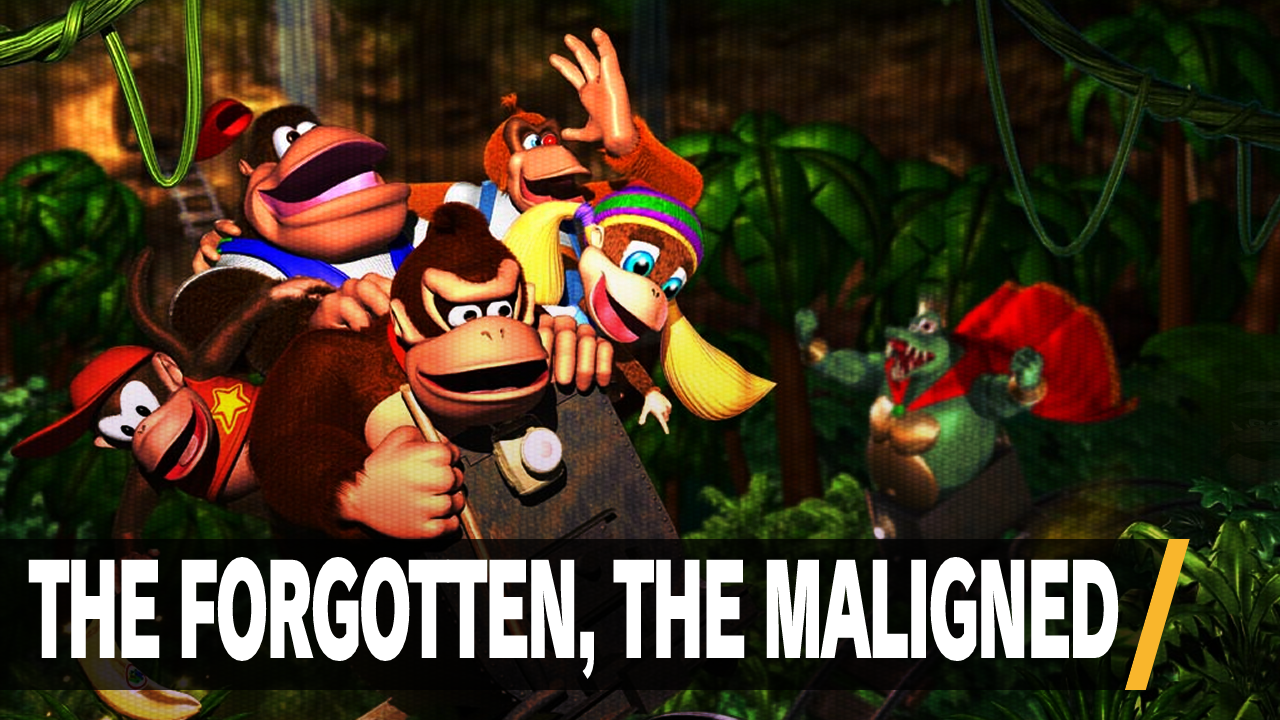
Games journalism is a field of writing done out of love. It is never financially solvent, nor is it a reliable path to employment, yet it still takes considerable time and labor. We write because we care about the medium and express that best through words. And because of that, our goals can be somewhat high-minded: interrogating our favorite titles, uplifting great ones by ambitious artists, criticizing the powerful for a lack of vision, and highlighting wonderful obscurities. There are certainly lazy writers, and there are many more who’ve sadly been creatively squashed under the boot of content mills, but if you’re writing about games, it’s because you want to contribute to the way we think about them. It’s a calling.
Sometimes, though, you just wanna pounce on an easy target. Can’t be helped.

Image: Source Gaming. The DK Crew performs in the incredibly awkward intro to DK64.
In 2026, Donkey Kong 64 is low-hanging fruit so far from the tree it might as well be in the ground. Reviewing it is like reviewing a Dan Brown novel or a late period Kanye album or Cool Cat Saves the Kids. These seem to exist to be mocked. I’m stating this because it’s informing how I’m going about this. “The Forgotten, the Maligned” has been an on and off series for over a decade as a way for me to interrogate games that carry notoriety. And while it came from a lifetime of enjoying Mystery Science Theater 3000, “My Year of Flops,” I Don’t Even Own a Television, and countless other projects that revel in bad art, it’s not meant to be comedic. It’s meant to examine art and reputation. Bad things fascinate me. Things with the reputation of being bad fascinate me. And for years, DK64 did exactly that.
But before we see how that bore out, we need to ask: why is Donkey Kong 64 such a joke? It wasn’t a flop by any means; it moved over five million copies, and that was in 1999 on the slowing Nintendo 64. There isn’t a Metroid game in the world that’s hit five million. It was also largely praised by critics at the time, and several do stand by it. Rebekah Valentine, now the best writer at Kotaku after having been the best writer at IGN, is an ardent defender (she also recently published a history of the recording of the “DK Rap” that I highly recommend). Plus, Nintendo fans, who never found a reference they couldn’t run into the ground, have kept the game alive for almost thirty years thanks to memes—memes Nintendo has reused ad nauseum. No, DK64’s reputation is more nebulous. And to get into it, we have to start with some history.

Image: Source Gaming. Chunky Kong rides a mine cart in one of the game’s many, many racing challenges.
Today, it’s expected that any mainstream release will be 3D by default. This is how the industry works, and because of that, every genre under the sun has been worked into 3D. Open world games, brawlers, RPGs. What The Game Awards has deemed the height of our culture. Whatever can’t fit is usually relegated to the indie sphere. This could not be the case in the 1990s. 3D was new, and one of the industry’s main goals was figuring out how 2D staples would work in a third dimension. So while a shooter might have used sidescrolling or vector graphics a decade earlier, Quake and GoldenEye had polygonal mazes and a first person perspective. This process changed a number of genres and created entirely new ones, but for a certain audience (particularly those raised on consoles instead of PCs), the main one was the platformer. These were the games that defined the NES and Sega Genesis, and they were adapted in a similar way. The single most important of all was the brilliant, trailblazing Super Mario 64. Through it, we can understand Donkey Kong.
One of the most important parts of Mario 64 was how it turned from the sidescrolling design of Mario’s past adventures. In the game, Mario traipses through a sandbox filled with obstacles. And since the sandbox has no dedicated “end,” the goal has to be something in that space, and the fun is overcoming the obstacles to get to it. For Nintendo, that “something” was a collection of Power Stars that dotted each course, and the process of nabbing them was the part that adapted the sidescrolling stuff. Add in Mario’s widely expanded moveset and an incredible level of nonlinearity, and you got a game about the joy of exploring space. Nintendo theorized that freeform, player-driven movement defined 3D games, something I think is still largely true.
This is not the only way to make a 3D platformer. Crash Bandicoot tried to imagine a sidescroller from the character’s perspective in the same year as Mario, and it’s novel if nothing else. In the decades since both games, Nintendo has made linear, courselike 3D Mario games, with the Stars being largely ornamental. Insomniac’s Ratchet and Clank has some platforming but is primarily a lighthearted shooter. Psychonauts is about dizzying levels and puzzle logic. But, as sidescrollers did in the Eighties, early 3D platformers often followed the Mario formula wholesale by capturing Mario 64’s most capturable trope: the collectibles. These games—40 Winks, Spyro the Dragon, Ty the Tasmanian Tiger, and many others—had dozens of trinkets to collect. Some had their own gimmicks, and some used their collectibles for new things, but overall, this was how the industry chose to adapt the games that defined the console market. “Jumping” or “exploring” mutated into “collecting,” and “collecting” just kept expanding.

Image: Source Gaming. One of the easiest Golden Bananas to find is in the hub. It’s just behind a locked door. It’s one of two hundred.
That is where Donkey Kong 64 sits. It has become, in the wake of platform games losing ground over the past three decades, the symbol of the excess and fall of 3D platformers. A Hat in Time creator Jonas Kærlev has explicitly blamed it and that broader excess for the genre’s decline. And that’s not just in its plethora of collectibles, of which there are literal hundreds. It’s in the size and scale: five main characters, an oversized play space, and many mini-games. Perhaps most of all, it’s in the hubris of developer Rare Ltd, which was at the height of its power in the late Nineties. Rare was the studio that rebooted Donkey Kong, it did more than any other studio to keep the N64 going, and a year before, it had released maybe its single best game in 3D platformer Banjo-Kazooie. DK64 and Kazooie’s sequel Banjo-Tooie, flush with capital-C “Content,” symbolized a company that had gotten high on its own supply. The boss fights, the critical path, the terrible rap that opens the game; DK64 almost dares you to mock its chutzpah.
I had actually played Donkey Kong 64 before… at least, for a few minutes. Years after Rare was acquired by Microsoft and left the Nintendo ecosystem, DK64 was put on the now-defunct Wii U Virtual Console. I bought it for ten bucks around 2016 and gave up almost immediately. It’s not a game that makes itself instantly appealing. I still wanted to play and write about it, but eventually I fully moved over to Nintendo Switch and figured I could wait for it to come to Nintendo Switch Online. So I waited. NSO added a Nintendo 64 app in 2021, Nintendo had multiple opportunities to tie a re-release of the game to new games and even a blockbuster movie, but Donkey Kong 64 was finally added unceremoniously on June 4, 2026. Almost exactly one year after the Switch’s successor. Conveniently, I made a promise in January to play one new NSO game a month for the year. Donkey Kong 64 could be my June game.

Image: Source Gaming. Chunky in Frantic Factory, a level full of high walls and precarious paths. He can grab the green Bananas.
Though it wasn’t beaten in June. Donkey Kong took two full months to be conquered, sharing space in my July backlog with the thirty-hour RPG Golden Sun and the open world Batman: Arkham Origins. It is a mountain of content: secrets, prizes, lands, worlds, bosses, music, and reused content. It was so big that for a time, I thought I could spin this off into two separate articles. Maybe I’ll write about it again if the mood strikes, but the thought ultimately terrified me.
As I had learned a decade ago, Donkey Kong 64 does not start off on its best foot. Its tutorial is confusing, its play space unsatisfying, and it begins with one of the most notoriously bad pieces of music in gaming. Composed by Scottish composer Grant Kirkhope, a bona fide musical legend with about the nicest reputation around, the “DK Rap” is astonishingly awful. The tone is jarring, the lyrics and scansion suck, and it’s impossible to ignore that this is a rap composed and sung by white men in a game about apes. Kirkhope himself has been open that it isn’t his best work. And yet, this became Nintendo mythology. The lyrics introducing cut-up newcomer Lanky Kong have been turned into legend after years of memes and semi-ironic references. Nintendo itself has gone back to the rap again and again, most famously—and controversially, as Kirkhope went uncredited—in The Super Mario Bros. Movie. Somehow, the opening notes of a song about telling Cranky Kong to take it to the fridge blasted at top volume in one of the biggest box office successes of all time. It’s nothing if not memorable, and it does set the tone for the game going forward.

Image: Source Gaming. The hub, Kong Isle and the Blast-O-Matic. Somewhat uniquely, the world entrances are split between the two areas.
Following up on three losses across the Donkey Kong Country Trilogy, King K. Rool has had it. The Kremling Kommander has built a floating fortress, stuffed it with a gigantic laser cannon, and stationed it within spitting distance of Kong Island. And to make sure no one can stop him this time, he’s got all of Donkey Kong’s friends… well, he’s got Diddy Kong imprisoned, but in the game’s first curveball, the rest of the five-character team is entirely new. Lanky Kong is awkward and floaty, Tiny Kong can shrink into small gaps, and Chunky Kong is the strong one. They appear to replace veterans Dixie and Kiddy Kong, heroes who could have mapped easily to Tiny and Chunky, respectively. It’s odd. DK himself escaped, starting a cascading chain of rescues and adventures. Together, the five-Kong team explores a series of themed worlds to rescue K. Lumsy, a friendly and imprisoned Kremling who can help them.
It’s a story of mounting pressure and a more immediate threat than Donkey Kong had been faced with, and the tone does follow that. While there are some more friendly areas, most are grungy, spooky, industrial, and intimidating. Their architecture is often underground and full of pathways; they’re dark and claustrophobic. This fits the plot and gives the game a bit of a kick. At the same time, it’s a strange selection for a platformer, a genre that often lives or dies on colorful landscapes. They also overlap more often than you’d want. With only seven main worlds, there’s a jungle and a forest, as well as two caverns.

Image: Source Gaming. The cutscene introducing World 1, Jungle Japes. The lush natural patterns are only found in a few places.
Jungle Japes is a mountain filled with extensive caves. Angry Aztec has burning sand and a plethora of temples. Frantic Factory is a nightmare of piping, machinery, and industrial tunnels. The lakes of Gloomy Galleon rise and recede to uncover caverns and shipwrecks. Fungi Forest has bouncy mushrooms and giant houses, but also a time-shifting mechanic that jumps between lighthearted day and haunted night. Crystal Caves is an underground full of icy buildings and palpable darkness. Creepy Castle, the largest of them all, splits its space between a rainy outdoors and several interior mazes. They are all huge, notably larger than almost every level in Banjo-Kazooie. They’re also universally hard to explore thanks to poor signposting, confusing level layouts, similar textures and visuals, and the sheer number of tunnels and mini-dungeons. It also means they end up feeling more similar than they actually are. Angry Aztec has wildly different architecture to Creepy Castle, but those differences ebb away as you backtrack constantly and collect with abandon.
Splitting with Rare’s linear, forceful Donkey Kong Country sidescrollers, it’s all about collecting—bananas, mostly. Golden Bananas unlock worlds, Boss Keys unlock the rooms that house the new worlds, regular Bananas unlock boss fights, Banana Coins unlock abilities, Blueprints alter the endgame, Battle Crowns unlock the final boss fight, and Banana Medals unlock the opportunity to play an emulated version of Rare’s 1982 classic Jetpac. That gives you yet another trinket that lets you access the final boss. Then there are the consumables: Oranges that act as grenades, caches that refill your gun’s ammo, and Crystal Coconuts that refill special moves. There’s even ammo for things that definitely didn’t need to use ammo, like a camera that only exists to take pictures of Banana Fairies.

Image: Source Gaming. Lanky’s signature move lets him float for a few seconds. It’s strange and doesn’t feel particularly good to use.
This process is exacerbated by what’s probably the most controversial part of the game, which is that every single collectible is character specific. Each normal Banana is color-coded to one of the five Kongs, each Golden Banana is behind a door only one can pass, and most of your time entails crossing the same routes again and again to nab everything. This is especially true in the sense that many paths are blocked and have to be overcome with one Kong before the others can go further (my favorite example of this is opening a door only to find a collectible you can’t grab). Donkey Kong 64 solves the problem of players gravitating to one play style and ignoring the rest by simply making it a requirement to endlessly swap characters. And unlike Mario 64 or Banjo-Kazooie, the Golden Bananas are almost never just behind one block at the end of one platforming challenge. No, each has a wild gauntlet that can involve multiple timed challenges, rooms, mechanics, and often a final mini-game.
Fungi Forest features a barn with a shut door; it’s past a gate that’s only open at night. Behind the barn is a switch that opens the door, but only Donkey Kong can press it. It’s surrounded by dangerous schmutz—I guess evil grass—which incentivizes DK to use his invincibility power. Either way, he presses the switch and enters the barn. There’s a giant barrel for a mini-game, but it’s too high up for him to reach. He has to use another unique ability to pull a lever, which summons a row of ropes for a precious few seconds, and rush to swing across them to finally reach the Bonus Stage. Hooray, it’s Minecart Mayhem, an irritating and confounding sequence about avoiding two bombs on a rail network. This process is slightly more intensive than most, but any timed rush through a door in Gloomy Galleon or Creepy Castle works the same way.

Image: Source Gaming. Big Bush Bash! is very similar to Gnat Attack from Mario Paint, though it’s hard to control. In general, the mini-games all feel very rough to play.
The mini-games are probably the second biggest issue. There are a ton of them, and few are fun. There are stealth sections, swimming sequences, even slot machines. Some are found as “Bonus Stages” and can be replayed, while others are unlisted but function the same. Most strangely of all—and I do hope I’ve imparted how strange this game is—are the emulations. Alongside the aforementioned Jetpac, there’s Donkey Kong from 1981, hidden away within Frantic Factory and locked behind Donkey Kong’s lever-pulling power. Several of these mini-games are borderline unplayable; Beaver Bother has you scaring animals into a hole, except that they don’t react to you in any consistent way. Others are exhausting, most notably the many racing challenges that involve mine carts, slides, a garish beetle, or RC cars. The best tend to be very simple: shoot X numbers of Kritter in a barrel, survive a “Battle Arena” for sixty seconds, outrun a demon in a mine cart.
This isn’t good or bad, but this structure makes DK64 feel very… for lack of a better term, “video gamey.” Every time a Kong winds up in a mini-game, an announcer shouts “WELCOME TO BONUS STAGE!” If they win, he shouts “WEEEEELLLLLL DONE!” There are warp pads that allow fast travel within the levels, but they’re specifically pairs of pads labeled 1 through 5, which reads as blunt and unvarnished. I’m not complaining, though I do think it does subtract from part of what makes many 3D platformers fun, which is a sense of place and context. The worlds feel like they only exist to house the mini-games. It’s almost the inverse of last year’s Donkey Kong Bananza, which had plenty of bonus stages but was fixated on the weight and feel of its destructible levels.

Image: Source Gaming. Fungi Forest is pretty quiet and unassuming in the day; it’s more interesting and memorable when you change it to night. But even with the gimmick, I found it the least memorable level overall.
And then there’s the repetition. I noticed it first in World 5, Fungi Forest. I’d go through a bunch of hoops to get a mini-game… only to discover it was a remix of one I had completed. While most of the mini-games are bad, there is an excitement to finding something new and bizarre, and the return of Peril Path Panic! or that stupid slot machine can’t provide that. Even two of the bosses repeat, which is the best indication that the scope could probably have been shrunk without much of a problem. Unfortunately, it contributes even further to the levels feeling similar, since so many challenges ultimately end with a mini-game you’ve already encountered. The game has fewer worlds than Mario 64, Banjo-Kazooie, or Banjo-Tooie, but so much reused content that those worlds mesh together.
Most of these are skippable so long as you find a Golden Banana in their place. Some aren’t. That original Donkey Kong is one of the most punishing games Nintendo has ever made, and not only do you have to beat it to reach the credits, you have to beat it twice. I would not have made it that far without liberally abusing the save states from Nintendo Switch Online; I’m skeptical I would have beaten the game otherwise. The bosses are also required, which is rough given their high health and general danger. Like in Banjo-Kazooie, Rare seems to have struggled with how to adapt boss fights to 3D, landing in this case on difficulty.

Image: Source Gaming. Most of the puzzles involving Diddy Kong’s Rocketbarrel Boost entail following a bird around, but movement is terrible. I had to use save states frequently doing these.
Donkey Kong 64 enjoys a middle ground of linearity between Banjo-Kazooie’s self-contained worlds and Banjo-Tooie’s obsessive interconnection. Donkey Kong rescues Diddy in World 1, Lanky and Tiny in World 2, Chunky in World 3, but as every world has an equal number of collectibles, there is reason to backtrack. All five also have abilities gifted over time by the always-miserable Cranky Kong: one you activate whenever (Diddy does a running headbutt), one from a unique pad (Chunky turns invisible), and one from a unique barrel (Donkey gets a barrel-rocketing mini-game). A couple Bananas also require moves from later levels. This didn’t work for me. I was happy to be done with each level, and the return trips never made them feel more complete. Plus, most of the powers are situational and unmemorable. The worst example is Tiny Kong’s final move, “Monkeyport,” unlocked in Crystal Caves. The name evokes Nightcrawler and the Portal Gun, but all it does is unlock Tiny-specific teleporter pads.
I’d also say that the game is hard on a tactile level, which is to say it’s hard to physically play. The camera is actively hostile, platforms and walkways are often super thin, later levels like Creepy Castle add in bottomless pits, and so many things are on timers. Diddy Kong’s Rocketbarrel Boost is barely controllable but can’t be treated daintily when several of the puzzles that use it are on a timer—and when the jetpack itself consumes relatively rare Crystal Coconuts. Tiny Kong is easily the most satisfying character to play, simply because she has a generous double jump. And while all early 3D characters looked a little awkward, the movement is bizarre, and I do think that influences how it felt to play. Lanky and Chunky are ungainly, with awkward spin attacks that spin their T-poses around.

Image: Source Gaming. Tiny in one of the Hideout Helm mini-games. This one is fairly, simply, but I think that’s not bad when everything in the level is on a timer.
This constant, protracted struggle reaches a fever pitch at the end. After seven bosses and at least a hundred Golden Bananas, you unlock the final world, Hideout Helm. It’s fashioned as an action movie climax; K. Rool has finally activated his Blast-O-Matic, and it’s up to the Kongs to deactivate it. There’s even a timer: ten minutes. That’s hardly enough to survive even more character swapping and ten tough mini-games. It’s a frustrating level after a frustrating and long game, but the way you overcome the time limit is incredibly neat. Every previous world has five Kong-specific Blueprints that are worth one Golden Banana and add one minute to the timer. Get all forty and you’ve got nearly an hour. It’s a natural way of letting players tune the difficulty and make an intolerable challenge more than doable. There are problems, namely the repetition (some of the mini-games are similar to older ones, and you can only submit Blueprints one character at a time), but it’s a cool sequence aided immeasurably by save states.
This is less successful in the final battle against King K. Rool, now reimagined as a heavyweight boxer. Each Kong in turn fights him, again on a timer. Donkey shoots himself out of barrels when K. Rool’s guard is down. Diddy rockets his way up to the stagelights to drop them on K. Rool’s head. Lanky tricks him into slipping on giant banana peels, Tiny shrinks herself down to shoot his toes, and Chunk baits him after he’s turned invisible. It’s a valiant attempt to make sure every Kong gets counted, and it never works. Lanky in particular comes across as random; he makes use of his stretchy limbs, a power I never used across all the hours I spent in DK Isles. Much like the “DK Rap,” it closes the game by showing it at its most abrasive.

Image: Source Gaming. Round 1 of the bonkers and bad final battle against King K. Rool. Despite lasting about a fraction of the time as Hideout Helm, it’s far more exhausting.
This has been pretty negative, but I do want to highlight a few things I did really like. For one thing, it’s pleasing to look at. DK64 is a great example of how quickly developers acclimated to early 3D and shows how the era could convey mood and character. There are a lot of fun visual tricks and graphical flourishes, particularly in the natural, non-industrial settings. For all its darkness, there’s a lot of color, particularly in Jungle Japes and Gloomy Galleon. This also extends to the music. As much as I slagged on the “DK Rap,” Kirkhope’s soundtrack is quite good. It’s not on the level of his Banjo material (though several songs were written for Banjo and switched over, as was the case with the Fungi Forest level), but his skill at making great pieces and rearranging them remains unimpeachable. My favorites include the themes for Frantic Factory, Gloomy Galleon, and Crystal Caves, the leitmotifs for when you switch characters, and the song when riding Rambi, DK’s rhino friend who first pops up in Jungle Japes.
There is also a rhythm to the experience. It’s tiring to backtrack two or three or four times, but I grooved with the process at times. If you’re someone who gets obsessed with finding secrets, raising numbers, or feeling a constant sense of progression, this scratches that itch. I don’t think that’s generally a good goal to set, nor do I think it redeems the game’s issues, but I’d be lying if I didn’t enjoy feeling that muscle build across the adventure. Figuring out the movement, mastering the mini-games, and doing my best at mapping these spaces was engaging. There were moments in Crystal Caves—a level that’s near-impossible to figure out, complete with a mini-boss who rains stalactites every few seconds—where I’d see a trail of Chunky’s green Bananas and grin as I stored the knowledge for later.

Image: Source Gaming. Gloomy Galleon is probably the nicest looking world. The blues, greens, and browns mesh wonderfully.
Probably the best structural feature is how relatively open it is. While none of the individual levels are optional, they often get unlocked in pairs of two, and Donkey Kong 64 is never fussed about the order you pick. After misunderstanding a cutscene, I started World 4 thinking it was World 3. But Gloomy Galleon was still fully playable; the only place I couldn’t go was a path that needed Chunky Kong. I got many of the required trinkets and even beat the boss before leaving and entering World 3, Frantic Factory. While the progression of characters and powers feels wrong, I do appreciate that there’s a decent amount of wiggle room.
I still can’t call it good. In the final analysis, it doesn’t capture the things I typically look for as a player or as a critic. It’s not fun on a basic level. It’s certainly not saying something interesting or important or new, or is it showing me something I’ve never seen before. What innovations are here aren’t additive or imaginative. Repetition isn’t inherently bad, but what’s repeated isn’t fun. According to a save file that missed all the hours I spent jumping back through save states, I spent almost twenty-seven hours on the game, and it all felt like empty calories by the end. I’m not even sure if I could give a favorite level, perhaps one of the simplest ways to discuss a 3D platformer. Perhaps Gloomy Galleon, with its pretty lakebeds? All seven congealed in my mind as this paean to endless consumption.

Image: Source Gaming. King Kut Out, the penultimate boss, represents the humor and awkwardness of the bosses in general. He’s a cutout of K. Rool who requires extra precise timing.
But that brings us back to the legacy of Donkey Kong 64. This dumb, large, audacious thing. It does feel like the end of an era, or at least one of Rare’s. After this followed up the legendary GoldenEye 007 and Banjo-Kazooie, the studio’s output got far less consistent. Three years later, Microsoft bought it. There were cult classics and notable releases here and there—the demented, hypersexed Conker’s Bad Fur Day; the wildly imaginative Viva Piñata—but the 2000s were a time where Rare’s quality and cultural cache fell. It was often stuck on cumbersome initiatives like supporting Xbox Kinect, and several of its creative leads left. The 2010s were better; it released the well respected compilation Rare Replay and found new success through the pirate MMO Sea of Thieves. It is, however, an entirely different company.
While this game was probably part of that change, I’m skeptical that one game or even an irritating, widespread trope was the main reason for the decline of platformers. My guess is it was mostly the proliferation of other genres, particularly shooters and sandboxes. First-person shooters, which had been deemed a bad fit for consoles due to the lack of precise mouse controls, became made for controllers. Grand Theft Auto 3, yet another title inspired by Super Mario 64, kicked off open world games, which had huge levels and even more content on which to nosh. These games brought new consumers into the video game ecosystem, many of whom probably weren’t invested in the platformer genre. Alternatively, this might have been a case of the console market simply falling in line with the PC market, where jumping games were by no means the default.
Whatever the case, the industry doubled down on what made the most money. More people buy Grand Theft Auto games, so more studios make games that play like Grand Theft Auto. Call of Duty and Halo top the charts, so we get more shooters. And despite being a somewhat niche genre today that mostly breaks containment when a new Mario game comes out, the tropes and values of 3D platformers are everywhere. Assassin’s Creed is a platformer. Marvel’s Spider-Man is a platformer. Plus, those games and plenty more have glut, just like DK64. One of the leading lights of Triple-A development is an obsession with providing content, even though that trend only started happening around the end of the Aughts. So the idea that people abandoned the genre over this is a bit suspect to me. Platformers absolutely did experience a backlash they haven’t fully recovered from, and DK64 was part of that as a best selling entry, but I’m just unconvinced that this wasn’t mostly a certain kind of game being crowded out.

Image: Source Gaming. While the five sets of teleporter pads aid with traversal greatly, this one in Crystal Caves is used solely for a puzzle and can only be reached with a leap of faith.
And yet, I do think Donkey Kong 64’s legacy is fair, if possibly misplaced. It is an absolutely exhausting experience that seems dedicated to nothing short of its own excess, a 64-bit “Ozymandias” of chutzpah and hubris. Other than Balan Wonderworld, it’s hard to imagine a game that best represents the most misguided aims of 3D platformers. Other than Conker or the worst parts of Banjo-Tooie, it’s hard to imagine another game that best represents the most misguided aims of Rare Ltd. And if you ever needed an example of how dangerous it is to simply add and add, this game makes itself a target with glee. In the end, it did live up to my expectations. This is spectacularly, wildly, proudly bad.
Thanks to Slink for edits.

- Back on the Bat Chapter 3: The Black Mask Casebook - September 28, 2026
- Nintendo Direct September 9, 2026: Information and Reactions - September 9, 2026
- The Legend of Zelda 40th Anniversary Direct September 8, 2026: Information and Reactions - September 8, 2026








Ah yes, Donkey Kong 64, a game that could make even the child version of me get exhausted with a video game. The N64 had its share of mediocre-but-well-intentioned games that spelled the decline of platformers before DK64, but DK64 is the big loud thudding cacophony anyone can cite.
This was that game that I had as a child that my parents continually ragged me about. “Sure, we could get you another game, but did you ever beat the donkey kong game we got you” – No, Mom I didn’t. It was fun, but overwhelmingly frustrating with bad gatekeeping mechanics. But I’d totally revisit it if they did a modern remake, and not just for nostaliga’s sake…was fun while it lasted.