
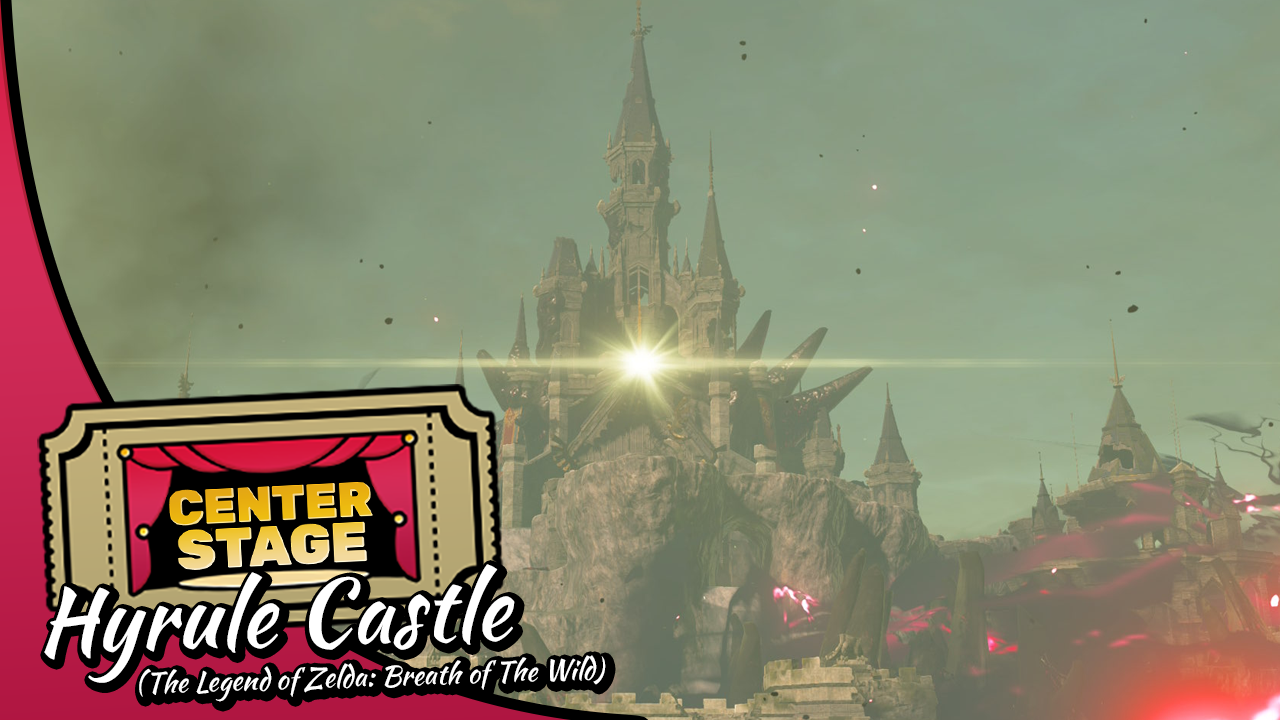
The opening act in The Legend of Zelda: Breath of the Wild is a spectacular thing. In the space of a couple hours, an amnesiac Link wakes from a hundred-year sleep, gets a few basic instructions, and experiences many of the game’s main mechanics. Climbing, cooking, combat, weather, player agency, and the powers of the Sheikah Slate all drive this tight sandbox. This did not go unnoticed; since the game’s 2017 release, the Great Plateau has been repeatedly lauded as one of the greatest tutorials in gaming. The claim is an accurate one, but these discussions generally exclude one important part. And that are two cutscenes in which Link sees his ultimate target: a castle, in the middle of a field, engulfed by evil.

Image: Source Gaming. The images for this were taken from the Nintendo Switch 2 Edition of Breath of the Wild.
Sitting north of the exact center of the map, Hyrule Castle symbolizes the demise of a kingdom. Threatened by the return of the timeless evil Ganon, Hyrule’s leaders unearthed weapons of war, only for those very weapons to be turned against them. Now Ganon’s essence haunts the palace, trapped by Princess Zelda’s magic but slowly breaking free. His monsters live in the castle’s ruined halls; his cephalopodan Guardian robots patrol the fields outside. It’s a place of death and ruin, and while Hyrule as a whole is dotted with communities and climates, there’s something eerie about the flat, quiet field surrounding the castle grounds. You get the sense that time isn’t allowed to go on. That any semblance of greater life has been snuffed out.
Hyrule Castle has appeared in other Zelda games, of course. It’s most often a dungeon, often the final one of the game. In The Legend of Zelda: A Link to the Past and Echoes of Wisdom, it’s the tutorial. In The Wind Waker, it’s the lost reminder of Hyrule’s mistakes. In Ocarina of Time and Twilight Princess, it once again becomes the seat of Ganondorf’s usurpation of Hyrule. The version in Breath of the Wild has all of these aspects and more. But it’s also more imposing, more threatening, and more interesting. Besieging it is far more of a task.
APPROACH
For one thing, Hyrule Castle is the case study in one of Breath of the Wild’s most tantalizing features. The game is famously nonlinear; players only have to finish the Great Plateau and assault the castle to finish the game. The four main dungeons, Link’s lost memories, the creation of Tarry Town, and every other sidequest are fully optional. The game puts a hat on this by ending the tutorial with Link facing the castle directly. His only quest: “Destroy Ganon.” He can make a beeline to the front door, sneak past the enemies, and battle Calamity Ganon at the heart of the castle.

Image: Source Gaming. The upper reaches of the castle are dripping with goopy Malice, Ganon’s hatred made manifest.
But unless he’s controlled by a high-level speedrunner, he won’t make it. Even getting close to the ruins of Castle Town is dangerous. Guardians, enemies whose overwhelming power made them de facto icons of the game as a whole, have good aim, fast legs, and a laser beam that slices through Link’s initial health. Inside, other Guardians act as turrets and drones. The Moblins, Bokoblins, and Lizalfos soldiers are all high level, with tough hides that’ll tank low grade weapons. The walls and cliffs are too steep to climb with the basic stamina bar. And if you haven’t done the main questlines, Ganon will even summon the bosses you didn’t beat as extra phases.
I tried it. In an abandoned replay of the game in 2025, I flew off the Plateau, ran up to the castle, sneaked and dodged my way through, and did make it in the door. I didn’t last much longer than that. Honestly, I didn’t expect to even get that far. It was a test, to see how my skills had atrophied years after playing it and its sequel, The Legend of Zelda: Tears of the Kingdom. Apparently, I’m still pretty good.

Image: Source Gaming. Whatever simple plan you have for scaling the castle will likely come up against one too many Guardians or monsters.
Many players will try this at least once. None will succeed, at least without dying at least once. Hyrule Castle is designed to not be conquered, especially not by anyone starting out. The walls are too tall. The enemies are balanced for players with ten or more Hearts and better gear. While some of the best weapons in the game can be found in the castle, they’re often on those enemies, and nothing in the Great Plateau or Hyrule Field compares. For a player with three Hearts, a single wheel of Stamina, and little knowledge of the game’s inner workings, it’s insurmountable.
This creates an interesting tension. Assuming you beat Breath of the Wild (and assuming you don’t continue to play after beating the game, as I did and as many players do), your journey ends here. There’s no other place for it to end, other than the downloadable expansion, The Champion’s Ballad. And obviously, that’s true in most narrative-driven games, but most games are not so hyper-fixated on the endgame. Everyone ends Resident Evil Requiem in the same place, but you’re not told that place from the start. Everyone spends Mass Effect 3 building up resources for the final battle, but most of those resources come from story missions you have to do anyway. Instead, Hyrule Castle is the goal, the only true goal, at every point. Everything you do and everything you don’t do, every quest you finish and every upgrade you get; they define the dungeon in a way they wouldn’t in a more linear or structured game. Because you’re going to have to tackle it eventually, and how you do that will come straight out of what you’ve done.

Image: Source Gaming. The Towers are one of the most important targets of a new player, as they fill in your map and give you a vantage point for finding important locales.
So you climb the Towers to open the map. You scope out Shrines in the distance with Link’s Sheikah Slate, enter them for Spirit Orbs, and spend those on health and stamina. You find better clothes and get the Great Fairies to upgrade them. You conquer the Divine Beasts and get powers from the Champions. You solve the mystery of Link’s memories and take back the Master Sword. You find Koroks and expand your inventory. You learn how to make food and elixirs after finding ingredients. You make money from quests and spend it on arrows. You swap out your puny sticks and ladles for Meteor Rods and Ancient Bladesaws. And all this time, you’re still learning the game, understanding Breath of the Wild on a deeper, more molecular level. Nothing feels wasted because everything was your choice.
The value of Hyrule Castle in this implicit agreement between Link and Breath of the Wild is that it is always there, to the point where you can see it across the map. It’s visible from buildings and mountaintops, from disparate corners. Ganon’s smoke cuts through the distance. You always know what this is all building toward, and while many games do make their final conflicts known, few are this explicit. It’s both a taunt and a comfort, because it’s there whenever you’re ready to try.
ENTRY
But, let’s say you feel ready to sneak in. Maybe you’ve captured all of the Divine Beasts and are rocking a full stamina meter. Maybe you want to test your limits. Maybe you’ve got that feeling in your gut that you can finally do it. Maybe you don’t want to fight Ganon but do want to track down all of Link’s memories first—one of them is in the dungeon, which feels as much like a statement of intent as anything else. No matter what, it’s time.

Image: Source Gaming. Approaching Hyrule Castle. The lasers in the sky appear with each main boss you fell; they symbolize the resources you’re bringing to the fight.
The first thing that stands out is the outskirts of Hyrule Castle. It is, as I said, very flat and open. There are a couple places to hide, and it is possible to kill Guardians, but generally, you need to move fast. Riding a horse is a good option; so is waiting for a Guardian to shoot its laser beam at the grass, dodging it, and riding the fiery updraft it causes with your Paraglider. It’s touch and go, but you’ll eventually make it to Hyrule Castle Town, find the bridge to the castle, and climb over the destroyed main gate.
…Or not at all! Unlike almost every dungeon throughout The Legend of Zelda’s forty years, there is no singular entrance to Hyrule Castle. You can swim to a beachhead below the building that leads into a basement tunnel, assuming you have the stamina to go that far. Or you can paraglide from the north, though that’ll deposit you away from easy access. Perhaps the craziest thing about this is that it’s just as easy to escape the level as it is to enter it. Because there are no hard walls, it’s entirely possible to simply glide off a tower and leave, if you need to and don’t want to use fast travel. If you’re only here for that one Memory, you’ll likely escape that way. It continues this agreement that, no matter how hard the game is, you’ll always be able to pick and abandon a challenge whenever you wish.
PATHS
Another way Hyrule Castle acts as a microcosm of the game is in its nonlinearity. In the same way that Link only needs to get through the dungeon to beat the game, the process of getting through it is very straightforward. He needs to find Ganon in the Sanctum, a room in the tallest spire (and whose location is already marked on the map). There are no big final puzzles, no Small Keys or Boss Keys, no sequential order of any kind. And because the level is so flush with enemies and walls, there isn’t any “right” way to go about that. You have to follow your own knowledge of the game. If you, like me, almost exclusively prioritize building stamina over health, the best way to move would be to scale the walls and bridges. If you’d prefer to deactivate the Guardians, pull out the Ancient Arrows you’ve collected and snipe the turrets. If you upgraded your gear and love to fight, go through the passages filled with beasts.

Image: Source Gaming. There are even Koroks hiding in the dungeon. This one gives you a good look at how decrepit the castle is.
This offers a pretty incredible level of openness, though it does pose a challenge for Breath of the Wild. The more linear Zelda games typically have great difficulty curves because the challenge and order are preordained. Breath of the Wild can’t, simply because it needs to always be open. When I first stormed that castle in this 2026 replay, it wasn’t to fight Ganon, only to find that one Memory, but I found the entrance to the Sanctum accidentally off of my full stamina bar. That’s a thing that can happen. The game’s answer to this is simply to have every threat operate at a ridiculous level of power, which is why I still had to hide from lasers and enemies. Even with a full health bar and upgraded clothes, Guardians are still hard. Even with a full stamina bar, you do need to be good at managing each climb.
LOOT
All Zelda dungeons have loot. It’s part and parcel of the series’ fantasy origins and a great incentive for exploring. However, the value of loot is at its highest in Breath of the Wild, simply because of that difficulty. Every arrow and Rupee is worth getting when you can’t cut grass to find them. Now that weapons degrade and break with use, even a middling sword or spear can be a life saver. So even though treasure can be redundant or not useful depending on the gear you currently have, it’s always worth seeking out. Outside of the recipes, it’s the most important part of Breath of the Wild’s focus on survival.
This is, naturally, important in the final dungeon in a way it isn’t in the more conventional Zelda titles, where there’s little reason to turn ever back. You’re liable to shatter several weapons on the normal enemies, and even Rupees have value since you have reasons to leave. One early NPC even lampshades this, noting that Hyrule Castle’s actually a great source of swords, shields, and money. There’s even a Shrine in the basement to let you fast travel in. And I think this is core to the experience. Hyrule Castle is full of cool side rooms, tunnels, hidden chests, and gear. A ton of gear ripe to be plucked. The most powerful is the classic Hylian Shield, found in the basement prison. It’s being guarded by a Stalnox, a reasonably tough mini-boss. It’s the kind of enemy who would guard the back half of a normal final dungeon, now relegated to a deathtrap for enterprising players.

Image: Source Gaming. Stalnox is relatively hard to find in the rest of Hyrule, so it’s possible some players will only find it here.
The most important stuff, though, is part of the game’s overarching narrative. I mentioned that one of the Memories is in Hyrule Castle, meaning that if you want to experience the emotional height of the story before defeating Ganon, you have to enter and leave his dungeon before committing to fighting him. It’s actually near a couple rooms with some diary entries. There’s another one for the late king of Hyrule in a secret chamber. These expand on the story and the way it functions as a loose mystery, and it rewards your exploration in a more personal way. Again, it’s empowered by the fact that none of it is necessary.
GANON
It all comes down to Ganon, though, doesn’t it? In Breath of the Wild, the Zelda villain is at his strangest. No longer a pig or a wizard, he’s an Eldritch, spindly beast of flame and magic. On a physical level, he’s as intimidating as ever. Mechanically, though, he’s a bit simple, especially if you’ve gone through the main plot to free the Divine Beasts. Each Beast has a boss at the end who also appears as one of Ganon’s phases, and if you beat it then, it doesn’t show up here. This makes sense. Skipping an entire phase of the final boss fight is a powerful and tangible reward for completing a dungeon, and having it be the same phase means you’re not barring adventurous players from seeing cool attacks and animations. But it does make Calamity Ganon far less dangerous if you progress through the story conventionally. His attacks are relatively easy to dodge and counter, and they won’t be too painful if you’ve got good health and gear.

Image: Source Gaming. Calamity Ganon captures the sci-fi energy that The Legend of Zelda semi-secretly loves.
This is even more true for his second form, where he tears ass across Hyrule Field as a boar. It’s little more than a silly final sequence, where Link shoots Light Arrows into his flank while riding a horse. These two sequences can be Breath of the Wild at its most discordant, where Ganon—the main villain of the series, and a primal, elemental force here—becomes simple and easily dispatched. He’s certainly going to be harder if you come in without as many Hearts or weapons, but that’s contingent upon you not empowering yourself. Short of tossing your best swords or only fighting him in Link’s boxer briefs, there’s not a way to make him more difficult, but there are a lot of ways to make him less. As a whole, the game is incredible at pushing, coaxing, and easing you into trying greater and greater challenges. But the final boss doesn’t really change alongside this, making him potentially anticlimactic.
At the same time, I don’t actually think it’s bad that Ganon isn’t at his most monstrous, or even that he ends as a goofy sequence. If anything, it’s Hyrule itself that was always the real antagonist of Breath of the Wild. Link’s journey to save the kingdom is also his journey of surviving the kingdom, of overcoming its monsters, climate, and sheer size. I don’t know if any final boss fight could adequately match whatever adventures you had along the way. Calamity Ganon is a bow you use to tie up your story. He’s a ridiculously over the top monstrosity that adds a lot of quick cinematic flair right at the end, and that’s useful on its own.
SYMBOL
The Legend of Zelda: Breath of the Wild is a game that brings out incredible, emotive states: excitement, curiosity, delight, fear, tension, defeat, and triumph. You feel these from the very start in the Great Plateau, and they ripple out underneath the forests and mountains. What Hyrule Castle does so well is marshall these feelings. As a dungeon, it provides both challenge and a way to show off your hard-earned skills. Emotionally, it’s extremely powerful, complete with a true banger of a main theme.
And when it returned in The Legend of Zelda: Tears of the Kingdom, many of these qualities remained. It was, once again, filled with powerful enemies. It was, once again, hard to reach, having been lifted hundreds of feet into the sky. This made it fun to traverse in entirely new ways. It was arguably more mysterious as well, as it was tied to multiple mysteries about the search for Zelda and Ganondorf. But it wasn’t quite as powerful, simply because it wasn’t the center anymore. It was still a symbol—now of the massive Upheaval threatening the restoration of the kingdom—but the main target was that nebulous overarching mystery.

Image: Source Gaming. Attempting to reach the castle with virtually no resources is fun in its own way.
This gets at the core of why Hyrule Castle matters, because it is a rare kind of dungeon that shines the brightest from the distance. It represents everything you’re fighting against and everything you’re building towards. At all times it is a goal, an enemy, and a place of treasure and glory. There aren’t a ton of video game spaces quite like it, spaces that are always visible and always threatening you. And it keeps the power of Breath of the Wild going across each journey, plan, and act of self-direction.
Thanks to Hamada for edits.

- Back on the Bat Chapter 3: The Black Mask Casebook - September 28, 2026
- Nintendo Direct September 9, 2026: Information and Reactions - September 9, 2026
- The Legend of Zelda 40th Anniversary Direct September 8, 2026: Information and Reactions - September 8, 2026