
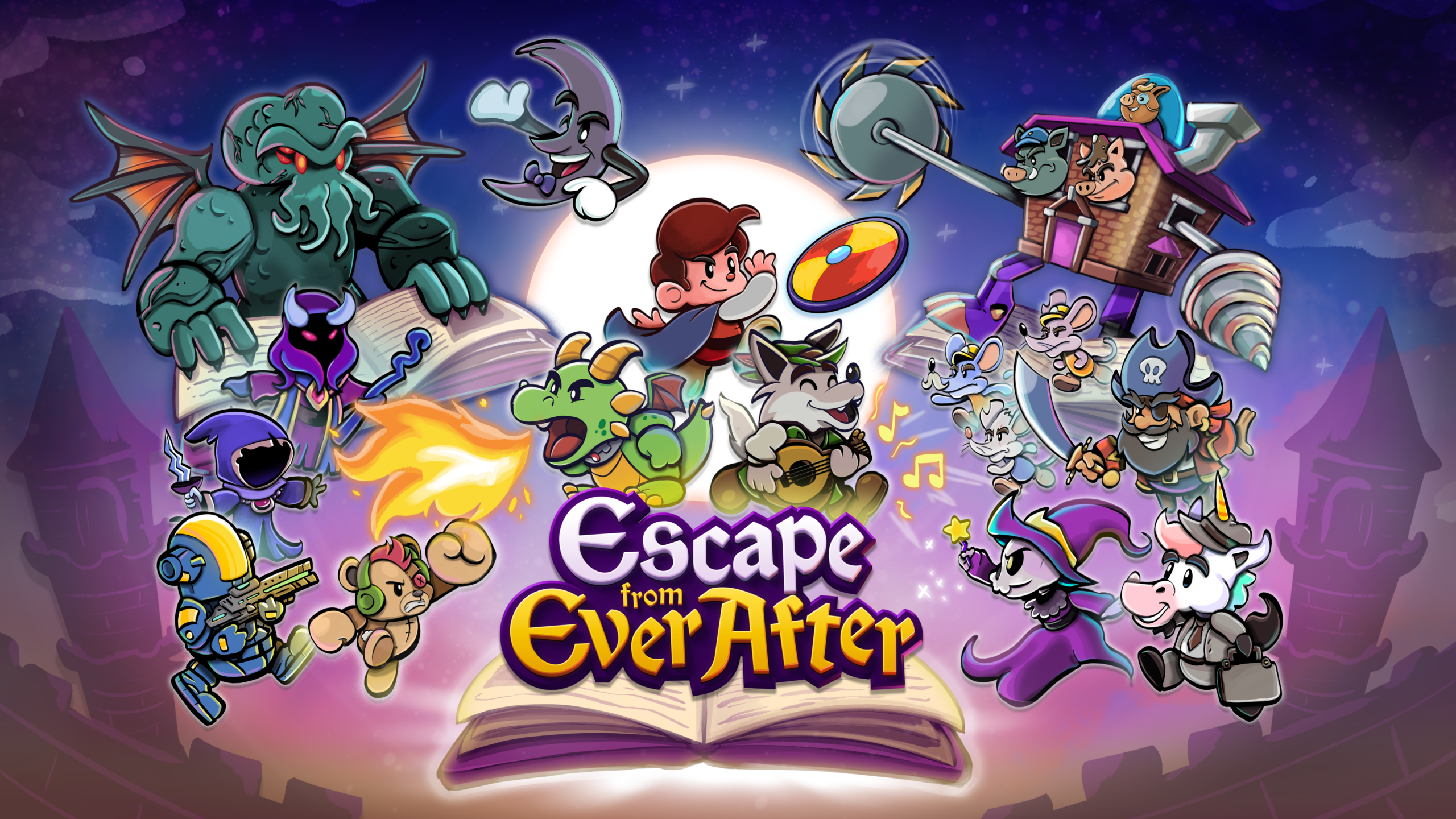
This review copy of Escape from Ever After was provided to Source Gaming by HypeTrain Digital.
It starts with a book. The Adventures of Flynt Buckler is about a status quo; every time, the hero Flynt tries to slay the dragon Tinder, and every time, he fails. And after establishing this stock fantasy, Sleepy Castle Studio and Wing-It! Creative’s Kickstarter-backed RPG Escape from Ever After turns it into ground zero. On his latest attempt, Flynt discovers that Tinder’s castle—their entire storybook world, actually—is the victim of a hostile takeover. Tinder is collared, cubicles line the halls, and the new boss has deemed fiction the final frontier of expansion. Under the edict of Ever After Inc., books like Flynt Buckler are viciously plundered for resources. The corporation only spares what few characters it deems useful, leading to a branch office staffed by public domain cutups like Dracula and Mother Goose. This forms the backbone of Flynt and Tinder’s shaky alliance. They’ll suck up to middle management, rise through the ranks, and get just enough power to destroy the “Telepager” that links each novel to the real world.

Image: Source Gaming. You go to spooky towns and volcanos, but the most striking image of Escape from Ever After is the fantasy castle cowed into the corporate life.
Escape from Ever After is a turn-based adventure with a fun combat system and gorgeous art. Flynt, Tinder, and their three fellow party members are drawn as animated 2D cutouts. They explore colorful worlds that go from bucolic villages to spooky ports to alien landscapes. They talk to eccentric NPCs whose fairy tale lives have been upended. They wear Trinkets to get buffs and pull off command prompts to do extra damage in fights. “Press A” when Flynt’s Buckler flies back to him to throw it again. Hold up and then down so lupine minstrel Wolfgang can deal more damage with his lute. There are also the puzzles, several of which are damn ingenious, and a saxophone-heavy soundtrack that’s an early standout for 2026. But… that’s not what Escape from Ever After is. Not really. What it is is, to be somewhat indelicate, a “Paper Mario clone.” The character animation, combat, aesthetics, and ephemera aggressively pay homage to the first two Mario role-playing games by Intelligent Systems.
It’s impossible to talk about Escape from Ever After without talking about Paper Mario, in particular the fan favorite Paper Mario: The Thousand-Year Door. Latte Points are Flower Points. Synergies are Special Moves. Research is Tattle, and everyone can perform it. Trinkets are Badges, with a few that are character-specific. Sun Gems are Star Pieces. There are Action Commands, silly choice responses, partner upgrades, a Pit of 100 Trials, and a few puzzles that don’t seem like they’d work for players with auditory or visual impairments (though at least the sound-based puzzles do have an optional accessibility feature, something Nintendo almost never provides). Much of the exploration resembles a point and click adventure, with Flynt running back and forth to find items or hints. The excellent score takes a cue from the modern Paper Mario entries, with lots of instrumentation and remixes. Even specific tropes are here, like sneaking up on a chatty parrot, running from a heartless monster, or standing on a pad that lets Flynt swim in water. And the writing very clearly follows the style of Nintendo of America’s localization. It’s not so much “derivative” as deeply reverent.

Image: Source Gaming. Tinder lays waste to a coven of Eldritch cultists. Every character’s pretty well-balanced, but I relied on her a lot.
Now, ignoring the fact that this is coming out a year and a half after the sumptuous remake of The Thousand-Year Door, the best Paper Mario game and one of the best RPGs on Nintendo Switch, there’s a legitimate niche here. Nintendo and Intelligent Systems have been open that they’re not interested in returning to this kind of game, and while that’s creatively fair, it’s also left a twenty-year hole in the market. Other games have tried to fill that hole, like Bug Fables and several now-delisted Steven Universe tie-ins, but not many and none that feel like definitive successors in any way. This one easily makes the strongest play for the role, and it’s also stuffed to bursting with game feel and aesthetic pleasures. And while I reviewed the Switch version of Ever After on Switch 2, it’s also launching on consoles that don’t have The Thousand-Year Door. There is plenty of room for this curious micro-genre of timed hits and adventure game logic to spread out.
Still, it’s kinda awkward. I’m personally mixed on new games that try this hard to recapture specific old ones, even games that try to recapture stuff I liked (full disclosure: no games have as strong a nostalgic hold on me as those first two Paper Mario games). This one’s adoration is sincere, intense, and honestly distracting at times. It’s also where the game is often at its weakest, unfortunately. It felt dizzying to see so many nods to The Thousand-Year Door, and to see so many feel just a bit off. For instance, Paper Mario has a thing where Mario can hit enemies preemptively or avoid them entirely, but the baddies here walk so fast that they’ll often overrun you. The timing for the Action Commands and overworld movement are both slightly finicky, several chase sequences and puzzles go on for too long, and the game demands a level of precision that sometimes feels needless. A lot of platforming with no slack for a game that is built to be a turn-based RPG. It also has some good caveats to this, like multiple difficulty modes and the option to make action commands on by default, but these don’t counter the atmosphere of imperfect mimicry.

Image: Source Gaming. Another Nintendo-adjacent feature are Wolfgang’s songs, which solve various puzzles. I quite liked them, and I’d have liked to see even more of the mechanic.
Escape from Ever After does expand on the Paper Mario standard in a few fun ways, particularly in combat. Certain attacks and conditions can synergize, like how Tinder can inflict a burn status effect and Flynt can spread it to other enemies, and characters have team-up attacks. The party members are also all relatively equal in terms of moves, strengths, and what Trinkets they can equip, so they’re more adaptable than the Paper Mario party members and can build unique synergistic plans. In that way and several others, the game feels very much geared for the Paper Mario fan who wants something new and slightly more hardcore. If you liked that one Princess Peach puzzle about putting potions in the right order, here’s one with six variables instead of four that I solved by cutting up a paper napkin. If you want a thornier challenge than “don’t avoid the enemy’s spike,” there are mechanics about removing shields, remote barrier drones, and attacking in all four cardinal directions. Speaking as someone who can rush through TTYD in his sleep, that’s a need I definitely get.
I think my biggest gripe is with the comedy. Across its history, Paper Mario has been one of gaming’s wittiest series, with a very specific comedic voice that isn’t easy to copy. It’s important for this game to have its own voice, too, and I don’t think it always does. Some of the humor feels transparently indebted to Nintendo’s scripts, and some of the humor that doesn’t can feel tired and hackneyed. There’s a lot of lampshading, a lot of meta jokes that fall flat, and a lot of dialogue that reminds me of a lot of other, much less imaginative indie titles. I didn’t like Flynt for the first half of the adventure, with his smirking Dipper Pines face and propensity for lines that were outdated years ago—he makes an “I’m glad there’s no fall damage!” joke, and in a story where video games don’t seem to exist—and he symbolized a lot of my frustrations. At its weakest, Escape from Ever After reads as obsessed with games twenty years its senior. Even the beautiful paper aesthetic suffers from this. Flynt can’t attack up and down when he’s in the field, just like how Mario couldn’t in those original games, and it never feels right. Perhaps the game didn’t need to be quite so faithful.

Image: Source Gaming. While some of the humor are very strong, Escape from Ever After also relies on some pretty tired jokes.
Indeed, it’s strongest when trying to do something Paper Mario hasn’t done. The corporate satire is very on point and as depressingly relevant as ever, but building the actual hub around that satire is a stroke of genius. Since Flynt is climbing the company ladder, he’s stuck jawing with his literary coworkers, solving pointless gofer sidequests (“fix my computer!” “plan this party!” “agree to an HR mediation that legally absolves us!”), and refilling his magic points with lukewarm office coffee. Get yourself a pumpkin spice latte at the dining hall; it restores 6 HP and 12 LP! It’s surprisingly rare to see an RPG unify its ideas so neatly. This is something The Thousand-Year Door might do for one chapter, but not the entire macro plot and not with this much focus. Similarly, while Mario has to be the main party member in his RPG appearances, there’s no brand expectation for Flynt, and he can be swapped out during battles for dynamic strategies. His party members also get more time to shine with arcs that develop over the course of the game, not just whatever chapter introduced them. That same fan devotion is here, too; the difference is it’s using those old games as a springboard.
But those are things a Paper Mario game could do, and the setting also lets Escape from Ever After do things a Paper Mario probably wouldn’t. The plot as a whole feels like a far more pointed take on Fractured Fairy Tales, the Rocky & Bullwinkle feature that spoofed classical stories. Ever After’s Three Little Pigs, for instance, are the three pillars of capitalism—a manager, a cop, and a CEO—and “Big Bad” Wolfgang blows down the headquarters of their union-busting empire. The heroes spend a minute in a resort was a swashbuckling pirate novel before the bulldozers came in. Content-wise, a chapter set in a Shadow over Innsmouth parody has adorable Lovecraftian horrors whose mid-battle deformations would never, ever get past Mario brand edicts. And using this bevy of public domain literary characters at all falls outside Nintendo’s preference for worlds that are more distinctly theirs. Sleepy Castle can be a little more pressing, a little more daring with the story it wants to tell. It works. Many of my favorite beats, images, and plot points from the game came out of this direction.

Image: Source Gaming. In one optional (but highly recommended) sidequest, the gang has to answer an HR complaint filed by the Chapter 1 bosses.
This focus isn’t perfect; the book parodies are tea tray-shallow and lack specificity. Sherlock Holmes is here, just at his most unmemorable save one wild plot point I’ll refrain from spoiling. But they give the game a perspective and help it stand as its own thing, not an act of devotion. What it adds most to this bizarre micro-genre is super-charging the twists that made The Thousand-Year Door so brilliant. Every thirty to forty-five minutes finds some new changeup, and while a few of them miss, most don’t. Maybe there’ll be a boss who dictates which party members you can use. Maybe the team will get separated and have to reunite. Maybe Flynt will suffer through a platforming section or enjoy a wildly inventive puzzle box conundrum. Maybe the plot will veer off in a wild new direction. Maybe there’ll be betrayal or horror or some of the indelible character work that made those classic games classic to begin with. There’s always been a variety show element to this strand of role-playing games, and it’s very strong here.
And I think that’s part of why I liked Escape from Ever After more as it went on. It starts with its worst foot forward; the combat feels rudimentary, and the dialogue lacks a spark. I was worried that this review would end up with me shellacking a small, ambitious indie title whose publisher was kind enough to give us a review copy. But as each hour went on, I kept finding impromptu gimmicks, puzzles, and plot twists. Best of all was seeing the writing shift just slightly. It stays irreverent and witty across the adventure, but the jokes get better and they share space with more serious, thoughtful writing over the breezy fifteen to twenty hour experience. Many of these things would be cool to see in a traditional Paper Mario sequel, but far more importantly, they’re simply good ideas mostly done well. I got excited for each new beat and started wondering about the next one coming down the pike.

Image: Source Gaming. I didn’t talk about this as much, but the graphics are very lovely.
There’s no shortage of homages, clones, and spiritual successors in the games industry. Some are bad, some great; most mediocre. Escape from Ever After never matches the two Paper Mario games that inspired it, and at its worst feels slavish. But it’s also filled with plenty of compelling ideas of its own and has a stunning amount of polish from a first-time studio. Not unlike its leads, who punch hard above their weight class, it’s a good game whose reach at greatness is both commendable and fairly extraordinary at points. I quite liked it, and I think other fans of classic Paper Mario will like it too.
Final score: 7/10: Good
Thanks to Cart Boy for edits.

- Indie World March 3, 2026: Information and Reactions - March 3, 2026
- On Phil - February 26, 2026
- Escape from Ever After | Review - February 17, 2026