
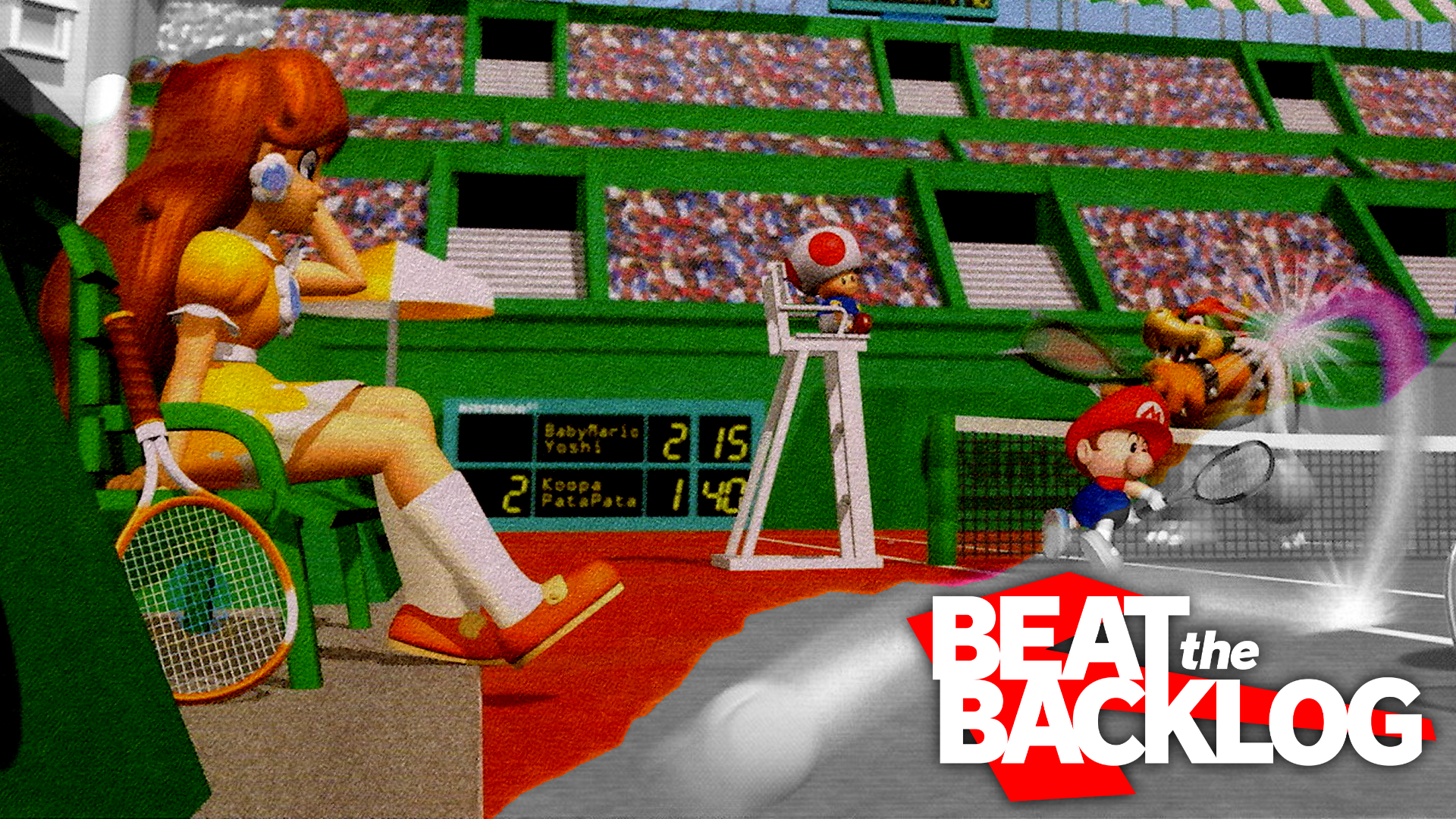
Visiting arcades as a tyke was thrilling and taught me how diverse this medium is. As far back as I can remember, platformers have been my go-to genre; Super Mario World, Super Mario 64, Donkey Kong Country, Sonic the Hedgehog 2, and the obscure DOS “classic” Monster Bash were formative experiences. But games could also be about martial artists duking it out, spellcasters roaming monster-infested dungeons, or… simple tennis matches. While I was dreadful at Virtua Tennis, its impressive polygonal models and comparatively mundane nature stuck with me.

Image: Source Gaming. One of my rental store staples during its heyday, I have a lot of affection for Mario Tennis. Nintendo has since re-released it on the Wii, Wii U, and Nintendo Switch.
After Nintendo’s success with the groundbreaking Mario Kart series, it was inevitable they’d push their mascot into more extracurricular athletics. I didn’t learn this until later, but the plumber had already picked up (and assuredly made) a racket in Mario’s Tennis, the 1995 Virtual Boy launch title. In 1999, Nintendo published Mario Golf for the Nintendo 64, a collaboration with Everybody’s Golf developer Camelot that cemented that sport as one of his pastimes. A year later, the pair followed it up with Mario Tennis.
The most eye-catching thing about Mario Tennis is its roster. For context, Mario Golf retained the core Mario Kart 64 group: Mario, Luigi, Peach, Yoshi, Donkey Kong, Wario, and Bowser; only Toad sat out as an NPC. Golf also set an important precedent by including alternate versions of the headliner, most notably Baby Mario from Yoshi’s Island (but I played Tennis first, where his presence threw me for a loop. How and why did Mario retrieve his infant self? Is he merely an audacious narcissist who wanted to double his odds of winning? Share your theories below). Bizarrely, Mario Golf even housed a handful of original, one-off human characters. Maybe you remember Plum, the one who scored a trophy in Super Smash Bros. Melee? Nothing against fresh faces, of course, and this batch retroactively gives Mario Golf a unique, nifty charm. But they didn’t excite me, y’know?

Image: Source Gaming. Since tennis demands hands, Camelot sought characters who have them (a restriction sequels cleverly worked around). Pairing everyone with a logical doubles partner was also critical and inadvertently cemented bright futures for a few now-famous franchise fixtures.
Mario Tennis keeps the Kart 64 clique, excised Metal Mario and the normies, and invited several cool people in their place! Exotic Super Mario Bros. 2 refugee Birdo had resurfaced a few times already, but Camelot promoted her into a future spin-off staple. Ditto for Daisy, the Super Mario Land lass. While I historically prefer playing as defined individuals over nameless mooks, Koopa Paratroopa, Shy Guy, and especially Boo were inspired inclusions. Donkey Kong Country mainstay Diddy Kong was still barred from the Mushroom Kingdom, leaving Donkey Kong Jr. room to emerge for one last hurrah (until his Super NES-stylized comeback in Mario Kart Tour two decades later). Oh, and Tennis spawned another new human participant, one who meshes with the Mario crew swimmingly and whose persistence is equalled only by his pettiness: Waluigi! While I never quite warmed up to him, he’s undeniably grown into an adored series icon. For the time, Tennis had a stellar roster, one that smartly built upon its predecessors and admiringly celebrated the broader universe. Shame Tatanga or Captain Syrup didn’t receive an invite, but Camelot can only work so many miracles, I suppose.
No-frills hard, clay, grass, and composition courts are accessible by default. While they’re identical in terms of size, each boasts distinct ball speeds and bounce heights. However, Mario flair bleeds in through six hidden arenas that are acquired by progressing through the single-player tournaments as specific characters (six additional stadiums require linking Mario Tennis to the like-named Game Boy Color companion title). In retrospect, these are hardly the most inventive bonuses the series ever saw; they simply flaunt pictures of their owners and some familiar iconography. For example, the Donkey Kong Court boasts his mug, barrels, a jungle, and an arrangement of the original arcade game’s theme; it is, unmistakably, a Donkey Kong court. Still, it’s fine, and I can’t hold Mario Tennis to the standards its sequels set on stronger hardware.

Image: Source Gaming. Contestants are split into five categories: All-Round, Technique, Speed, Power, and Tricky. Experiment to find the eccentric who suits your style!
Mario Tennis feels like a tennis game first and Mario game second, but it’s a mechanically sound tennis game! Rounds start as you’d expect with Player 1 serving. Plenty of depth powers Tennis even at this point in a match: pressing the A or B button tosses the ball into the air, then you press either button again to hit it, and you can tweak the direction via the control stick. Timing the serve carefully yields a “Nice” bonus, providing a modest power and speed boost. Typically, the server holds the advantage, so make your turn count!
Multiple options are at your disposal when volleying. Should you press A twice, you’ll perform a topspin, which get an orange trail and feature a higher arch. Performing the same with B yields a slice, a blue blast at a low trajectory. Meanwhile, pressing A and then B yields a lob shot, while a drop shot’s performed by doing the opposite; these respectively reach the back and front of the court. Pressing A and B simultaneously makes your Mario mascot deploy a pink smash shot.

Image: Source Gaming. After a volley ends, a dramatic replay airs. You can skip or repeat it.
Other rules are important to remember, too! Should you seek extra oomph, start charging your shot beforehand. You’ll remain stationary while doing so, meaning a misread’ll cost ya—same if you hit the ball too hard and smash it out of bounds. Make sure your shot falls within the court’s boundaries; exceeding them twice in one serve incurs a double fault, which concedes the point to your rival. If a match ends in a tie, a tiebreaker decides the victor.
Learning the rules is only half the battle, though. Aiming your shot away from your opponent usually isn’t enough! On the fly, you’ll need to ask questions and make decisions. When do you approach the net or fall back? Which maneuvers best take advantage of the characters’ strengths and weaknesses? Doubles matches add more layers; you gotta ensure you and your buddy are in sync and intelligently covering the court. A second’s hesitation can cost you!

Image: Source Gaming. Each character has leftie and star-powered variants; the latter’s acquired by finishing the first three single-player tournaments. Shy Guy and DK Jr. are unlocked by conquering the singles and doubles Star Cup, respectively, and come with their star selves unlocked automatically.
Exhibition mode is the main attraction. If your friends are unavailable, you can practice with up to three computer opponents, whose difficulty options span easy, normal, hard, and intense. Singles and doubles tournaments are the other big draw; players compete in progressively harder matches across the Mushroom, Flower, and Star Cups. Clearing them as all sixteen athletes grants access to the Rainbow Cup. Then there’s the Moonlight Cup, and finishing it opens the grueling Planet Cup. Becoming the grand champion as everyone unveils the game’s ultimate prize: the max-level computer difficulty. Now, there’s nothing particularly novel or mechanically inventive here—really, it’s all “just” tennis—but devotees are absolutely catered to.
Like me! If kosher tennis appeals to you, you’re gonna enjoy this game. Eventually, you’ll get pretty decent at it, too. One of the novelties the Nintendo 64 library held for me was that it forced me to practice my favorite games, to get good at them. And while I’m hardly a professional, learning the various shots while trying to read my opponents and throw ‘em off guard is always engaging, rewarding. Especially when I’m facing other people! One memory of my late, local Toys “R” Us is a long match I played against another kid, a tight back and forth that seemed to last indefinitely. It probably did; I won during a close tiebreaker, at which point our parents displayed visible relief. That never would’ve happened in Mario Kart 64; there’s only so long a race therein can last, particularly when it assists stragglers with stronger items. Rounds of Mario Tennis are predicated purely on skill; Spiny Shells aren’t nudging me back into first.

Image: Source Gaming. While there’s only so much room for it to shine, Camelot clearly reveres these characters. While I haven’t unlocked the corresponding court yet, I’m thrilled Mario Tennis contains Wario Land 3 content. I wish Mario spin-offs dipped into that wonderful, gross corner of the universe more often.
While Mario Kart is also based on a real-world sport, it fully embraces the fantastic stylings of its parent series; Tennis doing otherwise was shocking. To be clear, my interest in sports is nil. I gave this spin-off a shot solely because it stars a wealth of weirdos I love, though it helps that tennis is simple and tactile; even I can wrap my head around Pong. I didn’t expect to wind up digging Mario Tennis as much as I did!
If you’re hankering for more Mario in your Mario Tennis, however, Camelot has a few trick shots up their sleeve. Ring Shot asks players to simultaneously face each other while hitting the ball through large, floating rings. Piranha Challenge pits you against three of the pesky plants as well as a normal opponent; make sure to return their volleys! Easily the most interesting bonus is the Bowser Stage, a Mario Kart tribute that lets you pelt foes with familiar items. Whisk the ball through an Item Box, score a goodie: banana peels, red and green Koopa shells, Starmen, Lightning Bolts, and Super Mushrooms make the leap roughly intact, and while they’re altogether less disruptive, things still grow pretty chaotic. A few “Special Games” also lurk about, though they’re barely worth mentioning. Anyone curious to see their exhibition records and tournament trophies can do so freely, too.

Image: Source Gaming. These diversions are welcome inclusions, though they’re very much merely that.
While Mario Tennis isn’t a technical showcase for the Nintendo 64, it’s more than serviceable. Characters are respectably expressive, laughing or whining depending on their performance. Each contestant also stars in a cute cinematic when winning a singles cup, scenes that lovingly showcase their quirks. Motoi Sakuraba’s score is one of my favorites on the system—and, surprisingly, more so for his original compositions, not the remixes! Little Cart Boy was always drawn to the intense “Tournament Round 2” theme, and I’d love to see an arrangement grace the Super Smash Bros. series. We’ve had a “Mario Tennis / Mario Golf” melody since Brawl, so hopefully I’ll get my wish someday…
Depending on what you want out of Mario Tennis, its later entries might be more appealing. GameCube classic Mario Power Tennis eagerly embraced Mario’s absurdity through “Power Shots” that drew from its history and can instantaneously upend the flow of a match. Combine that with the sequel’s delightful victory sequences, Pixar-esque blooper reels, larger roster, and more robust, wild stages, and it remains my favorite in the series. Never tried its apparently iffy New Play Control! Wii reissue, though (I also feel obligated to add that Sumo Digital’s crack at Power’s formula, Sega Superstars Tennis, was a passable early purchase on my Xbox 360).

Image: Source Gaming. Designed as the cast’s token “heel,” Waluigi’s hostility in the intro and eye-glowing exude an uneasy, even sinister aura. Meanwhile, his winning ceremonies and “no controller connected” cameo are goofy, a quality his many, many encores ran with.
Subsequent titles are hit or miss. The GBC Mario Tennis and its Game Boy Advance follow-up, Mario Tennis: Power Tour, boast robust RPG single-player campaigns; I’ve heard nothing but praise for them. Then Mario Tennis Open was a personal disappointment on the Nintendo 3DS, while the Wii U received Ultra Smash, the series’ nadir. From what I hear, the Switch entry, Aces, started off as a fairly threadbare package, but gradually grew into a commendable one through post-launch updates. And I’m looking forward to trying Mario Tennis Fever, tomorrow’s big release! Hopefully, it’ll wind up the plumber’s best tennis tournament yet… even if it’s responsible for spawning Baby Waluigi, the latest and most disreputable addition to the Mario baby pantheon. Hey, if any studio’s gonna create such an abomination, it should be the one that lovingly made his adult self in the first place.
None of those games quite recapture what endeared me to Camelot’s first Mario Tennis, though. As a kid who was still learning about the world, both ours and Mario’s, there was value in playing it. Yes, it was strange seeing these oddballs take a break from their wacky adventures to partake in an unvarnished depiction of tennis. But that speaks to the brand’s versatility. Besides, maybe these misfits deserve a day off, an opportunity to hang out and hit the courts. It’s nice we could spend it with them. And while the impact of Mario Tennis on the broader franchise is underappreciated—it’s difficult to envision Waluigi or Daisy skipping a shindig today, and the latter’s even been playable in two mainline Marios now—it’s unmistakable and enduring.

Image: Source Gaming. Even without Tennis, I’d have grown into the massive Mario (and Wario and Donkey Kong!) fan that I am, but it accelerated that metamorphosis. Meeting so many whimsical souls was exciting and teased the breadth of this universe.
Thanks to Wolfman for helping with edits.

- Continuity Corner: Why Did Ash’s Pikachu Forget Volt Tackle? - October 16, 2026
- The Donkey Kong Bananza Hype Cycle – A Retrospective - July 17, 2026
- Beat the Backlog: Sonic Blast - July 9, 2026