
The code for Pastel☆Parade was provided by publisher room6.
Developed by indie studio Matsu Friends and published by Kyoto-based room6, Pastel☆Parade is a brand new rhythm game for the Rhythm Heaven fans in the audience. The game combines Rhythm Heaven-styled musical mini-games, with music by artists FALL and MasaDo, with a cute and adorable little story reminiscent of SEGA’s Puyo Puyo Tetris. However, just because this sounds like a winning formula on paper doesn’t guarantee that the game is without flaws.
The story follows four high school girls becoming friends, forming a band, going to the beach and finding ancient ruins and a lost beast tribe. You know, as friend groups tend to do. Each act of each chapter is presented as a rhythm mini-game, sandwiched between brief moments of dialogue and CG scenes of the characters hanging out. It’s all very cute and charming.

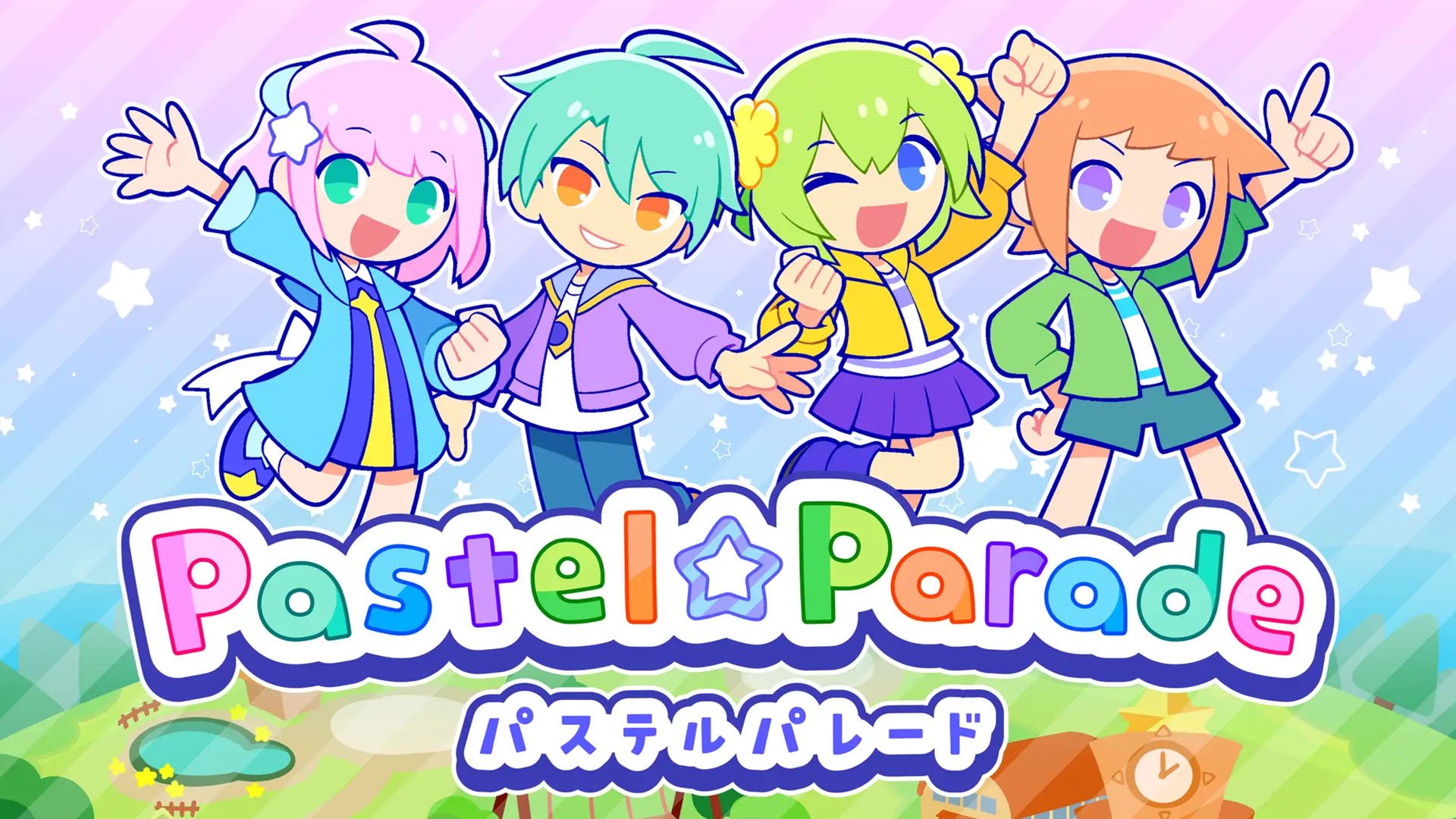
Pastel☆Parade follows the growing friendship of Nagisa, the straightman type who has a fascination with the occult; Amane, the aloof, friendly girl who is up for trying anything; Morn, the responsible, sporty upper-classmen; and Kohaku, the irresponsible, playful type of girl. By following this group, Pastel☆Parade differentiates itself from Rhythm Heaven by having every mini-game star its heroine quartet, sometimes putting the player in-control of a specific member or randomising it, depending on the context of the mini-game. The cast are all very endearing and it is easy to become attached to them by the end of their journey.
It helps that the story of Pastel☆Parade is very unserious, full of fun dialogue as the cast gets pulled left and right to each new mini-game setting. Paired with the cute character designs and visuals, it makes the story sections enjoyable to read and it even manages to have a little bit of mystery in its plot, even if the reveal isn’t that shocking given the hints.
The main game is presented in an overworld with the group walking around from location to location, with side areas to interact with for extra dialogue. The player can also hang out in the girls room, filled with memorabilia from their journey, and providing quick access to every mini-game and cutscene in the game. It’s a contextual menu that adds to the game’s overall charm.

But how about those mini-games? After all, they are the main gameplay element of Pastel☆Parade and its main reason for playing. For the most part, they are pretty good, with a great sense of beat and rhythm for the player to follow. The first rhythm game in particular is a great introduction to what Pastel☆Parade has to offer. Which is good because this mini-game shows up again. And again. And again.
While Pastel☆Parade advertises itself as having 30 original songs, this unfortunately does not actually correlate to 30 original mini-games. By my count, there are only actually 10 unique rhythm games with many of them getting repeated. To an extent this makes sense as Pastel☆Parade can introduce a rhythm game early on and then provide a harder variant of it to test the player’s growing skill. However, this justification becomes redundant upon completing the game where nearly every mini-game unlocks an alternative track to experience. This first mini-game, the Splash Festival, has eight variants of itself, which is just over a quarter of the entire soundtrack.

Unfortunately, this messes with the pacing of the game, which left a slightly concerned feeling in me. After four original rhythm mini-games back-to-back, it then hit me with two of the same previous mini-games in the same order for games 5 and 6. It then did the same thing in world 4, repeating the first two mini-games of world 3 in the same order once more. Given there are only four worlds to play through and each rhythm game is roughly over a minute long, Pastel☆Parade is not a very long game, which makes the repetition of content feel all the more severe.
That said, Pastel☆Parade is not a game that’s meant to be played once. Each rhythm game is scored in a way reminiscent of arcade rhythm games with a ‘Perfect’, ‘Fast’, ‘Slow’ and ‘Miss’ rating. The timing for each beat is tracked and a percentage score is provided on how accurate the player was, earning a Platinum, Gold, Silver or Bronze medal. Getting Platinum is not an easy feat, so much of Pastel☆Parade’s playtime will be spent repeating rhythm games in order to master them.

For the most part these rhythm mini-games are pretty good, thankfully. The dancing one and the volleyball one are personal favourites. However, there is one rhythm game that I found to just be bad and it is unfortunately one of the most important, appearing twice in the story. The Pastel☆Parade rhythm-game itself, where the girls form their titular band, is far more focused on remembering a specific button combination than reacting to the beat of the song. It requires the player to remember four very specific button combinations and then play them alongside Nagisa when certain visual cues are on screen.
One of the best parts of rhythm games like Pastel☆Parade and Rhythm Heaven is that they can be beaten with their eyes closed, just following the beat and rhythm of each song. For the most part, Pastel☆Parade does this. However, the guitar mini-game, and to a lesser extent two others, goes against this philosophy and it ends up being the worst mini-game as a result. At least Pastel☆Parade doesn’t fail the player for messing up really badly like Rhythm Heaven does, so even if every beat is missed the story still goes on.
A slight story spoiler in this paragraph, so skip ahead if you want to experience it for yourself. The guitar coming back for the finale instead of a compilation of all the mini-games seems like an odd choice. The context of the scene is Amane getting her memories of her time with her friends back, so a remix that goes through each rhythm game on her journey would be perfect here. Instead the game throws another guitar rhythm game with an even harder beat at the player, and it is not that fun.

Despite all the complaints I just laid out, I think Pastel☆Parade is still worth playing, especially for rhythm game fans. It’s a quick hit, but for the most part Pastel☆Parade provides a great time with several fun rhythm games and a great soundtrack. It even has functionality to adjust the timing of inputs for players with a soundbar or other accessory that might delay the music. The visuals are cute and the four girls are all very charming with good chemistry.
Pastel☆Parade ultimately provides an enjoyable time with just a few stumbles on its journey. For Rhythm Heaven fans it is a must play and for newcomers to rhythm games it is not a bad starting spot, just suffering from some difficulty spikes at a few points. Its cute aesthetics and likeable characters do a good job of keeping spirits up and pushing the player forward, even through the few annoying moments.
Pastel☆Parade: Pastel☆Parade ultimately provides an enjoyable time with just a few stumbles on its journey. For Rhythm Heaven fans it is a must play and for newcomers to rhythm games it is not a bad starting spot, just suffering from some difficulty spikes at a few points. Its cute aesthetics and likeable characters do a good job of keeping spirits up and pushing the player forward, even through the few annoying moments. – NantenJex