
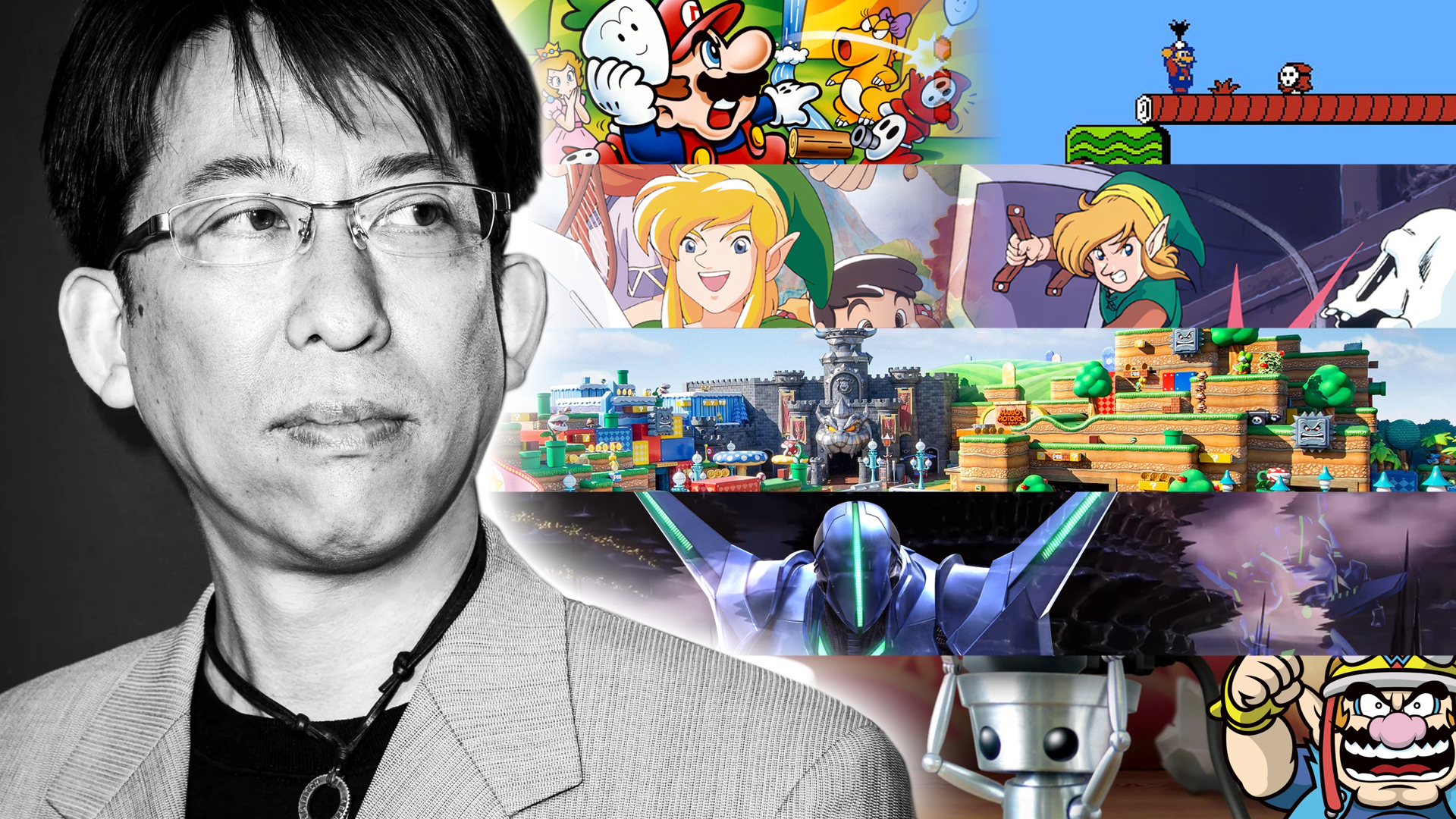
Back in January, producer Kensuke Tanabe reportedly announced his retirement after a forty-year career at Nintendo. It’s a fairly major change. While he wasn’t as well known as Shigeru Miyamoto or Eiji Aonuma, his career—spanning decades, eras, presidents, and over a hundred and fifty games—is beyond prolific. He was one of the key developers of Super Mario Bros. 2, integral in the development of the Legend of Zelda series, one of the biggest boosters of the Metroid Prime games, and as a producer worked with dozens of developers in and out of Nintendo. Metroid Prime 4: Beyond will be his last game, with longtime producer Risa Tabata poised to take over his role.
If there was a Nintendo franchise, there’s a decent chance Tanabe worked on it. Super Mario, Paper Mario, Metroid Prime, The Legend of Zelda, Donkey Kong, the Super Nintendo World theme park; he touched all of them, often in significant ways. He was a designer, supervisor, script writer, localizer, advisor, and most often, a producer. That led him to blockbusters that sold millions of copies and to strange, surreal titles that never left Japan. Many Nintendo higher ups follow a similar path due to the company’s organizational structure, but few have the number and diversity of projects.
The Source Gaming team wanted to honor Tanabe’s years of work. But instead of writing a biography, we’d like to go through his work in the form of a somewhat unconventional listicle. We’re not gonna be jokey or creative or imaginative. Instead, we just want to highlight a few games that you likely love, the histories of how they came to be, and the contributions of one man who worked on all of them and might have flowed under the radar for you.
Yume Kojo: Doki Doki Panic (1987) / Super Mario Bros. 2 (1988)
Super Mario Bros. 2 is, unfortunately, the only title of Mr. Tanabe’s works that I’ve played (yet). However, it was the first Mario game that I ever played, via Super Mario Advance for the Game Boy Advance, and thus shaped my perspective of how 2D Mario should always be. Featuring multiple playable characters each with their own traits, allowing not just for variety of play, but also being able to take control of your favorite characters like Luigi and Princess Peach. However, taking the time to replay Super Mario Bros. 2 (NES) via Nintendo Classics after many years, I began to feel that it’s the first early Mario title that feels the most like an adventure. An adventure through dreams, jumping across logs on waterfalls, ascending hills and clouds or descending tunnels with a key in your grasp, all while being chased by the scary mask, Phanto.

Image: Source Gaming. Super Mario Bros. 2.
Rather than jumping on top of enemies for instant defeat, Mario and co. will land on enemies heads or their own attacks, such as with Mouser and Birdo, to pick them up and then toss them back or at others for damage. Thus, bringing about more interaction with enemies rather than a more immediate death or skillfully avoiding them. This idea, of picking up and tossing enemies and plants, stems from the game’s original prototype as developed by SRD (Systems Research & Development). As reported from a 2011 interview with Wired, Kensuke Tanabe mentioned that the prototype originally featured two players utilizing the capability to throw each other and items to ascend vertical platforms. While that idea didn’t work out for Doki Doki Panic and Super Mario Bros. 2, reading this made me think of Super Mario Maker. Witnessing builders create a variety of horizontal progression and vertical ascension levels, plus the competitive or assisting nature of players to carry one another to the goal or sabotage them by tossing them into a gigantic Bowser – it lives on. That initial prototype idea feels very representative of where the Mario series progressed to, and while Tanabe may not have had a hand in Super Mario Maker or the other titles that make up its existence, his roundabout start with the franchise truly impacted the way people see it. – PhantomZ2
The Legend of Zelda: A Link to the Past (1991)
Kensuke Tanabe entered the Zelda scene with A Link to the Past, becoming its scenario writer. Before this game, the creators of Zelda only had a vague idea of where it would go, and concepts show that it might have even taken a sci-fi turn at this entry. Thankfully, that didn’t happen. Tanabe’s contribution not only set the stage for much of the lore that was followed until 2017’s Breath of the Wild, he is also responsible for some of the most iconic things for the series. The Master Sword in the pedestal, hidden away in a forest, that was him. – Slink
The Legend of Zelda: Link’s Awakening (1993)
Link’s Awakening was a huge turn for the series, heralding a focus on storytelling and narrative that was not present in prior games. Starting as a port of A Link to the Past, the ideas snowballed into a full game without the supervision of series creator Shigeru Miyamoto, Link’s Awakening is a daring and experimental title that still stands as one of the most unique in the series. Without the involvement of Tanabe and his peers, the series as we know it would not be the same. Series lead Eiji Aonuma would later recount that “It wasn’t until [Link’s Awakening] that the series started having a proper plot,” and that, “If we had proceeded from [A Link to the Past] straight to [Ocarina of Time] without [Link’s Awakening] in between, [Ocarina of Time] would have been different.” – Slink

Image: Source Gaming. The Legend of Zelda: Link’s Awakening DX. While Tanabe didn’t work on the Game Boy Color port itself, his script was retained.
Metroid Prime (2002)
During the Nineties and 2000s, Tanabe slowly shifted to being a producer on games primarily made by third party studios or Nintendo’s Western teams. Pokémon Snap, Eternal Darkness, and Mother 3 are just a few. In this role, which he held for the rest of his career, he’d act as both a representative of Nintendo’s interests and a creative figure with a personal stake. There’s no greater example than Metroid Prime. The game was the product of a complex, collaborative, and at times fraught relationship between Tanabe, Shigeru Miyamoto, and the team at Retro Studios, who all had very strong ideas about content, design, and production. Lights on the Morph Ball holes, diegetic HUDs; you name it, Tanabe probably fought for hours over it. The sticking point was often cultural. Nintendo has a style of game production that focuses on functional prototypes and fine grain details, they expect their studios to follow that, and many at Retro weren’t used to it or found it creatively stifling.

Image: Source Gaming. Metroid Prime Remastered, which Tanabe produced as well.
I wasn’t there, obviously. I don’t know how Tanabe made his demands, how many fights were “won” in his favor or anyone else’s, or the feeling of working at 2000s-era Retro. What I can say is that Metroid Prime as it stands could only have come from this partnership. I don’t think another studio could have made Prime, not at the time, and I also don’t think a Prime without his input would have become one of the best first-person shooters ever made. He was right when he said that you shouldn’t be able to skip the already tiny transition scene where Samus pops out of her Morph Ball, and he was also right to support Retro after they made working prototypes of those cool Morph Ball halfpipes. He was deeply skeptical of the idea, but I can’t imagine a version without them. After this rocky production, Tanabe would enthusiastically produce every Metroid Prime game to follow, standing for both Nintendo’s preferences and his own. – Wolfman Jew
Metroid Prime Hunters (2006)
The game that planted a blue and green colored seed which wouldn’t be revisited for 19 years, and also permanently influenced my tastes on sci-fi design. Hunters exists the way it does since Tanabe approached NST to make a game that Retro Studios couldn’t, being too busy with making Echoes to fulfill. The result, in tandem with creative freedom being given to NST for the project, was an entry in the franchise with more Western influences in contrast to other Nintendo titles of the time. The relatively few first person shooters on the DS owe a lot to Hunters as it exists given that it set the standard for control schemes on the console adopted in everything from Dementium to Bionicle Heroes to even Call of Duty.
Obviously, the game’s biggest enduring legacy is the introduction of Sylux to the mythos, setting up a villain that Tanabe evidently wanted to use one day in a major capacity since Hunters gave him the most relevance. With Beyond being Sylux’s first full reappearance in nearly two decades, it’s easy to feel let down by how the game approached him, which I do agree with, but I think a follow-up with new talent, a fresh outlook from a new director, and full creative control will let the character shine and bring the ideas Tanabe had for a Sylux saga to life. – Liquid
Captain Rainbow (2008)
I never really think of Tanabe when it comes to Captain Rainbow. If there’s any person I connect the game with, it’s the writer Kenichi Nishi, who also created Chibi-Robo. But on reflection of Tanabe’s catalogue of work, I think Captain Rainbow fits right in. The weird, dream-like nature of the game and its ambiguous ending match-up quite well with Tanabe’s other titles like Link’s Awakening, Metroid Prime 4 and even Super Mario Bros. 2 (with the whole thing being a dream). Also, I’ve only just realised this now but Tanabe being the producer on this is almost certainly why both Birdo (who debuted in Doki Doki Panic) and Crazy Tracy (who debuted in Link’s Awakening) both appear in this game.
It’s a shame that Captain Rainbow didn’t do well enough to warrant any kind of interview with the developers, so we don’t know the full extent of Tanabe’s involvement. But hopefully someday that game can reenter the cultural zeitgeist. Maybe when we eventually get Wii Classics on NSO in 2030. – NantenJex
Donkey Kong Country Returns (2010)
Tanabe’s first work on the Donkey Kong series was as a localizer for Donkey Kong Country; like a lot of Nintendo staff members at that time, he filled different shoes from game to game. Sometimes he’d write the original script, sometimes he’d translate, sometimes he’d make levels, sometimes he’d do something else. But while he did work on several Mario vs. Donkey Kong games, it was only in 2008, after he’d moved into the producing phase of his career, that he came back to DK’s platforming adventures. After finding out that Shigeru Miyamoto was interested in reviving the Country games, he recommended Retro Studios, who knocked it out of the park. As with every other project, it was collaborative. He was one of the main supporters of the multiplayer mode, for instance, quietly defying Miyamoto. And naturally, he also worked on the even better Donkey Kong Country: Tropical Freeze. Both games are notable for perfecting a “back to basics” approach that he generally preferred to avoid in his projects.
Returns was also one of the many projects he worked on with longtime Assistant Producer Risa Tabata. During a week where he struggled with back pain, she took over for him, and when Tanabe returned, he had her take on more of the project. Her own story is fascinating; she was a Humanities student who applied to Nintendo under the assumption that it would be office work, got assigned to Nintendo EAD without knowing what it was, and almost immediately began work on Metroid Prime. Since then, Tabata continued working with Tanabe as an Assistant Producer on titles like Tropical Freeze, Paper Mario: Color Splash, and Metroid Prime Remastered (she also produced the remake of The Thousand-Year Door). This is common for Nintendo, as the higher ups often work with their future successors for years before their various retirements and promotions. Tanabe has openly stated that he wants Tabata to continue the story of Metroid Prime, and she’s well positioned to head up Luigi’s Mansion, Paper Mario, WarioWare, and Donkey Kong Country.
Luigi’s Mansion 3 (2019)
Retro isn’t the only Western Nintendo studio, and naturally, Tanabe worked with Next Level Games on titles like Punch-Out!! and Mario Strikers Charged. Not Luigi’s Mansion: Dark Moon; he’s credited as a “Special Advisor” but wasn’t actively part of the project. But he was involved in Luigi’s Mansion 3, enough that he was its most public-facing marketing figure (this led to the interviews that inform this entry, including an amazing Kotaku one where he learns about Hotel Mario in real time and a Eurogamer one where he said “The Mario family does not really doubt”). He was one of the people who pushed for stronger bosses than Dark Moon’s, one of the many changes that make 3 a masterpiece. He was one of the people excited in the possibilities of the hotel setting, which led to the eclectic selection of what I’d later call “fifteen Vegas hotels stacked on top of each other.” He was also bullish on a cool idea that was ultimately shelved, that the individual floors could interact. Note that Tanabe was never credited solely for these, nor director Bryce Holliday or supervisor Yoshihito Ikebata. I need to reiterate that these were all collaborative projects. And that is itself a producer’s job, to make collaborations easy and fruitful. His skill in that is probably Tanabe’s greatest legacy. – Wolfman Jew

Image: Source Gaming. Luigi’s Mansion 3.
Paper Mario: The Origami King (2020)
The Origami King was my first Paper Mario game, and I wasn’t happy about it! A sibling received it as a gift, so although I expected a diehard Mario & Luigi fan like myself to hate it, there was no harm in giving the thing a shot. Despite the odds, I really enjoyed my time with it! As we all know, though, the public dragged it down with Sticker Star and Color Splash for sticking to the generic Mario-verse designs. Tanabe is an infamous figure in this whole thing, as he’s mentioned in interviews the challenges that came with the new direction. However, I’m just gonna say it: the ring battles were neat! And if nothing else, I think Bobby the Bob-omb is proof they can still make banger characters under these so-called mandates. Moreover, Olivia is completely original and the best sidekick Mario’s ever had, and need I mention one of the best soundtracks in Nintendo history? Beyond audio, just looking at the game and its beautiful vistas makes me nostalgic. Snif City? The Great Sea? Autumn Mountain?? The origami theming pitched by Tanabe could’ve come across as a gimmick, but they committed hard enough to make something special. The Legion of Stationary bosses did a great job marrying aesthetics with memorable fights, and water in other games has yet to surpass the Water Vellumental’s witchcraft… What I mean to say is, divorced from its predecessors or not, this game truly deserves its flowers. – Hamada
Metroid Prime 4: Beyond (2025)
Metroid Prime 4 is a rough game with a rougher history. Its nine year production suffered multiple delays, a studio switch from Bandai Namco to Retro, and despite being one of the first Nintendo Switch announcements, it ended up releasing months after Nintendo Switch 2. The final product is ungainly, and it reviewed markedly worse than its predecessors as a result. It chose to veer heavily from some of Metroid Prime’s most beloved elements—something Tanabe always valued creatively; he also supported it in the Paper Mario and Chibi-Robo series in ways that were both good and bad—and I really don’t think that was ever an inherently poor idea, but the new direction feels unsupported and indistinct at times. Unlike most Nintendo games, which feel very self-assured, Prime wears its struggles on its sleeve.

Image: Source Gaming. Metroid Prime 4: Beyond.
And all the time, there was Tanabe as its producer and highest profile creative figure. He regularly did interviews, talked up his excitement about positioning Sylux as a key player, and may well have been that anonymous but clearly high up spokesperson who divulged aspects of the production to Famitsu. Notably, he mentioned that it might be his final project due to his age (something his older colleagues at Nintendo might be thinking of, too, especially with how long development takes nowadays). Many of the more controversial features, like the focus on NPCs, weren’t new just to be new but things he’d been interested in for years. I do wish Prime 4 was a better game; I certainly wish it was more focused. But I also think that’s what makes it special as a final product. In the time it took to make, he helped create three WarioWare games, Mario Strikers: Battle League, multiple high profile remasters, and a theme park. And he and the hundreds of others who made Prime 4 kept at it. It was a genuine passion project for him. – Wolfman Jew
Of course, there are so many other games. We haven’t touched on the work he did for the early Kirby games, Mother 3, Punch-Out!!, and modern WarioWare, to say nothing of dozens of smaller games and collaborations. Kensuke Tanabe was a creative powerhouse, and while we at Source Gaming are all interested in seeing how these series change without his stewardship, we will also miss his perspective. It was focused, specific, and sometimes difficult. He often took a “my way or the highway” approach not unlike the company he represented, and his desire to constantly reinvent the wheel led to both great games and a few real misfires. He was also seemingly great at getting the best out of his colleagues, as well as pushing the kind of gameplay- and prototype-first design that has led to Nintendo’s strongest art. It’s not our intention to present him as a perfect designer, just an artist with a long and complex career who both exemplified and existed outside his publisher’s philosophy.
If you’d like to talk about one of his games, of course, please jump in the comments. But we hope this was informative. Not just in talking about Tanabe himself as a creator, or these ten works, but in showing just a bit of what goes into these games. We have more of a window into the nature of making games than ever, but even still, it’s often inscrutable from the outside. Hopefully this makes the inner workings just a bit clearer.

- Indie World March 3, 2026: Information and Reactions - March 3, 2026
- On Phil - February 26, 2026
- Escape from Ever After | Review - February 17, 2026