
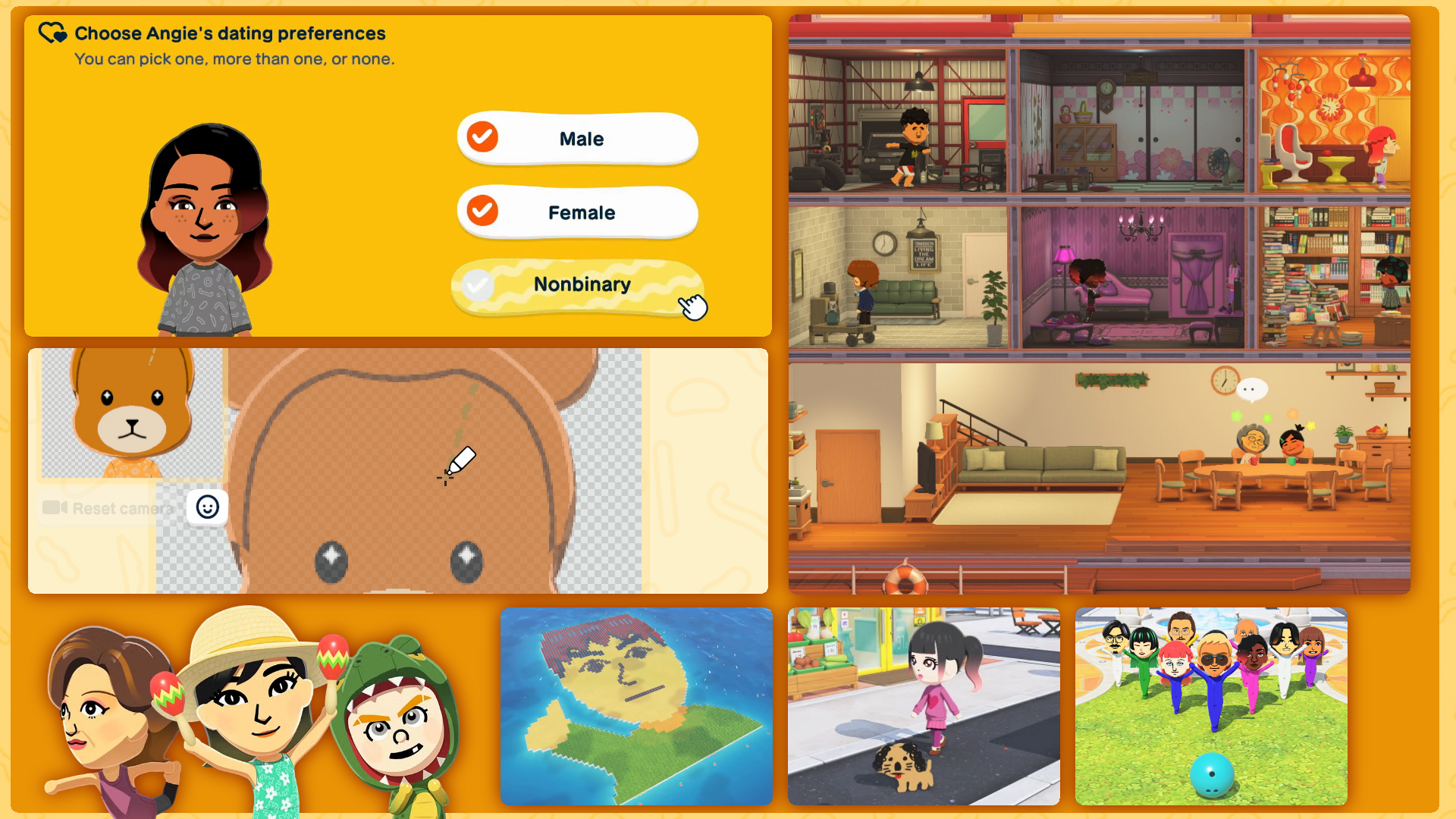
EDIT, 12:28 PM EST: added a paragraph near the top about Nintendo’s restriction on image uploading.
Tomodachi Life (and its Japan-only predecessor Tomodachi Collection) was a strange game. You could, somewhat dismissively, see it as Nintendo’s B-list—or C-list, really—version of Animal Crossing. It was a life simulator for Miis, one that ran on charm and surreality. And it was a life simulator that was distinctly low-definition, meant for small handhelds like the 3DS. Like a lot of those series, your Rhythm Heavens and Chibi-Robos, they didn’t easily fit Nintendo’s transition into the Switch, which requires fancier graphics and larger timetables.
That all made the announcement, almost a full year ago, of Tomodachi Life: Living the Dream all the more surprising. This wasn’t another series that’s doomed to be trapped on the 3DS forever; it’s got a big new sequel and the “one more thing” of what was an admittedly small 2025 Nintendo Direct. It might be one of the very last games Nintendo makes for Nintendo Switch now that they’re transitioning into Switch 2 development. And today, it even got a dedicated Direct, whose information we’ve collected into an easily readable infodump.
…Which is kind of ironic given the rumors of a full Nintendo Direct next week, since that mirrors how the Nintendo Switch 2 show came just days after the presentation that announced Living the Dream in the first place. But as Karl Marx taught us, Nintendo Directs appears twice, the first as tragedy and the second as farce. Anyway, here’s all the news that’s fit to print.
Release Date: April 16, for both Nintendo Switch and Nintendo Switch 2 (there’s no dedicated Switch 2 Edition or upgrade patch, at least not now).
Like the previous game, it’s a Mii life simulator. The cast—specifically called “Mii characters” as per Nintendo’s strict terminology guidelines—live together on an island city. As a life simulator, it appears to have no strict endpoint. You watch the characters evolve and intercede at points to move the plot along.
EDIT: This was not included in the Direct itself, but Nintendo published a support page afterwards detailing vague restrictions over the ability to upload screenshots, which is standard practice for almost all Switch / Switch 2 games. The Japanese page (via Kotaku) is more explicit, stating that it’ll fully deactivate the ability to upload screenshots. Their reasoning is extremely vague, as per usual for Nintendo, and it could reflect anything from a concern about highlighting player-created queer content to the possibility of players using Miis to bully real life people.
Mii Customization:
- The cast almost entirely comprises Miis you create. They get built in two ways:
- You can get help, which provides a questionnaire that generates Miis based on your answers.
- You can build them from scratch, which does what it says on the tin.
- In addition, you can import Miis from your Nintendo Switch or build one off a Mii Character who already exists in the game.
- Using a “college student” theme as a template, the Direct showed the specific process. Picking face types, hair types, body sliders for height and weight, and the like. While the basics of making Miis follow the template they’ve had since 2006, the breadth of customization is as big as it’s ever been and even includes unique parts. Like ears!
- In addition, you can combine parts or use facepaint, so at least some parts aren’t mutually exclusive.
- There are, for the first time ever, nonbinary Miis! Given how aggressively heteronormative the original Tomodachi Life was and how rude Nintendo’s attitude was about it (and how much queer content is being threatened these days, but that’s perhaps a topic for another time), this is super cool. In addition, you can alter a Mii’s dating preferences to independently include or exclude male, female, and nonbinary Miis.
- …Wait, did Cyberpunk even let me pick nonbinary options? I remember its trans options were pretty dire. But again, perhaps for another time.
- One of Living the Dream’s first (and strangest) announced features was its use of automated text to speech voice acting. This is extensive throughout the game, and like the other features, this can be altered extensively via speed, pitch, depth, delivery, and six types of tone—or you can just pick “simple,” which I’m assuming gives you presets.
- Personality is another type of system, which determines how your Mii behaves. The game generates a personality and selection of Traits based on your input. It has five features:
- Movement, which is the literal speed of each character and goes from “Slow” to “Quick.”
- Speech, which goes from “Polite” to “Honest.”
- Energy, which goes from “Flat” to “Varied.”
- Thinking, which goes from “Serious” to “Chill.”
- “Overall,” which goes from “Normal” to “Quirky.”
- You can also make nonhuman characters? One of the castmates in the Direct was a teddy bear.
- Like in The Sims and other life simulators, the characters have certain needs at the start of their time on the island, and you need to take care of them in various ways. Feeding them pudding seems to help sometimes, as is the case in real life. These typically get shown through though bubbles.
- You can also give Mii Characters Little Quirks, which govern tics like how they move, eat, walk, sleep, and speak. This includes giving them catchphrases or ways to end sentences.
- Dreams are part of the game in ways. Characters can have fantasies or see aliens.

Image: Nintendo. The whole “you can make screenshots for your character’s favorite fake TV show rules.” I wanna make Cheers episodes.
Relationships:
- One of the main features of the game is that Miis can build relationships and histories. However, this doesn’t exist at the start. You have to do a bit of intervention to ensure that the Miis actually interact at the start, making acquaintances with each other. After this, they’ll start interacting independently.
- I’m not entirely clear on whether you can program any preexisting history in advance and they only appear after the relationships deepen, or if those only emerge through the relationships.
- This forced interaction involves literally dragging Miis around until they’re next to each other. If you put them in a strange position, like next to a sprinkler, that’ll also generate unique reactions.
- As the cast grows and deepens their relationships, they’ll also start to think about the relationships of other Miis. The example the Direct gave is a Mii Character thinking that two residents they knew would be good friends, and asking you for help with conversation topics to facilitate that.
- You can submit topics for this and see if the characters hit it off.
- Romance seems to be a major theme—so much so that the game actually has “meet cute” moments that may happen randomly or procedurally. As mentioned in the previous section, characters can be assigned dating preferences for whether they’re attracted to male, female, nonbinary, or no characters. Mii Characters can fall for other Mii Characters, shoot them down, or rebound by falling for someone else. The second option can make them depressed, and you can try to help make them happier.
- Love triangles and weddings can also occur.
- Your role in these events is to push them for or away from these relationships. In the case of romance, for instance, you can support their desire to confess their love and recommend how to do it. If a character wanted to move in with a platonic friend, you could suggest they find a topic to bond with the friend over.
- Notably, the player only has so much control over these. You can push them in one direction, but what they do and what reaction that gets is up to the scenario.
The Island:
- Your island starts out barren in terms of both architecture and people. Some of the beginning of the game involves creating Miis to form the cast. This causes the island to grow in population, which seems to also lead to the construction of more buildings.
- Like Animal Crossing, the game moves in real time, and the characters interact whether or not you’re playing the game.
- The main food market is Fresh Kingdom, which provides standard food options for six days of the week and strange offerings on Sunday. “Strange,” they say. Like crab is strange.
- Where & Wear is the main clothing shop, with both normal and goofy costumes.
- MiiNews is the in-game news channel and provides various inscrutable news stories. I have no idea how deep these go in terms of character development, but they’re at the very least deeply surreal. Characters’ heads will often be superimposed on live action photographs.
- T&C Reno offers room models, a bit like the Animal Crossing templates but with less of the granular customization.
- The Marketplace features a revolving selection of products that change with the time, including “mystery bags” with unknown and strange contents. A lion, for instance. What does the lion do? We’ll find out!
- Foto-Tomo is a photography station that lets you make in-game photos. There are naturally tons of backgrounds, formats, and graphical overlays to keep things weird.
- Naturally, there are many options for landscaping. Characters may offer suggestions, or you can add things at your own leisure. The Quik Build shop sells these, as well as the option to move buildings and alter and expand the physical landmass.
- Outside of being stuck to a pixel-y grid structure, which is great for anyone wanting to reference classic Nintendo sprites, the customization is very open.
- Using the Palette House shop, you can create customized patterns for pets, lattes, TV show screenshots, walls, and clothing. These are 2D images. This is how the pets work; they’re 2D cutouts like Paper Mario and shake and move.
- Like the first Tomodachi Life (and its corresponding Super Smash Bros. stage), there are small apartments that each have a room for one resident.
The Direct:
Wolfman’s Soapbox: I wasn’t necessarily gonna cover this, but hey. Pretty decent queer rep, Nintendo, and that alone made me want scramble to write this up a half hour after it aired!
To me, Tomodachi Life is kind of the apex of “Weird Nintendo,” that aspect of the company that gave us Captain Rainbow and Dillon’s Rolling Western and Sushi Striker and Odama and a hundred other oddities. It’s an aspect of the publisher I really love, and it’s an aspect that has definitely gone down just a bit in the Switch era. I’m not saying it’s gone. If anything, Nintendo’s biggest franchises might be as weird as they’ve ever been, so I’m not here dismissing the impressively strange Tears of the Kingdom or Xenoblade 2. But there aren’t as many smaller weird games, largely because these were all studios moving from the small 3DS to the HD Switch, essentially jumping two hardware generations at once. And almost everything is made with the intention of getting a worldwide release, so there are fewer games that are made that only need to, say, do okay in the Japanese market. We have a few of these, but not a lot, and I was reasonably confident that Tomodachi would be one of those series that was fated to be a curio. A fun fact about 2010s-era Nintendo.
I was wrong. And while I’m not sure I’m going to get Living the Dream, certainly not at full price, I also can’t deny that this did a lot to make me interested in something I was always expecting to appreciate from afar. I like the way it seems to create a niche distinct from Animal Crossing or The Sims, where you’re not a character or God but somewhere in between. I find the queerness refreshing, especially as queer representation is being threatened in my country (perhaps an upside of Nintendo’s “my way or the highway” approach to development is that they don’t seem to give a damn about that kind of reactionary placating). But most of all, I like how proudly weird it is. The automated text to speech isn’t trying to be anything other than creepy and unemotional, which is a lot nicer than a version that tried to sound naturalistic. The fact that you can make animal people but 2D cutouts for the “actual” animals is beguiling. The costumes, the 2D sprite pet, the music video atmosphere, the focus on granular relationships… this is a game with an aesthetic and holds onto it really well. It makes me think of how Nintendo’s games are often really good at feeling distinct and specific. They know what they are and what they want to be. Living the Dream captures that really well.

- Indie World March 3, 2026: Information and Reactions - March 3, 2026
- On Phil - February 26, 2026
- Escape from Ever After | Review - February 17, 2026