
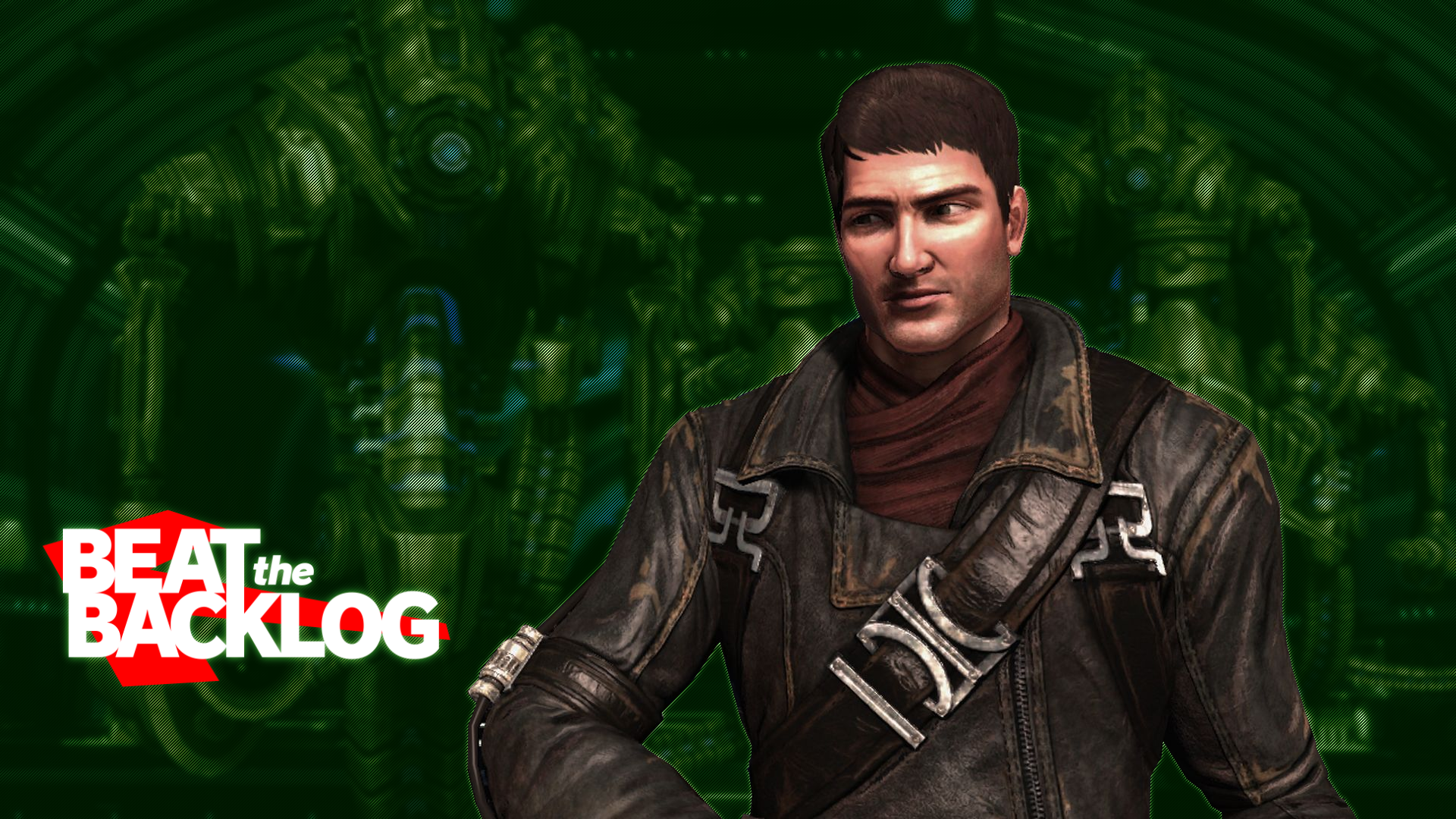
Industry mainstay Capcom boasts a venerable stable of franchises. However, the late Aughts, early Tens marked an insecure era for them. Then-producer Keiji Inafune incessantly ragged on Japanese developers for lagging behind their western contemporaries (Metal Gear auteur Hideo Kojima later suggested that Japanese games lacked global appeal; notably, Japan was estimated to have lost around forty percent of its market share). Following Inafune’s lead, Capcom tastelessly rebooted some of their franchises, Resident Evil recklessly chased trends, Ace Attorney struggled to leave Japan, and even my dear Dead Rising decayed despite initial success under an overseas studio. Original IPs, namely Spyborgs and Remember Me, also failed to court western audiences. It was a distressing time to be a fan, and arguably no title is more emblematic of Capcom’s misguided misfires than their 2010 cover shooter Dark Void.

Image: Source Gaming. Today, no one ever discusses Dark Void, perhaps better known as “Gears of War with a jetpack.” It’s even been delisted on Steam.
Capcom and late developer Airtight Games certainly tried to make Dark Void succeed. A series of developer diaries presaged its launch, one of which highlighted the involvement of Battlestar Galactica composer Bear McCreary. Naturally, Dark Void hit the Xbox 360, PlayStation 3, and Steam, the era’s “hardcore” platforms. Anyone who pre-ordered it got a superfluous in-game bonus. Proper downloadable content, a gauntlet of survival missions, arrived shortly thereafter. Brad Pitt was tapped to spearhead a film adaptation that, like many a dubious collaboration before it, never saw the light of day. Most notably, Dark Void received a prequel: Dark Void Zero, a humble DSiWare / Steam romp whose reputation eclipses the game it’s meant to promote… and is no longer available to purchase, regrettably. Reception to the series’ console centerpiece was tepid, however, dooming every other endeavor in its orbit. At least Dark Void’s official website somehow still exists and is somewhat functional.
Upon its release, I was suspicious of Dark Void. Same for my friends, I assume, as I don’t personally know a single soul who owns it. And, besides, as a casual Gears of War fan, I was never lacking in cover shooters. Nobody was; calling them prevalent during the 360 years would be an understatement. The first Uncharted hit in 2007, a year after Gears 1, and their influence on Dark Void and debts to Capcom’s own Resident Evil 4 is clear as day. Most were happy sticking with Gears or Uncharted, or any of the dozens of other cover shooters of the time, relegating Dark Void to live up to its generic name and fade away. Nevertheless, a digital copy wound up in my library—it’s discounted heavily and often on the Microsoft Store—and I never pass up an opportunity to tear into maligned relics.

Image: Source Gaming. Let’s dive head-first into Dark Void.
Starting it is disorienting: you’re automatically flying ahead and gotta shoot UFOs with little context while acclimating to the controls. Quickly showcasing the jetpack, Dark Void’s selling point, was Airtight’s attempt to grab players. Plenty of classics—Metroid Prime, Castlevania: Symphony of the Night—employ similar hooks before taking away your tools and forcing you to regain them. But that isn’t effective here because, well… what Airtight’s teasing isn’t that enticing. You’re just roaming around a large mountain range gunning down enemies that are fast and hard to hit at a distance. Once you’re done, our nameless avatar is unceremoniously shot down and killed. Cue us cutting to our real lead, pilot Will Grey, one week later.
After their plane crashes in the Bermuda Triangle, Will and his navigator / ex-girlfriend Ava find themselves alone in the jungle—and, soon, will enter a nebulous dimension called the Void that links Earth to an alien world. A conspiracy involving fascist lizards, a society under their rule, and a resistance led by famed Serbian inventor Nikola Tesla revolve around Will, a hero of prophecy. But he isn’t interested in playing savior and simply wants to leave with Ava, whose opinion of him consequently sours. She eventually flees to fight the good fight, forcing Will to begrudgingly join the resistance in pursuit of her.

Image: Source Gaming. Like many games, collectible journals in Dark Void shed light on the cast. Some sit in the open; others require searching. Did you find the note hidden near here?
Wasting little time, the Watchers—those aforementioned evil reptiles—sic their robots on Will. Our first hour or so teaches the basics. By default, Will walks; clicking the control stick down makes him run. You can press X to snap behind a wall, and then you can press X while holding the stick to leap behind an adjacent wall. You start with a standard machine gun and can pick up alien firearms from fallen foes. Will can only carry two guns at once, but any you grab can be freely retrieved from storage boxes, which are strewn throughout longer levels and greet you upon booting up your file. Occasionally, you’ll stumble upon a turret, which are strong but overheat if you carelessly keep the trigger held. Grenades are thrown by pressing the left bumper. Unlike Gears mascot Marcus Fenix, Will can perform a weightless jump. But where Marcus feels hardy, his imitator is clumsy.
Now, Gears of War isn’t the richest shooter, but its choreography and enemy design effortlessly rank above Dark Void’s. Marcus and his crude comrades fight a fairly diverse assortment of aliens; Will mostly solos humanoid robots that dash or hover aimlessly. Sure, a few are sturdier or use stronger guns. Neither matter much; just punch ‘em in the face. And, yes, that is the most efficient way to neutralize the metallic mooks; it’s the Chainsaw Bayonet of Gears without the believability or risk-reward dynamic. Seldom did I die while smacking these mechs, leaving the resources Airtight spent on Dark Void’s weak firearms feeling almost entirely for naught.

Image: Source Gaming. Theoretically, a tense dynamism powers Dark Void: you’ll run out of ammo and then scour the ground for fresh firearms. Once I realized how buff Will is, I never bothered and mainly reserved my rifles for the rare foes he can’t deck.
In fairness, Dark Void hosts more hazards than generic robots. Also in fairness, few leave an impact. You’ll kick angle-high lizards away without a care. Serpent-esque mechs act as big bullet sponges. In a twisted way, they were actually the Void’s greatest threat: one mission wouldn’t end until I killed one that refused to spawn, meaning I was stuck in limbo until I manually reloaded my last checkpoint. Open skies are rife with UFOs, those annoying flying targets. And the bosses range from forgettable to lousy.
Resident Evil 4 and its successors adore QTEs, another quality Dark Void inherits. Collectively, the UFO fights are Void at its most QTE-dense. When nearing a spacecraft, clearing an optional minigame lets you hijack it. Dangling from a UFO, mashing a few buttons, and occasionally tilting the control stick is pace-breaking, though the reward—killing an enemy and scoring a free ride—is admittedly handy (sometimes, you can man resistance ships on the fly; vessels are meant to fuel midair duels with a similar dynamism). Facing the larger Watchers may also involve QTEs. While I don’t share these games’ affection for the concept, it’s harmless enough here.

Image: Source Gaming. When injured, the screen flashes red, as with other shooters. Will recovers health automatically, so if he’s aching, retreat and hide for a spell.
What drags Dark Void down, though, is how formulaic it is. Where Gears’ baddies might erupt from the ground at any position mid-fight, Dark Void’s are frustratingly stale; you’ll lumber through straightforward corridors and discover groups patiently waiting for you. On rare occasions, they muster more ambition—maybe a ship will drop off reinforcements—though nothing groundbreaking. In what’s easily the game’s single worst sequence, a flock of UFOs and five tank-like Archons open fire on the resistance’s ship, the Ark, and you have to take down the latter under an unforgiving time limit and the intensity of a bullet hell (kindly, you can freely adjust the difficulty, and for this one fight I had to drop down to easy).
Anyway, Will obtains a jetpack pretty quickly. An imperfect model, one only capable of hovering and a double jump. Once he does, levels start asking you to leap along ledges. Pressing X supposedly makes Mr. Grey grab one automatically, though that never felt completely reliable. Some firefights even transpire on ledges, and it’s actually novel at first, especially the one set along the USS Cyclops. Ultimately, though, the change in perspective is limiting. The platforms are too small to facilitate any freeform experimentation and Will can casually hoist the bots overboard in lieu of his usual punch, meaning these matches play out identically. Thankfully, you can ignore the enemies during at least some of these sequences. You’ll reach your destination faster, and Dark Void doesn’t care.

Image: Source Gaming. I can suspend my disbelief pretty far, but watching a mostly unarmored Will withstand laser blasts, smash mechs with his bare hands, and not instantly die whenever I crash head-first into a cliff is… a lot. Whatever; it’s a game and he’s the chosen one or something.
Only near the climax of Episode I (of III; Void can be cleared within six hours) does Will receive a fully functional jetpack. What immediately follows is another flight tutorial, which is a little superfluous; the first wasn’t that long ago. Regardless, some optimism sets in here. You now have ready access to all the game’s movement options, and Dark Void teases a potentially compelling avenue for them. You may perform free-roaming flying one minute, land to infiltrate a Watcher base the next, and then hit the thrusters to flee an explosion before facing an Archon, a nuisance vulnerable to midair and ground combat. Quickly alternating between them adds an energy, an identity Dark Void sorely needs. Unfortunately, the two styles drift apart afterwards, whisking you through stretches of one or the other. Rarely a mix.
Which still isn’t a dealbreaker! What is, however, is the subpar level design. Whatever goodies—journals, currency to buy jetpack or firearm upgrades—the linear pathways hide never inspire a desire to explore. If anything, Dark Void discourages exploration. Stages are full of invisible walls, and when you fly into one, Will immediately flips around… which regularly caused me to inadvertently smash into the scenery, amusingly. It’s always obvious when a fight’s about to start, as you’ll enter a wider area filled with barricades. Some warzones tease avenues to sneak up on enemies, and some also span two floors, demanding the double jump. Again, that’s all rather moot when the safest strategy is to flail Will’s fists around. Only the fights that require you to fly break up the monotony, but even then they accomplish little the initial tutorial doesn’t.

Image: Source Gaming. Dark Void’s loading screens display tips, plot points, and foreshadow looming reveals. Even having seen this tease, one twist in particular caught me off guard.
Narratively, Dark Void similarly falls flat. It relies heavily on South American imagery for its environments, silly theories that aliens are secretly manipulating the world’s governments, and cliché chosen one plots, and that’s fine! But it all breaks down in execution. Cutscenes are choppy, sometimes missing vital connective tissue—even whole threads may be dropped as swiftly as they’re introduced. Resistance field leader Atem rewards Will with a chrome Iron Man helmet midway through the game, one hyped up as useful, meaningful. It’s only ever barely relevant in two late-game cutscenes. Both men are “Adepts,” people with ill-defined abilities that are important for equally vague reasons. As the game grinds towards its climax, Tesla is murdered by a shapeshifting Watcher who assumes his form, a genuinely exciting development! A few cinematics later, some no-name soldier casually tells Will that Tesla’s dead and his impersonator… vanishes, never to be referenced again.
On the other hand, one development is absurd. Dark Void is set in 1938, shortly before the start of World War II, and one of the big reveals is that the Watchers were Adolf Hitler’s beneficiary. But they didn’t donate any of their impressive, futuristic tech, no. Just your typical aircrafts and gats of the Thirties. Weakening the twist further is that it accompanies a sequence where we’re restrained and being whisked through a facility à la Half-Life 2. This isn’t to say taking inspiration is wrong—the uncontested best level in the otherwise mostly drab Outlast does something similar—but you gotta back it with some clever spin, or at least a heretofore unseen level of polish. After a while, it became deeply depressing how bereft of imagination Dark Void is.

Image: Source Gaming. Artistically, Dark Void’s stock backdrops—jungles, ruins, mountains, and spaceships—aren’t gripping. Even the short, one-off chapter set inside a giant beast’s belly underwhelms.
Nobody in the cast compensates. While Will isn’t as unrelentingly dour as the Gears guys, he lacks a single distinct attribute. He unabashedly shares a voice actor with the Uncharted frontman (and every other video game hero from the late 2000s to the early 2010s), Nolan North, his bomber jacket evokes Wolfenstein’s BJ Blazkowicz, and you’ve seen his character arc handled better elsewhere. At least I can laugh at Marcus and his tree trunk legs; Mr. Grey’s a dark void of charisma. Everyone else, meanwhile, is too one-note to invest in. Honestly, I only remember Ava’s name because Will shouts it incessantly, Atem’s because he shares it with a beloved Yu-Gi-Oh! icon, and Tesla’s because he’s a real person.
More shortcomings betray how rushed Dark Void is. I already mentioned one glitch, but it’s full of ‘em. While dashing towards a foe, I clipped through the stairs and was stuck underneath them until I—again—reloaded my last checkpoint. The frame rate chugs when too much stuff is happening on-screen, a serious issue in an action-heavy affair. One time, the final boss kept jerking around when it was supposed to be calmly perched atop its mountain. Some Achievements apparently struggled to unlock for players, though the fault there might’ve been Microsoft’s. And I’ve read anecdotes of other hiccups over the years on various forums.

Image: Source Gaming. Replay value is limited to hunting collectibles and trying the different difficulties: easy, normal, and hard. A multiplayer mode could’ve been fun in theory, but I’m glad Airtight didn’t include one; they were spread too thin as-is.
This lack of polish extends to the visuals. Textures, stage geometry, and the character models lack detail. Look at that screenshot; shouldn’t some of that water ricochet off Mr. Grey? And the limited facial animations channel a Telltale Games joint, an issue I can more readily forgive in their lower budget output. Roaming Dark Void, I often thought back to Condemned: Criminal Origins, another unsightly Xbox 360 title. But Condemned is a 2005 game, a 360 launch title at that, and to an extent its crude veneer elevates its atmosphere. Dark Void arrived five years later, long after developers grew comfortable squeezing out the HD machines’ potential. Fellow 2010 release Metro 2033, which I went through after Dark Void, boasts lighting and detailed backdrops that almost look a whole generation ahead.
The Rocketeer meets Gears of War. When Dark Void was pitched, that probably sounded like a slam dunk. Doubly so when you consider that Airtight Games was composed of Crimson Skies alumni! Whatever vision the team had was clearly held back by a lack of resources, which is upsetting; I have no doubt many smart, talented people worked on Dark Void. Sadly, success kept eluding the studio. After a few self-published outings and two collaborations with Square Enix, Airtight closed its doors. I hope everybody landed on their feet.

Image: Source Gaming. The final boss. To its credit, it bears the game’s most inspired design, and the Star Fox-esque pacing—you dodge attacks, then fly in front to retaliate—is refreshing. By the way, you can clear Void without mastering its aerial evasion maneuvers, hence why I’m only now mentioning them.
Comparably weak games flaunt the Capcom logo, and Dark Void isn’t even the most offensive thing a big publisher subjected us to in 2010. But it was eye-opening seeing “Capgod,” once an enviable trailblazer, toss out something so slapdash, so derivative—and derivative of works they inspired, no less! Today, we’re exactly sixteen years removed from Dark Void’s release. While less deserving comebacks have happened, it’s hard to imagine Capcom salvaging this IP. It doesn’t receive any nods in crossovers like Marvel vs. Capcom, nor is there any palpable demand for the company to resolve its sequel tease. Today, Capcom’s in a fine place, one characterized by a firm respect for its franchises. The insecurity that spawned Dark Void seems over, thankfully. I mean, it better be; working with overseas teams proved difficult for Capcom, and the only bona fide hits that yielded were Dead Rising 2 and its Case Zero prologue. And, hey, going off its reputation, I guess Dark Void Zero counts too. Maybe Dark Void isn’t thoroughly disposable.

Image: Source Gaming. Fading into the ether is probably the best position Dark Void could hold in Capcom’s oeuvre. Being surrounded by more notorious flops and on-disc DLC scandals almost obfuscates it. Almost.
Thanks to Wolfman for helping with edits.

- Character Chronicle: Vanillite - March 5, 2026
- Character Chronicle: Cinderace - February 27, 2026
- Beat the Backlog: Mario Tennis (Nintendo 64) - February 11, 2026