
This review copy of Demonschool was provided to Source Gaming by Ysbyrd Games and Keymailer.
One of the greatest potentials of playing a new game is its ability to surprise me. Despite sitting on my wishlist for some time, somewhere between three months and a lot longer, I did not look into Demonschool until now. I saw it as a game with an art style that I liked and sought to check it out solely on that basis. Within the first hour or two of gameplay, I was impressed by almost every aspect of the game, and that continued for the next eight hours.
Upon a boat ride across a purple ocean towards a remote school, Demonschool wastes no time introducing its eccentric cast of characters, starting with protagonist Faye, gushing over the impending return of demons in the mortal world, to the sane, unbelieving Namako. With the boat finally arriving on Hemsk Island, its occupants are met by a fleet of gangsters, separating those who will stay on the island and those who will have to return home. With Namako moved to the line of students meant to return home, Faye steps up to her defense, knowing that she’s destined to be here for what’s to come. But that isn’t just with words, but also with our fists through tactical RPG combat.
Across the several weeks attending the college of Hemsk Island, Faye will encounter a variety of classmates who will become entangled within this demon-bashing adventure. For instance, there’s the powerhouse Destin, who isn’t completely bright but is incredibly earnest in all he does, and healer Knute, an enthusiast of rare media and horror films with a kind heart. There are more classmates to encounter, some of whom can become allies and some who will—at least at this point in my playthrough—remain as rivals. But so far, despite those I’ve encountered, every character has something about them that makes them interesting. Whether that’s from a snarky first encounter or a mini-game like karaoke and cooking that reveals part of their personality and progresses their relationships with Faye. Some party members take more time to kick into the narrative rather than just being present. But when they do, such as with the animal-caring Mercy (who reminds me of my partner), they can quickly become favorites.
Some of the inspirations that Demonschool takes from are the first two Shin Megami Tensei and Persona games. I have no experience with those titles. Instead, I did spend time with Persona 3 Portable back in high school, experiencing its high-school-centered narrative, exploring Tatsumi Port Island, and utilizing game mechanics on a day-to-day school schedule. However, unlike Persona, Demonschool matches Faye’s headstrong nature by quickly progressing the story, tossing the player into the next part of its narrative once engagement begins. When time passes, the player will often be provided an opportunity to engage in side stories or relationship mini-games. As those extracurriculars are also fast-paced, while maintaining interest equivalent to the main story, engaging with them is just as rewarding. So far, I’ve felt the only instance where Demonschool halts steadfast progression is with learning new skills. In the pause menu, a skill chart is accessible at any point for at least two units to study a new skill, with recovery taking some variable number of days. To mention a gameplay qualm now, studying with anyone will unlock the skill for everyone who can use it, but the game won’t tell the player who can use said skill beforehand. This has caused moments where I felt like a genius, teaching attack units to implement healing capabilities, and vice versa, to be met with constant disappointment.
Another point at which Demonschool doesn’t waste much time is with its battle system; everything that I’ve needed to learn is taught within the very first battle. Combat takes place on a grid in which the entire team has an allotted amount of activity points to spend within a turn, each action incrementally raising the cost. Within that grid, Faye and co. will move to their maximum extent perpendicularly or diagonally to progress and bump into enemies for combat; dropping their health, knocking them into other enemies for collateral, or into allies for combo attacks that deal killing blows. Any move made isn’t permanent until the entire turn is confirmed, allowing the player a preview of every possible action before they commit. Rather than any sort of level system, the battle system is based on how well the player can defeat enemies within the expected turn amount and without losing allies. Taking too many turns isn’t an instant loss, but it will be a demerit on the resulting score, keeping the theme of the team’s excursions being assignments. Concluding the battle doesn’t fall just on defeating each enemy; the player must also progress at least one unit to the other side of the grid, opening the portal to send gangsters and demons back to Hell.
In my time playing, the tactical RPG format it implements reminds me a lot of Disgaea, specifically 2 through 4. I’ve spent many hours attempting to line up my units in the perfect placement for team-ups, combos, and movement to clear Item World stages in one go or to progress towards the Advance Stage panel. The main difference is the restrictive elements that treat combat not just as a TRPG, but as a constant puzzle. Some characters can only heal or cause status effects, some do damage, others do damage and move a character, and more. Playing Demonschool requires and accommodates trial and error in a way that I really enjoy.
In regard to exploring Hemsk Island, the implementation is similar to that of Persona 3 as well. Walk around the current area, and then when approaching and selecting the exit, the player will quickly travel to other areas of note, in addition to seeing what points of interest are there. While I don’t have an issue with this format overall, turning the areas into a list on the side of the screen makes exploration a bit exasperating. Not every locale selection is on the screen equally; you’ll have to scroll for some, causing the map as a whole to feel like a checklist rather than a connected setting over long sessions of play. Additionally, the lack of a level system means that each moment of progression in the narrative (main and side stories) will often include a battle. The amount of brain-teasing back-to-back battles may lead to a bit of fatigue when looking to experience more of Hemsk Island and enjoy Demonschool as a whole.
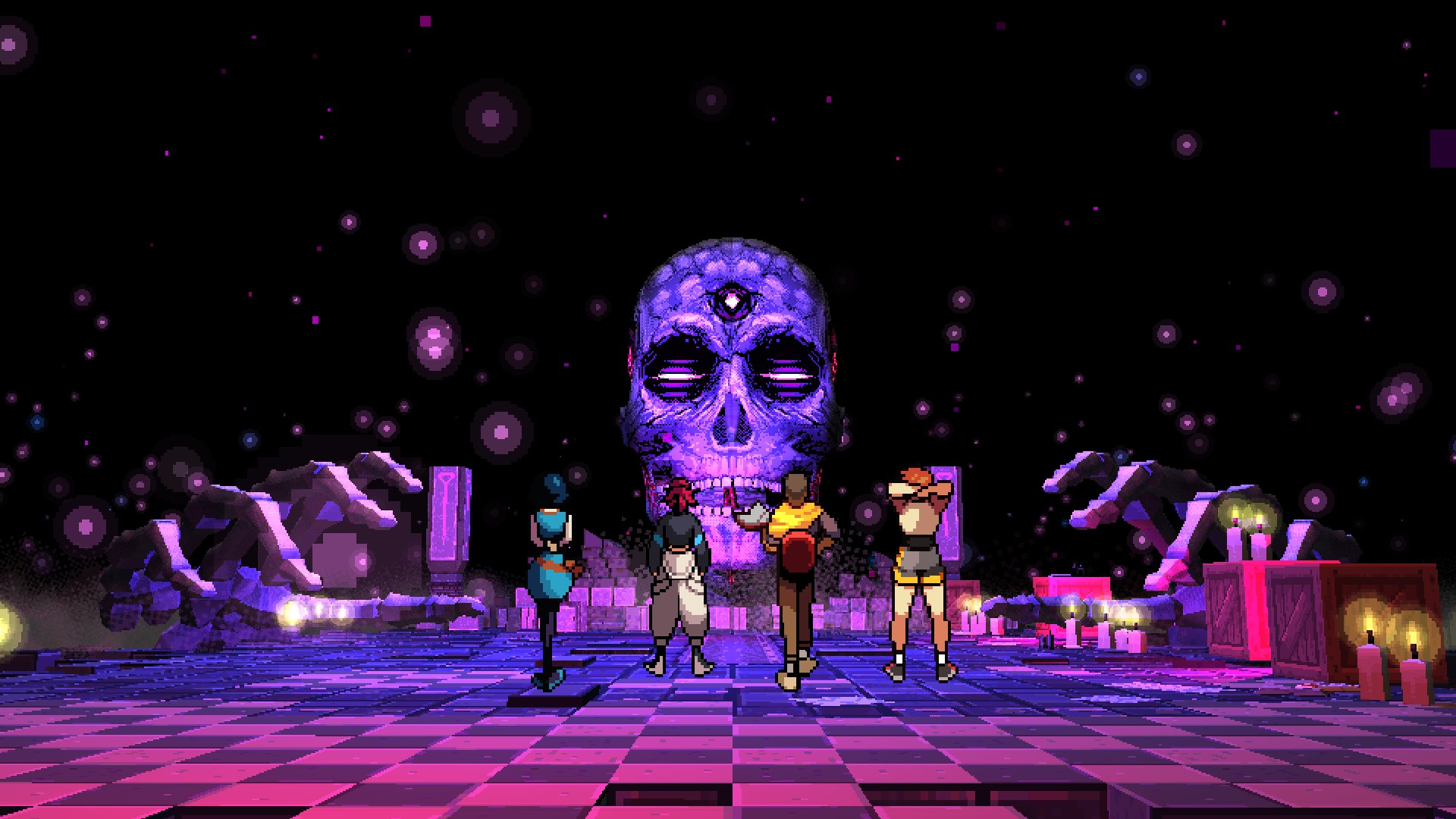
Of all the games I’ve played this year, Demonschool was the most visually outstanding. The first two hours show expressive, thick-outlined character portrait illustrations done in a pixel art rendering. An isometrically presented world with stunning 3D visuals that could be mistaken for pixel art itself. Demonschool’s battle transitions aren’t always stellar, such as when the story places the characters in an area often inhabited by demons. However, when the outside locales of Hemsk Island turn into a battlefield, they sport one of the fastest, unsuspecting, and mind-blowing battle transitions that I’ve ever seen. Words can’t describe it enough; it is something that needs to be witnessed. Such can also be said for the soundtrack. As the days went by on Hemsk Island, I was bathed by daily tunes that I enjoyed playing alongside, whether dynamically altered to be more upbeat in conversations, settled and anticipating when deciding turns, or more ghoulishly enticing during combat. My absolute favorite track so far has to be “Tuesday Overworld (Investigation).” When I first heard it, I was stunned, absolutely whisked away to a world I’ve never felt before in my life.
In my encounter with Demonschool, so far, I haven’t encountered much that I dislike. Some adjustments could be made to gameplay for limitless fun and menu design for clarity or snappiness. But, overall, so much of Necrosoft’s title absolutely captures me in a way that I did not expect, and I’m very curious to see how much further it can go. From hilarious and snappy character writing, to a brain-teasing battle system, and to fantastic visuals and sound. Demonschool has, so far, shown itself to be a fantastic RPG to close out 2025 with.

- Demonschoool | Indie Highlight - January 9, 2026
- Pokémon Legends: Z-A – Nintendo Switch 2 Edition | Review - November 11, 2025
- HOTEL BARCELONA | Review - September 29, 2025