
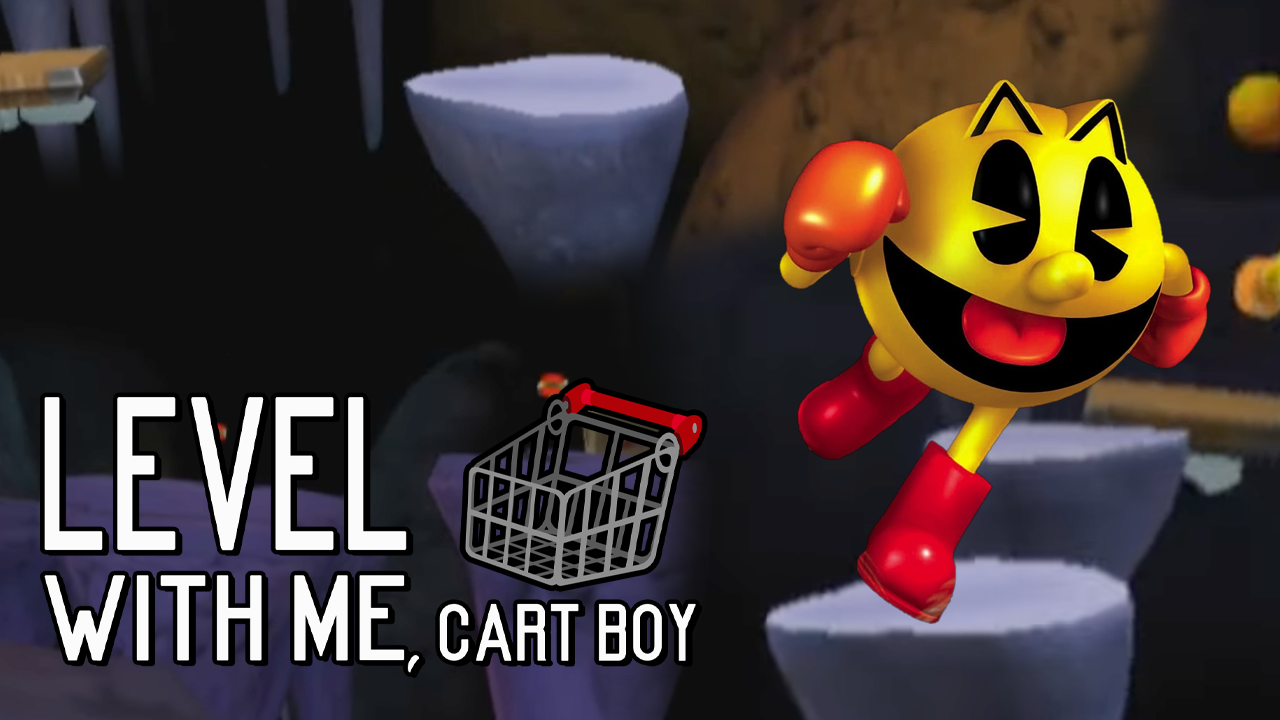
Source Gaming is closing out 2025 by partying… with Pac-Man! Two days ago, guest writer Echo honored Shadow Labyrinth by exploring what its stars could bring to Super Smash Bros. Today, Cart Boy is diving into Pac-Man World 2, the basis for the mascot’s other major release this year. Happy forty-fifth, Pac-Man!
Over two decades ago, a young Cart Boy was visiting his local Toys “R” Us on a mission: to buy a new game for his shiny Nintendo GameCube. I don’t remember which one I sought specifically—Luigi’s Mansion or Mario Party 4, I think—but along the way my dad and I stumbled upon Pac-Man World 2. For whatever reason, its packaging didn’t quite grab me, although I really liked Pac-Man and Ms. Pac-Man. But it did appeal to my dad, presumably in part due to his long history with the arcade icon. He suggested I purchase World 2 instead, adding that he’d refund me half the money if I wound up disliking it. I suspect some of this was an effort on his end to gently nudge me into broadening my horizons beyond Mario, Donkey Kong, Pokémon, and Sonic, the franchises I was firmly entrenched in (which did start happening during this era). Ultimately, I was persuaded and purchased Pac-Man’s latest adventure. Midway through the fourth world, Volcano, I redeemed my twenty-five dollars.

Image: LongplayArchive. 2002 was a busy year for the GameCube, boasting visual spectacles like Metroid Prime and Resident Evil. Multiplatform venture Pac-Man World 2 doesn’t quite measure up, but it looks clean and colorful.
Having hopefully not alienated fans of the GameCube / PlayStation 2 / Xbox / PC platformer, a remake, Pac-Man World 2 Re-Pac, hit store shelves in September! It’s nice that a version of World 2 is widely accessible again, even if Re-Pac regrettably gives the homely Pac-Mom a cameo. Coincidentally, I’ve considered revisiting Pac-Man World 2 since I tackled World 3 over a year ago (and the first before that). But I wasn’t interested in giving it the “Beat the Backlog” treatment. Since my “Level with Me” series is relatively new, I’d rather focus on it, and it’s still a fine venue through which I can dissect a game. And, hey… there’s a lotta love for Pac-Man World 2. Maybe by reevaluating it as an adult, I’ll finally see the masterpiece its devotees do.
Which level to cover, however? There’s no shortage of worthwhile subjects. Examining how tutorial levels teach newcomers always entices me. B-Doing Woods is memorable. Snowy Mountain’s stages are striking; art depicting Blade Mountain even adorns the game’s cover. Or there’s Ghost Bayou, that anticlimactic labyrinth. But the Volcano territory left the greatest impression on me; tackling it makes the most sense. Magma Opus is likely the world’s most notorious romp, but let’s instead head Into The Volcano, its opening stage and the game’s fourteenth altogether.

Image: LongplayArchive. After the last realm’s slippery ice, skating, and front-facing Indiana Jones-esque avalanches, Volcano reintroduces unvarnished platforming. A noticeable rise in difficulty, it may be home to the strictest platforming in the whole trilogy!
Starting in a fairly claustrophobic room, the Hungry Hero is greeted by a wealth of familiar iconography: rows of Pac-Dots, a strawberry, cherry, two ghosts, and a Power Pellet. By now, you know the drill: grab the goodies if you’re a completionist, or ignore them if not. Should you suffer a hit from the ghouls, eating them will yield a health wedge (eating fifty Pac-Dots does too, which is the lone benefit they grant casual players). Afterwards, you’ll slide down a steep slope and into a corridor. Just… don’t Butt Bounce down it. Physics in World 2 can be strange, and mindlessly bouncing on the slide might propel Pac-Man into the bottomless pit ahead.
Most people will instinctively grab that eye-catching cyan ledge on the left and use it to climb onwards. Daredevils will perform Pac-Man’s Spin Dash-esque Rev Roll along the right wall, a thrilling trick that’ll also work elsewhere in this stage. Either way, a checkpoint awaits Pac-Man in the next area. More pressingly, so do miniature, explosive Pookas! As long as you keep moving, they’re unlikely to harm you. More leap out of that hole indefinitely, however; you gotta pay them some mind. Enthusiasts will crack that crate open to score another cherry before looking backwards towards a ramp.

Image: LongplayArchive. Music in World 2 is nice, and each world’s tracks play with a core leitmotif. Into The Volcano’s theme is calm, complementing the lingering Snowy Mountain iconography (even its icon on the map is white, another tundra holdover).
Now, the Rev Roll is an essential, engaging tool. Ramps litter Pac-Land, and Rev Rolling in front of them supplies you with the momentum needed to soar across the chasms they’re usually hovering over. What’s noteworthy about this ramp is that it sends you to a hazard you’ll face frequently in the Volcano, one Snowy Mountain employed sparingly: footholds that’ll fall over seconds after Pac-Man lands on ‘em. If he barely misses it, he’ll grab onto the ledge and then slowly pull himself up, like most surfaces in the game. Problem is, the pillar will have already begun breaking and the hero will only pull himself up to where it was, not its current position. Invariably, this’ll cause a quick death, one that ignores the leeway ledge-grabbing is meant to offer. That isn’t really an issue yet; this pillar’s optional and only contains a token, collectibles that don’t even affect completion percentage. Since this isn’t the shaky stalagmites’ proper introduction, it’s also fine that Volcano’s first one is potentially lethal. Players probably dashed across the earlier ones swiftly, so this one may even teach a new lesson: their protrusions point in the direction they’ll fall in. And this pillar tumbles towards the cyan ledge, kindly nudging you back onto the main path.
The next room has four more unstable stalagmites, three wooden Helivator platforms that hover across them, and two sturdy stone surfaces on the left and right. The left one houses a crate that shelters an apple, while a treasure chest that requires an apple to break adorns the right. Within that chest is a green switch; Butt Bounce it to spawn a Pac-Dot trail on the final foothold that’ll whisk you through an orange and to the next room. This marks a gentle escalation in difficulty, but it’s still pretty simple.

Image: LongplayArchive. This room is easier in the Japanese release. That’s a recurring theme across Into The Volcano and, really, the whole game.
So you’ll land, walk through a small corridor, and encounter a checkpoint and another ramp. This one isn’t optional: you need it to reach the cluster of platforms across the canyon. More Pookas grace them alongside two tokens, an orange treasure chest, and a Power Pellet. That the latter’s situated on one of the last footholds suggests the following stretch of land hosts a ghoul or two.
Oh, but if you obtained that orange, head to the top pillar first. That chest contains a Galaxian, teleporting you to a more traditional Pac-Man-styled maze. Regrettably, World 2’s take on them isn’t special: the lobotomized Blinky and company lost their distinct strategies from the arcade titles and now lethargically lumber after their rival identically (mazes in Pac-Man World 1 and 3 suffer from the same problem, but they at least tried spicing things up by integrating original hazards and power-ups, respectively). Annoyingly, the yellow pellets and bright lava can blur together depending on the camera angle. Changing it is easy, thankfully, so use the three lives you’re loaned to clear this easy, if momentum-killing, diversion. Win or lose, you bag a bonus checkpoint when you’re done.

Image: LongplayArchive. Tokens unlock arcade games in Pac-Village, and eight lurk each stage. Finishing a level with 100 percent completion yields a ninth. Collected coins are replaced with health on replays.
After snacking on that lone Power Pellet, you’ll encounter two specters wandering around three tiny waterfalls. The currents can push you overboard, but as long as you keep pressing ahead, there’s nothing to fear. You’ll reach another checkpoint, and then a light will draw your attention towards another Pooka pack and a new threat, the Pooka Plant. This one-off foliage licks up the sentient explosives and then spits them at Pac-Man; either Butt Bounce the bush or bolt onward. Another crate’s stored behind the flower that contains an apple. Invariably, you’ll Rev Roll across another ramp onto another, surprisingly large foothold that’s home to an apple chest. Maybe developer Namco Hometek wanted to give a little leeway in case we’re caught off-guard by a Pooka projectile? Getting hit by their explosion does send Pac-Man flying!
Regardless, that chest contains an extra life, one my younger self found invaluable. See, if you press the A button after Rev Rolling, Pac-Man’ll cancel out of the move and gently plummet down. Micromanaging him while midair is nigh impossible, so utilizing this trick is essential. Admittedly, I forgot about it by this point in my initial run through World 2, so the subsequent Rev Rolls over two small pillars took me many tries. That’s on middle school-era me.

Image: LongplayArchive. Revisiting levels lets you try their checkpoint-less time trial variants. Clocks replace the fruits and temporarily stop the timer, iterating on Ms. Pac-Man Maze Madness. Getting a good time rewards you with a level’s tenth and final token.
What wasn’t—and isn’t—is Pac-Man World 2’s contentious camera. Usually, you can reset it by pressing the left trigger, which pulls it behind the headliner. Moving it around is done via the C-stick. With enough regularity, though, it’ll inexplicably get… stuck on scenery. At specific locations, it tries to aid us by stopping altogether or moving itself automatically, shifts I typically find disorienting. And while dropping from a great enough height, the camera may return to its normal, behind-the-back perspective mid-fall, obscuring your view of the trampoline you’re assuredly trying to land atop. This is hardly the most unreliable camera in the medium, and it isn’t a particularly big handicap in this course, but it will kill you.
Finish that sequence, enter a cave, nab another checkpoint, and then you’ll encounter an angled bounce pad. This is Into The Volcano’s most boring room: it has a string of thin walkways linked together by larger, circular platforms. An unconnected pillar hosts another token. Just hop along the walkway; it’s faster than treading slowly. Reaching the end brings you to a green button, which spawns more bounce pads. One whisks you back to the start of the section and an extra life. A criticism levelled at Pac-Man World 2, one it inherits from its forebear, is that it’s full of backtracking. It’s thankfully optional often enough, as it is here, and this room takes mere seconds to traverse anyway. Still, I strive to avoid it when possible.

Image: LongplayArchive. When the green icon appears on the bottom-right of the screen, seen here, you can move the camera freely. A yellow one means it’s locked, so you’ll have to manage if it’s at an unfavorable angle.
Soon, you’ll reach another checkpoint, possibly after eating more Pac-Dots. Another ethereal void and more unsteady footholds serve as Pac-Man’s next challenge. This is their hardest iteration yet, with the distances between platforms growing ever farther. If you wanna press that blue button, more trampolines appear that let you backtrack to munch on a melon—and then pressing the now active button at the start of this section yields a Pac-Dot trail to kindly send you back. Which gestures towards one of Pac-Man World 2’s smartest ameliorations over the original. Nabbing goodies usually meant clearing some hazards, backtracking through them, and then re-doing them again in World 1. Sometimes, World 2 drops that busy work and simply lets you use a Pac-Dot trail to return to where these diversions start.
This checkpoint and the last one feature hand-crafted stone structures that emit a subtle orange glow, indicating we’re deeper in the Volcano. Indeed, we are: a straightforward set of pillars is our only means to hop along our first pool of lava! A new threat, a fire-breathing Stony, rests on a stalagmite to the left, but it mainly acts as a warning of dangers to come. A trek across a few bridges brings us to another checkpoint and another test: can you dash across all the footholds in the next room? Doing so means evading fireballs that swoop up from the lava (which can easily blindside you) and timing your movements around the geysers. A health wedge and token lie here, too.

Image: LongplayArchive. A quality distancing World 2’s stages from World 1’s blocky obstacle courses is how naturalistic they look. Into The Volcano’s a fantastic showcase: stone ramps bleed into cavern walls, it acts as a clean transition between Pac-Land’s freezing and flaming domains, and the manmade ghost statues imply a history between them and Pac-People.
Y’know, we should chew over the game’s collectibles. I’ve seen many decry them, often opining that they oughta be a one-and-done deal like in Banjo-Kazooie. For what it’s worth, the Pac-Dots and fruits subtly channel the series’ roots: aficionados are asked to achieve perfect runs. Mastering mazes in Pac-Man or Ms. Pac-Man followed a similar logic; you wanna grab every goodie possible to maximize your score, right? It also evokes Pac-Man World’s contemporary and inspiration, the box-bashing Crash Bandicoot. Alas, it isn’t a perfect translation. Stopping my forward momentum merely to munch on rows of Pac-Dots isn’t engrossing. Same for securing every collectible—two dozen fruits, over a hundred dots—in each level. It’s… a lot, and feels particularly unfulfilling when World 1 at least rewarded extra lives for the trouble. Levels may also prevent you from returning to earlier areas, something that feels almost hypocritical given this trilogy’s reliance on backtracking. Now, this is an aspect of World 2 nobody needs to indulge in, to be fair. Considering how tedious it can get, I figure most don’t.
Anyway, we’re almost done! Next is a small room that houses a river of lava flowing down the middle with three platforms; any one will help us cross. But they highlight another camera woe: depth perception is occasionally hard to gauge. It’s not a pervasive problem, especially when the camera isn’t pulled down to the ground, but you will jump over or around the odd platform or Pac-Dot trail. Thankfully, it isn’t hard to keep tabs on the Pacster’s shadow here. And if you’re playing the Japanese release of Pac-Man World 2, congrats! You’re done! Fitting that Into The Volcano closes with a harsh, bright pit of magma, right? Us in the west, however, have one final trial…

Image: LongplayArchive. Into The Volcano is a fascinating melting pot of the game’s strengths and weaknesses. Along with bridging Pac-Land’s two rocky regions, it also sorta works as a transition between the game’s mostly solid first few worlds and mostly disappointing back half.
Functionally, lava’s identical to an ethereal abyss, which makes sense and fuels the Volcano with flair. But it’s a bit weird that Into The Volcano ends by whisking us across another black abyss. Whatever. To your right rests another foothold waiting to come crashing down. Time your leaps carefully so that the Helivator on the left hovers close enough to hop onto. What follows is a surprisingly simple series of jumps across more of both. Naturally, trekking along these uneasy stalagmites is necessary for completionists, another idea that improves upon World 1; some goodies require the foodie to survive tougher challenges. Wait until the collapsing pillars inch just close enough to the next one and hop over.
And then… the exit! We’ve made it!
Volcano remains spotty. When accounting for potential camera snafus, jumping along precarious pillars, especially collapsing ones, always feels dubious. Magma Opus closes with an awkward slide, a metaphor, perhaps, for how Volcano marks a dip in quality World 2 never fully recovers from. The subsequent battle against Blinky, who’s accidentally called Clyde, is infamous for its difficulty (though he doesn’t touch the atrocious Anubis Rex from World 1) and the fact he recycles the previous two bosses’ concepts. The next world, Ocean, hosts three drab, long swims along linear corridors and an equally disappointing, out-of-place Star Fox-like duel against a mechanic whale. Things improve when we infiltrate Ghost Island, but then Ghost Bayou and an underwhelming final boss close the affair.

Image: LongplayArchive. Into The Volcano can end the same way it began: by slowly climbing across a ledge. If you’re not fussed about the prizes on the left, use the ledge to reach the final Helivator.
Alas, I haven’t yet pursued Pac-Man World 2 Re-Pac. But Echo has kindly filled me in on the mascot’s latest release, which strives to preserve its namesakes’ positives and polish them. A massive improvement across the board is the camera, alone a considerable boon to Into The Volcano. Developers Now Production were far more liberal with the source material this time, however, and reimagined each level (while World 1 Re-Pac reworked the original’s bosses, stages were straight recreations). Here, that’s felt immediately thanks to the reworked pillars: their mechanical makeovers render them easier to read, they don’t topple over should you stand on them dead center, and they only begin leaning once you scoot towards the edge. Stony and the Pooka Plant are no longer glorified footnotes but integral parts of the cavern, changes that also make Pookas more prevalent. Even the striking Metal Cap-esque power-up now factors Into The Volcano. Considering the praise this Re-Pac has received by fans—my Bluesky feed in September was dominated by Pac-Man—I’m happy Bandai Namco doled out a solid remake World 2 veterans and newcomers alike can rally behind.
I did kinda come around on the original. Shortly after beating Pac-Man World 2, I replayed the first two worlds and mostly had fun. Until I remembered its low points, I even considered completing it! This article marks the first time I’ve booted up World 2 since 2003, and it only reinforced my opinion of it: World 2 is uneven but… all right. That isn’t meant as an insult. Not every game needs to be a genre-defining masterpiece, and there is an elegance to the simplicity in this one. Speedruns can also make for enjoyable watches and nicely convey the utility in the yellow fella’s deceptively austere moveset, particularly the Rev Roll. Altogether, I like Pac-Man World 2, it’s an interesting chapter in the hero’s history, but it needed more time in the oven.

Image: EchoSaefir. Into The Volcano is conceptually sound, not unlike most of Pac-Man World 2! Thanks to these glimpses, I’m eager to experience its Re-Pac revamp.
Although Pac-Man World 2 was commercially successful in the United States, it wasn’t in Japan, and Namco Hometek sadly closed its doors in 2006 after their parent company merged with Bandai. But I’m glad their vision for the franchise lives on. And, hey, I’m looking forward to securing a copy of its remake sometime next year. Pac-Man World 2 Re-Pac isn’t a “replacement” for the original, which I appreciate, and dissecting it will be a fun, fascinating experience. I hope you’ll join me on that journey, too.

Image: LongplayArchive. Pac-Man has a long, storied history dabbling in platforming, and I’m happy Bandai Namco is honoring it.
Thanks to NantenJex and Echo for helping with edits.

- Character Chronicle: Vanillite - March 5, 2026
- Character Chronicle: Cinderace - February 27, 2026
- Beat the Backlog: Mario Tennis (Nintendo 64) - February 11, 2026