
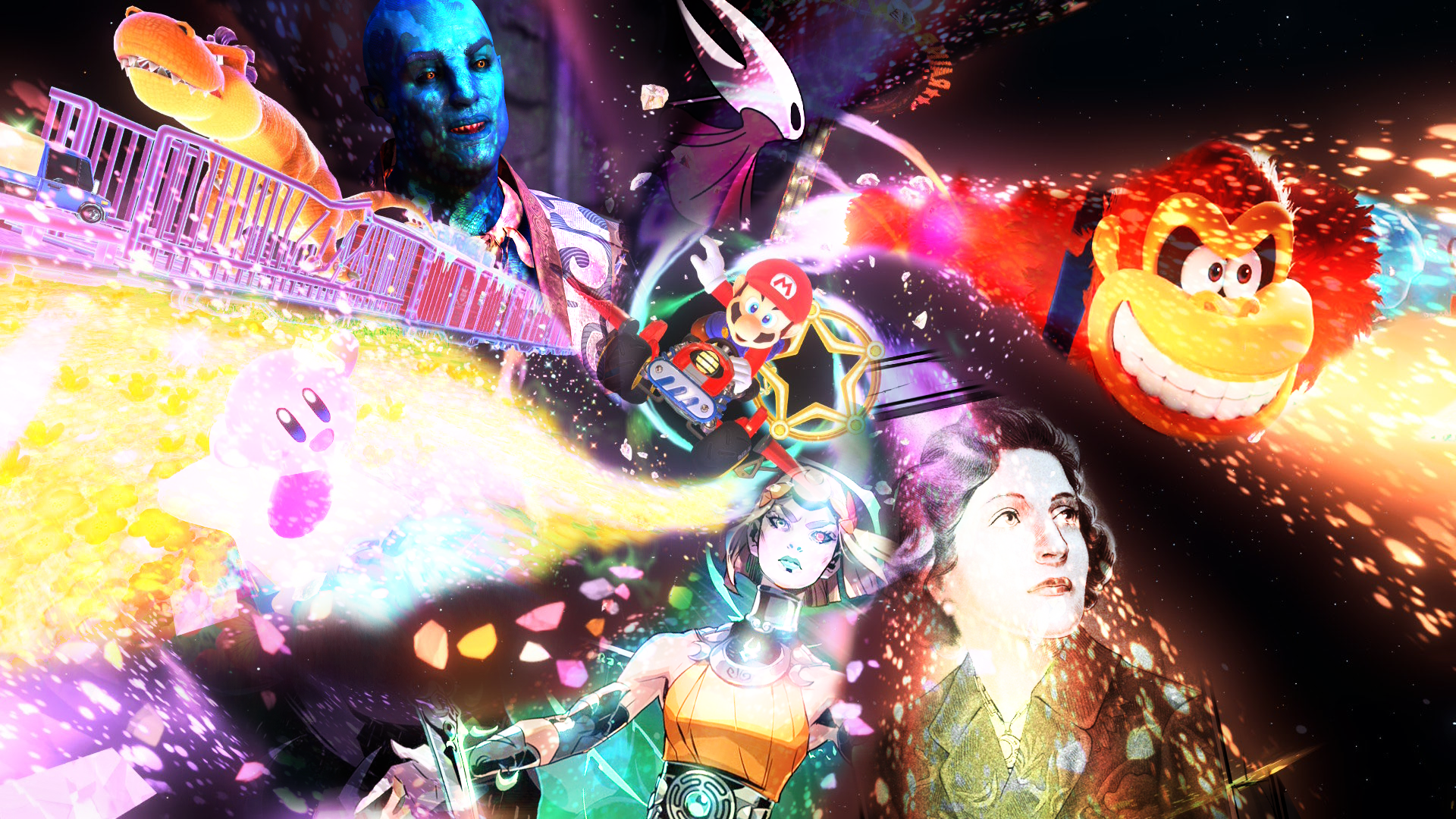
EDIT: December 28, 2025: replaced the Avowed screenshot, as I realized it had been used in a previous article.
Hollow Knight: Silksong is a big game. A gigantic, king-size party bus of a game. It practically leaks ideas wherever it goes. Now, I love Silksong (I literally gave it a 10 out of 10!), and its size was part of why I loved it. The game has an unbelievable wealth of unique enemies, graphics, music, and ideas. Few parts feel obligatory or dull. It is very rare to find a game that is both this big and this consistently interesting. And yet, one thought has crept up throughout my still ongoing, currently eighty-plus hour adventure: “This game has too much s***.” Too many repetitive gauntlet rooms with waves of generic enemies, too many long runbacks between bosses, too many difficulty spikes. The size is an incredible and undeniable boon to Silksong, but not exclusively so.

Image: Source Gaming. One of the first levels in Silksong. The quality of levels is largely impeccable, but trekking through it all is a lot.
Silksong was not the only game of 2025 to make me feel this way. It’s a reaction I repeatedly had to Hades II, another game I’d spent years excited to play but one that left me disappointed instead. It was a common sentiment towards Nintendo Switch 2 exclusives Mario Kart World and Donkey Kong Bananza, albeit sentiments I didn’t share. And if we’re willing to expand size beyond the purely physical, there were games that were painfully big in other ways. Blue Prince, for instance, is a focused roguelike in pure floor space but contains so many individual rooms, puzzles, puzzle types, clues, gimmicks, documents, and tricks… I mean, it was overwhelming from the word go. Even the weird $10 tech demo Nintendo Switch 2 Welcome Tour was shockingly large. This was perhaps unfairly offset by a project where I played sixty-four games in three months, but at least for my gaming in 2025, size ruled the roost.

Image: Source Gaming. One of the many, many, many clues in Blue Prince. You need to take notes on all of them, but it feels more frustrating than note-taking in other games because of how the randomness gets involved.
Perhaps this stems from a year with a console launch—possibly the last exciting one we’ll see in the foreseeable future. Perhaps it’s related to the upcoming and obviously mammoth Grand Theft Auto VI, which was initially slated for 2025. But even without it, size was a recurring theme. Battlefield 6, the latest entry in a series obsessed with massive sandboxes, was built with the intent of having one hundred million players. Monster Hunter Wilds repped another series known for size, though somewhat less successfully. Death Stranding 2: On the Beach reimagined the continent of Australia, while Assassin’s Creed Shadows and Ghost of Yōtei set themselves in large chunks of Japan. Pirate Yakuza in Hawaii turned Like a Dragon into a ship combat epic. Doom: The Dark Ages stretched its perspective to the point of self-parody, with humungous levels and silly mech sequences. Metroid Prime 4: Beyond crowned itself the heir apparent to classic 3D Zelda, complete with a dull and barren take on Hyrule Field. Deltarune’s second and third chapters ballooned the scale of a compact episodic RPG. Borderlands 4 was, by all accounts, Borderlands, as bloated as ever. We even got a re-release of Xenoblade X, one of the classic examples of stupidly large open world maps.
But for ease, and because I think they complement each other well, I’d like to focus on these four games: Hollow Knight: Silksong, Hades II, Mario Kart World, and Donkey Kong Bananza. Four sequels, all of whom chose to expand in substantial and dramatic ways. Whatever their obvious differences in style, look, goal, genre, and attitude, they chased tangible bigness—for better, and for worse.

Image: Source Gaming. Sidestepper rides the crab as one of Mario Kart World‘s massive roster of “NPC Drivers.” Promoting obstacles on the road gave it the largest roster in series history.
I guess to start, we could look at how all four are sequels. The original Hollow Knight and Hades were already pretty robust, with tons of enemies, abilities, and secrets, and while their follow-ups add far more mechanics and features, the size feels like the most important addition in both. Silksong’s map is ridiculously big, vastly eclipsing Hollow Knight’s, and it’s stuffed with dozens of gorgeously animated bosses, optional movesets to collect, and unique environmental gimmicks. Hades also has a lot of ideas, but those are overshadowed by a more overt twist: there are twice as many levels because it features two full size campaigns, the second of which you can unlock very quickly. Mario Kart is a bit different; it has two fewer conventional tracks than Mario Kart 8 had at launch, to say nothing of the final total in Mario Kart 8 Deluxe, and its addition—the big open world—doesn’t have a counterpart in any other game in the series. Once again, though, the big change comes from expanding the world physically, as it’s now a contiguous and massive space dotted by courses that would normally be separate.
The wild card here is Donkey Kong Bananza. It’s Nintendo EPD8’s follow-up to both the fairly giant Super Mario Odyssey and the far more humble Donkey Kong Jungle Beat, but as the second 3D Donkey Kong game it’s also saddled with the legacy of Donkey Kong 64. That game has perhaps the most notorious slate of collectibles in any 3D platformer, and while Bananza technically has even more, the Banandium Gems are a lot more tolerable than the hellish glut of character-specific bananas, tokens, and mini-games. If nothing else, you don’t actually have to get a single Gem in Bananza, nor are they especially critical. It also means that the gigantic Layers can be blitzed through quickly if that’s what you want, but gigantic is the operative word. They’re huge, with multiple sub-levels that are all sandboxes in their own right. You could probably cut half the levels and still wind up fielding complaints that the game is too big.

Image: Source Gaming. Kong Bananza demolishes a seemingly impervious enemy.
All four have specific goals they reach with their size. Bananza‘s reasoning is the easiest to understand: it’s to facilitate the gameplay. The main gimmick is Donkey Kong’s unfettered ability to demolish whatever level he’s in, and the levels support that by giving him room to make alternate paths, move unimpeded, and play with the diverse and gimmicky types of terrain. The game has smaller rooms for more specialized challenges, but ultimately it’s most compelling in the big levels. And in general, Silksong is similar. It’s an incredibly nonlinear and permissive Metroidvania, and having so many areas allows it to include alternative and optional routes. That’s great for agency, especially in a super hard game with cruel, unforgiving bosses. If you can’t handle the Last Judge, go find the back way past Sinner’s Road. If you’re willing to opt for the “bad ending” in Act II, you don’t need to struggle for the double jump. Both games want you to go off on your own. The big worlds, and the wealth of mechanics therein, need to be there for that to work.
As for the other two, it’s less clear. Mario Kart World was built with the intention of being a new direction, as Mario Kart 8 perfected the series’ formula (and kept being supported throughout World’s development; a normal sequel would look anemic next to its ninety-six track list). Nintendo EPD9’s answer was the open world, and the coolest stuff in the game does come out of it. The focus on tricking and vehicular platforming makes more sense in a sandbox, and it’s always awesome seeing the looming shadow of a far-off racetrack. The 300 piece soundtrack, the game’s most universally acclaimed feature, was made to account for the size. But it’s an obviously reactive choice, and playing Hades II, I get the sense that its size was reactive as well. Like the game as a whole, it feels like an attempt to target the most obvious things fans liked. We loved the bespoke levels, so now we get twice as many. That isn’t a bad thing—though I ultimately found the final product a creative dead end—and its “upper” set of levels has plenty of cool stuff. The fights against Polyphemus and Eris, the gimmicks of the Ephyra and Olympus regions, and the ever-perfect art direction are distinct. Playing Hades II feels wonderful, and every new level or enemy often feels like a runway catwalk there for you to strut. I don’t think either game needed as much stuff as they give, but they do get something from it.

Image: Source Gaming. Hades II is very good at giving basic pleasures, and the sumptuous and numerous areas are central to that.
That being said, each of these games has issues, controversies, or problems of another sort, and they’re at least partially tied to that tangible bigness. Silksong’s difficulty is mostly satisfying but does have several very cruel spikes, and the larger the map, well, the more spikes there are. Even getting the bad ending can be exhausting, and the optional Act III endgame is almost joyfully cruel at times. Donkey Kong has the inverse problem; even though you can ignore the vast majority of content, the level design, aesthetics, and marketing relentlessly push you further and further. And that’s different from Mario Kart, whose map feels empty and bereft of moments. The most contentious feature, the more simple and humdrum Routes between courses, are in every mode because otherwise the open world wouldn’t factor in at all. Hades II works hard to justify its two sets of levels, not just through wonderful enemies but by stuffing them with collectibles that quickly turn into an overwhelming headache. It feels obligatory, as though Supergiant Games thought it had to stretch in every axis it could.
Taken another way, all four have a clear idea of what their size is worth, but that chafes against player response and, at times, the game’s own mechanics. Like, World has reimagined itself as a Forza Horizons-style sandbox, but that breadth goes against Mario Kart‘s famously tight design, and Nintendo didn’t do enough to ensure that the Routes and Free Roam felt up to snuff. Silksong simply kept growing and growing thanks to Team Cherry’s Hollow Knight money giving them free rein, and that’s literally the best climate for actually making a game, but I do wonder if that long development is also what led to the annoying and common gauntlet rooms. Donkey Kong wants to be open, it wants players to destroy and speedrun however and whenever they want, but its communication emphasizes the destruction well beyond its cool puzzles and open design. And in general, Hades’ issues seem to stem from doubling down on those most obvious pleasures of the first game, leading to it having twice the love interests (but only as many good ones) and way more mechanics (that often get in the way of the fun).

Image: Source Gaming. The route to Starview Peak is visually spectacular but less interesting to drive through.
Now, I’ve got my own takes. I like World as it is, including its super-chill Free Roam and the Routes, though I’ll grant that several of those straightaways are very dull. To be honest, the vitriol over it feels ridiculously overblown. The Donkey Kong levels are indeed way too much if you choose to mainline them (as I did for several after finishing the game), but you literally never have to, and the game does demonstrate that. Silksong is beyond intimidating in its size, but I think the bigger culprit is how thickly it applies its difficulty. As for Hades… yeah, it absolutely didn’t need over ten varieties of plants to farm, or Familiars who seem to exist mostly to collect resources, or a story that’s twice as big but with half as much to say. For all of these, I think the size exacerbated a different core problem, rather than being the problem itself. But the size is still there and at times still problematic.
These four are in a strange position. Circumstances demand they scale up, either for the sake of a mechanic or, more often, the expectations of players and developers. And all of them do find a lot of value in their scale. But all of them failed to perfectly stick the landing. Whether it’s Mario Kart World not doing nearly enough to make a rich sandbox, Hollow Knight: Silksong stuffing itself with one draining sequence after another, Hades II feeling cumbersome and bloated, or Donkey Kong Bananza’s communication issues, they missed one important detail. It makes playing and replaying them come with caveats, and post-launch updates for all four suggests that fixing these issues is harder after the fact. You can rewrite the shockingly bad original ending to Hades II, but that economy’s probably there to stay. You can give Donkey Kong a crazy roguelike DLC, but those levels can’t be reined in.

Image: Source Gaming. Avowed‘s four regions are pretty small by conventional open world metrics, and they only show a few types of biomes, but they’re also packed and feel full of stuff.
Of course, there is another way to do things, which is to scale down. That was the philosophy behind Avowed, Obsidian’s perfectly cromulent Pillars of Eternity spinoff from this spring. There are four sandboxes and a few dungeons, but nothing in Avowed feels cut down or unfinished or wanting for more. It’s exactly as big as a Western action-RPG needs to be. Obsidian has pursued a smaller, focused scale in its projects for years, and that’s led it to releasing Game of the Year candidates, unorthodox gems like my beloved Pentiment, and what looks from the outside to be a fairly healthy corporate culture. It actually put out three games in 2025, all well received. There are games and teams that can’t go small, and Obsidian’s circumstances are pretty much irreplicable (they seem to be one of the few relatively safe Microsoft studios, though who knows how long that’ll last), but Avowed is a good example of something that feels “big” but not “overbearing.” Even if its smaller content isn’t perfect—for one thing, there are four companions and one’s a dud—the direction is solid. Clair Obscur: Expedition 33, Pokémon Legends: Z-A, South of Midnight, Mafia: The Old Country, Dispatch, and Cronos: The New Dawn all took a similar tack and largely succeeded. With the exception of Pokémon, these are notably all “Double-A” games, a framework of production that’s drastically shrunk in popularity over the past decade.
But also, maximalism can work. It can be a direction for its own sake. And fortunately, the year actually ended with the latest title by Masahiro Sakurai, the gaming community’s king of maximalism. So for a final case study, let’s consider Kirby Air Riders.

Image: Source Gaming. Kirby Air Riders expands on everything from the first game, including its extra aesthetics.
Riders is another sequel, specifically to Sakurai’s 2003 cult game Kirby Air Ride, and yet again the expansion is the most obvious change. It retains its predecessor’s three modes and adds a fourth, rebuilt all of Air Ride’s nine main courses alongside just as many new ones, and wildly buffed the roster from eight Kirby palette swaps to twenty-one unique characters (Kirby did lose two colors, though the six remaining are now distinct). City Trial, the original’s most iconic mode, has been injected with tons of new events, boss fights, powers, endgame levels, and a better sandbox. The Checklist system that governs unlockable content is twice as big. Seemingly the only things that didn’t come back were the original City Trial map and Top Ride courses, all of which would need expensive redesigns. Several reviews, including ours, noted that Riders follows an old fashioned video game trope of being as much a remake as it is a sequel.
Air Ride was an early standard of Sakurai’s “more is more” philosophy, the direction that powered Kid Icarus: Uprising and the Super Smash Bros. series. Its three modes incorporated wildly different mechanics; Top Ride played like slot cars, City Trial was a timed sandbox full of random bonuses, and all of them had a strange mixture of kart racing and vehicular combat. At the same time, it was a bit small, janky, and graphically limited. You could almost see the GameCube straining to play it as much as most critics were. Riders is a far more stately production by comparison, complete with graphics that threaten sensory overload at all times. But, like Hades II, it also grows by adding another mode: Road Trip. This is a chunky story mode that remixes the other three modes in a fun, frenetic way. I don’t know if it’s what Air Riders “needed” to feel less like a proof of concept and more like the Triple-A game its massive credits list prove it is, but it’s just one of several things that give a sense of completeness. The additions all make sense. They all feel right.

Image: Source Gaming. Dedede in a fight against Zero Two from Kirby 64: The Crystal Shards. Air Riders‘s crazy boss fights are a great addition.
I don’t think Kirby Air Riders shows an “answer” to the other four games. I mean, I could try to make that argument. Its race courses zip by and never feel too big, the way some players found Bananza’s levels. Its economy is much simpler than Hades’, and its buffet of content feels far more natural (its near-total lack of writing is also better than Hades’ at times bad writing, but that’s outside the scope of this article). Having multiple ways to unlock Riders and Machines echoes Silksong’s interest in letting players explore on their own terms, albeit with the painful chokepoints made fully optional. And if Mario Kart World’s sandbox felt empty and samey, you’ll find every square inch here to be packed. But that’s glib, and beyond that, the game simply isn’t interested in the same things. The size and expansion aren’t a means to an end; they are the end. Like most of Sakurai’s projects, Riders is an all in one variety show stuffed with mini-games, alternate modes, and secrets to wring as much out of the mechanics as possible. That started with Kirby Super Star, crystallized in Smash Bros. Melee and Brawl, and many of his trademarks started in the original Air Ride. The assortment of stuff is here because Sakurai has always been obsessed with giving customers what he personally thinks is the biggest bang for their buck.
Fittingly, the biggest difference between Riders and the other games is that the tangible bigness isn’t an issue in any real way. The Air Ride courses are all delightful, the Checklists encourage you to master the game without being too oppressive, Road Trip is fun, the new bosses are bonkers, and the game is eminently playable in short bursts or long sessions. The most glaring flaws are the same ones from the first game: Top Ride’s less fun than a mode of its size should be, and the game can be needlessly uncompromising, particularly when it comes to its “two buttons only” gimmick. Those are real problems, but they don’t really interact with the size.

Image: Source Gaming. An super-cool secret area in Silksong. For whatever criticisms I have of the game’s size, it is commendable and incredible how many interesting locations are just completely optional.
Maximalism is not a virtue on its own, of course. It’s a challenging and risky philosophy no matter what medium you’re working in, because size is a risk. In games, it demands oodles of content, time, labor, and money, and it impacts everything, from balance to pacing to tone. These five games, all standouts in a fairly memorable year (three were Game of the Year contenders and one has likely sold over ten million copies), show the promise and pitfalls of going big. You can create jaw-dropping worlds… that may be exhausting to walk through or bereft of stuff. You can keep players going forever… unless they have to give up for their own sake. And it can work for, against, or without any relation to your goals as an artist. In 2025, these virtues and flaws were all on display across the games industry. Maybe if we’re lucky, we’ll have learned something from it.

- Indie World March 3, 2026: Information and Reactions - March 3, 2026
- On Phil - February 26, 2026
- Escape from Ever After | Review - February 17, 2026