
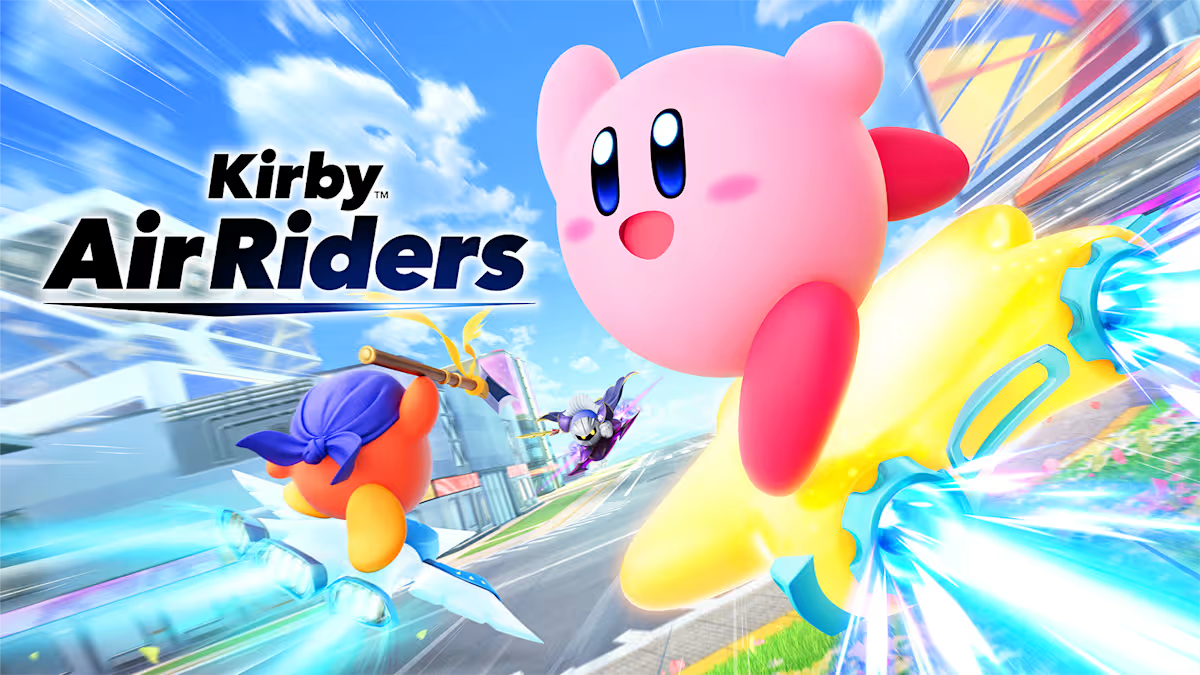
This review copy of Kirby Air Riders was provided to Source Gaming by Nintendo.

Game of the Year
Masahiro Sakurai is back, and not with Super Smash Bros. this time! Instead, he has returned to his roots by taking on the Kirby franchise with Kirby Air Riders, a sequel to the last Kirby game he directed, the GameCube cult classic Kirby Air Ride. It’s almost like he never left!
The original Kirby Air Ride was an average game. It had an interesting premise, a racing game that only used a single button, but it lacked a lot of depth and content. Mainly, it was remembered for its City Trial mode, an open arena where the goal is not to win a race but collect stat-boosting items, culminating in one final, random stadium event. It was a unique mode, especially for the racing genre, and provided the most amount of depth in an otherwise depthless game.
Kirby Air Riders is a vast improvement over the original in almost every regard. In fact, it could almost be considered a full on replacement. Almost all the content that was in its predecessor has returned: every track, every City Trial event, every Machine and every Rider (there were three, so that was easy). And then that content was more than doubled, with more unlockables, modes, customisation and the addition of online.

Eclipsing the GameCube racer’s roster, Air Riders hosts a wonderful assortment of Kirby all-stars. Fan-favourites like Magolor and Susie are present. One of the Kirby series’ strong points is its charming assortment of little guys, and Sakurai took care to celebrate them with newcomers like Rocky and Waddle Doo. The selection of Machines is varied with consideration taken for pretty much every scenario and playstyle. Some are better suited to City Trail over races, some make flying easier while others are bulky and unlikely to be destroyed. And many change the way the game can feel to play.
The Chariot Star provides more control, making it great for beginners. The Swerve Star, on the other hand, stops all momentum when boosting, allowing for more control on the turn angle (which might sound like it makes things easy, but I found this to be one of the most difficult stars to use). The Hop Star replaces the quick spin, every character’s generic attack, with a jump, and the Wagon Star trades the ability to boost for an all-around stat spread. There’s a ton of variety in Machines to experiment with, and it’s worth swapping between them for the right scenario, as many stadium battles have specific machines that excel in them.
The best way to test out every machine is in the new Road Trip mode, Kirby Air Riders’ equivalent to a story mode. It is structured similarly to Super Smash Bros. for Nintendo 3DS’s Classic Mode combined with Super Smash Bros. Ultimate’s Spirit Battles. A series of challenges, usually three, are presented and one must be completed to advance. Challenges vary from a race to a battle to one of the main stadium battles, and offer stat boosting items and in-game currency as rewards.

The idea is to work your way through all the stages, picking challenges that provide the stats to customise your machine in the way you want, occasionally being forced to tackle harder challenges that serve as bosses. Fail, and you can either spend money to restart the event or you’ll be forced back to the last checkpoint. I actually found it best to go back to the checkpoint instead of retrying, as the Riders level and stats carry over, meaning you can replay previous challenges, or new challenges, to get even stronger.
The Road Trip is contextualised with a story that gets absolutely wild at points. It’s pretty typical for Kirby games to pull the rug out from under the player towards the end; sudden shifts in tone are a proud series tradition. But Air Riders is on a whole different level. There are points where I had to question if I was actually still playing a Kirby game! Yet, the game’s story is really solid and has some incredibly hype moments in its end-game.
As a Kirby fan, it is also quite neat seeing some of these classic Kirby elements return. Air Riders feels like a celebration of the whole franchise, at least of the parts that Sakurai helmed. Classic villains like Nightmare, Zero Two and Galactic Nova all return with new 3D models that make them look absolutely terrifying (especially Nightmare; the team went hard on his design here).

I’ve focused mainly on content as that was one of the bigger complaints about Kirby Air Ride that was universally agreed upon. A complaint that was more mixed was its general game feel. Personally, I always struggled to enjoy it. The original game was slow and, despite having one button for everything, didn’t feel as intuitive or polished as I think was intended. Thankfully, once again this is an area that has been greatly improved.
When first turning on Air Riders, it might feel slow, like 50CC Mario Kart. But this is done on purpose because once a few speed-boosting stats have been collected the game shifts into becoming pure chaos. Speed-based Machines and Characters like Rick will be seen flying across the track at ludicrous speeds. It can be quite overwhelming and overstimulating. However, once I played the game enough and got used to the chaos, it suddenly became far more manageable. The trick is to not be intimidated and slowly acclimate to the insanity that is happening on screen.
It’s at those high-speeds that Kirby Air Riders truly shines, not just because of the high-octane action but rather the sense of progression it provides. Some of the most fun I had in this game came from when I was far enough into Road Trip that my character had gone from making slow turns and playing catch-up, to soaring through the skies at ridiculous speeds. I had become a true Air Rider, spending an entire lap never once touching the ground itself.

That’s where Kirby Air Riders excels, the pure sense of progression that is felt from it. The game starts with very little unlocked: four Riders, four Machines and a handful of levels. But through the checklist and its over 500 missions, new content gets unlocked after almost every single Air Ride, Top Ride, City Trial or Road Trip play, and in those latter two watching your Machine go from baby speed to supersonic over the course of a round is incredibly satisfying. No modern game has quite hit that same sense of satisfaction as Kirby Air Riders has.
Kirby Air Riders: Kirby Air Riders shows how much depth developers can get from a simple concept with a few tweaks. While the original Kirby Air Ride was okay, it's single button approach and lack of content left it feeling like a one and done ordeal. Kirby Air Riders is not that. It's polished, has a ton of replayability and plenty of charm galore, with a plot that's greatly helped by the juxtoposition against its adorable characters and world. – NantenJex