
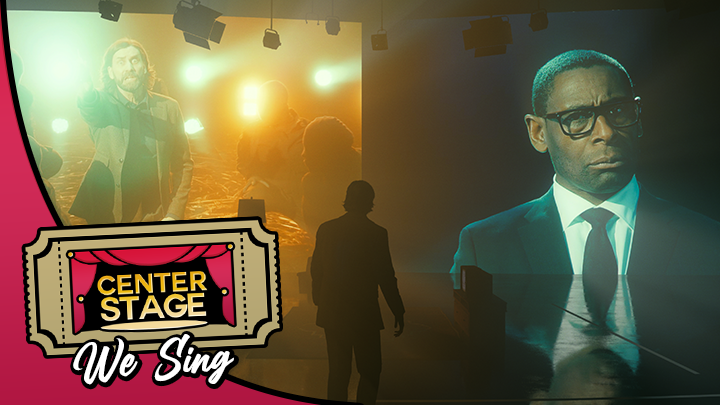
In “Center Stage,” Wolfman Jew discusses environments and level design across the games industry. They may be single levels, larger sandboxes, or broader settings. They may be as small as a room and as large as a world. Some may not even be good. But they are all interesting.
Spoilers for the level “We Sing” in Alan Wake 2, minor spoilers for Alan Wake and Alan Wake 2.
I do not wish to boil Alan Wake 2 to a single idea. It’s a game about adapting the trappings of police thrillers into a survival horror mold. It’s about the unreliability of memory and the feeling that reality is breaking down. It’s about white attempts to define Blackness and the cruelties of crumbling, rural America. It’s about navigating jumps between different and at times discordant pillars of gameplay. It’s about Finnish pride and having fun at the expense of X-Men actor Shawn Ashmore. It’s about the beauty, terror, and overwhelming force of art. It’s about an almost physically palpable depiction of darkness rare even in the horror genre and the single craziest menu in the history of gaming. It’s about failings, and the compounding failings that come from trying to fix them. Alan Wake 2 is “about” a hundred different things.

Image: Source Gaming. Co-lead Saga fights one of the Taken. Alan Wake 2 is memorable for its incredible visuals—visuals that actually gave WordPress trouble for this article.
But more than anything else, I think it’s about legacy, both within and outside the story. While long-lost author Alan Wake suffers the consequences of a life of failings, and FBI agent Saga Anderson navigates a world that seems intent on writing out her life story, developer Remedy Entertainment examines its own history as the studio behind Max Payne, Alan Wake, Quantum Break, and Control. Released in 2023, the game is an apotheosis of everything the team had done since 2001. Its signature motifs are all there: cinema and television aspirations, live action footage, proud Lynchian influence, the Poets of the Fall, cracking third-person shooting, and an abundance of style. These constantly overlap, most thickly at one point in Alan’s story. Though this scene is short, it’s electrifying. So dive into the light of an old CRT television and let Mr. Warlin Door, Alan Wake, the Old Gods of Asgard, and Remedy Creative Director Sam Lake perform The Story of the Journey of Alan Wake: The Musical!
Part 1: Childhood
The chapter “We Sing” starts with Alan Wake reeling in the makeup room of New York’s “Number 1 in Late Night” talk show, In Between with Mr. Door. He was there in the last chapter, too, and he’s not sure why, but we can be confident it’s not real—Alan’s been trapped in the nightmarish Dark Place for years. A television is in the room, one of those chunky CRT models. It’s playing footage from the interview he’s about to be on, maybe, and things aren’t great. Alan is stiff and awkward. Mr. Door is charming but off-putting, and probably on purpose. There’s also a dead ringer for Alex Casey, a man who is somehow both Alan’s most famous literary creation and a fully alive NPC in Saga’s side of the plot. David Lynch’s fingerprints are all over the games industry, but his influence (and especially that of Twin Peaks: The Return) has never felt so acute. And then Mr. Door explains that this interview is different: they’ll be singing it.

Image: Source Gaming. The strange late night talk show shows up in both the live action footage and an in-game survival horror level. This scene is from an earlier chapter.
Alan likely isn’t the only one confused. Fans of the first game wouldn’t know Warlin Door, the narrator for Alan Wake’s “show within a show” Night Springs. More pertinently, people who only bought the game off its numerous year-end awards might be surprised that this interview is not depicted through the beautiful in-game graphics or CGI, but live action footage. Alan’s played by his face model Ilkka Villi and dubbed over by his voice actor Matthew Porretta. It’s… strange. While games have a long history of using full motion video—cutscenes that don’t use the in-game graphics, like the anime movies of Persona 3 Reload or the hand-drawn shots in Hollow Knight: Silksong—it’s almost always awkward when live action is involved. Real footage is actually quite common in Alan Wake 2, and Remedy’s output as a whole. Throughout the game, dual protagonists Saga and Alan see visions of flesh and blood actors and walk through superimposed footage of the other character’s levels. It creates this constant sense of cosmic overlap, like the “truth” of where you are is always in doubt. Great for the horror genre.
In this instance, the sense it brings is one of overwhelm, as it is at this point that Alan finds himself on a massive soundstage, beset upon not by bewitched cultists or the Dark Presence but a music video. A music video he’s in. Because the onset metal rock anthem “Herald of Darkness” features the musical stylings of not just the Old Gods of Asgard (an alias for the Poets of the Fall, who play paranormal musicians Tor and Odin Anderson in Remedy’s weird shared universe) but Alan and Mr. Door, whose interview makes up some of the lyrics. You watch a screen of your character expressing his feelings while you walk him through the level, which opens and moves to create gigantic screens of the actors. They dance, they sing, they get composed in cool collages. And you just… walk through it, like an art exhibit. It’s mesmerizing.

Image: Source Gaming. A relatively sedate part of Alan’s walk. Emphasis on “relative.”
Let’s back up a bit. Alan Wake was a 2010 cinematic horror game that garnered a passionate cult fandom. It’s… fine. The forests of Bright Falls, Washington were gorgeous, and it was far more interesting than its drab military shooter contemporaries, but it was painfully limited. As a shooter, it never got more interesting than a loop of shining a light on enemies before popping them. And its story was unsatisfying, with a main character who was somehow both generic and pompous. The game wore its Twin Peaks and Stephen King inspirations on its sleeve but never matched them. Still, there was enough fan passion for Remedy to make a sequel that could answer the cliffhangers of Alan Wake and its side story American Nightmare, which ended with Alan trapped in a realm born from tortured art and artists. Of course, they’d need to account for new players and that distance. It’s not as rough as Twin Peaks returning after twenty-five years, but a thirteen year gap is a problem. You can’t only make games for plugged-in devotees.
The answer they found comes in two parts. Broadly, the game’s surreal and nonlinear story is built around shaking fans and newcomers alike. Memory and history are constantly played with; the game has two protagonists who spend their time interpreting a shifting, incoherent reality. The stories—instead of having two campaigns, you can and are encouraged to freely jump between Saga and Alan—are about trying to discern the world in different ways. In addition, details from the first game are twisted, recontextualized, or simply retconned outright. Fans’ knowledge is sometimes weaponized against them. But those are broad. The easy answer is that once you get to swap characters, Alan’s story gets a recap. A “previously on” segment. That’s what “Herald of Darkness” is; it’s a retelling of the events of Alan Wake… sort of.
Part 2: Rise to Fame
After running through ramps and backstage material, you find yourself in a New York set. It reuses some of the brickwork and graffiti from Alan’s gritty NYC sandbox, but there’s no hiding the artifice. It kinda reads like experimental or low-budget theater; the obvious set dressing is more immersive simply by being upfront that it’s set dressing. Plus, while the assets were great for making those city levels scary and ominous, here they add to this sense of excitement. The huge graffiti, the neon signs, and the posters of the new Alex Casey movie have an abundance of personality. It’s super cool seeing them backlit by the live action screens.
What was Alan’s backstory? In Alan Wake, it’s pretty simple. He was a conflation of the horror of Stephen King, the thrillers of James Patterson, the paparazzi assaults of your average TMZ subject, and, at least from what we see of his work, the talent of Garth Merengi. He goes to a Twin Peaks homage of a town with his wife, loses her to its picturesque Cauldron Lake, and winds up bedeviled by an evil witch who feeds off stories. The game was notable for its literary aspirations, but Alan was as ill-suited to supporting them as his game was. He was, well, a 2000s television protagonist, a “Bald Whitem’n” in every regard. Remedy’s new deal to adapt the property to TV, while potentially fun, feels redundant given how beholden to TV it already is.

Image: Source Gaming. The bits of environmental storytelling, like the posters for the upcoming (and nonexistent) Alex Casey movie, are all found across Alan’s other levels.
“We Sing” takes all these ideas and makes them, well, sing. The Clicker, this childhood toy of Alan’s that connected him to a cosmic fight against the darkness, has more mythical proportions. Pieces of his backstory that were largely tossed off, like his hitting a tabloid reporter and the critical success of his works, are turned into these looming forces. While Alan always had demons, this emphasizes their hold over him in a way the first game never really bothered interrogating. It also adds new stuff; Part 1 features set dressing—a locked door, an empty bed, footage of Alan with a massive bouquet—that implies an otherwise unspoken family tragedy. It makes the hero feel so much larger, especially when compared to his 2010 incarnation.
The most interesting part of this section from a gameplay perspective is how linear it is. The “puzzle” you solve involves following giant neon arrows; they’re used in other parts of the New York level, but without any attempt at naturalism here. My view of this is an implication that he’s being directed. That his time as a successful, award-winning, violent author came from impulses and fears that weren’t under his control. When he regains more control of the stage, it’s by using the Lamp, this mechanic you normally use to alter the reality of areas. Normally he has it on him, but here it’s reimagined as a literary award that’s become an albatross. Throughout his plot, Alan swaps light in or out of a light source, changing the world for some simple but very cool puzzles. That happens here, too, as he unlocks one of the TVs you use to go from part to part.
Part 3: Bright Falls
Unlike the Ashtray Maze in Control, Remedy’s last interactive music video, there’s little combat in this chapter. It is arguably a problem; the level doesn’t make you feel as part of the song as it could (though perhaps that was outside the scope of Remedy’s ambitions; co-director Sam Lake has admitted that the intent was to make an actual interactive musical number). The only time enemies show up is here, the section meant to recap the actual events of Alan Wake. You shoot the monstrous Taken—they’re surprisingly hard, even on Normal Mode—on a sound stage of fake trees, wooden steps, and supply caches filled with so much delicious ammunition. Once again, the set dressing draws attention to itself. If someone were to turn the 2010 game into a reasonably budgeted off-Broadway play, it’d probably look like this.

Image: Source Gaming. Like a lot of great art, Alan Wake 2 can be proudly unsubtle, and it’s not a coincidence that the central shot of Alan—the one towering over “our” Alan—looks a lot like the cover of Alan Wake.
Like the second scene, this sequence is less about retelling the original story than it is about recontextualizing it. The basics are here: Alan comes to town, Alan loses his wife, Alan becomes a “Champion of Light,” Alan winds up trapped as the “Herald of Darkness.” Everything extraneous is removed, like Alan’s horrible sidekick Barry or the human form of the Dark Presence. The game’s groundbreaking use of light and darkness isn’t and probably couldn’t be replicated, just because of how technology has moved on, but you still feel small and enveloped by the dark.
In practice, the most notable absence from Alan Wake might simply be the boring gunplay. Alan Wake 2 is an excellent survival horror shooter, taking its predecessor’s “shine and shoot” loop into something far more visceral, satisfying, and scary. Like in Control, Remedy’s previous game, the graphical effects make Photo Mode an absolute delight. It’s a far cry from the original game’s stiff, weightless action. And instead of making itself more accurately bland for the sake of authenticity, Alan Wake 2 instead prunes the “survival horror” and ups the performative element. The reason Alan gets to go hog wild on baddies with his insta-kill flare gun might just be that it’s the most theatrical weapon in the game. I suppose that if the narrative parts of “We Sing” are about injecting a life to the story that lacked it, this combat section is doing the same mechanically. This is, in all likelihood, what Alan Wake was “supposed” to feel like in your hands. It’s not scary (though ironically that does make it more like the first game), just extremely cool.

Image: Source Gaming. Note the “ENEMIES ->” tape on the ground. There are several others to help Alan hit his marks.
At the end of the level, the song suddenly swerves into a metal section straight out of Doom. It doesn’t connect to anything from the game it’s adapting—well, it might be a reference to the best part, the fight on a homemade rock stage backed by an Old Gods of Asgard song—but it’s really cool. This is an intense rock song, rock songs have cool riffs, and video games with rock songs need to play those riffs over fights. It’s also indicative of how much Alan Wake 2 relishes its tonal swings and reveals the work that goes into the sequence’s dynamic music. Each chunk of the song has a little section that loops endlessly until you cross an invisible tripwire or start the next part of the level. It’s pretty simple and unsubtle, but it’s the only way the actual level can function, and the ridiculously hard loop here is extremely fun. It’s very “gamey” in a pleasing way.
Part 4: Champion
“We Sing” is the most meta part of Alan Wake 2, but it’s far from the only one. The entire game is aggressively in conversation with itself, its predecessor, and Remedy’s general output. It is, thankfully, not an impenetrable in-joke only parsable by the studio’s fans—its Night Springs DLC is, but that’s just pure comedy. By and large, the metatext is a tool of drama and central to the dreamlike nature of the story. These are references, but they’re references that are unclear, not required for understanding the plot, and at times fully at odds with what “actually” happened. You’re expected to feel a bit like Alan and Saga, never quite sure how to take the latest plot twist. It’s an ambiguity that you’re meant to feel whether you played Alan Wake, you didn’t play Alan Wake, or you are Alan Wake. In this chapter, the weight of Alan’s fears, his sense of burden, his own hazy, incomplete memories of what did or didn’t happen in 2010 are the building blocks as much as the actual world geometry. It’s meta for him, just as it is for us.

Image: Source Gaming. The New York level’s noir aesthetics harken back to Max Payne.
All of… this, this explosion of rock and violence and live action footage, is meant to be disquieting and scary, and funny, too. This is why Sam Lake is in the dance number; he was always the face model for Remedy’s first hero, the hard-boiled cop Max Payne, and since they don’t own the rights to the character they turned Alan’s literary hero Alex Casey into a barely obscured Max Payne analogue. He’s one of the main supporting characters of both plots, and you’re always wondering whether he’s a book character brought to life, a real man who inspired a bunch of doorstoppers, or something else. This is also true of Mr. Door, who was almost certainly based on a character they made but don’t own. There’s this ouroboros element to the project, the studio creating things that redefine themselves over time, and those things then acting in ways you’re not meant to expect. That this works so well is a testament to everything the team learned over the past two decades.
In Quantum Break, a 2016 shooter Remedy made for Microsoft, the studio took its love of FMV to perhaps its most ridiculous extent: a game bundled with a live action miniseries. You’d shoot bad guys as Shawn Ashmore’s hero Jack Joyce, then watch an episode where Ashmore acted opposite The Wire and Game of Thrones alum Aiden Gillan. This was, at least from a distance (I’ve never played Quantum Break, though I intend to), profoundly awkward. The dialogue wasn’t well written in either the game world or the TV one, but more importantly, the worlds didn’t synthesize in any real way. If anything, it seems to have deflated the values of both mediums. Seven years later, Alan Wake 2 upends the idea. The live action footage is more compelling, interspersed in more interesting ways, and that awkwardness is partially the point. It feels invasive.

Image: Source Gaming. Alan Wake 2 loves darkness. It drowns its characters in it. Even after Alan’s metaphorical climb, he ends up back in a dark room.
And yet, the most disarming part of “We Sing” is the part in which the song—and by extension the music video—is at its quietest, simplest, and most intimate. The metal thrashing has been replaced by a jazzy cabaret number where Alan sings about how he’s trapped in the song itself. Musically, this is nothing like what we’ve come to expect. The set dressing is just one big shot of him and a ginormous ladder. You’re literally having Alan climb out of his own personal hell. Afterwards, you approach the plot board, activate it like you’ve done to rewrite reality in previous chapters, and you get the end of the video. Everyone dances on set, Alan confidently slumps onto the couch, and… that’s it. “End of Chapter” and all that.
End of Chapter
Why did “We Sing” blow up as much as it did? Why did it earn innumerable Let’s Plays and reaction videos and a live performance at the 2023 Game Awards? The easy answer is that it’s a provocation, and a loud one. You could not unfairly describe this as a level in which the hero “fights a music video;” there’s audacity here. That’s true of the game as a whole; Alan Wake 2 is fiercely challenging, both as a survival horror game and as a story. And… sure, that’s the main way a lot of players and viewers will take it, as a water cooler moment and nothing more.

Image: Source Gaming. Part of the final sequence—though you can watch the whole thing on YouTube. It’s got over 15 million views.
Song helps, too. The Poets of the Fall have put out six songs as the Old Gods of Asgard, and every one is a banger. The lyrics are goofy but on point, the riffs are cool as hell, and the way they’re used to hide the transitions is, if not seamless, at least very fun. There are many games about shooting, and many cool songs that play while you shoot; “Herald of Darkness” just happens to be an especially cool song for a sequence with equally impressive shooting. I replayed this chapter several times for this article (largely due to issues relating to Xbox’s screenshot capturing), and it never got old. Even jumping back in months later for screenshots felt great.
But I don’t think the level would be this memorable if it was only crazy live action footage and a great metal song and a level of confidence few studios could justify. Alan Wake 2 is a masterpiece, with incredible levels and writing and UI design, and I could never believe its most famous moment was backed only by its most superficial qualities. There is something there. Between the small bits of environmental storytelling, the way its level design changes in tandem with the plot, and its conversation with its flawed, often bland predecessor, “We Sing” has a real heart. It is meta in a way precious few games are, one that isn’t winking but thoughtful, serious, and questioning of its history.
…But also, like, yes, that music rules. “Show me a champion of liiiiiight…”
Thanks to Cart Boy for edits.

- Indie World March 3, 2026: Information and Reactions - March 3, 2026
- On Phil - February 26, 2026
- Escape from Ever After | Review - February 17, 2026