
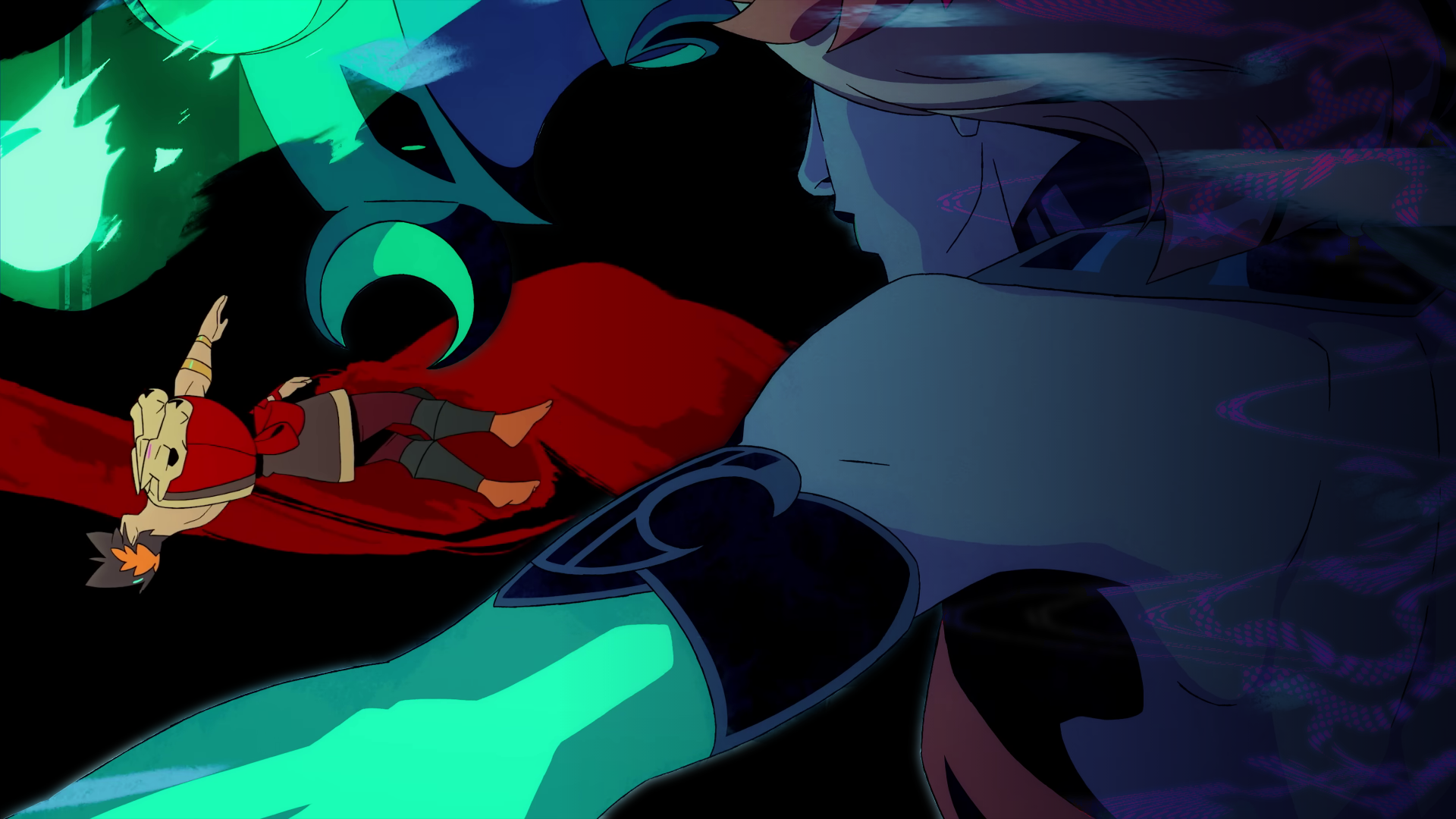
Hades was not the first roguelike. Hell, even Rogue, the genre’s namesake, wasn’t the first; Beneath Apple Manor and several others predate it. But these Seventies and Eighties games, and others, started the idea. They were top-down, dungeon-crawling RPGs, often rendered in ASCII graphics, and procedural generation was the main event. Each game whipped up unique scenarios for every session, with new loot and rooms and enemy placements, and once you won or died, that was it for that setup. This combination of randomness and permadeath created a lineage of role-playing games that were hard, unforgiving, but also special. Every “run” was yours.

Image: Steam, where Rogue (or at least its 1986 Amiga port) can be emulated alongside console. I tried some of the original on abandonware websites, and it can be addictive.
Hades was not the first roguelike mashup, which is to say one that isn’t a top-down, turn-based RPG. That might be Strange Adventures in Infinite Space, but at least culturally, the concept was introduced by the original Spelunky from 2008. Spelunky’s a roguelike and a polished 2D platformer. This was provocative because at the time, the genre almost exclusively consisted of super-hard RPGs like NetHack and Angband. But it argued that the randomness, permadeath, and procedural generation were the core tenets of the genre, and those can be paired with anything. Now we live in a world awash in unique and wildly inventive roguelikes. Rhythm games. Immersive sims. Bullet hells (and “reverse bullet hells”). Deckbuilders. Horror deckbuilders. Metroidvania. Shooters. Puzzlers. 3D platformers.
Hades was not the first “roguelite,” the sometimes disparaging term for a roguelike with permanent progression (and is also the sometimes disparaging term for any roguelike that isn’t an RPG in ASCII art). I’m not sure which game was the first. But many had already explored the idea of a “metagame” element where runs aren’t purely individual. In The Binding of Isaac, successful campaigns might unlock powers or player characters for future campaigns. In Rogue Legacy, you collect gold that can be spent on improving your chances with each new attempt. This can potentially flatten the difficulty curve, but it can help less skilled players and adds an interesting wrinkle; you have to juggle multiple kinds of progression.

Image: Source Gaming. 2025 critical darling Blue Prince has a lot of these values. There’s piecemeal storytelling, randomized levels, unique puzzles built around them, and permanent progression about the floorplans you juggle every day.
And, of course, Hades was not the first of any of these to attempt more serious storytelling. That would be flagrantly dishonest. The Pokémon Mystery Dungeon games are beloved for their characters. Darkest Dungeon uses its disposable, procedurally made heroes as meat for a narrative grinder; they’re the ones doing the fighting, but at the behest of the player’s unseen leader. And if we’re willing to expand beyond pure “plot” to story, aesthetics, and atmosphere, there are many games—FTL, Isaac—that offer worlds full of mystery and intrigue. Those core tenets make roguelikes a hard fit for conventional stories, since your progress is constantly getting reset. It can be hard to find natural connective tissue, and it’s often at least a little contrived. However, that has never stopped games from trying.
But Hades still mattered. It mattered because of how it chose to represent all of these ideas. From its beloved characters, to its crackling action, to the randomness, to the way the genre itself affected the story, it represented a vision of roguelikes that was and remains hard to match. And so, with Hades II finally out on Switch 2 after a year in Early Access, I thought it would be good to look back on what made Supergiant Games’ “godlike roguelike” masterpiece so great—and to see how its sequel has taken those virtues forward.
DEVILISH FUN
Here’s the pitch: Zagreus, smart aleck Prince of the Dead, is trying to flee his Underworld home. To stop him, his father Hades has staffed the mazelike layers of their domain with monsters and traps. Each level—the spooky Pits of Tartarus, flaming Asphodel Meadows, serene Elysian Fields, and nasty Temple of the Styx—is constructed procedurally for every escape attempt. That includes the rooms you get, the enemies guarding them, and most crucially, the powers they hold. This is set in the world of Greek Mythology, after all, so Zagreus’ Boons come from the thunderous gods of Mt. Olympus. Each time he clears a room and meets the likes of Zeus and Athena, the deity lets him pick one power from a list of three. That could enhance one of his attacks, improve his damage or defense, or do something crazier. He’ll bring these to bear against four consecutive bosses: Megeara the Fury, the skeletonized Lernean Hydra, a team of Theseus of Athens and his onetime Minotaur foe Asterius, and Hades himself. And when Zagreus dies, which will happen many times, those Boons are lost and he starts a new, randomized run.

Image: Source Gaming. Zagreus blasts away at fools in Tartarus with the Adamant Rail, a gun and his most complicated weapon. I’ve rebuilt the gun so that it lobs extra-powerful bombs.
The combat of Hades is spectacular. All six main weapons are unique and fun, though the Cast projectile often feels inessential. The four bosses are similarly fantastic, as are the multitude of charming mini-bosses, enemies, and hazards. Best are the kind of combinatorial powersets that make Balatro and Vampire Survivors so addicting. Since the gods have purview over different effects (Zeus lobs thunderbolts, Artemis adds critical hit chances, Poseidon slams dudes into walls), and since you get a preview of which one’s coming up, you can semi-deliberately end up with a build that deals a half-dozen kinds of damage. Plus, there are dedicated “Duo Boons,” like one that combines Dionysus’ poison damage and Aphrodite’s stat debuff. Your kit is way more inconsistent than the levels, and a huge part of the appeal is in seeing how far it can go. Alongside contemporaries like Slay the Spire, Hades is a symbol for the power of synergies in roguelikes.
That level of randomness is aided by the sheer amount of stuff on the table. It’s not just the gods and powers and weapons. There are also plenty of unique challenges within every level, like timed rooms with a ceaseless enemy swarm or ones where you choose one god, spurn another, and survive their hateful reprisal to earn a second power-up. Maybe death incarnate Thanatos will challenge you to a contest of who can kill the most monsters, or a hole will take you to the realm of Chaos, whose Boons are extra powerful but start shackled by a temporary handicap. All the while, individual levels pepper in optional challenges. Just the opportunity to see more of these is incentive enough, especially since they really let your moveset sing.

Image: Source Gaming. You use the Mirror of Night to give Zagreus himself buffs, though after well over a hundred runs I had almost entirely maxed it out.
Hades’ take on permanent progression is also noteworthy, largely because it’s so multifaceted. The most immediate path is the Mirror of Night, which gives permanent improvements like extra health, lives, or the option to reroll rewards. These are extremely useful and can be rescinded (and if that’s not enough, there’s also a God Mode). But there are more ways to up your chances. You can pay a House Contractor to improve the condition of future runs, like adding a safe spot to a region’s pool of possible rooms or giving extra bonuses to minor rewards. The Three Fates have a list of “Minor Prophecies,” in-game Achievements that pay out rewards. Some of these and more appear as time goes on; the goddess Demeter only appears to offer Boons after you’ve beaten Hades at least once, while all six upgradable weapons reveal unique forms under certain conditions. To keep the difficulty up to compensate, the Contractor also sells an optional “Pact of Punishment” that lets you add extra conditions for high value prizes. This may involve adding more enemies, or a shield that protects each one from a single hit, or fully reimagining a boss fight. This keeps the progression from being overwhelming and encourages you to chase multiple goals at once.
A common bugbear in roguelikes is the concept of “wasted runs,” the idea that some attempts feel worthless. In this year’s Blue Prince, it’s easy for an in-game day to die off a string of bad luck, and it always feels bad. In Balatro, I know the mechanics well enough that I restart constantly until the first Joker on offer is a good one. And that kinda sucks, since the repeated failures and bad luck are part of the point. It’s that friction that makes roguelikes fun, but it’s also what makes less successful sessions a bit of a bummer and the genre inaccessible to some players. But in Hades, the idea of a wasted run doesn’t really exist, at least not so severely. You’re always getting at least something: Darkness to boost your permanent stats, Keys to unlock weapons, Gemstones for the Contractor, new powers for specific Prophecies, and Nectar and Ambrosia for NPCs. Every collectible has a specific, clear function. But the greatest reason to stick with a run isn’t economical. It’s narrative, because Hades’ real trick is to be a roguelike whose story is its most compelling aspect.
SULFURIC COMEDY
Let’s start with that premise. Since Zagreus is from the world of the dead—and, as he learns after beating Hades for the first time, unable to even live outside the Chthonic realm—every run ends exactly the same: he dies and gets sent to his room. Whether it’s after killing his father or getting whacked by a random goon, he winds up at the lobby of the House of Hades, where he can talk with characters and buy upgrades before launching his next offensive. All the enemies and bosses are brought back to life as well, ‘cause they’re not dreaded fiends but grunts on the clock. This strange workplace sitcom setup is another way of blurring the line between “failed” and “successful” runs. Historically, roguelikes treated losses as largely “non-canonical,” incidental to the plot, or as part of a vague meta narrative, like the family lineage in Rogue Legacy. Hades, however, bakes the format into the plot in every way. Its narrative only makes sense as a roguelike; its world is a status quo that can’t be broken… but can, through a hundred attempts or more, be mastered, improved, and even subverted.

Image: Source Gaming. Hades is both the last enemy you’ll see in a successful run and one of the first NPCs you’ll see at the start. It cements the rivalry between him and Zagreus and shows the growth in their relationship.
This is especially true when it comes to the broader plot. Initially, Zagreus intends to escape once and forever. He beats Hades as the final boss, walks into the hills of Greece, meets his lost mother Persephone, and quickly dies. But the goal was as much about discovering why his family is broken, so now the goal is to beat Hades again and again, wringing just one clue from his parents each time. Only after the tenth successful run does the main story conclude with a lovely, happy ending. This sets up the postgame, where Zag’s fate is… to still escape the Underworld again and again, but officially, as a job. After the emotional rollercoaster of the main plot, this setup is silly, but it makes sense. For one thing, it’s an evolution of all those optional commissions Zagreus makes with the House Contractor. It’s also the punchline on a running joke about how immature and reckless he is, both of which turn out to be his only employable qualities. And, most obviously, this is a great setup for continuing to play, even if the postgame is less engaging. Once Zagreus and Hades are on pleasant speaking terms, all that’s left is to tie up some loose threads, like reuniting lost lovers or setting up a fun but slight epilogue.
Because our hero’s deaths are part of the story, and because every character is either a god or stuck somewhere in the Underworld, the relationships he makes with them are built around the idea that he’ll run into them throughout his attempts. Each level has a helpful NPC (whose appearances are random, naturally), and every interaction with them advances a story where Zagreus helps ease their torment in some way. Bosses may succeed or fail at killing him, but they still build a dialogue over every attempt. It’s probably not a coincidence that Zag’s two love interests are both rivals he meets in the field: Megeara and Thanatos. For every character—every NPC, at least, including Meg and Than in their off-hours—there are dozens of individual dialogues between them and the hero. Most are unlocked in a linear fashion, some come from giving Nectar and Ambrosia, and they all tell a story staggered across the collective runs. Again, this incentivizes engaging with these characters, because the only way to, say, reunite Achilles and Patroclus is to seek them out. You’re often awarded something for doing this, though usually in the form of resources. This turns the “run” into a naturalistic storytelling tool, and it feeds into the idea of mastery. Zagreus’ acts of kindness and his own character development stem from getting better at the game.
And, finally, there’s the secret spice, which is how the game is constructed at runtime. Under the hood, Hades tracks countless variables—which weapon you’re using, which aspect it’s taken, which Boons are on you and which gods granted them, how much health you have and lost, the events of previous runs—in order to figure out when to trigger one of thousands upon thousands of conversations. These dialogues between the cast, all impeccably written and performed, typically appear only once. If you face a boss with a certain god behind you, they may reference your patron. If a specific enemy kills you, sleep god Hypnos will have a snide comment about it the moment you revive in the House of Hades. If you manage to beat Hades on the very first run, there’s stuff that’s otherwise entirely missable. Other NPCs will dynamically come and go into the hub, sometimes randomly and others in response to the plot. It’s extraordinarily reactive. The part that astonished me in my 2025 replay was a line from Megaera before a fight. She chided Zagreus for not having grabbed one of the Hammers of Daedelus, powerful upgrades that dramatically rework his weapons. There were almost certainly several previous times where I made it to Meg without one, so my assumption is that the line is saved until you’ve found a Hammer in Level 1 multiple times. That level of specificity is wild.

Image: Source Gaming. All of Zagreus’ rivals are memorable, but there’s something special about Theseus, an unflappably pompous oaf who refuses to engage with his recurring enemy.
Setting it in a mythology helps a lot. The gods are famous enough that you can easily get that Ares will give this kind of Boon while Athena will give that, and they’re famously fickle enough for the rooms where you pick one god and fight to mollify the other’s wrath. Being a deity himself gives Zagreus both infinite lives to screw up and a bratty privilege that gets prodded the more time he spends with the likes of philosophical sinner Sisyphus or scatterbrained servant Dusa. He literally cuts the line of souls awaiting judgment. Befitting a pantheon that was notoriously amoral, there’s not really a “good vs evil” overarching plot; instead, it’s about navigating an unhealthy family, and trying to be a little bit better of a person each time. He’ll never leave Hell and the only thing you can do is help him try, so the only real outcome for both of you is incremental self-improvement.
OTHER GAMES’ REACTION
All this—exciting powers, extensive randomness, multilayered progression, and a story built around the genre—created a game that seemed to always give you something. You’d have to play perhaps hundreds of escape attempts to exhaust all the unique dialogue. Many would comment on specific events in a specific way, making the world feel alive and reactive to your behavior. And all the while, you’d be collecting a wild and imaginative set of powers, all of which were fun to get and even more fun to combine. Hades felt alive in a way few games do, and every avenue leading to that used the roguelike structure as a buttress. Declaring this experiment a success would be a severe understatement. Supergiant Games already had a commendable backlog with Bastion, Transistor, and Pyre, but Hades has defined them as a studio. It got Game of the Year nods; it was the first video game to win a Hugo. Few projects of this relatively modest scale break out quite like this.

Image: Source Gaming. I replayed Hades casually in June after testing its performance on Nintendo Switch 2. I wanted to have screenshots from the start of the game, so I opened a new save last week. Even underpowered, Zagreus’ abilities remain very fun.
I’d be remiss to not point out the other reasons why it exploded. It’s a rather sexy game, full of hot gods and a polyamorous hero who radiates chemistry with everyone he talks to. The voice work, music, graphics, and character designs are killer. There’s so much humor between the bickering deities, neurotic characters, and a sonorous narrator who moves heaven and earth to play up the import of this world. The writing does the most heavy lifting; the characters are all distinct, well written, very fun, enough so that it really is worth doing a run just in the hopes of finding a new conversation. And maybe it’s a bit ghoulish to say, but coming out in late 2020—and super polished, thanks to a year in Early Access—made it stand out at a time when COVID threw off the entire industry’s timetable.
With that success came imitators. Teenage Mutant Ninja Turtles: Splintered Fate, Ember Knights, Lost in Random: The Eternal Die, [Redacted], and Sworn are just a few in an ever-growing list of action RPGs with isometric levels, rewards that let you pick one of three options, and at times shockingly similar UI elements and aesthetic choices. Some are more explicit (just look at something like Reignbreaker or Dandy Ace), but “Hades clones” are becoming a micro-genre of their own. To a broader extent, Hades also contributed to the ongoing mainstreaming of roguelikes as a whole, and it foreshadowed future entries using the randomness and procedural generation to facilitate storytelling. Returnal and Blue Prince, for instance, couldn’t work in another genre. And Supergiant themselves became part of this in 2025, when after another period of Early Access, they released their very first sequel.
HADES II
Hades II doesn’t fix what wasn’t broken and keeps Hades’ underlying structure. Once again, we’re playing one of Hades’ spawn, the dutiful princess and dark witch Melinoë. She’s also fighting through Hell, just going down instead of up in order to save her family from the imperious Titan Chronos. Getting to him entails going through four regions, all constructed at random with every attempt. Each cadre of enemies has a reward, ideally a Boon from one of the Olympians (a roster that’s been bolstered by the addition of Apollo, Selene, Hestia, Hera, and Hephaestus, though three gods have left the rotation for new roles). The powers help make the long range combat both exquisite and nicely distinct from the previous game. Permanent progression is back, too, but it’s far more extensive, including weapon upgrades, spells and incantations, individually unlocked familiars, and a deck of Arcana that confer useful benefits but take up a strict amount of space. It’s a bit more trouble, though, simply because the number of materials used to unlock, buff, or otherwise acquire these bonuses has shot up like a rocket.

Image: Source Gaming. Melinoë gets a Boon from Selene. In the first game, every god could provide a “God Power” super move. In Hades II, Selene unilaterally owns that space, but the moves can synergize with specific Olympians.
As that list of stuff implies, the biggest change is an explosion of size, especially as Hades II actually features two sets of four levels. Melinoë can slink back into Tartarus through misty Erebus, waterlogged Oceanus, and the massive Fields of Mourning; that’s the main path, with Chronos in Hades’ position as the repeatable final boss. But within just a few runs, she gets the opportunity to instead spend each night climbing Mt. Olympus via the dead city of Ephyra and the Rift of Thessaly. Naturally, these feed back. The permanent progression often requires items procured from all eight of the game’s areas, many side characters are exclusive to one level, and you need to defeat both sections’ final bosses several times over to see the credits. There are also bonus missions alongside a new and slightly overcomplicated take on ratcheting up the difficulty. The trope of rivals in the field has expanded as well with Nemesis, Heracles, and Icarus. At times, it feels like two Hades sequels for the price of one.
And, of course, the storytelling has been retained. There are NPCs across the world, like Odysseus, Circe, and Narcissus, and their stories play out by talking to them and giving them presents. Everyone has the bar of hearts telling you how much of their story is left; everyone has the moment where they and Mel make a breakthrough in their relationship. Each attempt and subsequent return to the hub gives Mel a new opportunity to engage with them. And, of course, the writing pulls off that trick of fine grain specificity. Gods, bosses, and other characters will regularly comment on your recent successes and failures. I spent several consecutive turns fighting on Mt. Olympus in a determined march against its super-hard final boss, and when I finally won and returned to the Underworld, two separate bosses commented on how I had been away for long. There was a moment where the game replayed a conversation, but otherwise every substantial dialogue is one-off.

Image: Source Gaming. Hephaestus’ side of the conversation that introduces his and Ares’ Duo Boon. There may be scenarios where you get the Boon beforehand, but eventually the conversation will happen.
However, this glut of stuff coalesces around a much more unfocused tale, and not just because you have to juggle more castmates and two fronts of a war. Hades was an intimate family drama, and the relationships Zagreus made always came first. Hades II’s more adventurous, heroic epic is flatter. There are a bunch of smaller reasons why, but mainly it’s that the war story themes and the roguelike themes constantly butt heads. For instance, there is a conclusion where Melinoë saves the day, but because the genre’s themes and the relationships encourage an endless postgame, the ending feels unfinished because she spends every subsequent run “cleaning up” enemy stragglers. The beat of heroes banding together is weaker when almost every plot point has to revolve around a single character, but that character also isn’t there for the crucial ending twist (this has been updated and addressed in a recent patch, but I was unable to see it for myself before publication). Mel’s relationships don’t get much out of the structure. It certainly isn’t great that the game presents the Olympians as actively capricious and malicious, waves away their divine crimes, and claims that they’ve become better people without ever depicting it. But the biggest problem might be Melinoë herself, whose place at the center doesn’t hold together.
One of Hades’ smartest moves was to have a character who knew he was immune to consequences and build outward from there. Zag was a snotty, entitled teen, which made him a perfect hero for the premise, but that also gave him room to grow and a healthy disrespect for his world. He grew from his friendships, as did his friends, so even if the basic combat never changed, the tone did. Melinoë lacks that; her character development is muted, offscreen, often just alluded to, and generally weaker. She also has privilege and a limited perspective, in this case a lifetime of cloistered training that makes her idolize the gods as bastions of goodness, but the game rarely challenges her on it (though in terms of game challenge, Mt. Olympus is a bear). And where Zagreus used his status to materially improve the lives of the people around him, sometimes by literally bribing their contractual damnation away, she… doesn’t. Many of her moments come from helping the supporting cast accept their arbitrarily cruel, mythology-derived fates. If the first game was about finding the holes in an imperfect system, the second seems to want to patch them up with spackle. And I guess that’s a perfectly valid direction, but at least for me, it made the story far less subversive or compelling, especially in 2025.

Image: Source Gaming. Chronos, the final boss of the game. He’s a really fun fight, with wild phases and powers, but his relationship with Melinoë is much less interesting, largely due to broader plot-related reasons.
This isn’t just a narrative issue, because it undermines what might be the main appeal of these games, that every individual run has meaning. If Arachne’s story is a disappointment to you, the sessions where you further that story have less palpable value. And that’s kinda true across the board. It’s still really fun—I might prefer Mel’s frenetic, souped up moveset to Zag’s—but everything around that fun is weaker. The excessive resource management is exhausting and slows the pace, several mechanics feel tertiary, the romances are less consistently satisfying, and the attempts to make the plot more pressing doesn’t work when you can call a mulligan and press the “abandon run” button once a night starts going south. Zeus and Hera may be worried about the primordial behemoth destroying their home, but you won’t be.
I feel bad saying this, but to an extent Hades II makes me think of those Hades clones. I’m sure it’s far, far better as a game (warts and all, it’s currently a runner-up on my list of 2025’s best games), but it also seems unsure about what made its predecessor so strong. It gets some of it: the crackling action, the gorgeous art direction, the sexiness, the charisma, the Boons. The soundtrack alone’s been pushed so hard, with one boss fight in particular that’s a standout for diegetic music in games. When you’re in the thick of the combat, the magic is there. But alongside a disappointing story, it seems to have lost that sense of immaculacy.

Image: Source Gaming. “A” battle against Hades. I’ve altered Zagreus’ bow so that its multi-pronged spreader attack homes in on one target, and made every one stack a “Wound” effect that causes extra damage. This isn’t great against crowds, but it chops up a health bar quickly.
That’s probably unfair of an ask for any game, admittedly, and Hades was always gonna be a hard act to follow. It really is special, a game where every single aspect reinforces a core. There are roguelikes that are arguably more “perfect” as roguelikes, but few that explore so many of its core themes. From a story that could only be told through endless randomized levels, to combat that feels exciting as you steadily build a synergistic moveset, to character writing that you love to unearth through your basic actions, Hades used its genre as the impetus for almost everything. Many great games do this; few do it so thoroughly. Little wonder that so many studios have followed it, hard act be damned.

- Indie World March 3, 2026: Information and Reactions - March 3, 2026
- On Phil - February 26, 2026
- Escape from Ever After | Review - February 17, 2026