
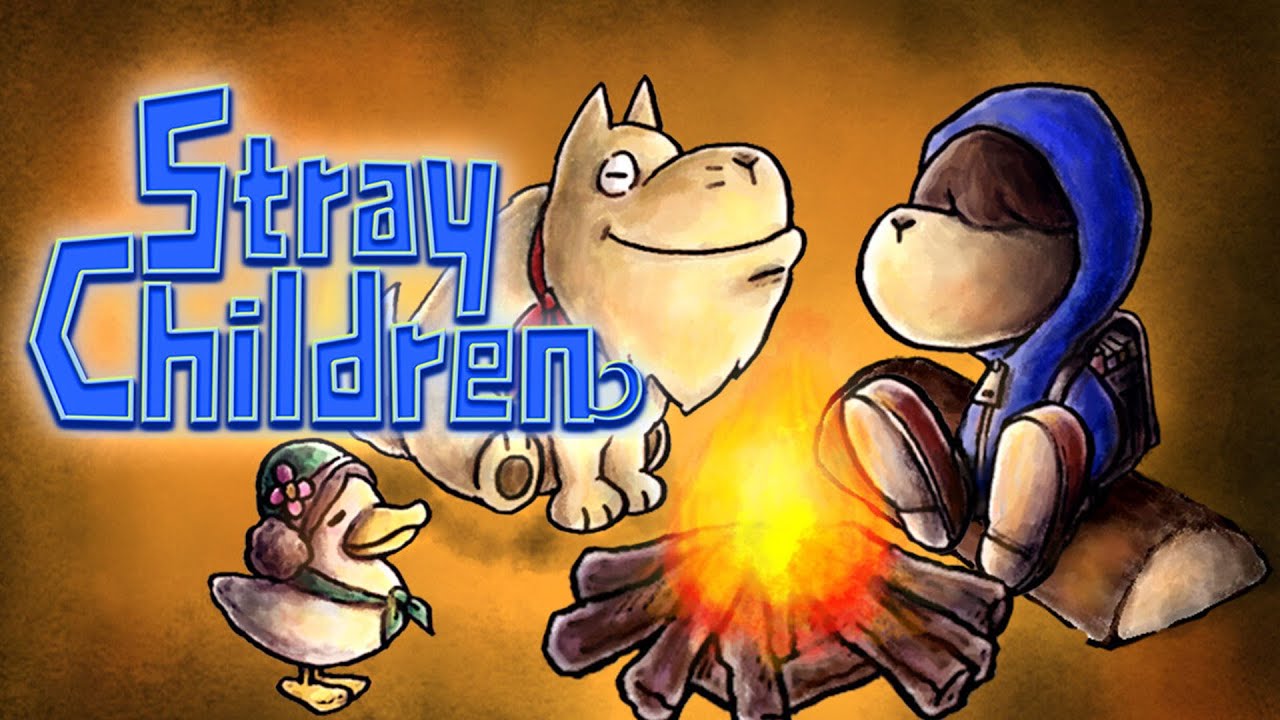
A copy of Stray Children was provided by Onion Games for review.
Stray Children is a brand new RPG by Onion Games, and in particular Yoshiro Kimura, best-known for titles like Little King’s Story, Black Bird, Chulip and (most relevant to Stray Children) Moon Remix RPG Adventure. Moon was released on the PlayStation and started the Lov-de-Like genre of video game, becoming a cult classic for its parody of the RPG conventions and going on to inspire the massive RPG sensation Undertale. Toby Fox cited Moon as one of the primary reasons that Undertale is the way it is, and Stray Children feels like a full circle moment. Just as Undertale was heavily inspired by Moon, Stray Children is very heavily inspired by Undertale, narratively and gameplay wise.
Stray Children is not a direct sequel to Moon but it absolutely positions itself as a successor in certain ways. The game’s entire opening and general premise is a parody of Moon. It follows the player character, known as the ‘Dog-Faced Child’ who while looking for his missing game developer father stumbles into the world of an unreleased, possibly cursed retro video game called Crescent Moon. As that game’s very data falls apart around the player, they fall from the sky and wake up in a world of monsters, one they have to explore, on the hunt for their father.
Words are Mighter than any Sword

Stray Children is a story about a child falling from the sky into a world of monsters, meeting many colourful characters along the way. Very Undertale-esque. And the similarities to Undertale don’t end here. When an enemy monster is encountered, the player has the option of fighting and killing it, like a traditional RPG. Combat is even handled using a time-based button press. But alternatively, players can use the TALK command to strike up a conversation with the monsters and pacify them that way.
Words can be more powerful than any weapon, and following a successful talking down of the Older, the general name given to all the monsters in this game, their heart feels lighter and their souls are released, offering some parting words to the player as they go. Obviously, for anyone who has played Undertale this implies the existence of a pacifist and genocide run of Stray Children and you would be right to think that. Stray Children takes its encounters quite seriously, almost as if every encounter is a boss fight of some kind. This is proven with the conclusion of any encounter, as once the player has either defeated or talked down an enemy it is gone for good. The Older is removed from the pool of random encounters until a new game is started. The only way to reinitiate a fight later is to run away the first time.
So it is very possible to save every Older, or kill every Older and the game keeps track of both of these options. Unlike Undertale though, doing either option doesn’t impact the story in any major way.
There aren’t multiple endings depending on if you save, kill or an inbetween of all monsters. Killing Olders provides more EXP to the player and is generally the easier option of the two, while the reward for sparing Olders is a deeper understanding of what the themes of this game are all about, and just a general feeling of satisfaction. The reason I am saying this all now is because for players going into this game, I want to be clear about expectations. I really enjoyed Stray Children and I believe that everyone should go into the game as blind as possible. Because of that I won’t be talking at all about the story and events that take place, they are best left to be discovered yourself.
However, the game is very frustrating at times for anyone who wants to go the pacifist route. It’s practically the complete opposite of Undertale, where the Genocide run was made purposefully obnoxious and monotonous to punish players who wanted to try it – Stray Children’s genocide run is remarkably easier, but less satisfying than its pacifist run, which can reach severe levels of complexity later on.
Life is One Big Puzzle

So why is the pacifist route so complicated? It’s because every encounter is essentially a riddle, one with an overabundance of options and some that require a lot, and I mean a lot, of forward planning.
To compare it back to Undertale, its Talk option often provides 1-3 options and the puzzle is figuring out which one to say to the enemy. Sometimes multiple options work, sometimes you need to say the same option multiple turns in a row, but the challenge comes more so from surviving the bullet-hell attacking phase and treating the talk option as your attack.
Stray Children also has the same bullet-hell attacking phase, which is unique to each encounter and has different difficulty levels, but the Talk option is less about one-liners and more about having a conversation with the enemy. You aren’t just flirting and patting a dog on the head here, you’re a psychiatrist and they are your patient and you need to say the right words in the right order to calm the Older down and hit upon the issue that they are each individually facing.
Each encounter comes with six options for conversation and often, each encounter will involve saying at least 3-5 topics to the enemy before they calm down. Figuring out what needs to be said is the riddle that makes up the most engaging parts of Stray Children’s gameplay, but also its most frustrating as what to say isn’t necessarily clear and in almost all cases, if the player picks the wrong option in a conversation it resets the entire chat. You might have picked the first two options correctly, but if you got the third one wrong that is all progress reset. Time to restart the conversation from the top!
This can make battles feel exceptionally repetitive, especially the Boss Older battles at the end of every area which also require unlocking conversation topics on top of having to pick the right options. And some of these Older encounters require the player to pick the same conversation topic over and over again, like some classic Japanese Adventure game, it can end up feeling very obtuse.
It’s not just trial and error though. These are riddles after all and a riddle wouldn’t be fun if there wasn’t some kind of clue to solve it. The player can find these clues in all sorts of places, but more often than not it can be found in one of three areas: the most common is in the Book, a bestiary that fills out when you find the shell of an Older in the overworld. Across the descriptions and images of each page can be hints to their riddles, as well as other hints like if an Older is hiding a hidden treasure chest in their encounter.
The second clue is in the encounter themselves. Sometimes an Older will say something that hints at what the player should do, and other times during one their attacks there can be a subtle visual hint on what the solution might be.
The final clue comes from objects and item descriptions that players can interact with in the overworld. This could be a sign-post, a piece of dialogue from an NPC or even an item description. Pretty much every Boss Older’s hint comes from an item you can find in the overworld.
There isn’t a single encounter or overworld puzzle in this game that doesn’t have a hint somewhere in the game. Except for maybe one, there was an encounter very late in the game that asked me to recite Pi to twelve places and because I’m a big old nerd I figured that out immediately. But it’s possible that there was a hint in the game that I just missed because I didn’t need to know it.
So a lot of Stray Children will be spent exploring, interacting with NPCs and objects and taking down notes on everything discovered, using it to defeat and solve the riddles of the Olders the player encounters. That’s where the fun and challenge comes from, with the frustration coming from some of the repetitiveness of these conversations when progress is reset because the wrong dialogue choice was chosen.
But if that’s all it was, I wouldn’t be thinking of Stray Children as a game for masochists. No. It’s the delivery of some of these hints, and the additional requirements of some of these encounters that pushes Stray Children into a one-of-kind strain on the psyche.

I already mentioned that some conversations just involve saying the same words over and over again until something new happens, but there are also conversations where the hints just do not help at all. Like this battle against a Phoenix Older, pictured above. What are these dialogue options? HIt doesn’t really relate to the hint I got in the book. Sometimes there’s a trick to the random options given, like the first letter of the correct dialogue spelling out a word. But not in this case. These are random bird noises.
Sometimes, the player will receive a hint on the solution to talk down an enemy, but said solution is found in random fluff text the player read at the start of the game, and this encounter is at the end of the game. Yes, Stray Children is the type of game to ask the player to have an item to hand that they picked up 13 hours ago in a random room to solve. You don’t have that item? Well to bad, no dialogue option is going to work for you now and saving the Older is going to be impossible.
Every boss encounter falls into this category by the way. If the player doesn’t have the boss’s associated item within their inventory, the boss won’t even have a conversation with the player. Most of the time, this item can be found shortly before the boss encounter but not always and this brings me to the final icing on this frustration cake – an aspect of the game I feel obligated to share as I wish I knew about it when I started. Stray Children is a game filled to the brim, with points of no-return.
No Turning Back

In many ways, Stray Children feels like the complete opposite of Moon, and this is one of the major differences. While Moon was an open-world game, letting the players explore and tackle the various monster riddles in any order – Stray Children is a linear game all the way to the end. Once you have left an area, most of the time you can never return to it. So if you didn’t save or defeat an older, didn’t fully find all the chests or solve the riddles, then tough stuff, you can’t go back.
This is how encounters where items are important become the most frustrating parts of the game, because you might not realise you lack an item needed to save an older, and that item was 10 hours ago, locked behind several points of no return. Sometimes, an item can be found hidden within another Older encounter as well. And all of this is absolutely by design. There is only one save file in Stray Children, that overwrites itself when you rest at a campfire, or sometimes automatically when you end a story act. The game is almost certainly designed around the player missing things on a first playthrough, emphasised by the fact the game doesn’t explain how any of this stuff works. There are no tutorials in Stray Children, it’s all just about the player figuring out what to do.
So in a sense, I am defying what the game wants in this review by explaining all of this. But I’m only doing this because of how much unneeded frustration I felt when playing parts of Stray Children, especially in its second half when the solutions to puzzles became more obtuse. I am the kind of gamer who aims to get every single confidant in a single run of Persona, and max out all support conversations I can in every run of a Fire Emblem. So being locked out of saving every Older on my first run brought me unneeded levels of anxiety.
But, and I say this all with hindsight, and aimed at players like me: Stray Children is designed around the player going through the game at least once completely blind. I played through Stray Children twice, achieving a 100% pacifist run on my second playthrough, which was a much less stressful experience now that I knew the solution to a lot of puzzles and I knew how this game ticked. On a second run, I was aware that I needed certain items for certain solutions, and which triggers would force me forward in the game. My obtained knowledge became useful to me, and New Game+ was much faster to playthrough because I knew the solution to a lot of puzzles already, which made all the encounters less stressful.
Why you Should Play Stray Children.

What message do I think you should all take away from this PSA of a review? You should absolutely play Stray Children and when you do, don’t worry yourself about going for 100%. Just take the game as it comes and move on if you can’t figure out a solution to a puzzle. I say this with all earnestness, because everything else within the game is an incredible experience. The vibes of Stray Children are peak Lov-de-Like. The visuals, the dialogue, the story, it’s some of the best I’ve experienced this year. The game is both wacky fun, mixed with poignant dialogue and messaging that tackle themes of adult hardships and growing up.
Serious issues such as the problems of crunch and overworking and the depths people will sink in order to find love are discussed alongside new contemporary problems like getting sucked into flame wars on social media or being obsessed with stocks and shares to the point of financially ruining yourself. The absolute breadth of everyday adult problems that Stray Children wants to tackle is seriously impressive, but it also touches upon the ideas of how adult problems can affect children and the importance of growing up healthy and proper to have a better life.
It’s the game that’s made me at times the most emotional, most uncomfortable, most engaged I’ve been with a narrative but also the most stressed out I’ve been, while still being unable to put the controller down.
Heck, I played the entire game twice through, because I was determined to see everything Stray Children had to offer and I still feel like I might have missed some things given I didn’t get every Steam Achievement. As an aside, I played this on both PC and the Steamdeck and it works really well on both. I’m sure it also works wonderfully on Nintendo Switch and Switch 2.
In the end, I still think I prefer Moon to Stray Children but the two are such different games in what they want to say and how they go about it that they aren’t really that comparable, despite the obvious homages the latter pays to the former. What I can say is that Onion Games have knocked it out of the park with this title and I encourage fans of Undertale or any Lov-de-Like to give it a go.
And if, if, you are a player like me who really needs to get that 100% in a single run and you don’t have the capacity to play the game multiple times. Well… I understand your plight and while I recommend going into this game blind and doing multiple runs (for reference my first playthrough took me about 24 hours but my second playthrough took less than half that time) in over a week from now I will be releasing my entire recorded 100% playthrough of that second run through the game over on our rarely used Source Gaming Archive channel If you really need a guide to help you through this game, that will serve as a reference although I did miss a single chest annoyingly, but I’ll point out where it is in the video description of the appropriate chapter).
Despite it all, I had a fantastic time with Stray Children and it is entirely down to the experience of playing this game. While I was frustrated and complaining a lot, I could not put the controller down. I just kept wanting to play more. It all comes down to the players mindset . If I had approached Stray Children on its own terms from the start, not trying to complete it all in a single sitting, then most of my frustration would have left me. Because, it was when I did come to terms and played by Stray Children’s own rules that it became a one-of-a-kind experience.
Stray Children: Stray Children takes Undertale's combat and amps it up to 11, really testing the players capacity to solve riddles to secure a perfect run. While the game’s linear structure, filled with points of no return, make a blind 100% run nearly impossible, this is the recommended route through the game for maximum enjoyment. By surrendering to its obtuse rules and leting go of a completionist mind-set, you're left with a poignant, visually amazing game that explores the hardships of modern life. It’s a stressful, gorgeous, and deeply uncomfortable masterpiece, that is nothing like anything else I played this year. – NantenJex