
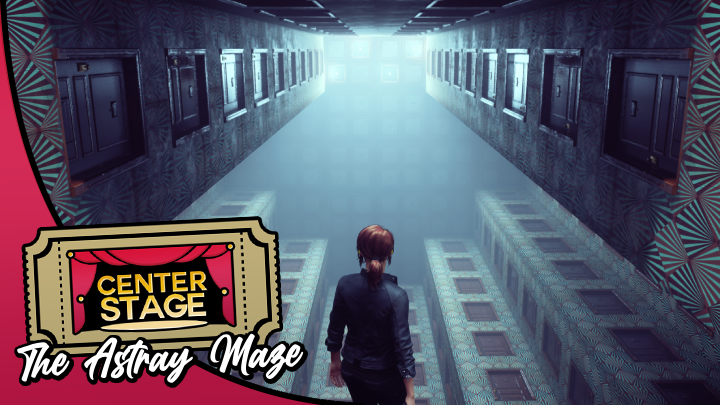
In “Center Stage,” Wolfman Jew discusses environments and level design across the games industry. They may be single levels, larger sandboxes, or broader settings. They may be as small as a room and as large as a world. Some may not even be good. But they are all interesting.
Spoilers for the plot and endgame of Control.
Jesse Faden approaches the Ashtray Maze. It’s all that stands between her and Dimensional Research, the most closed-off hole in the Bureau of Control. It’s also impenetrable, an utterly labyrinthine web of identical walls that open and close like magic. The hotel look is almost tailor made to put off a visitor, all red checkerboard carpeting, green wallpaper, and doors with shoes placed outside by nonexistent tenants. No one goes into the Ashtray Maze and makes it out. Even if you, the player, try to enter it normally, the maze simply sends you through a circle and dumps you right at the entrance. But the one thing Jesse needs is behind it. So she goes to Maintenance and tracks down the one person who can navigate the shifting walls, and though most of what Ahti the Janitor says is inscrutable, what he gives her is not. It’s a pair of headphones! Jesse returns to Central Research, puts them on, and right before the wall opens up to her right, strings are strummed, drums are pounded, and two words play in her ear:
“Take control.”
The song “Take Control” comes from the Finnish rock band Poets of the Fall. Performed under their alter ego the Old Gods of Asgard, it plays at the climax of the 2019 game Control. Poets are tight with Remedy Entertainment, the game’s studio. The Old Gods first showed up in Alan Wake as a pair of elderly brothers; they were in-person NPCs whose family barn was the setting of the game’s best sequence. In Episode 4, Alan Wake battled shadowy monsters on a stage while “Children of the Elder God,” a song they composed for the game, blasted heavy metal flare. It was a wildly memorable moment of a game that often strained for memorable moments. “Take Control” has the same role here, and for the five to ten minutes it takes Jesse to walk through the Ashtray Maze, it blares. It only stops when you reach the end.

Image: Source Gaming. Given Remedy’s history making third-person shooters, it’s no surprise Control feels great to play.
As the song plays, Jesse fights her way through rooms that shift so wildly as to beguile the mind, yet so smoothly as to appear the most natural thing in the world. Hallways open and close with an intriguing pattern. Walls turn into floors, while floors sink or rise. She telekinetically throws lamps and chairs at the Hiss, soldiers and bureaucrats who’ve been corrupted by an alien force. She shoots them with the Service Weapon, a shapeshifting, jittery gun. And throughout all of this, she’s also running through and flying over this collection of hallways, whose colors and patterns feel almost fluid. The Ashtray Maze, visually inspired by the ugly hotel from the Coen Bros.’ Barton Fink, turns staples of dullness, of stylistic banality into a gorgeous Escherian nightmare.
Remedy likes the Poets, but not as much as it does blunt titles. Its two big properties before this were simply named after their leading men, men with big names like Alan Wake and Max Payne. Control is perhaps the most fitting title of all. It’s a game about, at all levels, control. As a shooter, it makes you wrangle, explore, and master psychic powers. In its environments, it depicts an unstable institution at war with itself. Virtually every part of its broader story is about power—and, crucially, the ways in which power can and can’t be wielded. The plot is about a woman who goes from being a drifter and conspiracy theorist into the leader of the largest conspiracy of all. And fittingly, that conspiracy, where the game is set, is even named the Federal Bureau of Control.
In that projection of reality
Something passes through the stars, shifting walls
Enter agents of ill fantasy
For evil holds you in its arms, false alarms
Taking inspiration from David Lynch, The X-Files, creepypasta, and the SCP Foundation, this clandestine organization is the embodiment of every government conspiracy. It lies, it covers up, it disseminates propaganda and misinformation. It’s all in the pursuit of “Objects of Power,” staples of 1960s Americana that carry Eldritch and lethal powers. A floppy disk that imparts telekinetic powers, an X-ray machine that controls people’s minds. The Bureau’s self-appointed task is to find these objects, steal them away, and figure out what makes them tick. To take control of them. Their methods are often blunt, sometimes horrific, and always limited. And yet, even these devices are small potatoes compared to their headquarters. The Oldest House is a tower in Manhattan that shapeshifts, can only be seen if you’re looking for it, and has no discernable date of construction. It’s a being of living concrete that may be as old as humanity itself and suffers pains and aches and sickness. The Hiss, a strange fungus, and all of these magical tchotchkes are running rampant in its body. And this… this maze is there, too, pulsing and shifting like a wriggly parasite.

Image: Source Gaming. The first room of the Ashtray Maze, before the song starts up. It’s hard to capture the way this level moves in a still image; this was about the clearest and most parsable screenshot I got.
There’s no other place like the Ashtray Maze in the game. Control deals in big, loud colors. Deep grays of stone and concrete, blinding whites across cavernous black backgrounds, towering green gardens, and red. Lots and lots of red. Compared to the bloodstains and crimson lights, the carpeting is subtle. The green wallpaper is almost hypnotic if you stare too long. My headcanon is that the Objects of Power that have summoned the maze are weaponizing the look of every joyless, ugly, uncomfortable hotel in America. That’s how they trap people forever in its walls.
The longest and funniest running gag in Control is the sheer absurdity of the Bureau’s very existence. Throughout the game, you compile a plethora of writings, audio diaries, and live action footage by doctors and officers. They research the Objects of Power, the building, and the invasive horrors that you spend your time fighting. Most of these documents cover experiments, rigorous tests of light and sound and taste and time, and it’s… ridiculous! Scientific rigor for that which is by definition unquantifiable, something that’s never more clear than with the Oldest House itself. This building has a will of its own, constantly shifting and occasionally killing its own residents because they can only partially predict how it will move. One log comes from a scientist who becomes entranced by the furnace, implying that she tried to throw herself or her coworkers into it. Other times, you find horrifying puppet shows meant as safety PSAs for child visitors and prisoners. Here, to “take control” is a joke; you cannot tame this space and at best can tame these items for a time. The Bureau’s job and name are beyond audacious. The amorality of its behavior can barely be justified when its staff have no idea how anything works. Ironically, the Ashtray Maze is one of the few things they do get. The former director turned it on to block access to the sector on the other side, and it worked as intended. Even the new director, with the fate of the agency up in the air, isn’t exempt. The thing they actually figured out is working against them.
Hissing noises in the hallway
Bloodshot eyes, staring through, what seeds are sown?
Who’ll survive the blood red power play?
Who’ll take control, whose name will be known?
The methods for beating Control are far less ambiguous. The gameplay hook is that alongside some rather excellent gunplay, you use various psychic powers. You can levitate, mind control enemies, pick up objects to throw at enemies, pick up enemies to throw at enemies… As an action game, it’s incredibly toyetic, letting you rip apart walls, flooring, and furniture with telekinetic abandon. It’s also hard, like really hard at times. The game only has one difficulty setting (though there is a fairly robust Assist Mode), enemies scale up as the adventure goes on, and you lose some of your currency whenever you die. “Take control” here is a call to arms. This game demands you take charge and dominate each area, and then it demands it again and again. At its best, it leads to an unbelievable level of dynamism and energy.

Image: Source Gaming. Jesse’s main thing throughout the game is to chuck stuff at bad guys. Lamps, chairs, pieces of rock she pulls off the walls. It leads the game to be incredibly fun—and experience quite a bit of slowdown at times.
From a combat perspective, the walk to Dimensional Research features no changes to this. The Hiss flank you, and you respond with furniture, floor tiling, and the bullets of Jesse’s Service Weapon. There are no new bosses or enemies. Instead, the sequence leans on level design, as the movement of the floors and walls is unmatched in its size, scale, or frequency. A shifting room is a common sight in Control, but typically during cutscenes. Here, it’s everywhere. Some enemies will appear from a self-deleting obstruction, while others show up only to be swallowed by a wall before you can exchange fire. But because the level design is so clear, and because you’re always pushed to go forward, navigation isn’t an issue. You feel… almost in command, even though you’re basically on a cinematic roller coaster.
And the story is, again, about control. It’s about a woman who’s spent her life on the run from the greatest conspiracy on the planet, only to walk through their front doors, pick up a gun that may be Excalibur or Mjölnir, and find herself elected to be the cabal’s next Director. No one questions her position; even the building magicks up portraits and photographs of her to decorate the halls. Throughout the story, Jesse’s job is to be both the chosen one and the fish out of water, always near information overload from coworkers who’ve all accepted her leadership. She uncovers the secrets and abuses of her childhood and interacts with the Oldest House in ways the rest of the Bureau can’t. In this context, “take control” is a bit muddled. Control is given to Jesse at the start, but from that point on it’s held by her, with the implication that it’ll last until her death. She takes control of that which has always haunted her.
A rising sense of awe and wonder
A might I see has always been deep within me
I can feel my inborn power
I call the shots when it’s all finally clear to see
So after several hours of deaths, skill trees, and listening to obstinate scientists and security guards, you’re ready to really unleash hell. To control the battlefield like never before. But what really sells it isn’t just the cool imagery. It’s that song. Because for a few minutes, Control becomes one of the coolest music videos ever put into a game. Forget rhythm games or bonus content, this is the good stuff. The dreamlike level design, the shifting walls and floors, the way those patterns seem to span the length of the world; everything seems to almost swim around Jesse and the song. Even the movement of the level changes seem in lockstep to the beats and lines, an impressive technical achievement that’s easy to consciously miss. You may die, as I did a couple times, but an in-game death seems to swim, too. It all leads to a sequence that is as mesmerizing as it is exhilarating. These screenshots, cool as they are, can’t hold a candle to how it looks in motion.

Image: Source Gaming. All of the screenshots in this article were taken in Photo Mode. I lost most of my pictures, and the ones I didn’t were pulled early as candidates for the header image (it’s better to not show the UI there). It hardly matters. The game looks incredible, and these perfectly capture the feeling and energy of the level.
The Ashtray Maze is, shockingly, not the final level of Control. There’s some more stuff, including a wild dreamlike sequence and a few final battles. These things are good, they do their job, but they don’t hold a candle to this one section. The only one that comes close is another endgame musical number that needs to be seen to be believed. I first played Control when it came out in 2019, and those two songs were the moments I remember the clearest. The rest of the finale largely slipped from my mind, and it was one of my favorite games from that year. Even after this playthrough, they’ll probably remain the moments I remember best, even more than the fun Alan Wake crossover DLC or the craziest boss fights or the way concrete and stone lovingly crumble whenever you pull something out of the ground. It’s not just the music, but it’s the music. Remedy gets the way songs get in your head, the power they hold, and they, you know, take control of that. But just as this wasn’t their first interactive music video, it wouldn’t be the last. In 2023, they’d challenge themselves with a sequence that went far crazier. And that’s what we’ll be discussing next time on “Center Stage” as we dive into the most famous moment of Alan Wake 2.

- Indie World March 3, 2026: Information and Reactions - March 3, 2026
- On Phil - February 26, 2026
- Escape from Ever After | Review - February 17, 2026