
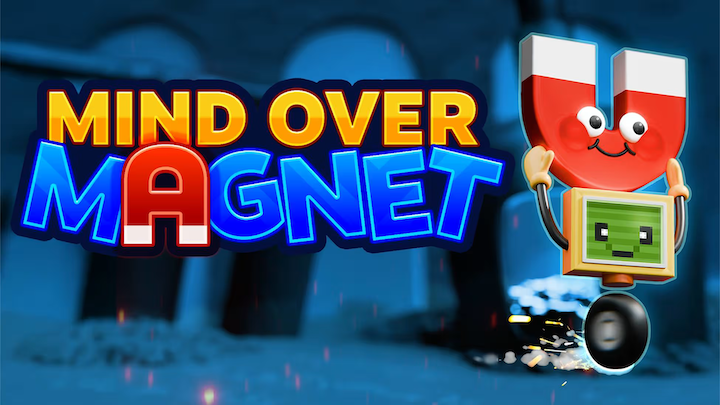
EDIT: 11:02 AM Eastern, August 25: added a new, more visually satisfying header, as well as a review score. September 4 This review was updated to meet the new review guidelines of Source Gaming.
This copy of Mind over Magnet was provided by Alchemy Games.
There were several times in Mind Over Magnet where I would put down my controller and simply stare at the screen. My character, the cute one-wheeled monitor Uni, couldn’t reach what they needed to. I had already tried what felt like everything to get them past a deadly laser, a bottomless pit, or a humongous block. No dice. So I’d relax for just a moment and take it all in. I’d think about the interesting layout of the room, which switches were there and which magnetic poles they activated. What you could turn on or off, and in what order. How your magnet sidekick could be used. Invariably, the lightbulb would flash, I’d try out my theory, and within no time at all I’d find myself up a pipe and off to the next level. Mind Over Magnet, which released in November of 2024 on Steam but was ported to Switch this August, chases the pleasure of sudden realizations with an almost religious fervor. Virtually no space exists that isn’t given to some wild puzzle, and virtually no puzzle lacks a twist tailor-made for such a moment.

Image: Source Gaming. Often, puzzle rooms have a pretty simple pitch. Here, you’ve got to get to the end, but the there’s a broken bridge, impassible doors, and fixing one ruins the other.
The mechanical theme of this puzzle platformer is more obvious; it’s right there in the name. This is a game about magnetism. Almost every level, mostly bespoke one-screen puzzle rooms, features a magnetic field in some way. The puzzles also incorporate deadly laser beams, magnetized metal blocks, drill bits, and crunchy On / Off switches, but at some point, something’s gonna be attracted (not repelled, though, as gravity is your sole opposing force here). Most often, it’ll be one of Uni’s magnet friends, these gigantic, googly-eyed horseshoes that slam into their attractors like a meteor. Together, the four methodically poke at each level as they attempt to flee a factory filled with danger, traps, and a leadership eager to pit its labor against each other. Magnets of the world, unite. You have nothing to lose but your polarity.
The best and most important part of this game are the puzzles themselves. Across five worlds, you’ll come across a bevy of challenges that juggle spatial reasoning, light physics, and multi-stop plotting. They’re almost uniformly excellent. The logic behind them is sound, and it mostly doesn’t depend on timing or dexterity. It is pretty easy to screw yourself over, but resetting the room takes no time. One solution I found to an end game level felt “incorrect,” or at least unintended, but what I came up with felt so great that I didn’t care. Consider that more of a “me” problem than a knock on the game’s readability, which is clear and generally excellent. Every room lacks a single extraneous part, and that’s true of the game as a whole. The only times you’re not solving immaculate puzzles are a few token moments that set the pace. This is all killer, no filler.

Image: Source Gaming. It takes little time for levels to begin mixing in tons of different mechanics. Despite that, they never feel cluttered or incoherent.
Maybe it’s the variety that really gets me. Throughout a runtime of just a few hours, you’ll see constant mechanics and new ways for them to interact. A flipping switch, a deadly laser, or a button that only operates when weighed down seem to have constant uses. You even get new magnet powers, leading to corridors where you’re toggling positive and negative charges. There’s a depth and breadth that’s delightful for the duration of the adventure.
It is not, to be clear, the world’s most sumptuous game. The graphics are jagged pixel art, lacking smoothness or softness to surfaces. The throwing mechanic feels somewhat inelegant. The plot is… well, it’s almost brutalist, focused on function over all else (which is probably the right call but isn’t going to blow you away). It’s also very short, with dozens of individual levels but clocking in at around three or four hours. And though I don’t consider this a problem, there really is nothing but the puzzles themselves, ones which can begin to bleed together if you mainline the game. Its quality may well convert someone who isn’t a puzzle fan, but it’s interested in only doing one thing and doing it well. The word “modest” comes to mind.
In keeping with this triumph of modest charms, Mind Over Magnet is full of fun aesthetic touches. Its graphics may be simple, but its color schemes are satisfying. There are a number of little animations, like how Uni and the magnets respond to running into a giant metal block. Best of all is the sound. The excellent score crafts a sense of mystery, confinement, industry, but also bounciness. And the sound effects are surprisingly big, like the pop of a cork that brings you to a new level or the whirring screech of a drill bit. The game even throws out random screws just so you can make noise as you wheel over them. It’s actually rather surprising for a game to up the default volume on its SFX this much, and it gives the game a great sense of place. A different sort of audio feature is the optional Developer’s Commentary, in which designer Mark Brown…

Image: Source Gaming. You’ll often come across these gigantic magnets. They, like everything tied to the magnet gimmick, have wonderful sound effects. Rarely has anything sounded as “magnetic” in a game as it does in this.
Okay, so there is no real example of a sincerely unbiased review, nor should you yearn to read one, but I should be upfront. Mind Over Magnet is the passion project of Brown (who, by his own admission, was not involved in the development of this port; that would be Alchemy Games), the video essayist behind Game Maker’s Toolkit. GMTK is the channel that made me want to become a games critic. The first few years of my time with Source Gaming could be charitably described as “inspired” by Brown’s material, perhaps more accurately as aping it. Developing, his series chronicling this game’s protracted development, has led me to fitfully dabble in Unity. When I started this article by talking about the emotions of solving a puzzle, I did so knowing Brown’s years of fixation on giving players “those all-important a-ha moments.” Writing this review, getting a full press code to do so, felt special in a way that’s hard to articulate. This isn’t something I’d want to dominate this review, but it needs to be acknowledged.
Also demanding acknowledgement is the fact that this review only exists because of that connection. While a very satisfying game with a disarmingly high standard of puzzle quality, Mind Over Magnet just wouldn’t get nearly as much attention had it not come from one of the most respected personalities in gaming culture. It is good to review smaller, more humble games, but calling this one “small” would be disingenuous when its creator has a million subscribers and a history of record-breaking Game Jams. I mean, there’s a switch to speed up the credits just to account for his huge number of Patreon backers. This is a legitimate creative exercise and not some unscrupulous vanity project—the Developing series was worth the investment even if the game itself had been a turkey—but there is privilege here.

Image: Source Gaming. Although the aiming itself is a bit clunky, the mechanics are very satisfying, and the pacing weaves them in well.
Before starting this thing up, I was unsure of how I’d find it. The premise is sound, and in general, I’m a fan of puzzle games, but it’d be impossible to decouple the game as its own thing with the legacy of its creator, especially when that legacy has impacted me personally. It simply can’t hold up to a decade of influence and years of documentation. Fortunately, it doesn’t need to, as Mind Over Magnet is ultimately a good time and a satisfying take on the puzzle platformer genre. Its obsession over those crazy mechanics, shocking twists, and sudden realizations has led to a puzzler with a shockingly high level of both quality and consistency. A lot of my time was spent staring, but a lot more was spent grinning.
Final Score: 7 / 10
Thank you to PhantomZ2 for edits.

- Indie World March 3, 2026: Information and Reactions - March 3, 2026
- On Phil - February 26, 2026
- Escape from Ever After | Review - February 17, 2026