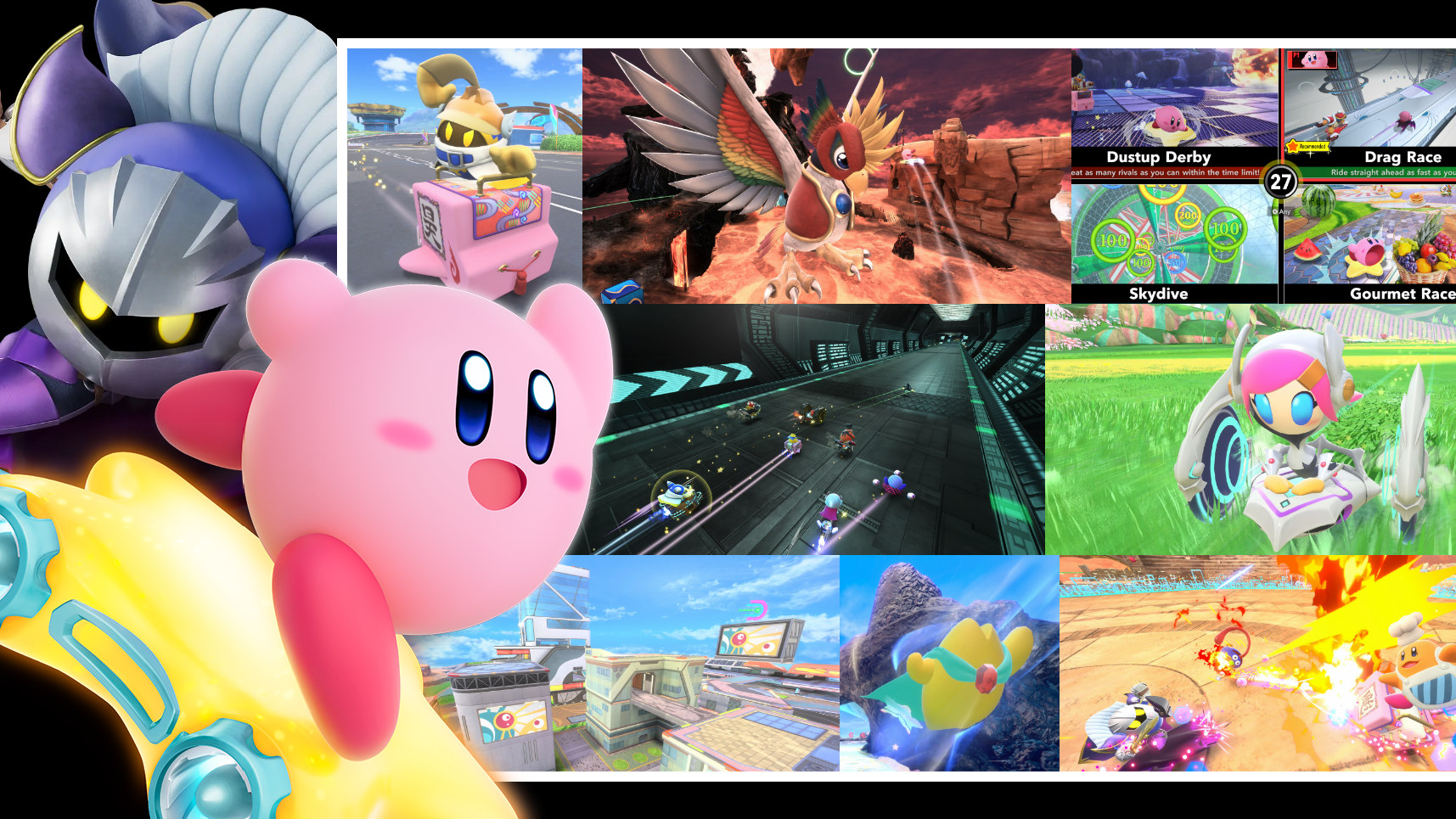
Kirby Air Riders may have a bit of a tough row to hoe. It’s Nintendo’s second major racing game of 2025, meaning it has to distinguish itself against the best-selling Mario Kart World. With twenty years between it and 2003’s cult classic Kirby Air Ride, it also has to sell itself as a remake, reboot, and faithful sequel. And there’s one other element of note, that it’s the latest project of Masahiro Sakurai, the Kirby and Super Smash Bros. creator who directed the original Air Ride. It’s actually patient zero for a lot of stylistic and mechanical elements of all his games since.
In his first public appearance since finishing his YouTube series, Sakurai came back to the limelight for a presentation on Riders. There’s a bit of familiarity to the process; he’s following the format he established for the various Smash Bros. Directs, with the last game he made before leaving Nintendo. Sakurai always gives good copy, and with forty-eight minutes on the clock—it was the longest Nintendo Direct of the year bar the Switch 2 Presentation—he dished on the game.
As a note, many of the features in Air Riders were also present in the original Air Ride. I’ve made a note of some of them.

Image: Nintendo. The very fun evolution of the Smash menu.
Basics, Controls, and Mechanics:
- Release date: November 20, putting it one day off from Nintendo’s history of games released on November 21.
- Riders, like the original Air Ride, is a racing game—albeit a combat and action-focused one. You pick a Rider (NOT “driver,” apparently) and an Air Ride Machine for them to drive; each has different forms, stats, and abilities.
- The game’s combat focus comes from the feature that attacking, whether it’s a rival or an enemy on the track, gives you a speed boost. Offense is tied to speed and attacks aren’t that strong on their own, so you want to hit the other Riders not to take them out but to get a boost.
- For instance, every defeated enemy gives you small stars that let you shoot forward slightly. Essentially, the optimal strategy is to attack as many enemies as possible.
- Air Ride’s main gimmick, that everything was controlled with one button, has mostly been retained with the B button. You primarily use it to Boost Charge and inhale enemies.
- Boost Charge: the game’s take on drifting; you slow down to a near stop while charging and turning. Turn the stick and hold the button as you get close to a curve, and you’ll put yourself in a position to blast forward. Courses are often built around ridiculously tight corners, making the game a practice in constantly boosting.
- This also means that you don’t press anything to hit the gas.
- As in Air Ride and the entire Kirby series, inhaling certain enemies gives you their powers. These can be useful for speed or offense. If the enemy doesn’t confer a power, you just shoot them forward as a single attack. In all cases, hitting an enemy gives you a small speed increase.
- Copy Abilities: Fire, Sword, Bomb, Wheel, Mike, Cutter, Jet, Steel Ball, Plasma (which no longer needs you to repeatedly tap the stick, thank God). Jet and Cutter are new to Riders specifically, while Steel Ball is fully original.
- However, in the interest of expanding the game’s depth, Riders has “unfortunately” (his words) also brought in the Y button. When a gauge under your speed has maxed out, you can unleash a Special, sort of a super move that’s unique to every Rider and may be an attack, a boost, or something else.
- Many of the cars can glide or even actively fly. There aren’t specific flying areas like in Mario Kart, but you can tilt the stick down to hold upward or up to begin a descent. This “works” on the ground, but you’ll just knock yourself into the ground.
- You’ll get an extra boost if you land parallel to the ground.
- Riders leave behind a trail of barely perceptible stars. Grabbing these gives you another boost in the form of a Star Slide, allowing those in the back to catch up (at which point they will themselves drop stars and continue the process) in a process similar to the slipstreaming of other racing games.
- Quick Spin is a weak attack if you don’t have any powers. It can be used to break boxes in City Trial, and in the original game, it was used to discard unwanted Copy Abilities.
- Unlike Mario Kart’s absolute lack of any standard manual, Riders thankfully includes a number of tutorials, called Lessons.

Image: Nintendo. Chef Kawasaki! My man!
While Air Ride let you play as non-Kirby racers, Meta Knight and King Dedede were functionally gimmick characters restricted to one power and one vehicle. Riders has been built around a larger and more varied cast, hence the name change. Here are details on the characters, roster, and mechanics to accommodate them:
- Characters, all of whom were introduced with a Smash Bros.-esque “___ is here!” title card and have some unique feature, move, or Special:
- Kirby, naturally, as the balanced and average main character. There are four versions—pink, red, yellow, and bloow—each with a unique Special (themed around, from left to right, his Ultra Sword, Burn, Crash, and Ice Abilities).
- King Dedede, Meta Knight, and Bandana Waddle Dee, the standard bearers for modern Kirby multiplayer. They keep their standard weapons: respectively, a hammer, sword, and spear. Like other characters on the roster, they’ll hit enemies automatically.
- Chef Kawasaki, who fights with a ladle and gains more health from food pickups.
- Cappy, whose cap is actually a limited shield that’s likely to get destroyed by the end of the race.
- Magolor from Kirby’s Return to Dream Land. He excels at using Star Slides and perfect landings.
- Gooey from Kirby’s Dream Land 2. He uses his notoriously long tongue as an attack.
- Waddle Doo, who uses his classic eye beam.
- Knuckle Joe, who naturally uses super-fast punches.
- Susie from Kirby: Planet Robobot. She has a propeller for flight.
- Starman, the obscure Kirby’s Adventure enemy who was added, from how it sounds, both to put more aerial characters in and out of Sakurai’s fondness for the character.
- Because the first game was based around identical Kirbies of different colors, there wasn’t a real balancing issue. Focusing on the broader Kirby cast threatened to give Kirby an overwhelming advantage because of his ability to change powers on the fly. Therefore, the game has decided to give everyone the Copy Ability. Instead of inhaling foes, they Capture enemies, sometimes with unique animations
- Naturally, everyone has a Kirby Hat, some of which seem to be unique to that character.
- One little detail is that some characters may appear as wandering enemies when they aren’t officially in the race.
- Counting every Kirby as a separate character (which you probably shouldn’t do since those are accessed from Kirby’s place on the character selection screen?), there are fifteen confirmed characters. I’m assuming there are more, as the game would probably want at least the bare minimum for City Trial.

Image: Nintendo. Look at this stupid goddamn thing. It’s hilarious. It’s brilliant. I’m excited to find the even crazier-looking Machines.
The Machines have a number of important features, but probably the most is that they have aggressively divergent traits, making them more like fighting game characters than traditional racing cars. Here’s the skinny on them:
- The main stats: Top Speed, Boost, Charge, Turn, Grip, Lift, Flight Speed, Attack, Max HP, and Weight.
- Typically, stats contrast each other; Machines that are great in the air tend to be frail, for instance.
- They can also be damaged during the race. This is dependent on which mode, but one twist is that half-damaged machines get a speed boost, again pushing you to be more aggressive and not distance yourself from other Riders.
- Currently announced ones. Note that several come from the original Air Ride:
- Warp Star: the standard, no frills device
- Winged Star: slow on the ground and gliding-focused
- Wagon Star: has high stats but no boost
- Wheelie Bike: essentially the bike equivalent that doesn’t seem capable of flight
- Shadow Star: very powerful and strong in the air
- Paper Star: extremely weak, but extremely fast and good in the air
- Bulk Star: very physically tough, and instead of the Boost being a one time propulsion, you actually use the charge as fuel over a longer time
- Swerve Star: cannot boost or change direction, so you Boost Charge only to change direction
- Chariot: uses two giant wheels for stability, good handling, and easy turning
- Tank Star: when you Boost, it doesn’t actually change direction. It keeps going straight and only changes course when you’re facing where you want to go.
- Turbo Star: very fast but sucks at steering.
- Slick Star: “offers a wholly unique approach” by being slippery and hard to control.
- Rocket Star: all about the Boost Charge, which is significantly more powerful than those of the other rides.
- Rex Wheelie: seems similar to the heavyweight class of Mario Kart: it’s got a high top speed but has to maintain that.
- Battle Chariot: a heavyweight.
- This means that Machines can synergize—or not—with the traits and stats of individual racers. They’ll also change size for their Rider, like in Mario Kart.
- Air Ride originally had two categories of Machine: star-type and bike-type. This has a few new standards, such as the two-wheeled chariot.

Image: Nintendo. Sakurai noted during the show that ocean courses in racing games tend to revolve around a same few ideas. This is, uh, not that.
The default, more standard mode is Air Ride. You do one lap, or several, around a sumptuous course:
- In an attempt to stave off the chaos of large races in other games, only six riders participate at once.
- In this mode, it’s either impossible or unlikely for a machine to be destroyed, though you can change the ruleset to make that a possibility.
- Like in Super Smash Bros. Ultimate, you pick the course before the characters. Also like Smash, it’s got a plethora of toggles for things like the number of laps, rules, and whether you want to play at a slower pace. The latter was meant partially for newcomers and partially to account for this game’s speed being a “little” higher than the first game.
- Courses:
- Waveflow Waters, a break from ocean racecourse conventions with a parted sea, antigravity water roads, and generally bonkers water imagery.
- Floria Fields, the standard “starting grass level” covered in towering fields and the shadow of a translucent butterfly.
- Cavernous Corners, a massive cave network underneath a jungle. Dangers include waterfalls and spiky gem walls.
- Cyberion Highway, an unstable and frenetic “digital world” level with lasers and pulsing neon.
- Mount Amberfalls, in which you drive between a snow-capped peak and a beach at sunset.
- Steamgust Forge
- “Random.” It’s important!

Image: Nintendo. I like Kracko reasonably well. I’ve found a lot of his fights obnoxious, but he just looks so cool.
The feature getting the most attention was City Trial, the most famous and popular element to the original Air Ride. It’s back, naturally, and Sakurai both went into detail and played a full game.
- The format is this: for five minutes, everyone explores a gigantic sandbox—in this game, the floating island Skyah—looking to snag healing items, new machines, and, most important of all, power-ups for your individual stats. After the five minutes are up, everyone competes in a Stadium’s match with souped-up cars.
- Unlike Air Ride, and unlike Air Ride’s City Trial, up to sixteen players can compete online (eight can play through local wireless). To account for this, the map is larger.
- That being said, Sakurai also didn’t want a mode where you get essentially random powers and conditions and have next to no chance of winning, which is why the player count is tiny by battle royale standards.
- Skyah is filled with distinct sub-locations, such as fields and a forest, a large city, caves beneath the buildings, an arena, a mysterious second island above, and a dragon-shaped volcano whose contents Sakurai conspicuously chose to hide.
- The power-ups are gigantic 2D logos scattered across the map. Some are on their own, some can be knocked out of a rival, some are in boxes,
- Sakurai dismissed the strategy of trying to get just any boosts, as it’s apparently better to emphasize what stuff synergizes with your current or preferred vehicle, what match you think will be coming, and the fact that power-ups might have trade-offs.
- Some other items are strewn about. For instance, you can find an item that lets you throw a gigantic version of Kirby’s invincible spiky enemy Gordo wherever you want. Some have multiple uses, and you can keep one in reserve.
- As in Air Ride (and City Trial’s first follow-up, the Smash for 3DS mode Smash Run), strange and unexpected events will appear as the seconds go down. These include:
- Secret Rooms with otherwise inaccessible power-ups opening.
- Short Race, an impromptu race within the sandbox that showers Riders in bonuses based on their performance. You can choose to ignore it, but if you wait for the match to start in the designated area, you’ll get a drip feed of power-ups.
- Dustup Derby, a battle arena that works the same way. If you get knocked out, your Machine will still be safe afterwards.
- Boss fights against Kracko and Dyna Blade, the latter of whom was the only boss in Air Ride.
- Gigantic meteors.
- Huge pillars you attack to release power-ups.
- Power-ups and other items becoming gigantic.
- Gigantic portals that send you to caches of power-ups.
- A boost to everyone’s flying ability.
- A rainstorm of giant Gordos.
- While you select a Rider, everyone starts with the Compact Star, a cute lil’ thing with great handling that’s otherwise painfully outclassed. Often, the best goal is to snag an Empty Machine on the road as soon as possible (using Y, continuing Sakurai’s interest in cutting down buttons as much as possible).
- You can also just ram into an opponent’s nearly broken car and take it. It seems as though that heals the machine.
- If your vehicle is about to break, you’ll just automatically jump into the car.
- There may be points where your Machine breaks, or times where you want to abandon yours. In those cases, you can freely run, but you can’t collect power-ups and ideally should try to find the closest vehicle.
- If you’re not in a vehicle when the time runs out, you get stuck with a Compact Star for the finale.
- Once the five minutes are over and you get to see your improved stats, you go to the Stadium—or rather, you pick the Stadium from a small, randomized selection. Everyone casts an invisible vote for the one they’d prefer. To help, the game actually gives you a “recommended” notice for ones it thinks would do best with your loadout (though you might prefer a more surreptitious tactic, like picking ones your biggest rival would want).
- However, this can muddle the “clarity” of who won, because sometimes players will be sorted into the stadiums they chose. In practice, you may be competing against only three or four opponents, or even none if no one else chose your room. Of course, you can simply just jump into a new City Trial; apparently the process is easy.
- Sometimes, you don’t get to choose. When that’s the case, you may get an alert about what’s coming up to direct your goals. You can also find the Prediction Codex item, but it may also give you explicitly false information, so pay attention to the advice.
- “Some” of the Stadiums:
- Kirby Melee, a race to beat the most foes.
- Air Glider, in which you fly as far as you can.
- Drag Race, a no frills race in a straight line.
- Target Flight, where you try to fly into the highest-scoring square on a scoreboard two times.
- Dustup Derby.
- Skydive, a mini-game bout trying to hit the most points as you fall onto a board.
- Gourmet Race, a collection of food items
- Just like Air Ride, there’s a plethora of modes and options.
- Sakurai insists that it’s also fun to play solo. Given the original game’s version and what’s on display here, that’s more than easy to imagine, but I also suspect he wanted to prioritize that.

Image: Nintendo. Air Ride was interesting graphically because it was very imaginative and at times gorgeous, but also compromised at lot by the limitations of the GameCube or the racing format or the mode. This is just stunning, though.
Other:
- The developer is the Bandai Namco studio that worked with Sakurai since Super Smash Bros. for Nintendo 3DS, not Kirby owner HAL Laboratory.
- Unsurprisingly, the game is absolutely full of the UI and interface touches that go into the modern Smash Bros. games.
- Riders features a vocal main theme, “Starlit Journey,” that was performed in English and Japanese. In a first for the app, Nintendo Music (which has never before released music from an upcoming game, or from anything released after 2023) uploaded it and five other songs to promote the game.
- Sakurai also went somewhat into the origins of this game. During his time working on the DLC for Super Smash Bros. Ultimate, he was asked by Nintendo executive Shinya Takahasi and former HAL Laboratory President Satoshi Mitsuhara to develop a Kirby Air Ride follow-up. Sakurai wrote up a proposal around the time he was beginning to develop his YouTube channel.
- During the presentation and, apparently, during the initial pitch, Sakurai pointed out an issue of a Nintendo mascot racer potentially feeling redundant with Mario Kart headlining the Switch 2.
- The Direct ended with an inscrutable final teaser, of a shady-looking biker driving in what looks like the wasteland from various Super Smash Bros. trailers. It is fully, entirely unclear whether they’re meant to be an all-new character, a tease for a story mode, a tease for some other kind of mode, or whatever else.
The Direct:
Wolfman’s Soapbox: Man, man, Sakurai can still bring it. In a year of strange Nintendo advertising, this is pretty strange, but it’s also just easy to grok. Sakurai’s long been known as a great pitchman, a reimagining of Kirby Air Ride is potentially wonderful, but what really made it work were two things: personality and details.
“Personality” is easy. We’ve got a director with a long public presence, talking about his thoughts and opinions alongside the actual features. Why does City Trial have 16-player gameplay and not 4 or 8 or 32? Well, because it wasn’t fitting with the tone and feeling he was specifically trying to set. Why is Starman here? Well, we needed more air guys, and also Starman is cute and a fun deep cut. Sakurai has understood for a long time the commercial power of having a public face, and he’s really good at his brand of high level trickery, casual fun, and an abundance of schmutz. He helps sell this as not just a reboot of a fun cult classic but something that’s personal and specific and not just done for its own sake. That means a lot, and it’s something that Nintendo is fitfully good at.
Of course, a lot of those fit in the “details” section, too. We got an absolute ton of information, on a game I wasn’t sure was necessarily gonna warrant it. I mean, I like Air Ride, I love Sakurai’s work in general, but the granularity helped everything feel crystal clear. There were deliberate spots of ambiguity, but we have a great idea of what’s been retained, what’s been removed or tweaked, and what’s new—at least, beyond the really big things that they’re keeping from us. I feel like I get it in a very clear way, in a way that the Mario Kart Direct didn’t really.
This has been a weird year for Nintendo advertising, and this is both part of that and something more familiar, more comforting. I liked it a lot. I’m so happy seeing Sakurai back on one of these. So, onward! To November and that cool edgy mystery fellow.

- Indie World March 3, 2026: Information and Reactions - March 3, 2026
- On Phil - February 26, 2026
- Escape from Ever After | Review - February 17, 2026