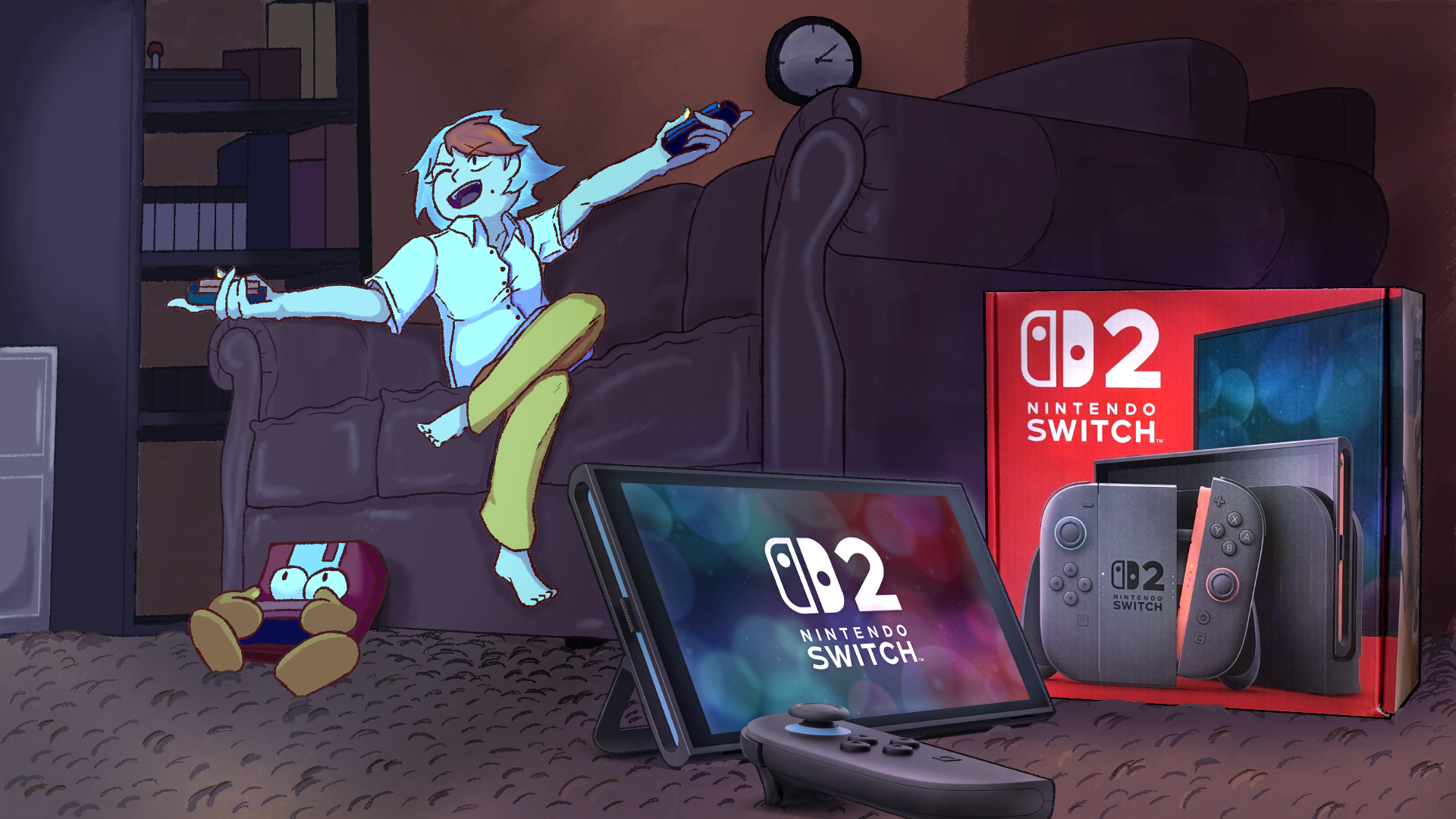
EDIT: 10:05 AM Eastern, June 17: added the final version of the header and some thoughts on GameShare, which I only tried after the review was published. September 4: This review was updated to meet the new Source Gaming review guidelines.
Thanks to PhantomZ2 for edits and NantenJex for suggestions.
“How do you follow up the Nintendo Switch?”
It’s a fair question, and one that players, journalists, and probably developers within Nintendo have been asking for years. The Switch was, in a not insignificant number of ways, the perfect video game machine. Thanks to ergonomic design, it could go from portable system to TV system with no more effort than sliding it into or out of a dock. While too underpowered for many of the world’s biggest blockbusters, it was an incredible indie machine, the perfect place to play the likes of Hollow Knight, Undertale, and Inscryption. Perhaps most importantly, it also featured Nintendo at the absolute top of their form; seemingly every new major exclusive was mammoth, exquisite, critically acclaimed, and wildly successful. This was the era of Breath of the Wild and Super Mario Odyssey and Smash Bros. Ultimate. At a time where the biggest publishers in the world were locked in an arms race of graphics and power, the Switch provided something convenient, elegant, and still packed with banger after banger. It was, for the most part, a system for “everyone” and the thing that brought all of Nintendo’s history, power, and institutional knowledge to bear. Arguably, it was the horizon they’ve been seeking since Nintendo DS. They were rewarded for this mightily, and the device stands as not just the second-best selling console of all time, but truly era-defining in a way no console has for a long time. I am not sure if it was the best console ever made, but in many ways it feels the most immaculate.
So… how do you follow up Nintendo Switch, if such a thing is possible? The answer is Nintendo Switch 2. After a history of making big swings with each new console—second screens, motion controls, or simply moving from cartridge to optical disc—what we have is proudly, almost defiantly iterative. Switch 2 retains its predecessor’s UI, its “home and portable” mixture, the basics of its detachable Joy-Con controllers, the bones of its online store, and, thanks to backwards compatibility, almost every single one of its over 15,000 games. This is not Nintendo’s first example of a console that feels like a sequel; the Game Boy Advance was effectively a more colorful, convenient Game Boy, and it and the DS, 3DS, Wii, and Wii U could all play games from the previous system. But they’ve never flat-out positioned a successor device so overtly as such. It has the “2” in the name and everything. Nintendo seems fully aware that this console will not, cannot, eclipse its predecessor in sheer cultural impact, and they’re wise to avoid trying. Iteration isn’t bad when the Switch was already fully formed (and I’m sure they’re very happy to keep the name).

Image: Source Gaming. The Nintendo Switch 2 Home Menu. There are a few new features, some of the icons are different, but it’s what you’re used to.
As a sequel, Switch 2 puts convenience first and foremost. The original system’s menus are here, and they remain clear and parsable. Same is true of the UI, which has been given only mild changes to account for the new features. Its screenshot capture system, certainly the easiest way of taking photos across all three consoles, is here, and now you can sync your device to a Nintendo Switch Online app to offload them more easily. Transferring data between your consoles is relatively painless. The technical buffs passively improve older games. NSO now has a GameCube emulator launching with the beloved The Legend of Zelda: The Wind Waker. There’s also GameShare, a service that lets you invite players into online sessions with select games they don’t own, even if they’re playing on Switch 1. Perhaps my favorite of these is the eShop. The Switch’s original online storefront was a bit of a nightmare; it had an unbelievable number of good games trapped behind a painfully slow menu. Switch 2’s version loads much quicker, has little lag, and gives you more access to all those lovely indies. Browsing, one of the joys of such an impressive library, is no longer a trial.

Image: Source Gaming. Transferring your data from Switch 1 to Switch 2 is rather easy. The vast majority of the time involves the individual downloads, but those have also been improved.
For Switch 1 users, all 152 million of them, this will be relevant, as Nintendo Switch 2 supports a degree of backwards compatibility unseen in Nintendo’s history. Alongside new titles like Deltarune Chapter 3 & 4 and ports of third-party standards like Cyberpunk 2077, almost every game released on the first system is here. I tested out several over different lengths of time: The Legend of Zelda: Breath of the Wild, Super Mario Odyssey, Hollow Knight, Gorogoa, Super Smash Bros. Ultimate, Deltarune, Pikmin 4, Hades, The Wind Waker via the GameCube app, and although it’s hardly a taxing product, Picross S9. Only two games in this list have gotten dedicated improvements; Breath of the Wild was upgraded to its new Nintendo Switch 2 Edition, while Odyssey is one of several games to get free patches. Those improvements were notable (Odyssey‘s less so, because I started a new playthrough and didn’t prioritize looking for graphical bumps). But even without upgrades, as far as I could tell, every single one had faster loading and more stable frame rates. It won’t improve Hades’ slightly fuzzy graphics, which were baked into the coding of that Switch port, but lemme tell you, the game’s even more addicting now that those load times are slashed.

Image: Source Gaming. For this review, I replayed a bit of the Wii U version of Breath of the Wild before buying my Switch 2. Going from that to the Nintendo Switch 2 Edition felt genuinely monumental.
The one area where convenience is severely lacking is in storage. The console has approximately 256GB (though it’s a bit smaller in practice), which is eight times what the original Switch had, but still small by modern game standards. Most day one purchasers likely bought the bundle with the digital and heavily discounted Mario Kart World; that game’s 21.9 Gigabytes. Easily the biggest file in my library, though it’s still very modest compared to the latest Call of Duty or Rockstar project—at least some of which will be coming to Switch and demand your space. The number of major games coming only in digital or “Key-Card” form doesn’t make this any easier. If you’re like me and have over a hundred indies tied to your Nintendo Account, the only way to have more than a fraction on your device at once is to invest in a MicroSD Express storage expansion. This is an increasingly common issue across the industry, and across every other ecosystem, the increasingly common answer has been to delete what you’re not using and keep whatever you expect to be delisted. If you own another current gen console or play on Steam, you’re likely used to this. One nice feature is that you can delete a game but still keep its menu icon to ease redownloading. For me, it’ll be nice remembering that I bought The House in Fata Morgana. But until you pony up for more space, you’ll likely have to keep most of your games benched between replays.

Image: Source Gaming. Without extra storage, you’ll be spending some time figuring out which of your biggest games need to be on tap.
Another pillar, the main shift from the previous console, and the biggest selling point of this one, is the power upgrade. We’ve gone from a device that was 720p on handheld and 1080p on TVs to 1080p and 4K. High Dynamic Resolution is on offer for certain games, unlocked titles can more regularly hit 30 or 60 frames per second, and even downloading is much faster. And games that could never function on the previous system can work with aplomb. Mario Kart World plays like a dream with a scale that’d utterly bedevil the original Switch. Switch 1 was very much in the low end of things, able to handle some PS4-era games but outclassed in pure power. Ports of big budget games needed at times shocking compromises. Switch 2 is similarly weaker than its counterparts, the PS5 and Series X, but speaking subjectively as a Series X owner, the gulf feels less obvious than the one between PS4 and Switch 1. Perhaps it’s that the jump is so big, or something about modern game production, but the compromises to make it function are less extreme. This is most striking in portable mode, where the higher fidelity screen looks so much nicer, but the boost does feel real across the board. Though this isn’t quite as consistent in GameShare, which did have some input lag on my online partner’s end during a test.

Image: Source Gaming. It’s a delightful game in its own right, but Mario Kart World is a very good show pony for what the new hardware can do.
Nintendo is not a company known for cutting-edge graphics or specs. In fact, their focus on the technical side of this hardware jump, headlining concepts like “4K” and “120fps” in their marketing, is rather unusual. What they are known for is weirdness and bizarre mechanical features, and that’s absolutely still here in Nintendo Switch 2; it’s just under the hood. The new Joy-Con 2 controllers in particular are whimsical things, packed with a noticeably improved rumble and disarmingly tight mouse controls. It is oddly fun to see them magnetically hook up to the main body. Probably most shocking is the quality of GameChat, Nintendo’s newest and very belated take on live chatting. On Discord, the only way for my friends to hear me is if I’m next to my laptop, but I’ve been using GameChat with a friend six feet away from my docked Switch 2 and we both come through clearly. None of these are game changers, but they’re all delightful and appreciated. You see this constantly throughout the charming paid tech demo Nintendo Switch 2 Welcome Tour, which goes into the inner workings of the machine with a granularity and transparency that’s shocking for the company.

Image: Source Gaming. Nintendo Switch 2 Welcome Tour offers a surprisingly candid dive into the workings of the hardware. It’s also a sales pitch, a way for Nintendo to explain the size of the upgrade.
I am primarily a couch player, and for this review I primarily played exactly that way: with the Switch 2 docked, and me often using a decade-old Switch Pro Controller. I still explored in portable mode, largely for the sake of this review but also because… it just works. The ease of moving from TV to handheld was the most exciting aspect of the Switch, they literally named the device after the concept, and it’s the quality that’s been refined the most. The screen is so much nicer, though it may take you a couple sessions to get used to the bigger size. It remains excellent, though it’s where my biggest—albeit still mild—complaints come in. GameChat still works quite well, but it’s a slightly muffled in portable mode and did require me to adjust the sound, if only by a few degrees. The battery life is slightly shorter, though if you’re going on a trip, it’s very easy to open the dock and retrieve your charger. I’ve also been finding it hard to fully move the all new kickstand, which is much stronger than the last one and makes tabletop mode reliable, past the 70° mark. To me, none of these mess up the portable experience, and its core virtues have only gotten better.

Image: Source Gaming. Unsurprisingly, Nintendo GameCube – Nintendo Classics works exactly as the previous Nintendo Classics collections. Not a complaint.
I suppose if there is one elephant in the room—and it has been discussed ad infinitum already, and I don’t know if it’s within Nintendo’s power to reasonably solve—it’s the price. For the time being, Switch 2 is not replacing the original Switch, and Nintendo seems to be treating the latter as more of a budget console for families instead of something to immediately phase out. The $450 price tag and the move to $70 games (Mario Kart’s $80 aside) is commensurate with increases across the industry. But it’s still an increase, and coming at an economically turbulent period unlikely to soon abate. So far, Nintendo seems to be moving much of the cost onto secondary accessories, like amiibo and those extremely useful storage expansions, but it is still a jump. A jump we’re seeing across the industry. And that’s to say nothing of the fact that while Mario Kart World is an exceptionally fun racer and July’s Donkey Kong Bonanza looks incredible, there are only three exclusive games currently on the system and only six we know to be waiting in the wings. For whatever it’s worth, I think it earns its cost. The leap is real, and Nintendo’s teams are clearly relishing it. But right now, Switch 2 is an investment in a possible future. That needs to factor into your decision making if you’re on the fence.

Image: Source Gaming. Deltarune‘s delightful third chapter is a perfect fit for Switch 2, but it’s also available on Switch 1, and that’ll be true of many indies for the next few years. True exclusives, for both the Nintendo ecosystem and the gaming one, will take time to come out.
If you are comfortable with that, though, or confident in the quality of Nintendo as a publisher and developer, you’ll likely find Nintendo Switch 2 a delight. It is kind to the games of your previous library and shows hints of real promise with its new one. Portable mode feels quite a bit nicer and less compromised than the last system’s was. To be frank, the biggest challenge to writing this was simply that I wanted to keep playing different games on it, whether they were new releases or improved old favorites. Making this purchase was a bet, and it’s one I’m confident having made. Living in our post-Switch gaming landscape, with an unstable games industry and so many misconceived would-be paradigm shifts, those buffs and tweaks and iterations all shake out to something lovely.

- Indie World March 3, 2026: Information and Reactions - March 3, 2026
- On Phil - February 26, 2026
- Escape from Ever After | Review - February 17, 2026