
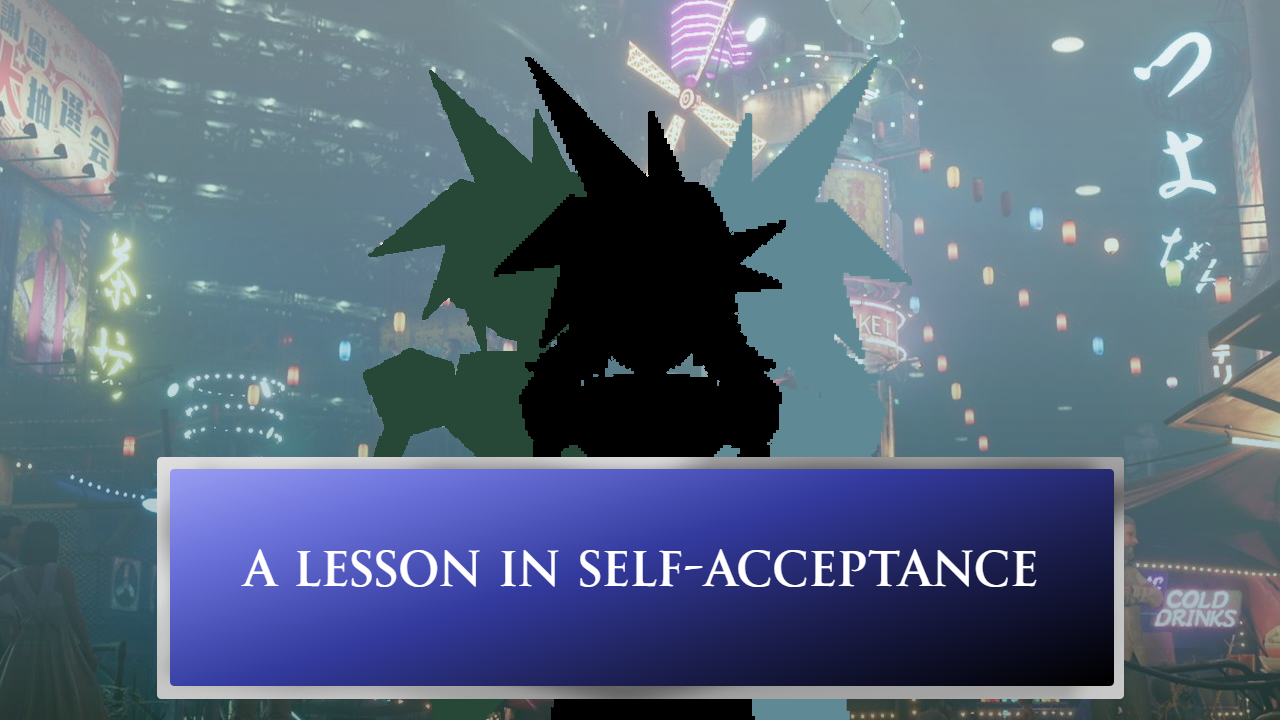
This guest article was created by Blake on Bluesky.
You know how you come across that one moment in a piece of media, video game or otherwise, that kind of fills you with dread as you approach it? Final Fantasy VII has a few moments where this line of thinking can apply, such as the numerous encounters with the main antagonist Sephiroth, a couple of key scenes concerning Zack and Cloud, or even the difficult battles against the Weapons. Personally, one particular moment fits this to a T, not because it’s an insurmountable foe or a jaw-dropping plot revelation, but because of the context of when this title was released. To celebrate Pride Month, I want to spotlight a standout moment for queer coding in games, and a moment I often think about when looking back on FFVII: the Wall Market dress quest.
 |
What is there to say about this game that hasn’t been already? It’s got one hell of an ensemble cast, an emotionally evocative soundtrack, an iconic and timeless story with so many thematic layers, and of course it has Sephiroth. But another thing FFVII has is style. Pure, unadulterated, edgy ‘90s style. It’s absolutely everywhere, from the gritty color palette, to the choice to make climate change the focus of the story, this game has an unmistakable identity that truly sets it apart.
 |
With its first step into the third dimension, a whole new level of storytelling was unlocked and with it came a promise to deliver something as good, if not better, than what came before. While it’s ultimately up to the player to decide how good it was, there’s no denying the cultural impact this title had.
 |
This exact style and love for the era it was created in, paired with it coming from Japan, is why I dreaded approaching Wall Market the very first time I played this game. I came into FFVII late, around 2015-2016 when the Remake Project was first announced. I’d obviously heard about it and loved what little I did know, but it was Cloud’s inclusion in Smash that finally got me to check out his origins. One of the few things I did know going in was there was some kind of scene where Cloud dons a dress for a brief period. I’ve been anything but conforming when it comes to gender and sexuality, and 2015 was a time I was beginning to explore that side of myself a lot deeper, but most portrayals of things like this had been famously…well, lacking.
 |
It was often the case that such inclusions were played for laughs, and it was never about proper representation, leaving us with caricatures instead of characters. Thankfully, the nineties were an era where celebrities were coming out and putting more eyes onto queer culture and normalizing it in many walks of life. Megastars like Sir Ian Mckellen, Prince, and Madonna, as well as shows like Will & Grace are touchstones of queer media and representation for the 1990s, but even this didn’t mean all portrayals were gonna be good from here on out.
 |
When it comes to queer advocacy, it should be no surprise based on my TWEWY article that I am very vocal about these topics. Recent years have seen Japan making an effort to catch up with the western world in terms of protections and rights for LGBTQ people, despite its patchy history. The nineties, like it did for the west, saw a significant uptick in queer media portrayals for Japan but also the rise of louder minorities finding their footing to push for equal rights.
Japan has not been kind to queer individuals, even as recently as 2017 saw an attempt to rebroadcast a character from the eighties named “Homoo Homooda”, a wildly offensive caricature of a gay man in a show called “Tunnels” / “とんねるずのみなさんのおかげでした”. While it was met with immediate backlash when the program aired, this is not ancient history. Even the original depiction of that character was only forty years ago. It’s demonstrably easy to turn a queer character into the butt of the joke, and the media often tended to not that long ago.
 |
With this in mind, let’s take a look at Wall Market and the dress quest. This location is the exact right amount of seedy and sleazy for the story it’s in, and shares many similarities with the entertainment district of Shinjuku, known as Kabukichō. The main thing I want to talk about in this comparison is the abundance of adult-oriented services in Kabukichō; it is famous for its concentration of host clubs, love hotels, and nightclubs which gives it a notorious reputation as Asia’s largest adult entertainment district. It also has a known history as a hub for yakuza members and their enterprises.
 |
This history is important to understanding what Wall Market is, an exaggeration of Kabukichō that expands its worst features and leaves only some of its best. It’s the kind of place that wants to lure you in with the promise of a good time and drain your wallet for all its worth, while feeding it to the ones running the show under the guise of seemingly normal nightlife.
 |
After a mission to the Sector 5 Reactor results in Cloud falling into the slums below and waking up inside the church, he meets the flower peddler Aerith and ends up as her bodyguard tasked with taking her home. Cloud tries to return to Sector 7 on his own later that night, but is rejoined by Aerith on his way back. Along the way, they stop in a playground and Cloud shares a story about his time with SOLDIER, but are interrupted by a Chocobo-drawn carriage holding Tifa hostage, which sets the duo on a sudden mission to Wall Market. It’s mostly unassuming as a location at first, I mean there’s a guy vomiting his guts up in a pipe on the way but overall it’s nothing more edgy than you’ve already seen from Sector 7. But once you’re lured into the back streets in your pursuit of Tifa, you encounter two significant names: the Honey Bee Inn and Don Corneo.
 |
While the Honey Bee Inn is entirely optional, it’s still important to Wall Market as a whole. It’s a members-only love hotel that features bees as its main motif, complete with workers wearing fitting attire. The club hotel itself isn’t actually important, it’s the people outside that are. There’s a group of men outside all dying to get in, including recurring gag character Johnny who wants to see all of Wall Market’s services before leaving Midgar. We’ll come back here shortly, but just keep in mind that there’s probably not a single pure thought in any of those guys’ minds save for Johnny, who actually criticises Cloud when he sees him bringing “another girlfriend”—Aerith—to such a place and reminding us that Wall Market is bad, even by the standard of the slums.
 |
That brings us to Don Corneo, FFVII’s take on a sleazy yakuza head who controls Wall Market with an iron fist, or rather has his underlings do his dirty work while he indulges. Corneo’s mansion sits at the back of Wall Market, and upon your first visit you learn he is hosting a “competition” where the contestants are poor, unsuspecting women and the prize is…Don Corneo. Eugh.
 |
You can’t even get in at first because Cloud’s not a woman, and of course the Don is only interested in one thing. But with Tifa being one of the “contestants,” Cloud needs to brainstorm a way to bust her out. Though as it turns out, it won’t be any of his ideas that we go with because Aerith suggests the fantastic idea of cross-dressing to sneak in. You can see why I saw this as the setup to an infuriating punchline. It’s a Japanese game released in an era only now properly embracing queer culture, tackling one of the easiest things to mock in cross-dressing or transgenderism, set in an area based on Kabukichō. But there’s another part to this moment that made it something I dreaded at first.
 |
In 1994, a movie called Ace Ventura: Pet Detective was released. While it is a beloved comedy helmed by legendary actor Jim Carrey, the fact remains that it is home to probably the lowest point in queer media. A character is revealed as transgender, and the titular Ace Ventura has the over-the-top reaction of vomiting multiple times. While it was meant to be a joke at the expense of Ace, it’s still an uncomfortable fact that the way it was presented had a negative impact on queer media for a long time, and because of how popular the movie got, so too did this scene. With FFVII releasing so soon after this, I had my doubts about it being handled well.
But as I progressed through the story, doing little side quests to collect the pieces of the ensemble for Cloud to wear, I was relieved, impressed, and probably awakened, let’s be real. This quest also opened my eyes to the way lead writer Kazushige Nojima approached FFVII, finding a way to balance all the absurdity with moments of maturity and depth that could easily be sidestepped or forgotten.
 |
Barret is a fantastic example of this. On the surface he is nothing more than a riff on Mr. T and the A-Team, and is sometimes the butt of the joke early in the story, and yet this ridiculous caricature coexists with a surprisingly nuanced story about fatherhood and redemption. He’s just one of many examples of this game taking a moment that could be silly and nothing more, and adding real thought to it.
So, to circle back to the dress quest, it’s not just the fact that Cloud ends up wearing feminine clothes that makes the quest memorable to me, it’s what you need to do to get it. The first stop on this quest is the tailor, but when you get there you find out the owner is in a depressive state at the local bar.
 |
Visiting him results in us learning about his struggles with creativity, but when he learns that the goal is to create a dress for Cloud, it immediately sparks a wave of inspiration when he learns there’s something challenging for him to do. Let’s take this in for a moment and appreciate that this old guy in Wall Market of all places hears about cross-dressing and rises to the challenge with glee, rather than being weird or making fun of Cloud about it like you’d probably expect.
 |
But a dress alone won’t make Cloud convincing enough to get in, and so after the tailor sews the outfit, you are tasked with finding various accessories to make Cloud appear more feminine. The only other item that’s mandatory for progression is a wig. The tailor nudges you in the direction of the gym, and after heading in and explaining the situation to the trainer there, it’s decided that you must compete in a contest to perform more squats than your opponent. Afterwards, a character known as “Big Bro” enters and expresses annoyance at their boys doing so poorly, and gives Cloud a different wig based on how well he performs.
Big Bro’s gender is never stated (as far as I recall), but the use of a feminine model implies he’s a cross-dresser. Whether an effeminate man, a buff woman who gets called “Bro” and runs a gym, or something in between, this character is yet another case of a comedic, yet respectful gender non-conforming character that adds to the quest. Better yet, the members of the gym treat getting the wig like it is super important, they all want it because Big Bro is a Big Deal.
 |
The other items are completely optional, but if you’re chasing after a unique outcome later, or an achievement in later rereleases of the game, you have to go all in and look not just girly, but attractive enough so that Corneo will pick Cloud over Tifa or Aerith. You can get a tiara of varying quality if you check out the inn’s vending machine for a shady seller, you can go through a side quest starting in the restaurant, resulting in a quick stop to the pharmacy that eventually lets Cloud swap some medicine for perfume.
But there is one more optional set of items you can find, and in order to get them you need to go back to the Honey Bee Inn. After acquiring a membership card from Johnny, who decides he is done with the sleazy lifestyle, Cloud can finally enter. He states that he “needs to go in to complete the look,” but Aerith teases him and chooses to stay behind. The inside of the Honey Bee Inn is…well, it definitely gets the point across. Your first encounter is with an employee who sounds like she’d rather be anywhere else.
 |
You enter a room called the “&$#% Room”—your guess is as good as mine there—and after a small cutscene where Cloud triggers some kind of memory, he passes out. He is awakened by, what else, a burly muscular man massaging him back to health. While it is kind of played as an odd moment, Cloud’s weirded-out reaction is to what happened in the prior cutscene, whereas the massage is met with nothing but a shrug. Walking up to the employee from before results in her being apologetic for the “adult things” happening, and gifts Cloud with…lingerie. Cloud promptly leaves the room, somewhat confused by the gift.
The next and final part needed to complete the pretty girl makeover is found in the dressing room of the inn. As you’d expect, Cloud is labelled as a pervert upon first entering, but continuing to talk to the employee there, results in her asking Cloud for his opinions on her. She’s met with immediate disinterest, which seems to shock the woman. Another great example of subverting the expected punchline that FFVII manages to do so well.
 |
Continuing further has Cloud realize that if he wants to look the part, he needs makeup. He asks the employee there to help him apply it, and she…says literally nothing and does it on the spot. To me, the Honey Bee Inn is genuinely one of the funniest parts of the original game for the exact reason the story is so successful; it takes what has the potential to be ridiculous and delivers a surprisingly charming story.
When you’re happy with the amount of accessories, you can return to the boutique and step into the dressing room to finally wear the outfit. Upon stepping out in the iconic purple ball gown, complete with the braided wig, the tailor is impressed enough to turn this into his next business venture, and both his assistant and daughter agree, and as thanks for helping her father, she gifts Cloud the dress for free.
 |
Aerith promptly calls him “Miss Cloud,” a fun little gag that doesn’t linger before she gets jealous…of how Cloud looks. She picks out a red dress and quickly changes, before stepping out and asking for Cloud’s opinion—of which he has absolutely none. Even glammed up, Cloud’s stone-cold persona remains consistent, frustratingly for Aerith and hilariously for us. In any case, with the ensemble complete, Cloud and Aerith are now many steps closer to confronting Don Corneo and rescuing Tifa.
Conclusion
It was a recent revisit to the title that made me give this quest a more thorough look. I already liked the dress quest back when I first saw it, but it never occurred to me just how much it reinforces the themes of the story until now. Identity and acceptance of the self is everywhere in this game: Cloud is fighting to live up to the identity of a hero, Sephiroth is a victim of shattered identity and past trauma, Barret must learn to accept his mistakes to be a good father, no matter where you look you will find these themes baked into the DNA of this title.
It’s a theme I think Final Fantasy VII Remake failed to represent in some places due to a need to alter the story, but one that Rebirth was able to bring back in full swing. The inclusion of these themes is no accident, Square Enix thrives on this exact kind of thematic storytelling. The World Ends With You and its sequel both revolve around identity as a theme, KINGDOM HEARTS touches on these same narrative devices through characters like Roxas and Naminé, and let’s not forget the Life Is Strange series which is all about choice and the themes of acceptance.
I said the same thing about TWEWY as I want to say here: Final Fantasy VII is about what you make of it, whatever the themes mean to you, whatever emotions they evoke, and even if they don’t mean anything beyond the surface-level story and action. My FFVII is about accepting who you are and what makes us human. Wall Market could have been a disastrous fumble, resulting in a bad faith joke at the expense of non-conforming individuals, but instead we got a short story full of care that handles these themes in a way that more modern media should strive to replicate.
Remake takes this to the next level with its reimagining, and while I’ve decided I won’t cover it here, I think the team expanded on Wall Market and the dress quest in a profound and meaningful way, with additions like Andrea being a welcome surprise. Moments of calm like this stand out to me in stories with sprawling narratives; UNDERTALE’s “It’s still you” quote, TWEWY’s “Broaden your horizons” quote and message, and many more are the reasons I come back to these games all these years later.
Once more, I’d like to thank Source Gaming for giving me the opportunity to talk about a topic that means so much to me and plenty of others, and to all of you who took the time to read my TWEWY article from a few years ago. I hope to come back yet again in the future to talk about other moments in gaming I found special, but for now I hope you found my analysis meaningful and enjoyable. Thank you for reading!
Special thanks to Hamada and Slink for edits, the Final Fantasy Wiki for information and resources on the game including images, and sbbit author Yuko Masuhara for information about “とんねるずのみなさんのおかげでした” and “Homoo Homooda.”

- Dream Smasher: Reimu Hakurei (Guest Article) - February 7, 2026
- Dream Smasher: Swordsman No. 8 & PUCK (Guest Article) - December 27, 2025
- Dream Smasher: Sidon - July 29, 2025