
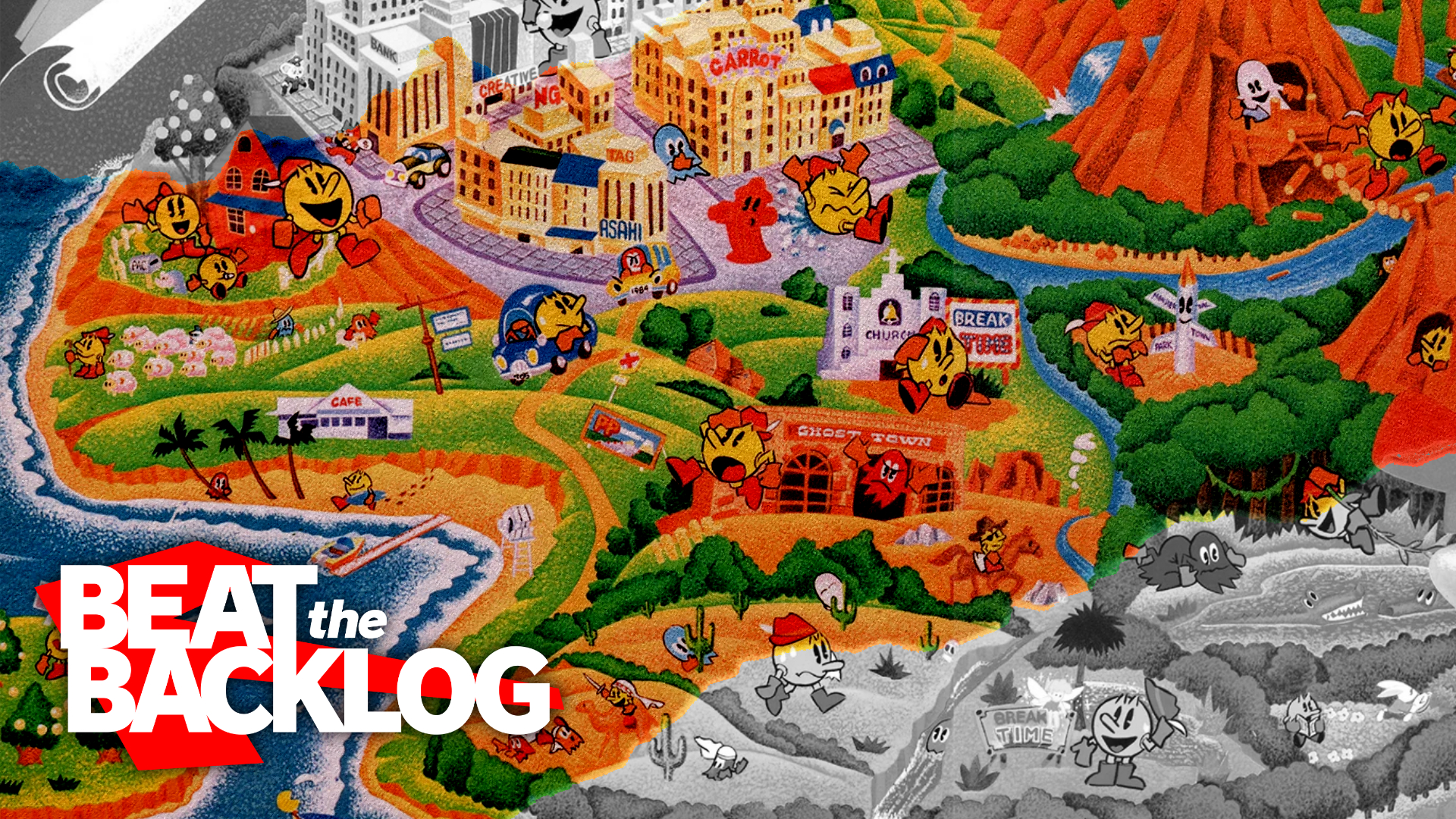
Thanks to Hamada for helping with edits.
Today, the 1984 arcade side-scroller Pac-Land is probably best known around this humble corner of the web for inspiring a stage in the Super Smash Bros. series. One of Pac-Man’s special attacks therein, the fire hydrant, is also lifted from Land; ditto for his jump sound effect. Some of his alts honor the platformer. Trophies in the Wii U and Nintendo 3DS Smashes cite Land as one of the star’s definitive appearances. Ultimate honors it through a Spirit and retools a few of his animations to include its fairies. To the layman, this probably seems baffling. Why would Smash auteur Masahiro Sakurai dedicate so much space to Pac-Land, especially over more recent or popular titles? Only a few generic moves and an allusion to the first Pac-Man World call back to that trilogy. Meanwhile, the Arrangements, Championship Editions, and other outings go unrepresented.

Over the years, I’ve seen some decry the Smash stage for resembling a Microsoft Paint doodle, and I don’t personally know a single soul who enjoys fighting on it. But it’s a loving, faithful tribute, and yes, I respect it, because… (Image: Source Gaming)
The answer is quite simple: it’s because Pac-Land is important. While the groundwork for platformers had already been established, Pac-Man’s maiden voyage into the genre is still an early, formative one—to the point where it influenced Super Mario Bros. Ruminate on that: the yellow fella beat Mario, Mr. Video Game, the face of genre-defining side-scrollers, to the punch on starring in one! And though Pac-Man was no stranger to bizarre experiments (arcade cabinet distributor Bally Midway’s Professor Pac-Man quiz show-esque flop predates Land by a year), Pac-Land’s release meant Namco was no longer strictly relegating their mascot to neon labyrinths. Now, the foodie could freely tackle any genre he saw fit, something that led to a wild array of titles.
Since its inception, Pac-Man’s character-centric nature helped distance it from the litany of space shooters crowding arcades. Pac-Land leverages that, to the point where it takes notes from the mediocre 1982 Hanna-Barbera Pac-Man cartoon—literally; Land near incessantly plays a chiptune rendition of its theme (it’s cute at first, but quickly grows grating). Its influence even extends beyond that: Blinky and Clyde inadvertently swapped personalities in an annoying first for the games. At least one episode of the show let a ghost violently hop around on a pogo stick, so they do the same here. Really, this is a colorful, well-animated game by ‘84 standards; everything’s lively.

Structurally, Pac-Land consists of eight Trips that entail four Rounds each, totaling thirty-two unique levels. But I admittedly stopped not long after reaching Round 20, as that’s where the Pac-Man Museum+ compilation stops rewarding your progress. (Image: Source Gaming)
A trailblazing text for the games, Pac-Land reveals that the family man owns a house! One situated near a town, castles, forests, mountains, deserts, and lakes! Each setting carries a unique gimmick or two, giving them some flair. Towns house fire hydrants, whose bursts of water can push Pac-Man. The dilapidated bridge stages also contain fire hydrants, though geysers that can swallow the hero or toss him around are its main pain (an item can also elongate specific platforms, although availing yourself of them is not only unnecessary, but usually more trouble than it’s worth). Trees in the forests obscure mid-air hazards or goodies. Mountains are easily the most platforming-heavy sequences, containing unstable bridges, thin footholds, and clouds that bop up and down. Watch out for ominous skulls in the deserts! Deadly quicksand surrounds them. And after your first run through a castle, subsequent visits limit your view. Navigating the three-story structures is frustrating, especially when you dash into locked doors that require stray keys to open.
One hazard is shockingly unintuitive, though. Marching through Pac-Land eventually presents you with levels solely dedicated to springboards and ponds, although you first encounter them briefly in Round 3. Upon first dashing atop the springboard, I instinctively timed my button press carefully, thinking I’d leap up at the maximum height, while holding right on the D-pad. That’s how trampolines tend to work in Super Mario Bros. and later platformers, but not here; that’ll cause Pac-Man to merely nudge right and then plummet like a rock. You gotta keep pressing right; then he safely hovers across. Managing the lakes becomes much simpler after mastering that, even if the wide late-game ones offer little leeway. Still, I always groan when encountering them. More than anything, this odd control scheme speaks to the time, an era when Namco was trying to figure out a nascent medium.

The Ghost Gang quartet—Blinky, Pinky, Inky, and Clyde—incessantly harass the star: they’ll man one- or two-story buses, planes that drop projectiles (which resemble their original Pac-Man sprites), or other rides. (Image: Source Gaming)
That unsteady feeling permeates throughout Pac-Land. By default, Pac-Man walks. Starting a sprint is when things get weird: you have to press the D-pad in quick succession to make him run. While this almost feels like it’s foreshadowing his Smash inclusion, it’s a setup programmer Yoshihiro Kishimoto drew from Konami’s Track & Field. Pressing the button makes the mascot jump, and the faster he’s moving, the farther he leaps. It takes a little practice to get the hang of his physics (when trying to tweak my positioning to prepare for longer leaps, I’d often nudge Pac-Man a mere inch backwards and cause him to unceremoniously walk off solid ground), but they hold up decently well. In one advantage over Super Mario Bros., the camera can scroll back to the left, although there’s rarely a reason to revisit earlier areas.
Naturally, the main threat is the Ghost Gang, the touch of whom instantly kills Pac-Man. Sue of Ms. Pac-Man fame constantly tails the hero while the usual four creeps ambush him from the front (Sue also now dons a purple body to distinguish her from the orange Clyde, a makeover that persists into most of her future appearances). However, there’s an odd luxury: Pac-Man can safely stand atop their heads. And he has two handy power-ups: Power Pellets and Wing Shoes. If you’re familiar with Pac-Man, you’re familiar with the former: eat one and then you can eat the ghouls for a spell. Eating all five yields bonus points, and that’s basically the only time you’ll ever voluntarily head left. Unlike the iconic bolus, the Wing Shoes only appear during a Trip’s fourth act and let Pac-Man hop indefinitely. It’s an interesting dichotomy, with one goodie letting him take the offensive while the other aids in evasion.

The plot’s simple: the selfless Pac-Man is escorting a stray fairy back home, which he succeeds in doing after clearing the first three Rounds in a Trip. (Image: Source Gaming)
And those fourth Rounds sorta flip the script. Now, you’re heading left! You’ll soar across many of the places you previously surmounted to reach the Mother Fairy, and it’s kinda empowering. Still, you can’t dawdle: one way Pac-Land channels the arcade games’ ethos is through a strict timer, represented on the bottom of the screen via the classic Pac-Man sprites. Every level is short because they need to be, and once you’re out of time, Sue sprints towards Pac-Man, ensuring a swift death. And on a Trip’s fourth Round, Pac-Man loses his Wing Shoes should the clock run out. Thankfully, checkpoints are plentiful and restore the timer.
Another way Pac-Land humors its roots is by imploring players to attain high scores. Finishing a level before the timer runs out boosts your score—and the faster you are, the bigger the bonus. Again, you’re encouraged to eat ghosts. Your reward for munching on the four main specters and then Sue is a Pac-Man icon, a lovely goodie that yields another point bonus and refills the timer. Grabbing the series’ iconic fruit causes more to spawn, and eating four consecutively yields progressively larger bonuses. To be clear, Land is not engaging to score attack. Aside from obtaining a few extra lives, the concept feels as extraneous here as it does in most Super Mario or Sonic the Hedgehog side-scrollers (or Pac-Man World 3). Still, it’s entirely inoffensive, and if it adds any replayability for Land diehards, then it’s a worthwhile inclusion.

Rounds are flat and fairly dense with hazards, which the game recycles regularly. After countless platformers have iterated on its ideas, however, Pac-Land now comes across as bland, rudimentary. (Image: Source Gaming)
But Pac-Land’s focus on score attacking only underscores how drastic a break it is from Pac-Man and Ms. Pac-Man, the franchise’s first and most famous entries. To casual fans seeking their familiar, maze-roaming gameplay, Land has little to offer. And to anyone looking for a fun, albeit simple, platformer now, well… Pac-Land shows its age. Even a year after its release, Super Mario Bros. codified how side-scrollers “should” roll with more intuitive controls, intricate level design, and a wealth of secrets. As conveyed by Mario’s now-iconic ? Blocks, any block or pipe may hide a prize; exploring the Mushroom Kingdom is deeply gratifying. Pac-Land isn’t devoid of that—it buries a few extra lives, stage warps, and fruit—but it just can’t compete.
Nevertheless, Pac-Land was a critical and commercial success, one that influenced the medium; Super Mario Bros.’ level progression follows its lead. One of Land’s biggest fans is Pac-Man creator Toru Iwatani, who worked on and cites Land as his favorite game in the series. Plenty of consoles have received a version of it; the Pac-Man Museum+ collection contains an edited port of the original. Even Museum+’s key art homages Pac-Land’s! A long line of Pac-Man platformers followed Land, while The New Adventures honed in on its audiovisual strengths. And while I don’t know if I’ll ever replay Pac-Land, I am glad I made time for it. If you have an interest in this industry’s history, it’s absolutely worth trying—and, yes, I’m happy Smash commemorates it. Even if the 3DS-exclusive Pac-Maze arena is way cooler.

More credit where it’s due: Smash’s Pac-Land kindly gives Ms. Pac-Man a cameo. The legally distinct and less charming Pac-Mom, seen above, replaces her in Land’s recent re-releases. Assuming Pac-Land returns in Ultimate’s inevitable sequel, I hope Pac-Man’s true first lady does, too. (Image: Source Gaming)

- Character Chronicle: Vanillite - March 5, 2026
- Character Chronicle: Cinderace - February 27, 2026
- Beat the Backlog: Mario Tennis (Nintendo 64) - February 11, 2026