
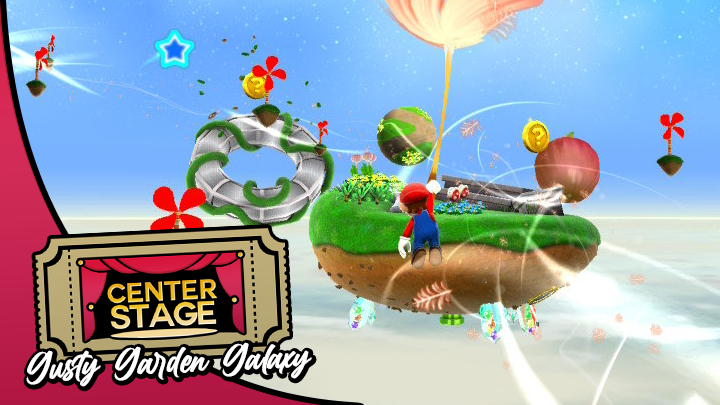
In “Center Stage,” Wolfman Jew discusses environments and level design across the games industry. They may be single levels, larger sandboxes, or broader settings. They may be as small as a room and as large as a world. Some may not even be good. But they are all interesting.
Super Mario Galaxy occupies, to me at least, an odd place in the illustrious Mario canon. It doesn’t have the best meta-level structure, certainly when compared to the wildly nonlinear Super Mario 64. It doesn’t have the best critical path; that’s Super Mario Odyssey. Both of those games also beat it decisively in Mario’s basic movement, which is far less complex or adaptable in Galaxy. It doesn’t have Super Mario World’s deluge of secrets, the overt wackiness of Super Mario Bros. Wonder, or the way Super Mario Bros. 1 and 3 expanded our collective idea of what a game could be. It is offbeat and bold, but less aggressively so than Super Mario Bros. 2 or Super Mario Sunshine. Super Mario 3D World provides a more consistent design in a granular, architectural sense. And there is an argument that it’s less polished, large, or inventive than its excellent and even more massive sequel, Super Mario Galaxy 2.

Image: Source Gaming. Perhaps “the” image of Super Mario Galaxy: Mario flying through the blues and blacks of outer space, crazy micro-planets all around.
And yet, when I look at all these games, I can’t help but wonder if it’s my favorite of them all. Part of it’s the level design, which is imaginative and impeccable. The game’s obsession with space and gravity—Mario’s adventures over floating blocks has reached its natural conclusion, where he’s leaping across deep space planetoids—allows mind-blowing platforming and level design. The soundtrack, the most dramatic in the series and the first to be recorded by a live orchestra, adds a lot; it’s powerful in a way that doesn’t undercut Mario’s innate joyfulness. It contributes to a nice shift in tone, one that’s still wacky and fantastical but also grand, epic, cinematic, and tinged with a quiet sadness. Rosalina’s Storybook, the more contemplative songs, and a few other details let Mario Galaxy capture an emotion of melancholy that the broader Super Mario series never bothered to grasp. Until Mario Odyssey, it felt like the one most interested in being “about” something.
Even since the announcement of the imminent The Super Mario Galaxy Movie, I’ve felt the urge to write about Galaxy. Its style, its mechanics, all the stuff that makes it special. And to do that, I’m going to zoom in on exactly one galaxy. These are the levels, forty-two in the entire game, that Mario explores for Power Stars. Some are big, some are small, many hide several Stars, and all of them are enchanted with Mario’s gravity-defying movement. We’ll use this one piece to study the game as a whole.

Image: Source Gaming. Toy Time Galaxy, a collection of set pieces on giant toys, is astonishing and goofy as hell.
Our choice needs to be special. It should be one of the fifteen “large” galaxies you spend the bulk of your adventure in. Most galaxies are one-off affairs, but these have plenty of meat to chew. Each would be good in its own way. Good Egg Galaxy is the first of the bunch and introduces the concept. Battlerock Galaxy has more Power Stars than any other, including one of the fabled Green Stars and Luigi sightings. Beach Bowl and Honeyhive Galaxies are small sandboxes in the vein of Mario 64, so we could compare them to the older games. Many of these have a boss, which is important for reasons we’ll get into. Freezeflame Galaxy has a boss, for instance. So does Ghostly Galaxy, and that also has one of the few mini-games. But in the end, I had to go with my gut.
GUSTY GARDEN GALAXY
Gusty Garden Galaxy is the first Galaxy you have access to in the Bedroom, the fourth dome in the game (they’re essentially this game’s worlds to the galaxies’ levels). To get it, you’ll need to have beaten Kamella and found twenty-four Power Stars, so we’re concretely in the back half of the story. The first thing you’re likely to note is the sky imagery. Despite setting itself entirely in deep space, Mario Galaxy trades in a broad swath of biomes, but the cloudy, midday light feels uniquely ethereal. The landmasses are nature and produce-themed; they’re beans, apples, gardens, plots, soil, and hedge mazes. It’s a strange combination of “grass” and “sky” level themes that don’t look like anything else, on top of the “space” theme that covers every galaxy.

Image: Source Gaming. Mario exploring one of the main planetoids of Gusty Garden Galaxy. The nature of the game means that it’s all but impossible to find a clear image of an entire galaxy.
The music also makes an impact. “Gusty Garden Galaxy” is the most famous song from Super Mario Galaxy by far. Composed by Mahito Yokota, it captures the sense of romance, drama, and size that Galaxy is going for more than any other piece in the score. It has two arrangements within the game, and it’s also been separately remixed in Super Mario Galaxy 2, Super Mario 3D World, Mario Kart 8, and The Super Mario Bros. Movie. I first encountered the song in a “trailer” before the game came out. It wasn’t showing footage of Galaxy, just the recording of this song. This was a formative moment for me as a teen, because it was game marketing selling not content or attitude but a more heady, inscrutable emotion (though Nintendo also made plenty of perfectly dumb marketing stunts for the game). Nintendo has done several of these recording trailers since, particularly for Mario Kart 8, but none felt more impactful. The music is also at the heart of what makes the level feel special and rich.
While Galaxy is more linear and directed than Mario’s previous 3D adventures, it still follows the structure laid out by Super Mario 64. Each major galaxy has several missions—three main ones and several that are hidden or secondary—that you go through, one at a time. Each mission sends you through a selection of planetoids in a specific order, with the pathway and challenges a little different each time. What unites them are mechanics, tropes, hazards, and aesthetics that build from one Power Star to the next.
BUNNIES IN THE WIND
“Bunnies in the Wind” starts you off on a simple planet, an oblate spheroid that’s got grass on top and dirt on bottom. Even this late, it’s important to Galaxy that you get your bearings in a safe zone. Soon, though, you’ll be flying from planet to planet, swinging on vines, and eventually finding your way to a soft cube planet made of hedges and lattices. There’s a Star Bunny carrying a Power Star, and you’ll have to catch it. Once you do, Mario poses, you get the Star, and the second mission unlocks. There’s no opportunity for sequence breaking. The three main missions of every “major” galaxy have to be done in a specific order, hidden stars are only found within specific missions, and just on a physical level, every piece of terrain is separated by thousands and thousands of feet. Instead of providing remarkable freedom, each galaxy offers a curated and delightful experience built around its planets, order, and gimmicks.

Image: Source Gaming. Mario rides a Floaty Fluff from one planet to the next.
Right off the bat, the mission introduces several of this one’s main mechanics. Undergrunts, spacefaring Monty Moles, are new enemies that tunnel through planetoids. Mario has to move to multiple planets by way of a Floaty Fluff, a giant dandelion that rides conspicuous wind drafts. You can push yourself upward three times by using his signature Spin move, and while the individual paths will become longer and harder with each mission, the first is short and easy enough to work as an invisible tutorial. There are also elements from earlier levels that had largely gone away since the beginning of the game. Sproutle Vines—elongated vines that Mario can swing from—appeared in Good Egg Galaxy, but the ones here are far more complex and circle around several planetoids. Another type of Monty Mole, Monties, were in Battlerock Galaxy but are more prominent here. Star Bunnies, which act as the level’s NPCs, hadn’t appeared since the tutorial.
In that tutorial, you chase a bunny down around a spherical body. It’s great at explaining quietly but clearly how this game explores level, structure, and gravity. Twenty-three stars and several major boss fights later, the Puzzle Cube planet twists that original challenge. There’s no time limit and little threat, but it’s harder to catch up. You have to develop a mental model of the planet’s shape. The Bunny at least seems faster and definitely handles the terrain better. It’s also just set far enough down the line that it feels like a fun callback. You’ve already handled Megaleg and Bowser Jr. and some dizzying platforming. This can be an anticlimax.

Image: Source Gaming. The hedge maze is another piece of Mario Galaxy iconography.
This initial trip and that chiller ending also make it abundantly clear what kind of level this is. Gusty Garden Galaxy is a collage of plants, produce, crops, fences, farming, and wind. The latter feels a bit hard to parse—perhaps it’s the inclement weather that’s important in gardening. Still, it’s not random with its imagery. I don’t know what (if anything) the level’s trying to say, or why it got the best song, but there’s a very romantic quality to it. The music swells, the enemies have so much weight, and it’s all in front of a background that could be in a lofi hip hop video. It feels emotionally large in a way Mario rarely expresses.
THE DIRTY TRICKS OF MAJOR BURROWS
Most of the major galaxies in Super Mario Galaxy have a boss fight. Following the Nintendo standard, they’re designed to be an extension of their level as much as a character. Major Burrows is a great example of this. He’s an obvious evolution of the Monty and Undergrunt, not just in design but the way you fight him. When he comes out of the dirt, you Ground Pound to stun him (like Undergrunt) and Spin while he’s down (also like Undergrunts and most enemies, including Gusty Garden’s Piranha Plants). The main complication comes in the dirt patterns from his movement, which can sometimes make it hard to reach him. To teach you beforehand, there are multiple things that require Ground Pounding, most notably a worm you coax through a series of giant apples in order to reach a Launch Star. It’s a byproduct of Nintendo’s obsession with interwoven tutorials and a good way to make each challenge feel like part of a whole.

Image: Source Gaming. I’m a very big fan of the bosses who fight you in these crazy spherical areas. It’s very cool in a way that’s hard to describe.
This is, and has been since the NES era, the overarching goal of a Mario and Nintendo boss. Bosses aren’t just a beefy enemy with more health; they are an extension of whatever themes lead to them. Fighting them is mostly about reading patterns and figuring weaknesses. I’m a big fan of this approach, as it makes bosses feel more special and tied to their level. However, I think it’s also fair that Mario had, up until Super Mario Galaxy, a mixed record when it came to these fights. The likes of Gooper Blooper and the Reznors are great, Bowser acquits himself wonderfully in his every appearance as the big bad, but the early era of Mario also had plenty of battles that were bland, too straightforward, or repeated far too often. I’d call them scattershot, and more incidental to their levels than they were clearly meant to be.
In that context, one of Galaxy’s real legacies may not be that it has good bosses (although they are very good, with a strong level of challenge and generally satisfying gimmicks), but that it makes their fights feel important. The music is louder, the animations larger, the particles more numerous. Even if the fights are relatively basic—there’s a lot of hitting bad guys three times to defeat them—the aesthetic features do a lot of work. A monster like King Kaliente or Bouldergeist or, again, Bowser occupies so much more mental space. I don’t think Major Burrows quite matches them, but he’s very strong. Every Mario Galaxy fight that lets you run on all sides of a spherical stage is compelling enough on its own, and it’s cool how he emerges from the dirt like a sandworm and swings back in pain after being hit.

Image: Source Gaming. The crazy ring that is eminently missable.
One of my favorite parts of this mission is something that’s not even tied to the Major Burrows fight, though. Before Mario actually gets to the planet, he jumps through a Launch Star and flies inside a large metal hedge ring. Five Pull Stars are inside the gap, which a player can activate to yank Mario off his trajectory. There isn’t a ton to find here, mostly Star Bits and a 1-Up Mushroom. It’s just there for enterprising players. This is another Mario trope: the puckish bonus challenges and secret areas. Galaxy is full of these. There are so many obscured Warp Pipes and alternate Launch Stars and Hungry Lumas. None of this is new, nor is it unique to this game. But it’s always cool.
GUSTY GARDEN’S GRAVITY SCRAMBLE
A common feature in many galaxies, and the point where they most emulate traditional Super Mario levels, is the obstacle course. Most levels are already linear sequences of unique planets, but these specifically demand precision. This is thanks to the chief rule of platform games: fall off, and you die. Most of the landmasses in these don’t have an internal gravity field, so if Mario walks off, he’s basically doomed. Despite that, the gravity mechanics are often at their most ridiculous here. Many of these missions have unique gravitational rules like a 2D sub-level where the wall is covered with panels that send Mario up, down, left, right, and to and from danger. And they keep coming; the very last level of the main story, Bowser’s Galaxy Reactor, starts off by introducing spotlights that direct gravity onto the surface of walls. I’d say they’re Galaxy’s version of the acrobatic “sky” or “athletic” levels in other Mario games, with the caveat that these are all kinda sky levels just by virtue of the space theme.

Image: Source Gaming. I genuinely don’t know what the boxes represent with regard to the overall theme. But these types of missions are the ones that often feel the most random.
Gusty Garden Galaxy’s version is a normal example, very well done but only surprising in how it moves from the gardening theme. After a few minutes of token jumps from one planetoid to another, “Gusty Garden’s Gravity Scramble” sends you through various collections of cubes. Naturally, only one side of any of them is safe. Some of these blocks move on their own, meaning that the “safe” side changes every few seconds, while others don’t. The main way you move between these sets is by flipping an arrow switch that determines the direction of gravity. This is broken up by a few things, like a bit where Mario runs around a series of discs and poles to reform a small Launch Star. Those little sub-missions where you have to find a set of collectibles allow Galaxy to have mini-challenges, and it often adds a tiny hint of exploration into the proceedings.
What I like about missions like this is that they show off Galaxy’s platformer bona fides. The levels are filled with interesting gimmicks, the constituent parts are short and don’t wear out their welcome, and the pace adds a jolt of energy. Much of the time, Galaxy can feel a bit slower than other Mario games, due to stuff like the animations of Mario flying through space or the ways he can lazily orbit planetoids with precise motions. These make you pick up the pace, which is important for a series that often has an almost musical, rhythmic quality to its gameplay. Though I suppose it’s mildly ironic that the impactful and bombastic “Gusty Garden Galaxy” song gets replaced by an eerier, slow remix of Super Mario Bros.’ classic Underground theme. It’s good for enforcing a sense of danger, but not for making you want to dash.
MAJOR BURROW’S DAREDEVIL RUN
Every major Galaxy has a “Prankster Comet.” These appear randomly, and they’re soft remixes of certain missions you’ve already beaten. “Major Burrow’s Daredevil Run” is as clear a version as you can find. Daredevil Comets put you right at the start of one boss fight or section—in this case, the fight against Burrows—but cuts any extra health. It makes the fight significantly more precarious and punishes play that’s either too bold or too cautious. I spent a ton of lives here the last time I played Galaxy, mostly because I was too slow to reach him while he was stunned.

Image: Source Gaming. Mario starts the mission on a tiny planet right before starting the fight.
There are a few other Prankster Comets, all of which randomly appear over one galaxy until you either beat it or bribe a Luma to get the one you want. Some put the level on a short timer and force you to speedrun, some make the enemies move twice as fast; some pit you against a spooky “Cosmic Mario.” They’re generally fun enough as challenges (I’m sure it was also helpful having a stock format) because they reward you for playing at a higher level. They’re all individually optional, and I don’t think you need to even get one to beat the game.
PURPLE COINS ON THE PUZZLE CUBE
The most optional Pranker Comet of all is the Purple Comet. This only shows up in the postgame, and fittingly, it can be hard. It targets exactly one planet or section of planets in each of the larger galaxies, fills it with 100 Purple Coins, and tasks you with getting all of them—often on a timer. These are remixes of earlier missions in the sense that they stick you back in a space, but they also recontextualize the level. Specifically, they recontextualize the level as harder. Space Junk Galaxy’s version, for instance, is set on a collection of platforms that only exist when you get near them and make exploration fuzzy and unsafe. This area is trippy, sedate, and a bit unnerving on your first trip, and now you’re forced to rush through it.

Image: Source Gaming. When I replayed this to get screenshots, I expected it to be a piece of cake. Definitely not the case.
Mission 5 of Gusty Garden Galaxy starts where Mission 1 ended, on the hedge cube where you chased down the Star Bunny. There are now 150 Purple Coins scattered across all six sides, and Mario has to gather one hundred and nab the Power Star they summon within two minutes and thirty seconds. While there are a few Goombas, the only real danger is that time limit. It turns what had been a fun and charming area into something dangerous, as you’ll have to regularly jump across sides and elevations to get the coins. And for a final twist, the timer doesn’t actually stop after you’ve gotten all one hundred. It keeps ticking down, forcing you to scramble to the fountain where you started. The mission is rather hectic in a way that goes against the emotion the planet had just invoked (Prankster Comets only come into play after you’ve secured at least one star in that galaxy, and you can’t do “Bunnies in the Wind” out of order, so you’ve touched ground here already).
Mario Galaxy was not the first Mario platformer to have a postgame. Super Mario Bros. had a light remix of itself after you beat the game, and The Lost Levels had an impressive, multi-layered collection of post-credits worlds. Super Mario 64 and Sunshine had little prizes for 100% completion. But decades after Lost Levels, Galaxy started a dialogue for how the postgame trope would work in the series. There are Stars you can only get after the final Bowser fight, and collecting them and every other Star unlocks both the epilogue and the ability to play as Luigi. It’s simple, but the other games in the series built on it. Two years later, New Super Mario Bros. Wii would include a secret ninth world after defeating Bowser. A year after that, Super Mario Galaxy 2 would have a massive array of post-credits content. The Purple Coins are fairly basic, but they’re part of a legacy that has continued through today.
THE GOLDEN CHOMP
And finally, the secret Star. Many of the main galaxies have one; a few ostensibly one-off galaxies do, too. As a general rule, they reward daring or exploratory behavior. In Buoy Base Galaxy, for instance, you can go through the intended platforming climb, or you can dive underwater, get a Torpedo Ted to destroy the gate on a Warp Pipe, and move on the underside of the entire level. These are catnip for “super players,” especially since they demand different skills and feel cool when you uncover one. Mario games love having light surprises, and realizing you’ve stumbled onto a big one feels especially great.
The one in Gusty Garden is pretty typical. In the main three missions, the starting section with the Floaty Fluffs always has a large ? Coin in the air that you can grab—at least, if you’re judicious with when you use the spin move. It’s part of the invisible tutorial but reads even less like an explanation. During “Gusty Garden’s Gravity Scramble,” there are several Coins, requiring far more precision than the ones before. If you’ve got perfect movement and get them all, the level spawns a Rainbow Star, which makes Mario invincible for several seconds. With just a few moments, you can jump to the next planetoid and destroy a mysterious Gold Chomp for a secret Star.

Image: Source Gaming. Rainbow Mario about to crash into the weird Golden Chomp.
What makes this work are three things. First, you already have the tools to access it because all three missions start with you having to use the Floaty Fluffs. You might not bother with getting the Coins because you’ve seen a half-dozen moments just like it that only ended with a 1-Up Mushroom or some Star Bits, but you literally can’t go through the galaxy without learning the basics. Second is that the Gold Chomp is really conspicuous. It’s large and garish in a level that’s almost entirely green, brown, and off-white, and a player will almost certainly notice it, whether or not they make the mental connection. And third is, of course, the fact that it is totally optional. Super Mario Galaxy does give you hints about the location of secret Stars; the game tells you explicitly when you’ve fully completed a Galaxy, and the menus actually have blank spaces for secret Stars you missed and a note about which mission to check. But these are as missable as a Power Star can be.
This level doesn’t have every kind of mission. There are three other Prankster Comets, which are arguably more interesting than one that simply takes your health. There are also the Green Stars, which when collected reveal a set of super secret gimmick levels, as well as the various missions that have you rescue Luigi. It also doesn’t have that classic Super Mario Galaxy look, which sticks pretty, four-color objects in a sea of starry blue (arguably it inverts it). There are also none of the larger planets that act like super tiny sandboxes, which lets the game point to Mario’s 3D legacy. No galaxy in the game has every flavor, this one included.

Image: Source Gaming. One of my favorite images from the galaxy is this puzzle where you get a worm to move from apple to apple. It’s only in the second mission.
Gusty Garden Galaxy does, however, perfectly show the power of Super Mario Galaxy as a game. It has the dizzying gravity mechanics in spades. It has levels that are slower, faster, and exploratory in quiet ways. It has the boss fight, the acrobatics, the secret, and the post-game content. More than that, though, it has the game’s tone at its most curious. It doesn’t feel like other spaces in the game, just like how Galaxy doesn’t feel like other games—even Super Mario Galaxy 2 jettisoned its quieter, more melancholic elements. Like the game from which it comes, Gusty Garden Galaxy is an iconoclast.
Thanks to Cart Boy for edits.

- Center Stage: Gusty Garden Galaxy (Super Mario Galaxy) - March 20, 2026
- Resident Evil Requiem | Review - March 13, 2026
- SG Choice: Mario’s Best Levels, Hubs, and Worlds - March 10, 2026