
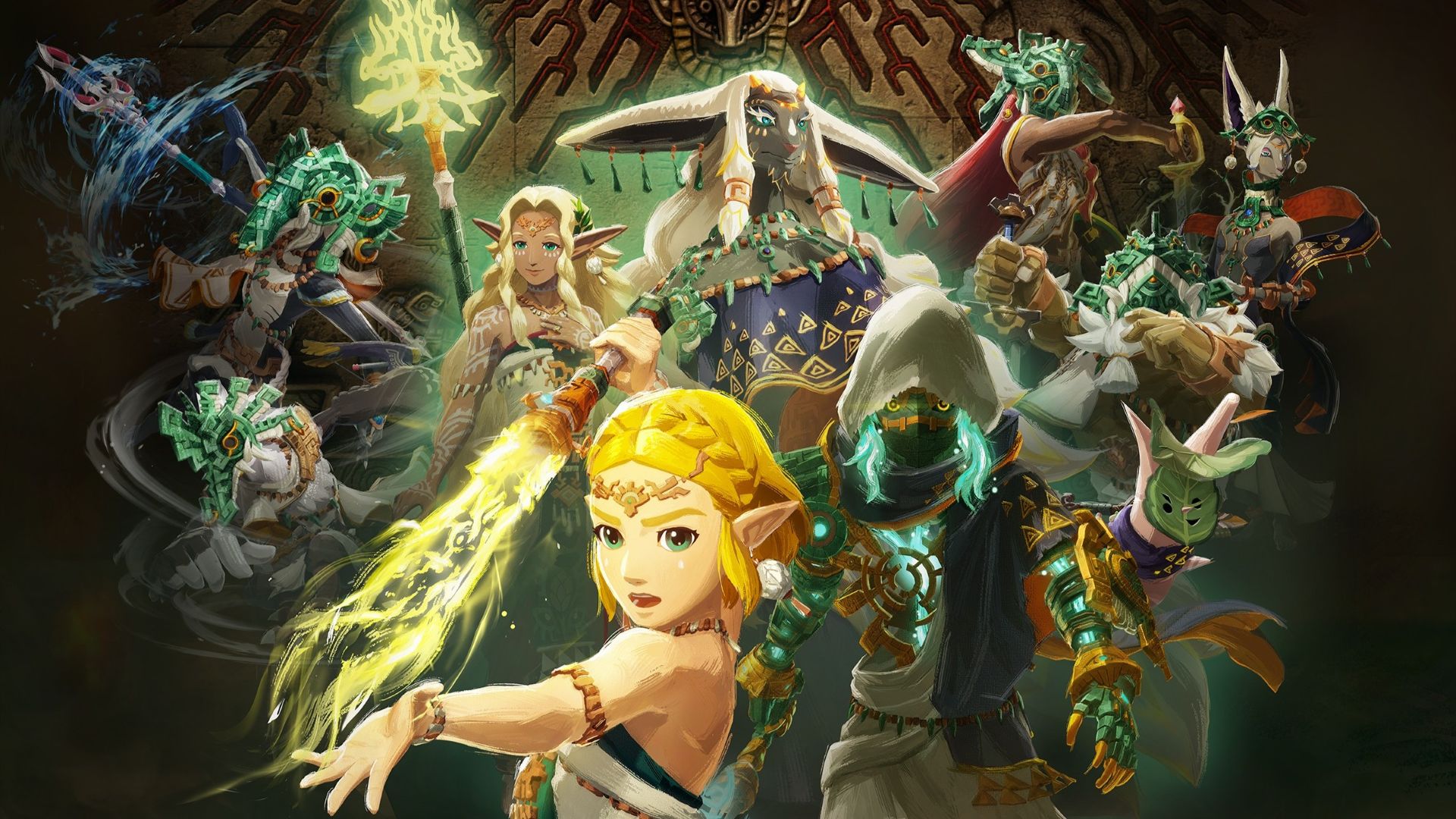
This review copy of Hyrule Warriors Age of Imprisonment was provided to Source Gaming by Nintendo.
Hyrule Warriors Age of Imprisonment is the latest entry in the Nintendo Warriors series, developed by Koei Tecmo and published by Nintendo (outside of Japan). It is actually the first game released by the new AAA Games Studio, a developer created by Koei Tecmo in 2024. Similar to the previous Hyrule Warriors, Age of Calamity, Age of Imprisonment tells the backstory portrayed to Link in its main series counterpart – Tears of the Kingdom. It is extremely similar to Age of Calamity in structure and presentation, but taking full advantage of the Nintendo Switch 2’s power and advancements in developers experience to provide fans with the best entry to date.
A Memory Retold
In an incredibly bold choice for the series, Age of Calamity follows the story of Princess Zelda and JUST Princess Zelda – no Link in sight. While the series’ primary hero is often mentioned in dialogue and journal entries, his only appearance is in flashback to scenes that played out in Tears of the Kingdom’s opening section. Instead, Zelda and Rauru, the King of Hyrule, take centre stage as they did within the Memories found across Tears of the Kingdom.
This commitment to only focusing on the canonical events of the Imprisoning War elevated the story being told here and avoided the trappings of Age of Calamity – telling an alternate storyline with a happier ending. Age of Imprisonment does not shy away from the dark times the Imprisoning War was and sticks true to its conclusion, that ultimately leads into the main series. And the overall experience is much better for it.
While Link is absent physically, his spirit is still felt throughout the game through a new take on an established character: The Knight Construct. This Link look-a-like serves as the developers vessel to bring Link’s moveset into the game, complete with access to different weapon types. It’s all expanded with cool construct abilities of course, making this Knight a fusion of Link and Monkey D. Luffy from One Piece in his attacking style. It’s a lot of fun and very energetic.

The Knight Construct is one of the strongest aspects of this game’s story, and is arguably the main character just as much as Zelda and Rauru, along with his best bud Calamo the Korok. Much of the stories first half is actually told through joint perspectives: Zelda and Rauru retreating from Ganondorf and unite the sages, and then the Knight Construct and Calamo travelling around Hyrule and saving its various residents: a host of optional characters from the five major races who make up the rest of the playable cast.
In a rather surprising, but appreciated twist, much of the playable roster is made up of original characters to the Zelda universe: Knights of Hyrule, Gerudo Warriors, other Goron factions and so on. Age of Imprisonment makes a big distinction between the two sets of cast members, even restricting which characters can be used between the two armies (think Alm and Celica’s split paths in Fire Emblem Gaiden). While the characters on Zelda’s side are more restricted in their abilities, with fixed weapons and access to Sage powers, the characters on The Knight Construct’s side can customise based on their weapon type, with access to fused attacks (although Calamo is the one exception to this rule).
The decision to not go with known characters for half of the cast was a bold decision but one that worked out quite nicely, with every character feeling unique in both gameplay quirks and personality. It all culminates in one of the most satisfying and unique stages in any Hyrule Warriors game, that does a fantastic job of showing the people of Hyrule themselves protecting what matters to them (something only Twilight Princess has ever gotten close to achieving).

The entire ending sequence itself is fantastic. The game starts out rather strong, but once all the sages are united the pacing of the game drops off as a crazy amount of side-content and additional calamities take place across Hyrule. Thankfully, once the story steps its final act, it picks up tremendously, ending on a highly emotional final battle for both sides. Tears of the Kingdom’s ending was also the height of its narrative, and it’s great to see that retained here – even though fans go into this story knowing how it will end.
The only downside of Age of Imprisonment’s narrative is the lack of focus given to Ganondorf and his henchmen. The refusal to name Koume and Kotake annoyed me as a Zelda-series fan (with them dropping out of the narrative entirely as soon as Ganondorf takes his demon form, They don’t even get named!) and the king of the Gerudo himself gets no additional depth to his character, something this version of the character desperately needed. He sits alone on his throne for literal months of in-game time, doing nothing until the narrative needs him to.
Thankfully, Zelda and especially Rauru get a ton of focus that really elevates this iteration of their characters. Rauru in particular gets a ton of characterisation and cool moments that really get across just how powerful, and how much of a leader, he really is. Plus, the five sages, who were all footnotes of Tears of the Kingdom (sans Mineru) are all fully fleshed out and enjoyable characters to follow. They might actually be my favourite quartet of Hyrule’s Champions shown so far.

Gameplay Enhanced
Outside of the story, Age of Imprisonment is essentially identical to Age of Calamity. There are some neat new presentational differences to its mission structure, as Ganondorf has taken over all of Hyrule. The player has to reclaim territories to unlock abilities and power-ups contained within them, but Ganondorf can attempt to claim these territories back and if they are ignored for a long time then he will succeed, causing a loss of access to what is contained within.
It’s a neat feature, but beyond that the rest of the game’s structure is virtually identical to its predecessor. Cooking to enhance battles, side quests alongside main chapters – some of which have fixed characters and others do not, shops to buy materials used for quests, a forge to enhance or sell weapons and materials, and a material finder that informs where specific materials or enemies can be found. Korok seeds and secret chests also return, exclusive to main chapters. All the exact same as in Age of Calamity.
One feature that is new however, are the Aside Missions – character specific missions that provide material and weapons as rewards, culminating in a support conversation that isn’t essential but does flesh out character relationships and personalities. I greatly enjoyed these Aside Missions, some examples being ‘Kill 5 Moblins as Zelda’ or ‘Freeze 200 enemies’. It gave me an additional reason to try out and master every character on the roster, and an additional quest to strive for beyond the main objectives. These quests also help to fuel the post-game, as many late-game missions require certain characters to kill certain bosses, and provide a new motivation to return to old stages.

The post-game is quite expansive, with more areas of Hyrule to liberate and new vicious battles that test the players skills. However, unlike Age of Calamity there is a surprising lack of reward for doing so, other than player satisfaction. The game does have a reward for 100%, that major fans of the Wild-era Legend of Zelda fans might enjoy, but there are no gameplay additions like hidden characters. It’s possible post-game updates could add in new optional characters to the roster, similar to what Age of Calamity did, but as of writing that isn’t the case and nothing has been announced.
A lot of the quests in Age of Imprisonment are also much shorter – the average sidequest takes around three-five minutes to complete, which I do think is a positive as aggressively long boss battles were an issue of the original game. This time is achieved by some of the new combat mechanics in the game that once mastered, absolutely decimate any and all enemies.
Replacing the Sheikah Runes from Age of Calamity are the Zonai devices and unique abilities. Five of these can be equipped and are used to counter generals and bosses. It’s a great mechanic that forces the player to not spam every move they have and instead wait for the right time to strike to shatter the enemies weak-point gauge, and it’s on a timer, or battery gauge if it’s a Zonai device, so that it cannot be spammed.

However, between the existence of battery recharges and the elemental Zonai weapons that burn, freeze and shock enemies, battles can be finished in seconds thanks to the addition of elemental chains. While it may seem complex when it is first introduced, by combining wind attacks with one of the three elements creates a mini-tornado that sucks in all surrounding enemies and stun-locks all non-boss and non-viscous enemies, causing their weak point gauge to appear. It also adds to their elemental damage and does chip damage. With the right set-up this can be easily spammed (especially with Calamo who gets access to all elements in his moveset, and a standard strong attack that quickly generates wind) making short work of enemies.
The new sync-attacks also contribute to an overwhelming sense of power. These double-attacks are similar to the series staple Musou/Special attack but require two units to be near each other. The sync meter builds up during combat, and if special tag-in prompts are pressed, and depending on the duo these can be absolutely devastating to all foes. In battles with four playable characters, it is very easy to set-off several sync attacks in quick succession, once the right upgrades have been unlocked.
All these new gameplay features add to an overwhelming sense of power in the player, more so than in any other previous Hyrule Warriors game. It’s both a benefit and a set-back, making the game a lot easier once the abilities are unlocked/upgraded enough but equally making the game a lot faster and a lot more monotonous – both addressing complaints that almost all Warriors games have received over the years.
As an aside, the game also contains on-rails shooter sections, reminiscent of Star Fox or Kid Icarus Uprising. They are few compared to the amount of standard gameplay levels there are, but these little breaks from the action provide some neat set-pieces and boss battles for the Knight Construct and Calamo. It’s nothing as in-depth as the two examples I gave above, but solid enough that I would be up for seeing it get fleshed out in another game (Kid Icarus Warriors anyone?)

Conclusion
There is no doubt that Hyrule Warriors Age of Imprisonment is the best of the Nintendo Warriors games, in terms of gameplay improvements and progression. It is up there with Fire Emblem Three Hopes as one of the best entries in the Warriors line of games in general, and the improved power of Nintendo Switch 2 made this the smoothest Warriors game I’ve ever experienced. It also has the best story of the Wild-era Zelda games, with fantastic cutscenes and character moments that left me feeling a little emotional by the end of it all.
However, it is still a Warriors game and still follows the exact same gameplay structure and stylings of all Warriors games. One unit ploughs through hordes of thousands of enemies, occasionally pulling off big super attacks to destroy enemies faster. If any previous entry was a struggle to get into from a gameplay perspective, Age of Imprisonment is not going to change any opinions. For fans of the series or those who don’t have any issue with its gameplay formula, there is a ton to love here and it makes for a great send-off to this era of The Legend of Zelda.
Hyrule Warriors Age of Imprisonment: Hyrule Warriors Age of Imprisonment is the series best, with improvements across the board. The Nintendo Switch 2 allows the game to run better than any previous entry, and its focus on story greatly adds to the history of Hyrule. However, it is still a Warriors game at its core, and if you're not a fan of that style then Age of Imprisonment is unlikely to change your mind. – NantenJex