
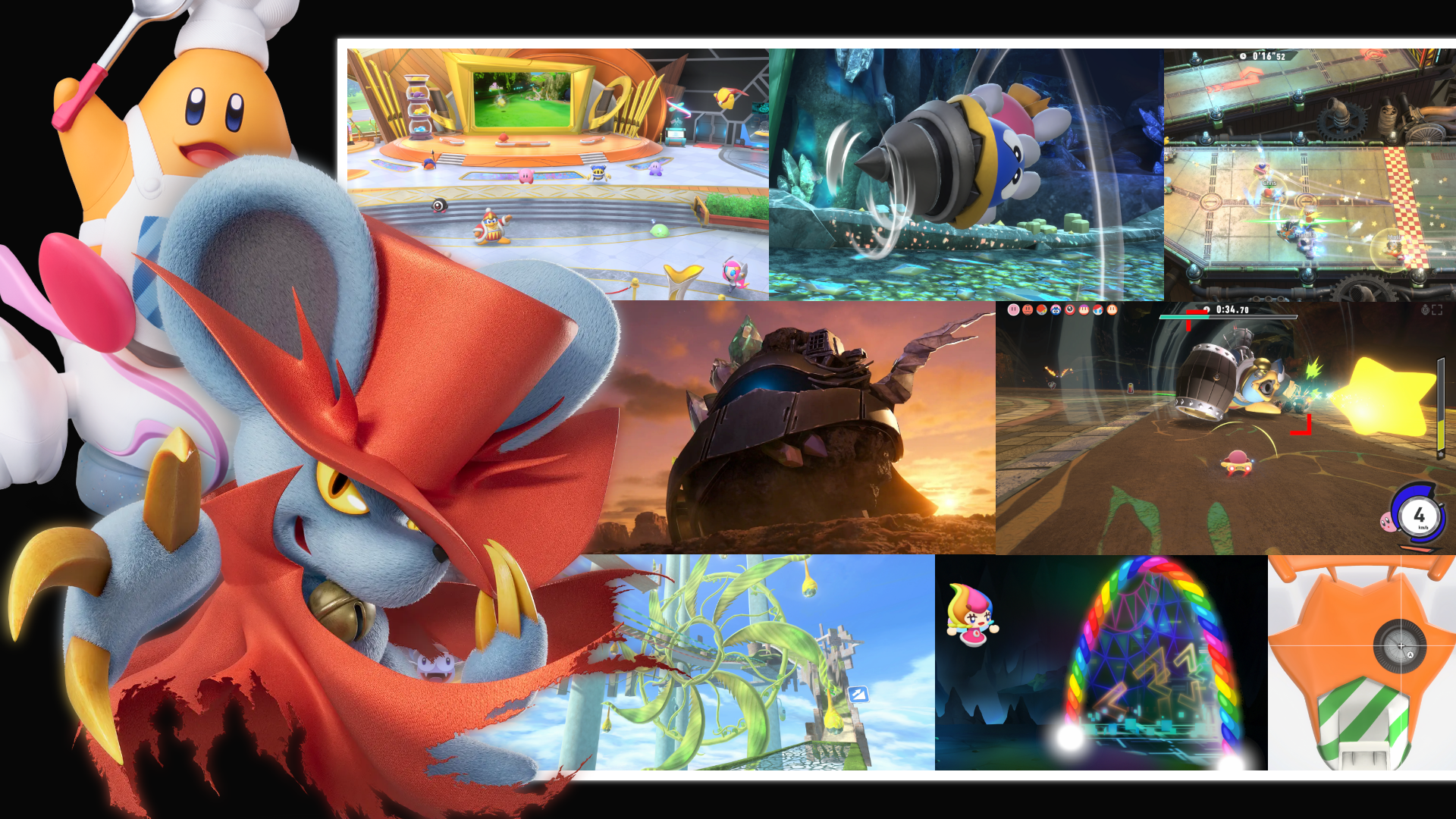
In around August or September, we at Source Gaming started work on a listicle about features we’d like to see in Kirby Air Riders. Nintendo had just released a 48 minute Nintendo Direct on the game hosted by director Masahiro Sakurai, and while it was flush with detail, many fairly important elements remained unmentioned—assuming they were in the game at all. The original Kirby Air Ride had an early achievement system that Sakurai reused in almost every subsequent release of his; that wasn’t referenced here. The Direct focused on two major modes, but not any others. There were clear gaps for undiscussed content; one mode can have up to sixteen characters, but only around twelve were actually shown. And it ended on a strange teaser implying some sort of wild story mode. Riders is clearly a big game, but even this deep dive was hiding a lot.
To assuage this sense that clearly, something was missing, Nintendo has just released a second Direct. Also hosted by Sakurai, it was massive, clocking in at over an hour. Even his obsessively granular Super Smash Bros. Ultimate shows didn’t go this long. As it turns out, there was a reason: all those missing gaps and questions got answered, and then some.
As a side note, don’t expect to see that listicle. I mean, several of our requests were already answered in this video!
Top Ride returns from Air Ride! This fan favorite mode is more like a slot car race, with small, compact courses that give faster sessions and a somewhat easier time than the more chaotic normal races.
- The mechanics work unchanged from the regular games mode, which is its main difference from the first game’s simplified mode. The original mode had simpler systems and only two control types: Free Star (which allows free control) and Steer Star (which only moved left and right). This time you pick those controls before and during the game, every Machine can be played, and you have access to Copy Abilities.
- The courses are also a bit larger, and wider.
- It’s also online-accessible, naturally, like Air Ride and City Trial.
- Due to the larger size, there’s a dynamic camera that follows the main character, but you can quickly change it to a top down perspective and slightly adjust the camera with the right stick. Sakurai suggested that the larger size and smaller characters are probably less of an issue at a time with larger flat screens than people had in 2003.
- The Courses are inspired by the ones from the first game: Flower, Flow, Air, Crystal, Steam, Mountain. These all have their own gimmicks, like ramps, air movement, wind physics, and hazards, but they’re much more relaxed.
- Up to eight players can play at once (though Sakurai thinks the ideal is four). Four human players can play on a single console locally
- Items: Kaboom (blows up), Drift Flames (hurts players in its fiery trail), Drill Driver (attacks enemies in front), Seeker Missile (homes in on players before exploding), Course Quakers (area of effect attack), Chickie (summons a swarm of birds to hit and mess up a rival’s controls, kinda like the wilder Smash Bros. items).
- Graphically, Top Ride allows a “diorama-style effect that… I’m not entirely sure what it does. It seems to make the level more colorful, and possibly more visually dynamic.

Image: Nintendo. Top Ride was a pretty fun mode, so I’m excited to see how it works here.
Alongside the main three modes of Air Ride, Top Ride, and City Trial, Air Riders includes a new Road Trip mode, something that includes all three in one.
- This new mode contains a number of courses and challenges from across the game—including ones that might not be in the other modes, like a Gourmet Race-inspired Top Ride mini-game. You pick a racer, start driving, and choose between various mini-games on a road.
- As you go through, you collect Machines from the game and items from across the Kirby series, all of which may prove useful as the challenges ramp up. A Poppy Bro. Jr. or a heart might defeat Whispy Woods, for instance.
- Characters unique to this mode: Magman (from Kirby 64: The Crystal Shards), Elline (Kirby and the Rainbow Curse), Tortuilding (Kirby and the Forgotten Land), Twister (Kirby’s Adventure), King Golem (Kirby and the Amazing Mirror), Computer Virus (Kirby Super Star).
- The Road Trip Mode is tied to a story mode. It might be the story mode?
- The opening cutscene shows the game’s status quo: a plethora of Machines fell to Pop Star, leading to a vehicular society. One day, the Machines looked to one spot in the distance, and the Riders are driving to help them get there. The story is meant to be about the Kirby cast becoming one with their vehicles.
- This was, apparently, hinted at with the announcement trailer, with the scene of Kirby hitting his Warp Star.
- Zorah, seemingly the strange character from the last Direct, is a main part of the story but remains an unknown quantity.
- Alongside apparently being a stage, the Heart of Nova also has a show in the trailer.
Online Functionality:
- You first make a license, which you can decorate in a variety of ways. Graphics include effects, stickers, background, and a “street name” combining two words. It’s a bit like the player profiles in Splatoon or Pokémon.
- The online lobby is a literal lobby. It’s a paddock where characters can walk around and find certain rooms. Players can directly set up sessions or find ones on a terminal.
- Like many online games, there are basic tools for emotes and canned lines, as well as a Sound Test and a screen for an ongoing online match.
- Class is the new basis for online matchmaking. Every player has a “Global Win Power” that determines their level of skill. Unlike Smash’s Global Smash Power, it only tabulates your victories, instead emphasizing your level of play over raw skill. Each rank—a letter, symbol, and color for all three main modes—is meant to emphasize what kind of player you are.
- While this normally has no material effect on a player, it can make certain “changes” to City Trial more likely. My assumption from this is that certain rare events might happen slightly more often.
New Copy Abilities:
- Needle has bristly needles.
- Freeze makes opponents slide.
- Sleep is, as it is in most Kirby games, an unhelpful hazard that makes you waggle the stick to wake up.
- Fighter improves Quick Spin and automatically kicks nearby opponents.
- Drill lets you dig underground before doing a jump attack.
- Flash has a boost attack.
- Missile shoots you forward and can explode.
New Courses:
- Airtopia Ruins, an air course centered around a massive ruin.
- Crystalline Fissure, an underground level with bit crystal structures and dangerous magma.
- Steamgust Course, a steampunk factory filled with giant aircraft.
- ???, a dramatically unnamed course that, by its ethereal sci-fi aesthetic and the inclusion of “Marx’s Theme,” seems to pretty clearly be the Heart of Nova from Kirby Super Star.

Image: Nintendo. Waddle Dee (probably?) on Frozen Hillside, my favorite course from the first game.
Returning Courses:
- All nine courses from Air Ride are returning, including their iconic music! Songs like “Frozen Hillside” and “Checker Knights” (both of which Sakurai namedropped) were a big part of Air Ride’s appeal, so it’s nice having them back. These include:
- Fantasy Meadows
- Celestial Valley
- Sky Sands
- Frozen Hillside
- Magma Flows
- Beanstalk Park
- Machine Passage
- Checker Knights
- Nebula Belt
- All of these levels have been wonderfully remade and are graphically in line with the rest of Air Ride. Due to the gameplay changes, they won’t play exactly the same.
- None of these courses will be available from the start. Instead, they’ll be unlocked over time, though Sakurai claims that the conditions for getting them are “pretty easy.”
- This makes eighteen courses in all.
Swap Relay:
- A mode in Air Ride that sends you through a relay gauntlet.
- You select one character for the whole match but a different Machine for every lap.
- Locally, you can play Swap Relay in a way where you pass the controller to a different player.
City Trial:
- There are several Items, including Speed Up, Dizzy Beam, Special Up, Item Catcher, Fireworks (which appeared in the previous game(, Laser Swiper, Multi-Missile, Size Up, and Mega Cannon.
- One of the main ways to get stuff is to break boxes with the Quick Spin, much like in real life. Blue boxes have power-ups, green have attack items, red have Copy Abilities, and Rare Boxes have “better” or “more” content in a way that wasn’t fully described.
- Sandag from Smash Bros. is here as well! He drops power-ups when hit.
- The Legendary Machines from the first game are back. The deliberately overpowered Dragoon and Hydra have three parts hidden across Skyah, often in red boxes, and getting all three gives you them. To make it easier for a player to get them in a mode that can have upwards of sixteen players, they’re programmed to be closer to each other.
- Team Battles is a new, 8-on-8 mode for City Trial. The Legendary pieces are a bit easier to collect, and the final Stadium challenge will be the same for everyone (though in cases where there are ten or more players, they’ll be split across two Stadiums). It’s designed to stop what I guess is the gamer equivalent of gerrymandering, where a team could collectively all vote for a stage they’re advantaged in.
- Areas in Skyah include the Highlands, Building Interior, Marooned Ship, Volcano, Mysterious Dimension, Floating Garden (with the Fountain of Dreams from Kirby’s Adventure), Spider Nest.
- Most mysterious is a floating island off in the distance. It can’t be approached without a high enough air speed.
- The previous Direct showed Field Events that randomly occur in City Trial. Here are a few others:
- A ton of boxes drop, including fakes
- A locked treasure chest is dropped on the map
- Huge Wheelie drives around
- Reward Rings
- Huge plague of Gordos
- Everyone starts driving UFOs
- The Legendary Machine parts get scoured on the island
- Battleship Halberd attacks the island

Image: Nintendo. My boy!!!
New Riders:
- Taranza (Kirby: Triple Deluxe) can swing on walls like Spider-Man to get extra bursts.
- Lololo & Lalala (Kirby’s Dream Land) swap between which is controlled by the player, a bit like the Ice Climbers from Smash.
- Daroach (Kirby Squeak Squad) steals other player’s Copy Abilities.
- Rocky (Kirby’s Adventure) is very sturdy. His Special is Meteor Rocky, where he flies up before crashing down.
- Rick (Kirby’s Dream Land 2) “handles corners nimbly” and is fast when running in City Trial. His special is Rip-Roaring Rick, where he just dashes on foot.
- Scarfy (Kirby’s Dream Land, your assorted nightmares) does the thing when it goes from happy to violent, which increases its speed.
- Marx (Kirby Super Star) is a full glass cannon. His Super Attack is True-Form Marx, “jinxes” any opponent he touches.
- Waddle Dee (Kirby Dream Land) is a more simple, easy lightweight. His Special is Golden Waddle Dee, which makes him shiny and golden.
- It’s unclear if these are the last characters in the game full stop or simply the last ones that will be revealed before launch.
- Specials:
- Gooey: Mock Dark Matter (fire six shadowy bolts)
- Knuckle Joe: Knuckle Rush (hits with a big uppercut)
Machines:
- The Transform Star combines the Warp Star and Bike archetypes. A Quick Spin lets it shift between each other, allowing you to swap between which one is best now—though, as it’s tied to your basic attack, you might need to plan when to transform.
- Formula Star is super fast but struggles with stops and slowing down.
- Hop Star jumps as you Quick Spin, making it able to dodge some hazards.
- Jet Star is super fast as it leaves the ground.
- Wheelie Scooter is maneuverable and built for sharp turns.
- Bull Tank is super armored.
Voices:
- The Riders themselves don’t talk, befitting their Kirby history. The Machines do… kinda, as they make pained grunts when they get destroyed. It’s an attempt at giving them more personality.
- However, most of the time, the voice you’ll hear will be the Announcer. They’ll announce the modes, do the count down, narrate Road Trip, and shout whatever Copy Ability the player just got.
- As with Smash, you can pick between different languages: Japanese, English, French, German, Spanish (Penninsular), Spanish (Latin American), Italian, Dutch, Portuguese, Chinese (Traditional), Chinese (Simplified), and Korean. Unlike Smash, there’s now a male and female narrator for each language.
- The Japanese announcers are Banjo Ginga and Makiko Omoto; they respectively played Nightmare in Kirby: Right Back at Ya! and Kirby in both the Kirby and Smash Bros. series.
- One nice touch is that you can set the actor for both the general announcer and the narrator.
Time Attack:
- This standard racing mode is in the game, naturally. You compete for the best time over a certain number of laps. Enemies are in the game, as they’re core to the gameplay as impromptu speed boosts, but no rivals.
- Free Run is a one-lap, no enemies version of Time Attack
- Because this is a purely single player mode (and because Free Lap has no combat), there will be some vehicles that will fundamentally be better or worse for every course. Because of this, records are tracked for every machine, so you can try to get your best time with a bad fit instead of abandoning everything but the most adept car for the course.
- This mode isn’t online, nor are there in-game leaderboards for it. It’s purely individual.
- Free Run is also available in City Trial, but it’s not a race. It’s more akin to something like Free Roam in Mario Kart World, as it allows you to just drive around the island leisurely. A garage has access to every car, and you can directly order one from a pause menu. There are also no random events.
- It features the Flight Warp Star, a machine with perfect flight capabilities to explore more easily (and make pretty contrails).
Stadium:
- While City Trial ends with players going through a one-minute Stadium, there’s also a separate mode just for those events. For the sake of consistency or clarity, all the vehicles have a set stats.
- New Types:
- Button Rush: ride over buttons to control the stage
- High Jump: jump as high as you can
- Big Battle: supersize yourself and try to crush everyone else
- Oval Circuit: a small, no-frills level
- Rail Panic: focuses on grind rails
- Beam Gauntlet: a corridor filled with lasers to avoid
- One notable one is VS. Boss, an evolution of the first game’s VS. Dedede mode. Players work together to fight Robo Dedede, a boss that switches between a Dedede and car form. To make it easier to see him, you can lock onto him by tapping the ride stick (though that will make it harder to see items), and you can actually use the different controls from Top Ride
- Other bosses will appear, and the Direct pretty blatantly teased both Nightmare from Kirby’s Adventure and O2 from Kirby 64.
- Players can also adjust the settings beforehand to remove individual stadiums from rotation. You can also organize it so it only allows Stadiums that cover a certain theme, like ones focused on speed.
Checklist:
- The aforementioned Achievement feature is back. There are murals hidden by a massive array of boxes, and each box is unlocked by completing a specific challenge. Each one gives you something as a reward, like a new character or a vehicle or whatever. They also reveal the unlocking conditions for adjacent squares.
- There are five separate Checklists (respectively covering Air Ride, Top Ride, City Trial, Road Trip, and Online), a move that Super Smash Bros. Ultimate and Kid Icarus: Uprising used.
- As a quick note, the Online one doesn’t hide any Riders or Machines, so players who don’t want to go online don’t have to.
- To make unlocking the challenges easier, the game actually features bonus levels designed just for individual ones. Click an unopened box, and it’ll offer an appropriate mission.
- Further still, you can try to adjust the settings to make certain ones easier.
- One twist from normal in-game Achievement systems is that the multiple individual challenges hide the same reward; for instance, a few both hide Waddle Doo. If it’s a character and you’ve already unlocked them, you’ll receive new color options, like Meta Knight’s Dark Meta Knight and Galacta Knight-themed skins. For Machines, however…

Image: Nintendo. The customization thing may be something I’ll like, or maybe it won’t be, but I’m sure I’ll love seeing people’s crazy vehicles.
My Machine:
- The reward for collecting the same Machine multiple times. Players gain the ability to customize the Machine with colors, patterns, decals, toys, and other accessories.
- There’s quite a bit of potential for customization.
- The online lobby includes a Machine Market, where you can spend in-game money to buy copies of other player’s customized vehicles. The more people buy them, the more expensive they get, and you can put up your designs as well.
- Of course, you don’t lose these Machines if you put them up, nor do you lose any currency.
- Riders also have their Stylish Headwear for customization, including a Cap, Crown, Silk Hat, Ribbon, Onigiri, Sunglasses, Bull Horns, Floral Pin, Topknot, witches hat, samurai helmet, and bunny ears. These are all sharable by every Rider, though a Copy Ability will supersede it during a match.
Miles and Gummies:
- Miles are the currency of the game. Like Smash, it accumulates as you play, no matter what you do. Each thing in a store—music, decals, stickers, patters—costs some miles, though none of what’s available actually impact stats. They’re purely cosmetic.
- Gummies are shaped like machines, and you get them every time you win against a higher ranked player (for players who don’t play online, they’re also available through other modes). You can’t eat them, alas. However, you can play with them in a silly bonus mode.
Garage:
- A personal hangout for your Machines. There are several models of room, and you can invite online players to yours.
Music:
- The main composers were former Air Ride composer Shogo Sakai and Noriyuki Iwadare, of Ace Attorney and several of Sakurai’s most recent games.
- My Music is back! It works as it does in Smash Bros., allowing you to adjust the frequency of new music, old music, a few Kirby pieces from Smash, and alternate tracks. The staff’s goal was to try to represent the breadth of Kirby’s history, something you can tell with the music choices in the Direct.
- Of course, there’s also a Music Player.
- Some tracks will be added to Nintendo Music, as they were after the first Direct.
Main Menu, Options, and Accessibility:
- Sakurai’s “more is more” philosophy of interactive menus is here, too. The menu is a giant wooden table, with a Kirby cursor moving with your choice.
- You can check the Checklist in most menus by pressing ZL and press why before most main modes to see a tutorial.
- There are a number of options. Connect is for Online Play, Extras are bonus modes like the Checklist and tutorials, and Collection is for all your fun stuff.
- Options include standard button remapping (which can effectively let you play Riders one-handed) and midair control inversion.
- Compared to Sakurai’s previous games, there are a number of new accessibility features. These include brightness, text size, color filters, the option to adjust visual intensity and screen shake, and Visual Effects. The latter allows players to add things like a grid, border, and focal lines.
- For ease, there are also preset options in the Accessibility menu.
- You can choose whether splitscreen bifurcates the screen horizontally or vertically. The horizontal framing also features a bar showing how far players have gone.
- All of these personalized settings can be given a name, like how Smash Bros. profiles include specific button remapping.

Image: Nintendo. A team battle.
Miscellaneous:
- Alongside Switch 2 and Switch 1 controllers, the game is compatible with the GameCube adapter that was almost exclusively used for Smash Bros.
- Photo Mode is here! It’s available in all modes.
- Sakurai also showed off three additional Air Riders amiibo: Meta Knight & Shadow Star, King Dedede & Tank Star, and Chef Kawasaki & Hop Star. All of these, like the Kirby and Banana he shocked off ones, can freely swap their cars. Dedede’s Tank Star can also move its wheels.
- You can also adjust the amiibo’s look in the menu, such as whether it has the right Rider or the pose you want it to have.
- Sakurai started out by noting the length of the show, and ended by noting the work that went into this game. He suggested that the game’s longstanding place as a cult classic was what led to this sequel’s development.
- While some of these features will be added or patched with a day one update, no DLC is planned, nor are any sequels.
- Similar to previous online Nintendo games, there will be a prerelease demo, a “Global Test Ride,” to drum up hype and see how the online lobbies work.
- November 8 – 9: 12 AM – 6 AM PT, 4 PM – 10 PM PT, 7 AM – 1 PM PT
- November 15 – 16 PM: 12 AM – 6 AM PT, 4 PM – 10 PM PT, 7 AM – 1 PM PT
The Direct itself:

Wolfman’s Soapbox: Dear lord, getting two sixty minute shows in a row is a lot. I mean, I like ‘em, I like ‘em a lot, but they’re pretty goddamn intense. I dunno if this is the new normal or part of 2025’s general weirdness, or if Sakurai wanted to play it like this. I do think the structure makes sense; have some racers and cars and whatnot in both, so it’s not just a rundown of modes. I’m willing to believe this was the smartest way to go about it. But still.
I have always been a devotee of Sakurai’s maximalist tendencies. It’s not a great aesthetic a lot of the time, no matter what the medium or the artist. More often than not, you’re getting bloated and unfocused work. But Sakurai always has his eye on the ball, whether or not he gets to it as fast as possible. And I think that’s pretty clear here. The speed, the energy, the simplicity, the customization. It’s all about trying to make a state of wild, colorful movement.
This Direct also made me confident in how the size of this project. I love the original Air Ride, but it’s a rather small game. Sandwiched in between Smash Bros. Melee and Brawl, it’s not quite as obsessive as the former and as grandiose as the latter. It’s surprisingly experimental for a Nintendo racing game, but there is only so much. This, though, shows real promise at the kind of breadth and depth that the formula deserves.
Plus, Marx! Marx was actually the thing I most wanted from this game. I love that freaky ‘lil dude.

- Resident Evil Requiem | Review - March 13, 2026
- SG Choice: Mario’s Best Levels, Hubs, and Worlds - March 10, 2026
- Indie World March 3, 2026: Information and Reactions - March 3, 2026








This is one of the most content packed Nintendo games this generation that I ever seen, can’t wait!🔥