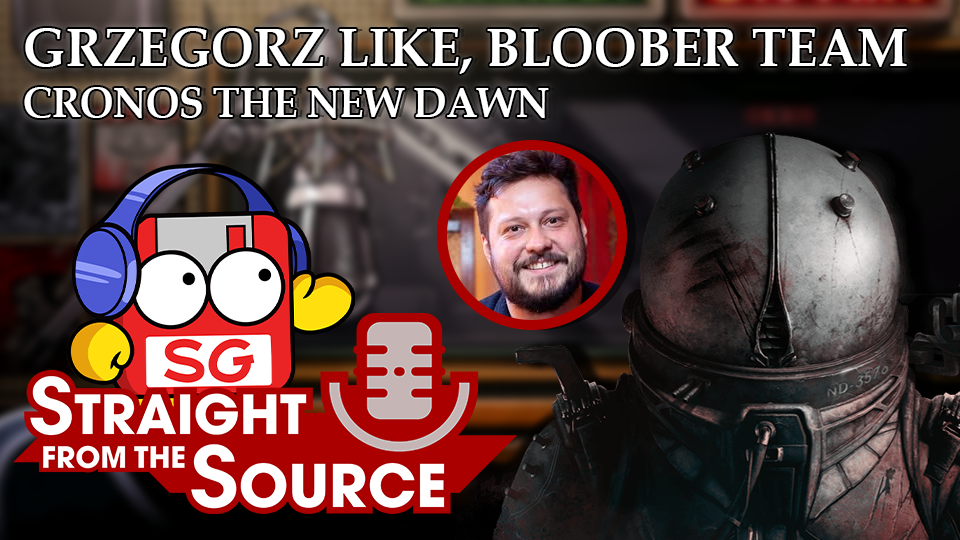
During Gamescom 2025 we had the opportunity to sit down with Grzegorz Like, Lead Writer and Narrative Designer for the upcoming survival-horror game Cronos: The New Dawn, developed and published by Bloober Team and launching tomorrow (September 4th 2025).
Cronos The New Dawn is a new IP from Bloober Team. It combines elements of both horror and action games with a time-travel narrative that sees the protagonist going back to 1985 Poland, before the apocalypse happened, and extracting the souls of key people from that era in the hopes of stopping the current virus that wiped out the world
We played the Nintendo Switch 2 version of this game during Gamescom 2025 and you can read our preview for it here.
How did development Cronos: The New Dawn begin?
Grzegorz: It began after the development of our previous title the Medium was completed, but shortly before the game actually released. Our boss [Piotr Babieno, CEO] gathered us and said: “Silent Hill 2 has been in the works for two years now. So we need to start another project.”
As Silent Hill 2[1] is more of a psychological horror game, journeying into the mind of James Sunderland, this next project had to be something completely different. This was so we didn’t just copy our previous work, we wanted to make something that was entirely new and so we settled on an action-focused title.
Given that Cronos was going to be an original IP from us, we decided to pull from all the sources of inspiration that molded us as a team of creatives. This led us towards a more sci-fi-inspired setting, pulling from old 80s horror movies that we loved like The Thing and Alien. We even looked at the original Star Wars trilogy for reference. The setting also allowed us to create a cool spacesuit for our protagonist to wear, which was fun.

It was a blast to do that and I feel blessed to have this kind of freedom in the current gaming landscape, where making a new IP is very, very risky. It did take some of the pressure of us that Silent Hill 2 was very successful.
It sparks joy in me when I see all these lines at Gamescom. Some people are waiting three hours to play 15 minutes of the game, even though the game is also out in less than two weeks! I think that shows that we managed to make something unique and appealing to people with Cronos.
[1] Silent Hill 2 is a 2001 survival horror game by Konami. In 2024, Bloober Team released a remake of the game for PlayStation 5 and Windows
A lot of your previous horror works have been more psychological but Cronos: The New Dawn feels like a purposeful step away from that to more mass-market horror. What was the reason for this change in approach?
I was a bit worried at the beginning about the change in approach but at Bloober Team we are all about storytelling. We put so much emphasis on narrative in our games because we previously didn’t have the resources to create proper survival horror games. All the walking sections we had in previous games weren’t made from an artistic decision but from one of limitations
We always wanted to create a big budget survival horror game like Silent Hill. We are all big fans of that franchise and I would say pieces of it are scattered around all of our games. When we decided to create the story for Cronos The New Dawn, we decided to lean more towards the philosophical, it’s about the end of the world after all, and have the story revolve around the protagonist, the Traveller. Cronos The New Dawn is about travelling back in time to rescue humanity and in the process discovering the humanity within yourself.
Even though there is a lot of action in this game, I wouldn’t say that the action outweighs the story. What’s important is that we needed to balance this story with action and we achieved that. There’s a lot to unpack in the themes and narrative of Cronos but I obviously can’t talk about that because the game isn’t out yet! Which is a pain for me because I really want to talk about it with someone. (laughs)
(laughs), well give it a few weeks after launch and you’ll have plenty of people to discuss it with.
(laughs), I hope so!
But yeah, it was important for us to find a balance between the action and the story. If you just looked at the trailers then you might think the game is nothing but action set-pieces, but that’s only because this is what you need to do to sell a game in the modern era. At our core, we are still storytellers.

Time travel is obviously a major part of Cronos’ story, so how and why did the idea come about?
It originally started as just a random idea but when we thought more about it we realised that a lot of our games utilise a two world concept. In The Medium[2] you have the spirit world and the real world, and in Silent Hill 2 you have the real world and the ‘other’ world, and by using time travel in Cronos the dichotomy is still there: the desolated future and the pre-apocalypse past. These are basically two worlds.
What’s important when writing a time travel story is that you have to decide on which model of time travel you are going to follow early on. Are you going for a Back to the Future style where changing the past changes the present or are you going for an Avengers Endgame style where changing the past creates a branching timeline? When you’ve decided on the model to use, you then have to stick with it. Unfortunately, I can’t tell you what model we chose because that would spoil the story, haha!
[2] The Medium is a 2017 psychological horror game by Bloober Team, available on all modern platforms.
During Time Travel, the player goes to Poland, Krakow, which is also where Bloober Team is based. What was it like recreating such a familiar location for a game?
It was super awesome. We actually already used this setting in both The Observer[3] and The Medium, so I feel like we’ve become professionals at putting Poland everywhere (laughs). But it’s not about tourism or promoting the sights of Poland, we keep coming back to Poland because it has a fascinating history.
[3] The Observer is a 2021 psychological horror game by Bloober Team, available on all modern platforms.
And why was 1980s Communist Poland the specific time-period chosen for the game?
We chose Nowa Huta for the setting for this reason. It was created just after World War II when we were under Soviet influence.
It was a dark and trying time for many in Poland and we thought it would make sense as a setting for Cronos: The New Dawn, given the themes and message we wanted to tackle. We want to tell stories about interesting characters and their relationships, and I think if you do that in a dark setting then it becomes more interesting because the sparks of goodness and kindness shines so much brighter.
In the real world, we overthrew Moscow’s puppet government by uniting as a people and creating solidarity as a community. It was the people of Poland who kicked those motherf***ers out of Poland and back to Moscow.
But, during the occupation the government introduced a Martial Law that forced everyone to stay in their homes. It was basically the OG lockdown. When it came to Cronos we asked ourselves ‘What if getting together like this was the problem?’ because of the merging and the virus [that leads to Cronos’ apocalypse]. The result of this lockdown was the extinction of the human race.

The merging of monsters, where enemies can fuse with defeated monsters to become much stronger, is the unique gameplay mechanic of Cronos The New Dawn. Where did this idea come from?
As you said, we needed to make something unique so that Cronos could stand out. Originally the game was more of a homage to older survival horror titles that the team enjoyed like Resident Evil and Silent Hill (obviously). But it needed something new that would add more challenge for veteran horror game players.
Let’s be honest, when the Traveller is dressed up in thick armour with a plethora of guns, grenades and flamethrowers at their disposal, the game becomes a little less scary, you know. We needed to balance it out by adding more danger and threats to the player, and our solution was to make the monsters bigger and tougher. We might have gone too far because we were scared ourselves when playing the game. (laughs)
The merging mechanic also adds some strategy to the game. It punishes bad tactical decisions when it comes to resource management, like wasting your flamethrower ammo. The player might use it all early without thinking and find themselves in a boss-like situation where they couldn’t dispose of the bodies later on and they’ve all fused into a massive, armoured, acid-spitting monster.
It was terrifying for us to test.
Yeah, I learnt that the hard way when I was playing the game. I accidentally wasted one of my incendiary capsules early on and had to run from a huge guy that wouldn’t stop merging with other enemies!
(laughs) It happens.
At some point, the monsters will start refilling their health up instead of growing bigger or gaining more attributes. We had to implement this because during development, some monsters got so big that they couldn’t fit through the doors! (laughs)
It was crazy, so we had to put a cap on how big they got and have the merging lead to different effects, like healing.

Were there any lessons learnt from The Medium’s development that you brought forward for this game?
Oh yeah. The Medium was a big release for Bloober Team. It opened extremely well and got good reviews, some mixed of course but it’s called the Medium so that’s fitting (laughs). It really was the game that made us feel ready to work on an important and beloved game like Silent Hill 2.
If you look at what the media was saying, as well as people on social media, you would think that Silent Hill 2 is the game that made us good developers but that’s not the case at all, that was The Medium. It was in this game that we came to grips with third-person controls, how to make cool cutscenes, how to write good dialogue and work with good actors. It was only because we The Medium made us good that we felt confident we could work on Silent Hill 2.
By the way, Kelly Burke, the amazing voice actor who played Marianne in The Medium is back and playing The Traveller in Cronos.
One thing that we decided after our time with The Medium is that we didn’t want to use fixed cameras anymore. It was a fun idea but it was also a gimmick and so we decided not to do it again. This change also allowed us more options for combat situations with Cronos. The Medium didn’t actually have any combat in the end but we did test some designs during development.
We were surprised to see a Nintendo Switch 2 port is coming day and date with the other platforms! How long has the Switch 2 version been in development?
The thing is, the guys from Nintendo are very secretive, so we didn’t even know about Nintendo Switch 2 back when we started development. Nintendo contacted us and said “What if you bring Cronos The New Dawn to Nintendo Switch 2?” It was a very quick and sudden decision for us to make.
I’m pretty sure it came about as the result of our CEO, Piotr Babieno having phone calls with Nintendo all the time. Out of the blue one day he came to the development team and said we were going to bring Cronos to Nintendo Switch 2. I thought he was joking at first, being a funny guy, but he was very serious.
My first thought was that bringing Cronos to Nintendo Switch 2 was going to be a wild development journey, but it wasn’t that long until I saw it working on the system’s display. It’s done already and it looks this good? That’s awesome! I was really surprised but I guess it goes to show how vastly different the innards of the console are compared to its predecessor. It’s far stronger and that made the job of bringing the game to the system much easier than I expected.
I’ve been very impressed with Nintendo Switch 2 in general and how some games look on it. Cyberpunk 2077 looks incredible. And it’s from a polish developer. (laughs)
Cronos The New Dawn launchs on 5 September 2025 on PC, Nintendo Switch 2, Xbox Series X/S and PlayStation 5.